Blog

  • Jo Freeman’s Review of The Road to Healing: A Civil Rights Reparations Story in Prince Edward County, Virginia

    By  Jo Freeman

    The Road to Healing: A Civil Rights Reparations Story in Prince Edward County, Virginia

    By Ken Woodley

    Forward by Mark Warner, 69th Governor of Virginia ; Afterword by Tim Kaine, 38th Lieutenant Governor of Virginia and 70th Governor of Virginia 

    Published by NewSouth Books, 2019

     Reparations for slavery has been in the air this year. It comes with lots of questions. In this book, Woodley answers them for one group who suffered directly from white supremacy.

    Ken Woodley

    In 1959 the Prince Edward County school board closed its public schools rather than integrate them. Most white students were able to attend private academies for whites only. Black students had to leave the county or go without an education. Not until 1964 did the Supreme Court rule that the county had violated the students constitutional rights and ordered the public schools to reopen.

    Author Ken Woodley

    Forty years later a Virginia professor calculated that these five years without public schools resulted in 2,202 black and 258 white youths receiving no formal education in their lifetimes. He also calculated the effects of this deprivation that were passed on to the next generation. The many other effects were harder to calculate.

    Prince Edward County was the defendant in one of the five cases making up Brown v. Board of Education which ended legal school segregation. That case had begun in 1951 with a student strike to protest the poor quality of the black high school. The NAACP Legal Defense and Educational Fund stepped in with a lawsuit demanding integration, not just equalization. The Prince Edward plaintiffs won the lawsuit and lost the schools.

    By 2003, attitudes had changed, if not all the practices. The Virginia General Assembly was ready to apologize for the policy of massive resistance to Brown. The Prince Edward County School Board was considering giving honorary high school diplomas to those who had been prevented from earning real ones.

    In this atmosphere the editor of The Farmville Herald thought something more concrete should be done. Farmville is the county seat of Prince Edward County, where the student strike had started. The Herald and the family that owned it were major supporters of closing the schools. However, Ken Woodley, the editor in 2003, came from a different generation with different attitudes. He proposed that the General Assembly fund scholarships for those injured by the closing of the schools.
  • “Fed Listens”, How Does Monetary Policy Affect Your Community? “Our goal is to keep inflation around 2 percent over time”

     Gov. Lael Brainard speech in December 2018

    *Photo created on December 7, 2018 Governor Brainard giving a speech on Assessing Financial Stability over the Cycle, Peterson Institute for International Economics in Washington, DC.*

    Two Goals
    So what are the monetary policy goals the Congress assigned us? Congress has assigned the Federal Reserve to use monetary policy to achieve maximum employment and price stability. These two goals are what we refer to as our dual mandate. By price stability we mean moderate and stable inflation. Specifically, the Federal Open Market Committee (FOMC) — the group at the Fed responsible for determining monetary policy — has announced that our goal is to keep inflation around 2 percent over time. The maximum employment part of our dual mandate is straightforward: The Congress has directed us to achieve the highest level of employment — and thus the lowest level of unemployment — that is consistent with price stability.

    While the Congress has specified the goals for monetary policy and a set of tools or authorities to pursue them, it has allowed the FOMC to determine how to best go about achieving those goals.

    Reviewing How We Conduct Monetary Policy
    Last year, core inflation was very close to our goal. And the unemployment rate is at a 50-year low. We are undertaking our review to ensure we are well positioned to meet our goals for many years to come.

    We also want to make sure that the way we are setting monetary policy is keeping up with the way the economy is changing, which I have been referring to as the “new normal.”3 There are a few key features of that new normal. For example, interest rates have stayed very low in recent years not only in the United States, but also in many other advanced economies. For a variety of reasons, it seems likely that equilibrium interest rates will remain low in the future. Low interest rates present a challenge for the traditional ways of conducting monetary policy. That is especially true in recessions when, in the past, the Federal Reserve has typically cut interest rates by 4 to 5 percentage points in order to support household spending and business investment. But when equilibrium interest rates are low, we have less room to cut interest rates and thus less room to buffer the economy using our conventional tool. For example, following the most recent recession in 2008 and 2009, we kept interest rates as low as the Committee thought they could go, which was close to zero, for many years.

    Another big change in the economy is that inflation doesn’t move as much with economic activity and employment as it has in the past. This is what economists mean when they say the Phillips curve is very flat. In many ways, the flatter Phillips curve has advantages: It means that the labor market can strengthen a lot and pull many workers that may have been sidelined back into productive employment without an acceleration in inflation, unlike what we saw in the 1960s and 1970s. Similarly, inflation doesn’t fall as much in recessions.

    But there is an important risk with today’s low sensitivity of inflation to slack: It makes it more difficult to boost inflation to our objective of 2 percent on a sustainable basis. And, as we know from other countries, if inflation consistently falls short of the central bank’s objective, lower inflation tends to get embedded in people’s expectations. Expectations that inflation will remain low in turn can create a self-fulfilling dynamic with actual inflation, making it even more difficult for the central bank to boost inflation. And because inflation is reflected in nominal interest rates, that, in turn, can also reduce the amount of policy space the central bank has available to prevent the economy from slipping into recession.

    In fact, in recent years, central banks around the world have had to use a larger variety of policy tools than they traditionally used to respond to the financial crisis and support economic expansion.

  • How Educated Are We? About 13.1 Percent Have a Master’s, Professional Degree or Doctorate; Number Doubles Since 2000

    Bryn Mawr Graduates in Line

    Bryn Mawr College graduates in line for ceremonies, 2018


    America Counts Staff, US Census

    The educational level of American adults is on the rise as more college graduates go on to earn master’s, professional and doctoral degrees.

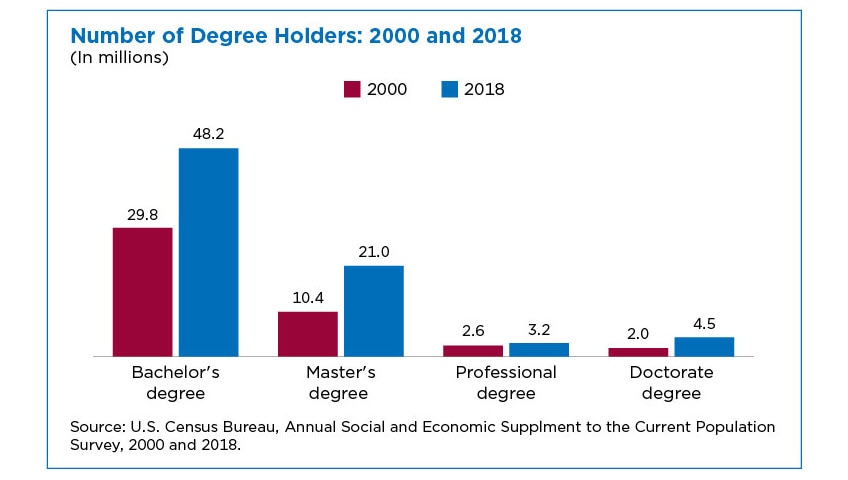
    Since 2000, the number of people age 25 and over whose highest degree was a master’s has doubled to 21 million. The number of doctoral degree holders has more than doubled to 4.5 million.

    Now, about 13.1 percent of US adults have an advanced degree, up from 8.6 percent in 2000.

    number-of-people-with-masters-and-phd-degrees-double-since-2000-figure-1

    These findings come from the US Census Bureau’s Educational Attainment in the United States: 2018 table package that uses data from the Current Population Survey Annual Social and Economic Supplement.

    It examines the educational attainment of adults age 25 and older by demographic and social characteristics, such as age, sex, race and Hispanic origin, nativity and disability status.

    In 2017, on average a person with an advanced degree earned 3.7 times as much as a high school dropout.

    The tables show, among other things, that women make up a smaller share of high school dropouts than men, the share of Asians with advanced degrees is growing and that recent immigrants are more likely to go to college than earlier immigrants or native-born.

    They also clearly show a rise in the number of college graduates who have advanced degrees. In 2000, one-third of people with at least a bachelor’s degree had completed an advanced degree. By 2018, 37 percent had done so.

    In 2017, on average a person with an advanced degree earned 3.7 times as much as a high school dropout.

    • The percentage of people age 25 and over who had completed less than a high school diploma or equivalent was higher for men (10.6 percent) than for women (9.8 percent).
    • Between 2000 and 2018, the percentage of people 25 years and older who had completed a bachelor’s degree or higher increased by 9 percentage points, from 25.6 percent to 35.0 percent.
    • Among Asians ages 25 to 29 in 2018, almost 7 in 10 (69.5 percent) had a bachelor’s or higher degree. Five years earlier (in 2013), the bachelor’s degree attainment rate for this group was 59 percent.
    • Recent immigrants to the United States were more likely to have a college education than earlier immigrants or the native born. 

    Among immigrants who have arrived since 2000, 38.8 percent have a bachelor’s degree or higher, compared with 35.2 percent of the native-born. Among earlier immigrants, the rate of college education was lower — for those who arrived in the 1990s, it was 31.3 percent.A 2018 graduate at BMC

    Naturalized citizens were among the groups with high levels of college attainment — 38.4 percent had a bachelor’s degree or higher.

    The children of immigrants were also likely to have a bachelor’s degree (39.6 percent).

    Editor’s Note: Photos are taken from Bryn Mawr College commencement news in 2018

  • Congressional Weekly Legislation: Hearings, Paid Family and Medical Leave: Helping Workers and Employers Succeed; Women and Girls in the Criminal Justice System Hearings

    This Week

    Mark-Ups:Debbie Dingel

    Appropriations — On Wednesday, May 8, the House Appropriations Committee will mark up the FY2020 Labor, Health and Human Services, Education, and Related Agencies spending bill (as-yet-unnumbered).

    Hearings:

    Employment —  On Wednesday, the House Ways and Means Committee will hold a hearing, “Paid Family and Medical Leave: Helping Workers and Employers Succeed.”

    Crime — On Thursday, the House Judiciary Subcommittee on Crime, Terrorism, and Homeland Security will hold a hearing, “Women and Girls in the Criminal Justice System.”

    STEM — Also on Thursday, the House Science, Space, and Technology Committee will hold a hearing, “Achieving the Promise of a Diverse STEM Workforce.” April 29 — May 3, 2019

    Right, Congresswoman Debbie Dingle

    Bills Introduced

    Child Protection
     
    S. 1264 — Sen. Steve Daines (R-MT)/Homeland Security and Governmental Affairs (5/1/19) — A bill to deny federal retirement benefits to individuals convicted of child sex abuse.
     
    H.R. 2480 — Rep. Kim Schrier (D -WA)/Education and Labor (5/2/19) — A bill to reauthorize the Child Abuse Prevention and Treatment Act, and for other purposes.
     
    Education
     
    H.R. 2421 — Rep. Elissa Slotkin (D-MI)/Education and Labor (4/30/19) — A bill to ensure that certain incidents involving a covered employee that are reported to the Title IX coordinator at an eligible institution of higher education have been reviewed by the president of the institution and not less than one additional member of the institution’s board of trustees, and for other purposes.
     
    Health
     
    H.R. 2403 — Rep. Grace Meng (D-NY)/Transportation and Infrastructure (4/30/19)—A bill to require agencies to ensure that menstrual hygiene products are stocked in, and available free of charge in, restrooms in public buildings, and for other purposes.
     
    H.R. 2428—Rep. Debbie Dingell (D-MI)/Energy and Commerce (5/1/19)—A bill to prohibit group health plans and health insurance issuers offering group or individual health insurance coverage from imposing cost-sharing requirements or treatment limitations with respect to diagnostic examinations for breast cancer that are less favorable than such requirements with respect to screening examinations for breast cancer.
     
    Judiciary
     
    H. Res. 354—Rep. Brenda Lawrence (D-MI)/Judiciary (5/3/19)—A resolution celebrating the 100th anniversary of the passage and ratification of the 19th Amendment, providing for women’s suffrage, to the Constitution of the United States.
     
    Military
     
    H.R. 2388 — Rep. Brian Mast (R-FL)/Armed Services; Rules (4/29/19) — A bill to amend the Uniform Code of Military Justice to eliminate the statute of limitations for child abuse offenses, and for other purposes.
     
    Miscellaneous
     
    H.R. 2423 — Rep. Elise Stefanik (R-NY)/Financial Services (4/30/19) — A bill to require the secretary of the Treasury to mint coins in commemoration of ratification of the 19th Amendment to the Constitution of the United States, giving women in the United States the right to vote.
     

    Stem

    S. 1299 — Sen. Kamala Harris (D-CA)/Health, Education, Labor, and Pensions (5/1/19) — A bill to provide grants to local educational agencies to encourage girls and underrepresented minorities to pursue studies and careers in STEM fields.
     

    Tax Policy

    H.R. 2461 — Rep. Dean Phillips (D-MN)/Ways and Means (5/1/19) — A bill to allow a refundable credit with respect to any stillborn child of a taxpayer.
     

    Violence Against Women

    S. Res. 178 — Sen. Dianne Feinstein (D-CA)/Judiciary (4/30/19 ) — A resolution recognizing and supporting the goals and ideals of National Sexual Assault Awareness and Prevention Month.
     
  • Elaine Soloway’s The Hometown Rookie: Clubhouse, Nomad and Omen Chapters

    Clubhouse

    After Tommy died, I moved from the house six months later that we shared to a convertible (bedroom hidden by a sliding door) studio at Kingsbury Plaza — a River North,  Chicago highrise.

    The apartment and location appealed for several reasons: it was the same monthly cost as my home mortgage, there would be an extra bed for a daughter or an out-of-town guest, and it was steps away from the East Bank Club. My first spouse and I were among the 3,000 early members of the “country club in the city.”

    Back then, in 1980, River North was isolated, semi-industrial, and bland. Because my clubhouse opened at 5 a.m., it fit perfectly with my pre-dawn awakenings. I could rise, have coffee and a banana, and as the darkened sky lightened, drive my Honda Civic to the club’s garage, exercise, and then join half a dozen friends for breakfast.

    It turned out that my spouse was not a fan of health clubs or untimely mornings, and she soon gave up her membership. She was a deep sleeper and disliked my early bird routine. She spoke of drawers opening and closing, and squeaks of floorboards that woke her. But now I think what she really meant was: “Why are you leaving me for them?”

    Our marriage frayed and she moved out in 1990. We lived separately for many years, with neither one of us eager to speed towards a divorce. But one day, while I sat at the breakfast table with club friends, Jimmy, an attorney, turned to me and said, “Your spouse came to my office.”

    I don’t remember if others eating their egg white omelets or lox and bagels saw me as I started to cry.  Jimmy put his arm around me; “I’m sorry; I thought you knew,” he said. I’m not sure why I broke down. After all, my spouse and I were living apart and a divorce certainly seemed to be inevitable. I guess it was just the finality of it that shook me.

    In 1998, I married again and tried to get Tommy to exercise with me at my clubhouse. But he was a devoted YMCA member and disdained the club’s glitz. Oh, he liked swinging golf clubs at the practice range, but this thrift shop-garbed second husband couldn’t abide the gym’s spandex crowd.

    I’m writing about these memories now, because after a three-year absence — that included nine months in Los Angeles and 10 at the Aqua in Lakeshore East — I’m reinstating my membership. The Breakfast Club no longer exists in the same configuration: A few people have died, several married, and some moved out of state.

    I’m returning to the club because I’m leaving my Aqua studio to move to a convertible, dog friendly apartment at Hubbard Place, across the street from the “country club in the city” that I first joined 37 years ago.

    If you’ve been following my essays, you’re aware I first had the notion to move to a walk-up one-bedroom somewhere on the north side of Chicago. Family and friends quickly quashed this fantasy and demanded that a woman of my age (78) must live in a building with an elevator, 24-hour security and maintenance, and in-unit laundry.

    And after viewing a vintage apartment in Lincoln Park, a one-bedroom in Evanston, and a millennial-filled highrise in Streeterville, I felt drawn to my old neighborhood, and to my familiar clubhouse.

    This will be a bittersweet move as I have flourished during my nearly two years at the Aqua. It was here that I learned how to swim, upped my Spanish language skills, and grasped basic piano — three goals that have been nagging for all of my adult life.

    Fortunately, my clubhouse has several swimming pools, so that exercise will continue. I now write my daily journal in Spanish (dictionary nearby), thus there’s no chance of me dropping that language. And my upright piano will move from a refigured closet to an alcove in my new home.

    Of course, I’ll bring along all of the memories I’ve shared with you, and the good news that my first spouse and I have continued as friends and emergency contacts.

    Aqua chums will certainly remain, and I expect Tommy to visit my new place — if only in my imagination. Perhaps I’ll sense him in the East Bank Club, watching from a corner to make sure I properly lift a weight.

    Oh, he’s bound to pop up to guarantee I foster or adopt a dog. Maybe he’ll even join us on daily walks. A new chapter — lived out loud — begins.

  • The Letter Sent to AG Wm. Barr From Special Counsel Robert S. Mueller, III on the Investigation Into Russian Interference in the 2016 Presidential Election

     Rayburn House Buildiing

    The Rayburn House Office Building  completed in early 1965, is the third of three office buildings constructed for the United States House of Representatives. It occupies a site southwest of the Capitol bounded by Independence Avenue, South Capitol Street, C Street SW, and First Street SW

    Oversight of the US Department of Justice: Report by Special Counsel Robert S. Mueller, III on the Investigation Into Russian Interference in the 2016 Presidential Election; and Related Matters

    Date: Thursday, May 2, 2019 – 9:00am EDT
     
    Location:  2141 Rayburn House Office Building, Washington, DC 20515
      
    Watch Live:  https://judiciary.house.gov/news/watch-live  on Thursday, May 2nd, 2019 
     
    Letter from Robert Mueller to Attorney General Barr:

    Text of a letter, dated March 27 and made available Wednesday by members of Congress and the Justice Department, from special counsel Robert Mueller to Attorney General William Barr, on Mueller’s investigation into Russian interference in the 2016 presidential election and obstruction of justice. In the letter, Mueller expressed frustration to Barr about how the attorney general was portraying the investigation’s findings:

    I previously sent you a letter dated March 25, 2019, that enclosed the introduction and executive summary for each volume of the Special Counsel’s report marked with redactions to remove any information that potentially could be protected by Federal Rule of Criminal Procedure that concerned declination decisions; or that related to a charged case. We also had marked an additional two sentences for review and have now confirmed that these sentences can be released publicly.

    Accordingly, the enclosed documents are in a form that can be released to the public consistent with legal requirements and Department policies. I am requesting that you provide these materials to Congress and authorize their public release at this time.

    As we stated in our meeting of March 5 and reiterated to the Department early in the afternoon of March 24, the introductions and executive summaries of our two-volume report accurately summarize this Office’s work and conclusions. The summary letter the Department sent to Congress and released to the public late in the afternoon of March 24 did not fully capture the context, nature, and substance of this Office’s work and conclusions. We communicated that concern to the Department on the morning of March 25. There is new public confusion about critical aspects of the results of our investigation. This threatens to undermine a central purpose for which the Department appointed the Special Counsel: to assure full public confidence in the outcome of the investigations. See Department of Justice, Press Release (May 17, 2017).

    While we understand that the Department is reviewing the full report to determine what is appropriate for public release — a process that our Office is working with you to complete — that process need not delay release of the enclosed materials. Release at this time would alleviate the misunderstandings that have arisen and would answer congressional and public questions about the nature and outcome of our investigation. It would also accord with the standard for public release of notifications to Congress cited in your letter. See 28 C.F.R. 609(c) (“the Attorney General may determine that public release” of congressional notifications “would be in the public interest.”).

    Sincerely yours,

    Robert S. Mueller, III

    Special Counsel

    Video Help:

    You should be able to watch Committee live video connections using the free Windows Media Player software. If you encounter an error, you may need to download the most recent version of Windows Media Player. If you are using an Apple computer or the QuickTime Media Player, you may also need to download Windows Media Components for Quicktime. Other media players are also listed on the Tools page.

    If you are unable to play the video in this page, you may also visit the Committee’s USTREAM channel.

  • Senate Judiciary Committee, May 1st: AG William Barr and The Department of Justice’s Investigation of Russian Interference with the 2016 Presidential Election

    Dirksen Senate Office Building 226

    Dirksen Senate Office Building 226; Senate Judiciary Committee

    Watch Video

    https://www.judiciary.senate.gov/meetings/the-department-of-justices-investigation-of-russian-interference-with-the-2016-presidential-election

    The Department of Justice’s Investigation of Russian Interference with the 2016 Presidential Election

    Majority Members (12) Minority Members (10)
    Graham, Lindsey (SC), Chairman 
    Grassley, Chuck (IA)
    Cornyn, John (TX)
    Lee, Mike (UT)
    Cruz, Ted (TX)
    Sasse, Ben (NE)
    Hawley, Josh (MO)
    Tillis, Thom (NC)
    Ernst, Joni (IA)
    Crapo, Mike (ID)
    Kennedy, John (LA)
    Blackburn, Marsha (TN)
    Feinstein, Dianne (CA), Ranking Member 
    Leahy, Patrick J. (VT)
    Durbin, Richard J. (IL)
    Whitehouse, Sheldon (RI)
    Klobuchar, Amy (MN)
    Coons, Christopher A. (DE)
    Blumenthal, Richard (CT)
    Hirono, Mazie K. (HI)
    Booker, Cory A. (NJ)
    Harris, Kamala D. (CA)


    DATE: Wednesday, May 1, 2019 ADD TO MY CALENDAR
    TIME: 10:00 AM, EDT
    LOCATION: Dirksen Senate Office Building 226
    PRESIDING: Chairman Graham


    WITNESSES

    Established in 1816 as one of the original standing committees in the United States Senate, the Senate Committee on the Judiciary is one of the most influential committees in Congress. Its broad legislative jurisdiction has assured its primary role as a forum for the public discussion of social and constitutional issues. The Committee is also responsible for oversight of key activities of the executive branch, and is responsible for the initial stages of the confirmation process of all judicial nominations for the federal judiciary.

    Origin

    1816 Handwritten Senate Resolution to Establish Standing Committees
    1816 Senate Resolution establishing the Standing Committees of the Senate.
    Center for Legislative Archives, National Archives and Records Administration.

    The delegates to the Constitutional Convention of 1787 did not provide for congressional committees when they drafted the Constitution of the United States. Nevertheless, a select committee of eight Senators, often suggested to be the precursor to the present-day Judiciary Committee, was appointed one day after the Senate first convened in 1789. The select committee was tasked with drafting what would become the Judiciary Act of 1789. This landmark Act established the present three-tiered hierarchy of the federal judiciary, and the Office of the Attorney General.

    Temporary committees commonly convened in the House and Senate during the early years of Congress. The small size of Congress made it unnecessary to create permanent committees. In the Senate, ad hoc committees were comprised of three to five members depending on the issues assigned. These committees met as needed to discuss issues at their desks in the Senate chamber.

    The rapid growth of the nation after the turn of the 19th century and the increase in the number of members of Congress resulted in greater complexity in the federal lawmaking process. Elected officials in both the Senate and House recognized that the legislative business of the rapidly expanding country could no longer be addressed within the structure of select committees. In a resolution adopted on December 10, 1816, the Senate established the body’s original standing committees, including the Committee on the Judiciary. The House Judiciary committee had been established three years earlier.


    1. The Honorable William P. Barr

      Attorney General
      Department of Justice
      Washington , DC
  • Less Than You Think: Prevalence and Predictors of Fake News Dissemination on Facebook from Science Advances

    A part of a political cartoon
    Reporters with various forms of “fake news” from an 1894 illustration by Frederick Burr Opper.  Library of Congress via Wikimedia Commons; The fin de siècle newspaper proprietor1 print : chromolithograph. | Print shows a newspaper owner, possibly meant to be Joseph Pulitzer, sitting in a chair in his office next to an open safe where “Profits” are spilling out onto the floor; outside this scene are many newspaper reporters for the “Daily Splurge” rushing to the office to toss their stories onto the printing press; this is a fragment from that illustration

    Jonathan Nagler

    Joshua Tucker

    Science Advances, © 2019 American Association for the Advancement of Science;   09 Jan 2019: Vol. 5, no. 1, eaau4586; DOI: 10.1126/sciadv.aau4586

    Abstract

    So-called “fake news” has renewed concerns about the prevalence and effects of misinformation in political campaigns. Given the potential for widespread dissemination of this material, we examine the individual-level characteristics associated with sharing false articles during the 2016 US presidential campaign. To do so, we uniquely link an original survey with respondents’ sharing activity as recorded in Facebook profile data. First and foremost, we find that sharing this content was a relatively rare activity. Conservatives were more likely to share articles from fake news domains, which in 2016 were largely pro-Trump in orientation, than liberals or moderates. We also find a strong age effect, which persists after controlling for partisanship and ideology: On average, users over 65 shared nearly seven times as many articles from fake news domains as the youngest age group.

    Introduction

    One of the most discussed phenomena in the aftermath of the 2016 U.S. presidential election was the spread and possible influence of “fake news”—false or misleading content intentionally dressed up to look like news articles, often for the purpose of generating ad revenue. Scholars and commentators have raised concerns about the implications of fake news for the quality of democratic discourse, as well as the prevalence of misinformation more generally (1). Some have gone so far as to assert that such content had a persuasive impact that could have affected the election outcome, although the best evidence suggests that these claims are farfetched (2). While evidence is growing on the prevalence (3), believability (2), and resistance to corrections (45) of fake news during the 2016 campaign, less is known about the mechanisms behind its spread (6). Some of the earliest journalistic accounts of fake news highlighted its popularity on social media, especially Facebook (7). Visits to Facebook appear to be much more common than other platforms before visits to fake news articles in web consumption data, suggesting a powerful role for the social network (3), but what is the role of social transmission—in particular, social sharing—in the spread of this pernicious form of false political content? Here, we provide important new evidence complementing the small but growing body of literature on the fake news phenomenon.

    Data and method

    Our approach allows us to provide a comprehensive observational portrait of the individual-level characteristics related to posting articles from fake news–spreading domains to friends on social media. We link a representative online survey (N = 3500) to behavioral data on respondents’ Facebook sharing history during the campaign, avoiding known biases in self-reports of online activity (89). Posts containing links to external websites are cross-referenced against lists of fake news publishers built by journalists and academics. Here, we mainly use measures constructed by reference to the list by Silverman (7), but in the Supplementary Materials, we show that the main results hold when alternate lists are used, such as that used by peer-reviewed studies (2).

    Overall, sharing articles from fake news domains was a rare activity. We find some evidence that the most conservative users were more likely to share this content—the vast majority of which was pro-Trump in orientation—than were other Facebook users, although this is sensitive to coding and based on a small number of respondents. Our most robust finding is that the oldest Americans, especially those over 65, were more likely to share fake news to their Facebook friends. This is true even when holding other characteristics—including education, ideology, and partisanship—constant. No other demographic characteristic seems to have a consistent effect on sharing fake news, making our age finding that much more notable.

  • Senator Amy Klobuchar Wants To Stop ‘Pay-For-Delay’ Deals That Keep Drug Prices High

    Senator Amy Klobuchar

    By Emmarie HuettemanKHN & POLITIFACT HEALTHCHECK
    April 26, 2019

    “We can stop this horrible practice where big pharmaceuticals pay off — they literally pay off — generics to keep the prices and the competition off the market.”

    Sen. Amy Klobuchar on April 22, 2019 during a CNN town hall for presidential candidates

    Washington’s recent fixation with lowering drug costs has introduced Americans to once-insider terms like “pharmacy benefit managers” and “list prices.”

    During an April 22 CNN town hall event for Democratic candidates, Sen. Amy Klobuchar (D-Minn.) described a drugmaker practice that sounds a lot like bribery — drawing attention to yet another secretive process that lawmakers and experts say prevents patients from obtaining affordable prescription drugs.

    America, meet “pay-for-delay.”

    “We can stop this horrible practice where big pharmaceuticals pay off, they literally pay off generics to keep the prices and the competition off the market,” Klobuchar said. “That’s bad, and we can fix it.”

    Klobuchar’s comment was one of the fundamental changes she said she would make to the health care system if elected president.

    She said ending the practice of pay-for-delay, as well as allowing Medicare to negotiate drug prices and importing less expensive drugs from countries like Canada, could help bring down pharmaceutical costs.

    Nearly 8 in 10 Americans believe drug prices are unreasonable, according to a recent poll from the Kaiser Family Foundation. (KHN is an editorially independent program of the foundation.) So it is little surprise that not only Klobuchar but also many presidential candidates are talking about drug costs.

    This practice of pay-for-delay sounds almost too shady to be real, so we decided to see if her claim checks out: Are pharmaceutical companies paying generic drugmakers to delay marketing their drugs, keeping prices high? Is that legal? And can it be stopped?

    The Back Story On ‘Pay-For-Delay’ Deals

    Yes, it is true that pharmaceutical companies compensate generic competitors to hold off on marketing their versions of brand-name drugs. It is also true that this practice results in delays before cheaper, generic drugs become available, leaving patients no choice but to pay for the pricier, brand-name drugs they have been prescribed.

    Take Humira, a blockbuster anti-inflammatory medication that treats diseases such as rheumatoid arthritis and Crohn’s disease. AbbVie, the maker of Humira, has aggressively defended its claim on the top-selling drug, filing many patents and striking deals with would-be competitors to retain its exclusivity.

    To be sure, the competitors’ versions of Humira are technically “biosimilars,” not generics. But as far as pay-for-delay deals go, they play the same role in this system.

    As a result, cheaper versions of Humira will not be available in the United States until 2023 — despite already being on the market in Europe.

    SOURCES:
    This fact check was produced in partnership with PolitiFact.

    Amy Klobuchar, comments during a CNN town hall, April 22, 2019.

    Kaiser Family Foundation, “Public Opinion on Prescription Drugs and Their Prices”, March 1, 2019.

    Sarah Jane Tribble, Kaiser Health News, “Why The U.S. Remains The World’s Most Expensive Market For ‘Biologic’ Drugs”, Dec. 20, 2018.

    The Pew Charitable Trusts, “Policy Proposal: Banning or Limiting Reverse Payment Agreements”, June 19, 2017.

    The Food and Drug Administration, “Paragraph IV Drug Product Applications: Generic Drug Patent Challenge Notifications”, accessed April 24, 2019.

    The Supreme Court, “Federal Trade Commission v. Actavis, Inc. et al.”, June 17, 2013.

    The Federal Trade Commission, “Pay-for-Delay: When Drug Companies Agree Not to Compete”, accessed April 23, 2019.

    Telephone interview with Dr. Aaron Kesselheim, a Harvard Medical School associate professor, April 23, 2019.

    Telephone interview with Rodney Whitlock, a health policy consultant and former Republican congressional staffer, April 23, 2019.

    Congress.gov, S.64 – Preserve Access to Affordable Generics and Biosimilars Act”, accessed April 24, 2019.

  • Research Roundup: The Multi-Trillion-Dollar Cost of Sexual Violence

    (Photo by Fibonacci Blue licensed under Creative Commons)
     

    By , Journalist’s Resource*

    The US has a sexual violence problem. Look at the numbers:

    • More than one-third of women and one-quarter of men in the US will experience sexual violence during their lives, according to the Centers for Disease Control and Prevention.
    • More than one-third of women in the US frequently or occasionally worry about becoming a victim of sexual assault, according to Gallup’s 2018 Crime Poll.
    • The US and the Syrian Arab Republic tied for third-worst for perceived threat of sexual violence against women – out of United Nations member states – in a recent Thomson Reuters poll of 548 experts on women’s issues.
    • The US falls roughly in the top quarter globally for the percentage of women who have experienced physical or sexual violence by an intimate partner, according to the Organization for Economic Cooperation and Development.

    Sexual violence perpetrators often leave victims and survivors with a raft of physical and mental health consequences, including post-traumatic stress disorder. Sexual violence survivors, victims and society also face economic costs. Rape and attempted rape can cost survivors more than $120,000 over their lifetimes, according to CDC research explained below. Society loses out in the form of lost productivity and through criminal justice and medical costs. More than 25 million adults have been raped in the US and the crime carries a total economic burden of almost $3.1 trillion, according to the CDC research.

    “Reasons one, two and three why one should look at the economics: money matters,” says Liz Karns, a senior lecturer at Cornell University who integrates research on the economic consequences of sexual violence into legal arguments. “Once we attach a financial cost to any kind of wrong or injury we can start discussing who should pay for that.”

    Below is some of the most recent research on the economic costs of sexual violence – but first, a quick note:  In this article, JR follows recommendations from the Rape, Abuse & Incest National Network on whether to use sexual violence “victim” or “survivor.” RAINN uses “victim” to refer to people recently affected by sexual violence, and “survivor” after a victim has gone through recovery.

    Recently, people affected by sexual violence have written about their experiences, while #MeToo has heightened public awareness of sexual violence and harassment. Some prefer “victim.” The choice is the individual’s. When covering someone affected by sexual violence, “the best way to be respectful is to ask for their preference,” according to RAINN’s website.

    Now, the research:

    Lifetime Economic Burden of Rape Among US Adults

    Peterson, Cora; et al.  American Journal of Preventive Medicine. June 2017.

    This landmark CDC study is among the first to include a range of long-term economic consequences of rape beyond criminal justice costs, according to the authors. They find that individuals and taxpayers bear massive lifetime economic costs that total more than the annual Gross Domestic Product of all but four of the world’s largest economies.

    • Individual rape victims encounter an estimated lifetime economic cost of $122,461.
    • The lifetime economic cost of rape across all U.S. victims is nearly $3.1 trillion.
    • “This value represents costs already incurred (for example, among older adults who were victimized in their youth) and costs yet to come (for example, among younger adults with recent victimization) across the U.S. adult population,” author Cora Peterson explains in an email.
    • It includes $1.2 trillion in medical costs, $1.6 trillion in lost productivity at work for victims and perpetrators, and $234 billion in criminal justice costs.
    • Governments pay about $1 trillion of the lifetime economic burden of rape. Government spending includes criminal justice, adoption and medical costs. The authors cite a small sample of 34 rape-related pregnancies that found about 6% of women placed the baby for adoption.

    Short-term Lost Productivity per Victim: Intimate Partner Violence, Sexual Violence, or Stalking

    Peterson, Cora; et al. American Journal of Preventive Medicine. July 2018.

    A follow-up to the previous CDC study, this research quantifies the number of productive days people lose when they experience intimate partner violence, sexual violence or stalking. In this research, productive days lost means lost school or work days.

    • Each victim was victimized by an average of 2.5 perpetrators, and victims lost 741 million productive days with nearly five days lost per victim, on average.
    • Each victim, on average, lost the equivalent of $730 in short-term productivity, and there was $110 billion in lost short-term productivity across all victims’ lifetimes.
    • Most victims — 79 percent of women, 90 percent of men — reported no lost days.
    • The authors calculated short-term lost productivity as the number of days lost multiplied by daily production value estimates from other academic research and the U.S. Bureau of Economic Analysis.

    The Economic Burden of Child Sexual Abuse in the United States

    Letourneau, Elizabeth J.; et al. Child Abuse & Neglect. May 2018.

    The researchers tabulate the economic costs of child sexual abuse nationally, including costs related to health care, productivity loss, child welfare, violence and crime, special education and suicide. For this research, productivity loss means a victim or survivor’s potential loss of earnings stemming from sexual abuse that occurred during childhood.

    • The authors estimate there were more than 40,000 new, nonfatal cases of child sexual abuse and 20 new fatal cases in 2015.
    • The average lifetime cost for female and male victims of nonfatal child sexual abuse tops $282,000 — though most of this total is due to productivity loss and information on productivity loss for males was insufficient, according to the authors.
    • The lifetime economic burden of fatal and nonfatal child sexual abuse is $9.3 billion.