Blog

  • Revisiting Favorite Books: The Forsytes and the Acquisitive Victorians

    by Joan L. Cannon

    These days, creating a believable world for readers who have never known anything like it seems to be the province of fantasy and sci-fi. Yet John Galsworthy and the eponymous Forsyte Saga make a reader understand comprehensively what Victorian England was like. If you’re a lover of Dickens, you may be surprised to discover there really was a whole other level of culture from that in most of his stories.That Forsyte Woman

    You find out what the clothes were like, the landscapes familiar to that caste of Englishman (and woman), the (to us) peculiar routines of people who did nothing, with the exception of a few hours a week on the part of the men, and interminably tedious “calling” for women. (The movie poster was an adaptation of The Man of Property, the first novel in The Forsyte Saga by John Galsworthy)

    Except for the military, men worked at desks and in boardrooms, women did no housekeeping, no childcare, little or no charity work. Like a perfectly arranged workshop, their lives were ordered, with a place for everything (and everyone), and everything in its place. Not many writers could hold modern attentions with such a world, yet it is more real than if it were shown on a movie screen.

    The characters in their houses, the décor, the customs, the music and art and social events are so meticulously portrayed that the reader is like an eavesdropper. You see these people and hear them, but most impressive of all, Galsworthy takes you inside their histories and their hearts, and in the gradual way one comes to know the people in real life — not all at once.

    Read more: http://www.seniorwomen.com/news/index.php/the-forstytes-and-victorian-england

  • Legislative Update: SNAP, Breast Health Education, Gender-Based Violence & Humanitarian Emergencies, Oversight of Board of the US Olympic & Paralympic Committee; Diversity of Ownership in Broadcasting Industry

    This Week: The House and Senate are in recess until September 9. 

    Bills Introduced, July 29 — August 2, 2019Senator Martha McSally

    Child Protection 

    S. 2401 — Sen. John Kennedy (R-LA)/Judiciary (7/31/19) — A bill to prohibit the importation or transportation of child sex dolls, and for other purposes. 
     
    H.R. 4150 — Rep. Jeff Duncan (R-SC)/Judiciary (8/2/19) — A bill to prohibit the importation or transportation of child sex dolls, and for other purposes. 
     

    Employment  

    S. 2312 — Sen. Jeff Merkley (D-OR)/Finance (7/30/19) — A bill to impose a surtax on corporations with significant disparities in employee wages. 
     
    S. Res. 291 — Sen. Patrick Leahy (D-VT)/Health, Education, Labor, and Pensions (7/30/19) — A resolution expressing the sense of the Senate that the Federation Internationale de Football Association should immediately eliminate gender pay inequity and treat all athletes with the same respect and dignity. 
     
    S. 2433 — Sen. Gary Peters (D-MI)/Finance (8/1/19) — A bill to direct the Federal Communications Commission to take certain actions to increase diversity of ownership in the broadcasting industry, and for other purposes. 
     

    Family Support 

    S. 2358 — Sen. Bob Casey (D-PA)/Agriculture, Nutrition, and Forestry (7/31/19) — A bill to increase the age of eligibility for children to receive benefits under the Special Supplemental Nutrition Program for Women, Infants, and Children [WIC], and for other purposes. 
     
    S. 2359 — Sen. John Kennedy (R-LA)/Agriculture, Nutrition, and Forestry (7/31/19) — A bill to require consideration of the assets of a household for broad-based categorical eligibility for the Supplemental Nutrition Assistance Program [SNAP]. 
     
    S. 2416 — Sen. Joni Ernst (R-IA)/Homeland Security and Governmental Affairs (8/1/19) — A bill to provide states with the option of applying for and receiving temporary waivers for the states to experiment with new approaches that integrate federal programs in order to provide more coordinated and holistic solutions to families in need, and for other purposes. 

  • Where is US Bill S.66, Assault Weapons Ban? New Zealand Bill Banning Certain Firearms, Magazines, and Parts Passed Six Days After Christchurch Attack

    Our legislation and where it stands: Text – S.66 – 116th Congress (2019-2020): Assault Weapons Ban of 2019

    https://www.congress.gov/bill/116th-congress/senate-bill/66/text
     
    Jan 9, 2019 – To regulate assault weapons, to ensure that the right to keep and bear arms is not unlimited, and for other purposes. Be it enacted by the Senate and House of Representatives of the United States of America in Congress assembled, SECTION 1. … This Act may be cited as the “Assault Weapons Ban of 2019”.

    Committees‎: ‎Senate – Judiciary
    Latest Action‎: ‎Senate – 01/09/2019 Read twice …
    Sponsor‎: ‎Sen. Feinstein, Dianne (Introduced 0…

     Hide Overview 

    Sponsor: Sen. Feinstein, Dianne [D-CA] (Introduced 01/09/2019)
    Committees: Senate – Judiciary
    Latest Action: Senate – 01/09/2019 Read twice and referred to the Committee on the Judiciary.  (All Actions)

    Tracker:

    This bill has the status Introduced

    Here are the steps for Status of Legislation:

    1. Introduced
    2. Passed Senate
    3. Passed House
    4. To President
    5. Became Law


    Global Legal Monitor, Library of Congress, Law Library

    On April 10, 2019, the New Zealand Parliament passed, with a vote of 119–1, the Arms (Prohibited Firearms, Magazines, and Parts) Amendment Bill, which bans most semiautomatic firearms and assault rifles along with high-capacity magazines and parts that can be used to assemble prohibited firearms. (Arms (Prohibited Firearms, Magazines, and Parts) Amendment Bill, NEW ZEALAND PARLIAMENT (last visited Apr. 10, 2019); Arms (Prohibited Firearms, Magazines, and Parts Amendment Act 2019, New Zealand legislation website. See also Changes to Firearms Law – Prohibited Firearms, NEW ZEALAND POLICE (last updated Apr. 16, 2019).) The Bill received royal assent on April 11, 2019, with the amendments coming into force the following day.

    Bill Process

    The Bill was introduced on April 1, 2019, following an attack, on March 15, 2019, in which a gunman killed 50 people at two mosques in the city of Christchurch. (Press Release, Stuart Nash, Tighter Gun Law to Enhance Public Safety (Apr. 1, 2019), New Zealand Government website.) Prime Minister Jacinda Ardern and the Minister of Police, Stuart Nash, had officially announced the government’s intention to ban certain firearms, including the types used in the Christchurch attack, on March 21. (Press Release, Jacinda Ardern & Stuart Nash, New Zealand Bans Military Style Semi-Automatics and Assault Rifles (Mar. 21, 2019), New Zealand Government website.) This followed Cabinet decisions taken on March 18, three days after the attacks. (Id.)

  • British Medical Journal: State Gun Laws, Gun Ownership, and Mass Shootings in the US

     Right, AK-47 assault rifle; the El Paso weapon was reported to be a  semi-automatic civilian version used in the El Paso shooting; Wikimedia image

    AK-47

    British Medical Journal 2019364 doi: 
    https://doi.org/10.1136/bmj.l542
     
    (Published 06 March 2019)Cite this as: BMJ 2019;364:l542

    Abstract

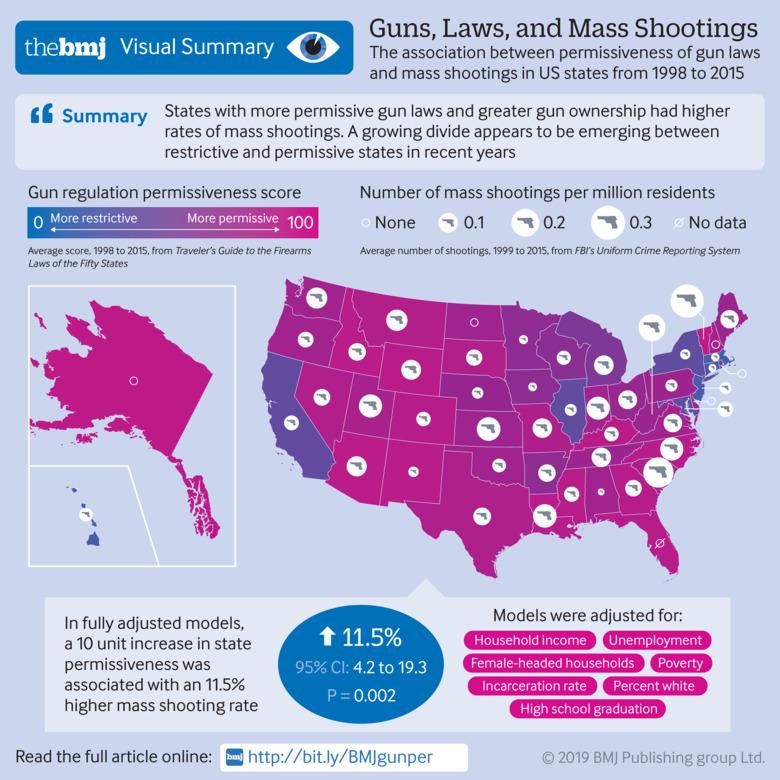
    Objective To determine whether restrictiveness-permissiveness of state gun laws or gun ownership are associated with mass shootings in the US.
    Design Cross sectional time series.
    Setting and population US gun owners from 1998-2015.

    Exposure An annual rating between 0 (completely restrictive) and 100 (completely permissive) for the gun laws of all 50 states taken from a reference guide for gun owners traveling between states from 1998 to 2015. Gun ownership was estimated annually as the percentage of suicides committed with firearms in each state.

    Main outcome measure Mass shootings were defined as independent events in which four or more people were killed by a firearm. Data from the Federal Bureau of Investigation’s Uniform Crime Reporting System from 1998-2015 were used to calculate annual rates of mass shootings in each state. Mass shooting events and rates were further separated into those where the victims were immediate family members or partners (domestic) and those where the victims had other relationships with the perpetrator (non-domestic).

    Results Fully adjusted regression analyses showed that a 10 unit increase in state gun law permissiveness was associated with a significant 11.5% (95% confidence interval 4.2% to 19.3%, P=0.002) higher rate of mass shootings. A 10% increase in state gun ownership was associated with a significant 35.1% (12.7% to 62.7%, P=0.001) higher rate of mass shootings. Partially adjusted regression analyses produced similar results, as did analyses restricted to domestic and non-domestic mass shootings.

    Conclusions States with more permissive gun laws and greater gun ownership had higher rates of mass shootings, and a growing divide appears to be emerging between restrictive and permissive states.

    Discussion

    Our analyses show that US state gun laws have become more permissive in recent decades, and that a growing divide in rates of mass shootings appears to be emerging between restrictive and permissive states. A 10 unit increase in the permissiveness of state gun laws was associated with an approximately 9% higher rate of mass shootings after adjusting for key factors. A 10% increase in gun ownership was associated with an approximately 35% higher rate of mass shootings after adjusting for key factors. On the absolute scale, this means that a state like California, which has approximately two mass shootings per year, will have an extra mass shooting for every 10 unit increase in permissiveness over five years. It will also have three to five more mass shootings per five years for every 10 unit increase in gun ownership. These results were also consistent across multiple analyses and when stratified as to whether or not mass shootings were committed by someone in a close relationship with the victims.

    Previous research

    These associations between state gun laws, gun ownership, and mass shootings are analogous to what was found in previous research for other types of gun injuries.678910 To develop effective state gun laws, the underlying cause of the association with rates of mass shootings needs to be identified. Perhaps as a result of outside pressures, relatively few specific gun laws have been scientifically studied, much less proven effective, for gun violence outcomes in general, and mass shootings in particular.235 Domestic violence and suicide are commonly connected to mass shooting events, so state gun laws involving restraining orders and extreme risk protection orders may be valuable first opportunities for scientific evaluation.3637 Non-legislative approaches, such as environmental modifications, policing practices, and bystander training, could also be worthy of evaluation in potentially preventing and reducing the tragic impacts of mass shootings.38394041 As with other large-scale, population-wide solutions to relatively infrequent mass health threats, both legislative and non-legislative approaches should be carefully studied for their potential beneficial effects as well as any unintended consequences that could emerge. This caveat is applicable here given the low rate of mass shootings compared with daily shooting events, although certain solutions could benefit both events.4243444546

    Strengths and limitations

    There are several limitations to our study. Our study design incorporated a time series component, lagged variables, and multiple covariate adjustment strategies, and was primarily able to show broad associations between state gun laws, gun ownership, and mass shootings. The potential for omitted variable biases and reverse causation remain and future analyses are encouraged to build on our work by testing the before-and-after effects of enactment or repeal of gun laws in specific states, or both, alongside appropriately matched control states.

    In addition, the state restrictiveness-permissiveness score we used has not been validated. However, this score had a wide range (0-100), was determined by legal professionals for use by actual gun owners, had nearly two decades of consistent data, and was highly correlated with other similar state-level scales that had been previously used (r=0.85).6 State gun laws and the enforcement of these laws can be difficult to separate and our measure of state gun laws might not reflect differing levels of enforcement among states with comparable restrictiveness-permissiveness scores.

    There are concerns about potential under-reporting in the Uniform Crime Reporting System Supplemental Homicide reports due to some states failing to consistently report. However, these under-reported data would likely bias our results toward the null. If errors were randomly distributed, then there would be non-differential misclassification, leading to an underestimate of our association. Alternatively, if there is differential misclassification, evidence points to it being among more permissive states (such as Alabama, Nebraska, and Florida) most likely leading to, if anything, underestimation in the associations we found. Despite this, improved reporting systems for mass shootings, including better tracking of whether mass shooters legally possessed their firearms or crossed state lines to obtain their weapons, or both,4748 are needed to further improve the accuracy and detail of future analyses.

    Conclusion and future directions

    The permissiveness or restrictiveness of state gun laws is associated with the rate of mass shootings in the US. States with more permissive gun laws and greater gun ownership have higher rates of mass shootings, and a growing divergence is noted in recent years as rates of mass shootings in restrictive states have decreased and those in permissive states have increased. Better data collection on mass shootings and more studies that test changes to specific state gun laws, compared with states that have not made changes, are necessary based on our findings, the general increase in state gun law permissiveness, and the pressing need reduce mass shootings in the US.

    What is already known on this topic

    • More permissive state gun laws and higher levels of gun ownership are associated with higher levels of gun homicide and gun suicide in the US

    What this study adds

    • States with more permissive gun laws and greater gun ownership have higher rates of mass shootings

    • There is a growing divergence in recent years as rates of mass shootings in restrictive states have decreased and those in permissive states have increased

    Figure3

    Footnotes

    • Contributors: All authors participated in the writing, editing, creation, and approval of this paper. PMR assembled the data, conducted the analyses, and wrote and edited the original manuscript. CCB first conceptualized the paper and participated in data preparation, analysis, writing, and editing. All authors had full access to the data in the study and can take responsibility for the integrity of the data and the accuracy of the data analysis. PMR is the guarantor. The corresponding author attests that all listed authors meet authorship criteria and that no others meeting these criteria have been omitted.

    • Funding: No extramural funding.

    • Competing interests: All authors have completed the ICMJE uniform disclosure form at www.icmje.org/coi_disclosure.pdf and declare: no support from any organization for the submitted work; no financial relationships with any organisations that might have an interest in the submitted work in the previous three years; no other relationships or activities that could appear to have influenced the submitted work.

    • Ethical approval: Owing to the aggregated nature of the count data used in the study, the Institutional Review Board at Columbia University determined that the study was exempt.

    • Patient consent: Not applicable.

    • Data sharing: Statistical code and dataset available from the corresponding author.

    • The lead author (PMR) affirms that this manuscript is an honest, accurate, and transparent account of the study being reported; that no important aspects of the study have been omitted; and that any discrepancies from the study as planned have been explained.

    This is an Open Access article distributed in accordance with the Creative Commons Attribution Non Commercial (CC BY-NC 4.0) license, which permits others to distribute, remix, adapt, build upon this work non-commercially, and license their derivative works on different terms, provided the original work is properly cited and the use is non-commercial. See: http://creativecommons.org/licenses/by-nc/4.0/.

    References

  • Dream Center Closure: Chairman Scott Asks Department of Education to Clarify Role in Collapse of For-Profit School

    Bobby Scott


    “…The actions of Dream Center and the Department of Education’s execution of its responsibility to protect students raise grave concerns.”

     Congressman Bobby Scott (VA-03), (right) chairman of the House Committee on Education and Labor, sent a letter to Department of Education Secretary Betsy DeVos over a week ago expressing deep concern over the Department’s role in the abrupt closure of Dream Center Education Holdings — a recently defunct, for-profit higher education company.

    The letter details newly obtained documents suggesting that the Department of Education enabled Dream Center to mislead students regarding the accreditation status of two Dream Center-owned schools. The documents also reveal that despite knowledge of Dream Center’s false claims of accreditation, the Department did not immediately require the for-profit company to take corrective action. Instead, the Department supported efforts to retroactively accredit the institutions in question by rewriting Department policy.

    “… The actions of Dream Center and the Department of Education’s execution of its responsibility to protect students raise grave concerns. As you can see, the information referenced from the documents obtained by the Committee raise questions about the extent to which the Department met its responsibility to protect student interests amid the collapse of Dream Center,” said Chairman Scott.  “In light of the serious concerns raised by the newly-obtained documents, the Committee is requesting information from the Department regarding its handling of the Dream Center collapse and the accreditation of certain Dream Center schools.”

    In the letter, Chairman Scott formally requests information regarding the Department’s handling of the Dream Center collapse — pointing to concerns that Department officials were not forthcoming to Congress and the public about their knowledge of Dream Center’s practices.

    The documents obtained by the Committee include internal emails among Dream Center executives outlining their decision to ignore the instructions of their accrediting body to remain transparent with students. Additionally, the documents describe communications between Dream Center and the Department of Education revealing the Department actively worked with the company to misrepresent accreditation at the expense of students and taxpayers.

    To read the letter, click here.

  • My Wish List: Where is Aladdin When I Need Him? More Specifically, Where is His Fabled Magic Lamp?

     Aladdins lamp, part of Burlesque Company poster

    Aladdin’s Wonderful Lamp, Courier Litho Company, Wikipedia

    by Rose Madeline Mula

    Where is Aladdin when I need him?  More specifically, where is his fabled magic lamp?

    Unfortunately, it’s been missing for so long that if I ever do find it, probably it won’t work because it will be coated with tarnish. So polish it, you say. Not very likely   Have you seen my silverware drawer? Of course, the prospect of having all my wishes granted would be a powerful incentive.

    If and when I ever do find — and polish — the lamp, I’ll be ready.  My wish list is on the launch pad and ready to blast off.

    First, I’d like some people. Yes, people.  So when meeting with the publisher of my new book, I’ll be able to say, “Have your people call my people.” Oh, wait.  That will have to be my second wish. First will be to find a publisher for my new book. Oh, wait again! Before that I have to wish for the inspiration and discipline to sit down and write the book.

    Next on my list is a Pulitzer prize for that book.

    I will then ask Genie to arrange a wildly successful book signing tour for me. By “wildly successful” I mean having some legitimate buyers show up at each stop — not just the few friends and relatives whom I shamed into making pity purchases of my previous books.

    I hope Genie has a real estate brokers license because I would like him to find me a vacation home in Hawaii plus a magic carpet to whisk me there in minutes — or if the FAA prohibits such transport, I’ll settle for luxurious accommodations on the Concorde. (Yes, I’ll ask Genie to bring it back.)

    I would also like some heirs.  Or, at least, enough money to necessitate my having heirs.

  • Exclusion: The Presidio’s Role in World War II Japanese American Incarceration

    Tuesdays to Sundays, 10 am to 5 pm, extended to June 2020
    Presidio Officers’ Club 


    During World War II, the Presidio of San Francisco — the Army’s Western Defense Command — played a pivotal role in the unjust incarceration of 120,000 Japanese Americans, purportedly in the name of national security. This special exhibition marks 75 years since Lieutenant General John L. DeWitt issued Civilian Exclusion Orders from the Presidio, and examines the post’s little understood part in these events.

    The exhibition invites visitors to investigate the choices — both personal and political — that led to this dark chapter in American history. How did leaders arrive at this decision? How did Japanese Americans respond to the violation of their civil liberties? And what, as a nation, have we learned that can help us address the present-day issues of immigration, racism, and mass incarceration?

    Exclusion is the latest special exhibition at the Presidio Officers’ Club, a cultural institution showcasing the Presidio’s role in shaping and serving the nation. Special exhibitions explore the Presidio’s heritage and allow for fresh perspectives and a deeper exploration of the topics and themes presented in the club’s permanent exhibition.

    In developing Exclusion, the Presidio Trust collaborated with the Fred T. Korematsu Institute and the National Japanese American Historical Society.

    Exclusion has been awarded the 2018 Charles Redd Award for Exhibition Excellence by the Western Museums Association, October 2018.

     
    Exclusion explores the Presidio’s role in Japanese American incarceration as informed by government findings, current historical and curatorial scholarship, and the Japanese American community. The exhibition invites visitors to explore how and why the past matters and inspires civic engagement by fostering an understanding of the ways in which the Presidio’s heritage is relevant today.
    Exclusion Exhibit in the Presidio

    Civilian Exclusion Orders
    As visitors enter the museum at the Presidio Officers’ Club, they encounter installations that address the Presidio’s role in the mass incarceration of Japanese Americans, including historic and contemporary perceptions and memories of the incarceration. Visitors first encounter a 1942 San Francisco street scene with a reproduction telephone pole and Civilian Exclusion Order No. 5 poster set against a life-size Dorothea Lange image of San Francisco’s Japantown.

    Names of family and loved ones at the Exclusion Exhibition

    One Hundred Twenty Thousand Lives
    Using historic government data, this installation shows the names of Japanese American incarcerees en masse. Many visitors with personal connections to the exhibition engage deeply with this installation, locating names of family and loved ones. Since Exclusion opened, exhibition staff has added interpretive material and takeaway resources to facilitate visitors’ engagement with this exhibit.

    Deconstructed Kimono by Judy Shintani

    Contemporary Art
    Select artworks by local artist Judy Shintani are on view throughout the exhibition. Currently on display is Deconstructed Kimono, pictured above.

  • Bureau of Land Management Plans Across West Favor Development, Reduced Protections and Minimal New Safeguards — and Ignore Agency’s Own Findings

    USPLR

    A Bureau of Land Management proposal would open 99 percent of the 13.4 million-acre planning area in Alaska’s Bering Sea-Western Interior to mining, including the Anvik River watershed. David W. Shaw

    The Bureau of Land Management (BLM) oversees a quarter of a billion acres of public lands across the nation — more than any other federal agency.  These places range from the boreal forest of the wild Alaskan interior to the panoramic red rock country of the Colorado Plateau, and from ancient Pacific Northwest forests to biologically rich sage-steppe ecosystems that are a hallmark of the inland West.

    BLM lands provide clean drinking water, fish and wildlife habitat, and recreational opportunities for millions of users each year — a powerful economic driver across the rural West. In fact, non-motorized recreation on BLM land in the West supports 25,000 jobs and generates $2.8 billion for the U.S. economy.

    Every two decades, the agency revises management plans for the more than 100 planning areas in this vast domain, ostensibly to balance development and conservation and ensure that the management of these lands reflects the public’s interest.  The resource management planning process includes opportunities for public comment and, usually, public meetings with agency officials in attendance.  

    For each area, BLM typically sets forth several proposals, ranging from no changes in management to options that emphasize conservation or development, or a mix thereof.  Protective designations typically account for unique natural characteristics and include Areas of Critical Environmental Concern (ACECs), Lands With Wilderness Characteristics, Ecological Emphasis Areas, and Backcountry Conservation Areas.

    The draft plans released in this cycle reveal a troubling trend that could result in the loss of protections for millions of acres of public land.

    In the past four months, BLM has released six draft plans covering more than 20 million acres in Alaska, Colorado, Idaho, Montana, and Oregon. The Pew Charitable Trusts’ review of these plans reveals that in each of the alternatives preferred by the agency, BLM significantly reduced protections that have been in place for decades and proposed minimal new safeguards for only a fraction of 1 percent of the areas. In addition, BLM proposes opening vast acres in these planning areas to energy and mineral development.

    USPLR

    In the recently released management plan for BLM’s Lewistown, Montana, area, the Department of the Interior proposed removing eight Areas of Critical Environmental Concern, along with other protections that the community sought to maintain. Tony Bynum

    The draft plan for the Alaska Bering Sea-Western Interior region is another prime example of lack of balance.  This 13.4 million-acre planning zone contains areas vital to Alaska tribal entities whose members have lived off these lands for millennia and depend on the fish and wildlife that the habitat supports.  Yet BLM’s preferred approach would eliminate 1.8 million acres of Areas of Critical Environmental Concern and proposes no new ACECs despite the request by tribal communities to preserve 7 million acres as traditional use areas.

    A similar script is playing out across the sagebrush desert and wild Owyhee country of southeastern Oregon.  In court-ordered amendments to BLM’s Southeastern Oregon plan, the agency identifies 1.2 million acres of lands with wilderness characteristics but proposes protection for none of them. For Montana’s Lewistown and Missoula planning areas, BLM proposed no safeguards for lands with wilderness qualities, and only one tiny 640-acre ACEC designation, while 23,000 acres of such protections would be eliminated in the Lewistown planning area. 

    In all for these six areas, BLM is proposing elimination of 94 percent of the ACECs established in prior plans and protection of just 2 percent of the lands that the agency determined have ACEC-qualifying values. Further, BLM’s preferred plans would safeguard just 0.03 percent of the lands that the agency identified as possessing wilderness characteristics. 

  • Paris 1900 and the Atmosphere of the Belle Epoque Recreated, A Vibrant and Swiftly Changing City

    Paris 1900, Portland Museum of Art*

    City of EntertainmentEiffel Tower

    Until Sep 8, 2019

    Georges Roux (1855–1929). Night Party at the Universal Exhibition in 1889, under the Eiffel Tower, 1889. Paris, Musée Carnavalet. © Musée Carnavalet / Roger-Viollet

    Travel back to Paris at the dawn of the 20th century and experience the splendor of the sparkling French capital as it hosted the world for the International Exposition of 1900. This was the height of the Belle Époque, a period of peace and prosperity in France when fine art, fashion, and entertainment flourished as never before. Fifty-one million visitors from around the world attended the Exposition and flooded the city, where they enjoyed its posh restaurants, opulent opera house, artistic cabarets, and well-tended parks. For the French, it was an opportunity to show off their prowess in the arts, sciences, and new technology, and to highlight what made Paris unique from rivals London and Berlin.Assyrian comb

    Inspired by an exhibition originally presented in 2014 at the Petit Palais in Paris, Paris 1900 re-creates the look and feel of the era through more than 200 paintings, decorative art objects, textiles, posters, photographs, jewelry, sculpture, and film, and will plunge visitors into the atmosphere of the Belle Époque. These objects, drawn from several City of Paris museums — including the Petit Palais, the Musée Carnavalet, the Palais Galliera, the Musée Bourdelle, and the Maison de Victor Hugo — form a portrait of a vibrant and swiftly changing city.

    Eugène-Samuel Grasset (1845–1917), Paul Vever (1851–1915), and Henri Vever (1854–1942). “Assyrian” Comb, ca. 1900. Horn, repoussé gold, cloisonné enamel, and sapphires. 5 7/8 x 3 7/8 x 3/8 in. Musée des Beaux-Arts de la Ville de Paris, Petit Palais. © Patrick Pierrain / Petit Palais / Roger-Viollet

    The splendor of Paris unfolds in six sections or vignettes. The visitor enters “Paris: The World’s Showcase,” which highlights the International Exposition of 1900 and the sweeping architectural and technological changes made to the cityscape to welcome the new century. As Paris was also the self-proclaimed “Capital of the Arts,” the second section of the exhibition examines the vast range of styles and talent present in the city in the form of sculpture, painting, and prints. Work by well-known artists such as Camille Pissarro and Berthe Morisot are on display.

    The seductive Art Nouveau style, so popular in the decorative arts, is the focus of the next vignette, which features furniture, jewelry, pottery, posters, ironwork, and fans that exhibit the whiplash curve and natural inspiration of this international style.

    French fashion and style were at the heart of Parisian pride, and the next section examines the cult and myth of la Parisienne — the ideal French woman — through textiles, paintings, prints, and decorative arts. Strolling through the city was considered one of the great Parisian pastimes and is explored in “A Walk in Paris.” New modes of transport, such as the omnibus and the newly invented bicycle, competed with horses, pedestrians, and automobiles as the 20th century unfolded. The final vignette, “Paris by Night,” features a selection of the vast amusements that made Paris the center of European entertainment, from lowly cabarets to the most refined theaters and restaurants. The exhibition concludes with a look at a great French invention of the Belle Époque: the moving picture. Clips from early film animate the exhibition and allow the viewer to rediscover the dawn of cinema.Palace of Optics

    Georges Paul Leroux (1877-1957). The International Exhibition’s Palace of Optics, 1900. Color lithograph, 31 3/4 x 23 5/8 in., Musée Carnavalet. © Petit Palais / Roger-Viollet

    Northwest Film Center screenings will illuminate Paris at the birth of cinema, and additional programming will explore the role of World’s Fairs in the crafting of national and racial identities, with a focus on Portland’s Lewis and Clark Centennial Exposition of 1905. Visitors can learn more about the exhibition in the companion publication Paris 1900: City of Entertainment by Cécilie Champy-Vinas, Curator of Sculpture, Petit Palais Museum of Fine Arts, Paris.

    Exhibition organized by the Petit Palais Museum of Fine Arts, with exceptional loans from the Musée Carnavalet – History of Paris and the Palais Galliera Museum of Fashion, Paris Musées. Curated in Portland by Mary Weaver Chapin, Ph.D., Curator of Prints and Drawings.

    *Don’t forget the Museum Shop if you go … No Museum admission is required to shop at the Museum; customers may enter through the Hoffman Entrance near the Roberts Memorial Sculpture Mall.

     https://portlandartmuseum.org/plan-your-visit/museum-store/
    Paris Musees - Les Musees de la Ville de Paris

  • Scientific Discovery Games: Anyone Can Play and Contribute to Solving the Hardest Questions in Science

     By Taylor Kubota

    Stanford University researchers Rhiju Das and Ingmar Riedel-Kruse like to play games. Specifically, they are champions of scientific discovery games – games that are designed so that anyone can play and, in doing so, contribute to solving the hardest questions in science.

    Rhiju Das, left, and Ingmar Riedel-Kruse 

    Rhiju Das, left, and Ingmar Riedel-Kruse developed a scientific discovery game and encourage people to use such games to expand biomedical research. (Image credit: L.A. Cicero)

    “There’s this paradigm of scientific discovery games and it may sound silly or far-fetched, but in the last 10 years it’s led to important scientific discoveries in several different disciplines,” Das said. “We want more people to play the games, more people to create these games, and more people to realize that this is a legitimate mode of discovery.”

    Both Das and Riedel-Kruse have developed their own games. Das, an associate professor of biochemistry, developed Eterna, an online puzzle game where players design molecules for RNA-based medicines. Eterna has engaged over 200,000 players. These non-experts have begun writing their own peer-reviewed manuscripts and have organized their own yearly Eternacon convention at Stanford.

    Riedel-Kruse focuses on educational games. In this realm, he has developed biotic games, where people can playfully interact with living cells, such as one game where people play soccer with light-seeking microbes.

    As part of a review they wrote for the Annual Review of Biomedical Data Sciencepublished July 22, they estimate about a dozen of these games have been developed in the last decade.

    “These games layer a playful aspect on top of the science, which adds motivation and can be educational,” said Riedel-Kruse, who was an assistant professor of bioengineering at Stanford when he did the work. “It’s also a window into how science really works – professional scientists are curious and they play around with ideas.” Riedel-Kruse recently joined the faculty at the University of Arizona. 

    In their review, Das and Riedel-Kruse traced the origins of scientific discovery games back to the 1800s to early bird survey efforts that relied on volunteers, a category of science now called citizen science. They also credit online crowdsourced work – exemplified by Wikipedia and Amazon Mechanical Turk – and video games with setting the stage for scientific discovery games.

    Most experts consider Foldit the first scientific discovery game. This online puzzle game, developed by researchers at the University of Washington in 2008, challenges players to fold proteins as perfectly as possible, given specific rules and tools. As with many of these games, it engages players to join into a supercomputer running multiple puzzles at once – but with the advantage that they have the nuanced reasoning skills and adaptability of humans. The researchers behind Foldit study high-scoring solutions to see if players have created novel protein structures. In 2011, players resolved the structure of an enzyme involved in the reproduction of an HIV-like retrovirus for the first time.

    Along the same lines, both Das and Riedel-Kruse are working on translating skilled game play into laboratory success. With Eterna, Das and his lab tested player-generated solutions in test tubes and used those results to both further their research and reward players in the game. In the future, Das hopes they can run these laboratory experiments not just in test tubes but with living cells, directed by Eterna players. Riedel-Kruse has done work on robotic biology labs controlled remotely online and sees the possibility of integrating such systems to enable real-time laboratory scientific discovery games. He is also working on ways to modify his biotic games for online play.