
|
Committee: |
House Intelligence (Permanent Select) |
|---|---|
| Related Items: | Data will display when it becomes available. |
| Date: | Wednesday November 13, 2019 (10:00 AM EST) |
| Location: | 1100 Longworth House Office Bldg, Washington, D.C. |
| Website: | https://intelligence.house.gov/ |
Witnesses
- The Honorable William Taylor, Chargé d’Affaires Ad Interim, Kyiv, Ukraine, Department of State
- Mr. George Kent, Deputy Assistant Secretary for European and Eurasian Affairs
Video of Proceedings
Committee’s website when it becomes available: https://intelligence.house.gov/
Impeachment Inquiry: Ambassador Marie ‘Masha” Yovanovitch, 116th Congress (2019-2020)
HOUSE COMMITTEE HEARING
| Committee: | House Intelligence (Permanent Select) |
|---|---|
| Related Items: | Data will display when it becomes available. |
| Date: | Rescheduled to Friday November 15, 2019 (9:00 AM EST) |
| Location: | 1100 Longworth House Office Bldg, Washington, D.C. |
| Website: | https://intelligence.house.gov/ |
- U.S. Capitol Map
- Committee Memberships
(Clerk.House.gov)
Witnesses
- The Honorable Marie “Masha” Yovanovitch, Former US Ambassador to Kyiv, Ukraine
Video of Proceedings
Data will display when it becomes available.
The Ten Thousand-Day War at Sea: The US Navy in Vietnam, 1950-1975; Lenah Sutcliffe Higbee Awarded a Navy Cross and Destroyer Named in Her Honor
View of Hampton Roads Naval Museum’s newest exhibit: “The Ten Thousand-Day War at Sea: The U.S. Navy in Vietnam, 1950-1975”. The new exhibit adds 130 new artifacts as well as 40 oral histories from local U.S. Navy Vietnam veterans
Visitors walking towards battleship Wisconsin spent the 2019 summer passing the closed gallery of the Hampton Roads Naval Museum. Glass doors that once welcomed visitors into 240-plus years of naval history in the Hampton Roads area, were covered over with brown craft paper.
Behind the glass, staff members, contractors, and volunteers were hard at work. The remaining artifacts in the museum’s World War II and Cold War galleries were removed and carefully stored. Contractors transformed a once quiet and serene gallery into a construction zone. Once the tear down was complete, new framing and electrical wiring went up, contractors installed new drywall, dramatically transforming half of the museum’s gallery.
Curator of Ship Models staff members add the finishing touches to USS Newport News (CA-148) after transporting it from the National Museum of the United States Navy in Washington, D.C. to the Hampton Roads Naval Museum in Norfolk, Virginia on September 24, 2019
During this time, artifacts both large and small arrived, along with printed graphics and text panels. Staff members installed wooden frames, plywood panels, and display cases. With fresh coats of paint applied, staff members and volunteers worked tirelessly to install artifacts, text rails, graphics panels, lighting fixtures, touchscreen monitors, and overhead projectors. Finishing touches continued right up to the exhibit’s opening.
On October 9, 2019, the gallery of the Hampton Roads Naval Museum opened to the public. Many who have visited before will recognize the familiar displays depicting the Revolutionary War through the Civil War.
Jo Freeman’s Review of Michael Barone’s How America’s Political Parties Change (And How They Don’t)
How America’s Political Parties Change (And How They Don’t)
By Michael Barone
Published by New York: Encounter Books, 2019; 130 pages
Michael Barone has been studying American politics for most of his 75 years and is very impressed with the two major parties. In this book he repeatedly says that the Democratic Party (founded in 1832) is the oldest party in the world and the Republican Party (founded in 1854) is the third oldest. (Britain’s Conservative Party is second). Longevity comes from resilience. Both have been frequently challenged. Both recovered from near-death experiences. The Democratic Presidential candidate won only 34 percent of the popular vote in 1920 and the Republican candidate won a little over 36 percent in 1936. Both are alive and kicking.


In twelve short chapters, each of which could stand by itself, he brings the parties from the 19th to the 21st Centuries. Among their “enduring character” is that the Democrats are “a collection of out-groups” and Republicans are mostly in-groups, which he defines as “a core group considered to be typical Americans.” Of course, what constitutes “typical Americans” does change over time as new immigrants are absorbed into the mainstream.
What changes over time is policy. In the 19th Century, the Democrats were the party of states rights and laissez-faire policies while the Republicans favored an active federal government with important decisions made by experts, not politicians or voters. The shift was gradual, but completed by the 21st Century. Economic regulation, tariffs, race and sex were all issues in which the parties switched sides. Foreign policy is more complicated; Barone doesn’t go into that. Race is a continual thread in party history; gender, not so much. Socioeconomic crises and demographic changes are prime progenitors of policy changes.
Both major parties have been challenged by third parties many times, but not successfully. Third parties may make a difference in the outcome of a presidential election (e.g. 2000) but have not won one since the Republican Party triumphed in 1860. Since then the Progressive Party has been the most successful, knocking out the Republican candidate in 1912; it was gone by 1920. Third parties are sometimes successful on the local level, and can even elect US Senators, but not in enough states to make much difference. Their primary effect on the major parties is to provide testing grounds for policy ideas, which the major parties adopt when they appear to garner lots of public support.
Barone traces back to Franklin Delano Roosevelt the idea that “we ought to have two real parties, one liberal and one conservative.” Then both major parties had conservative and liberal (or progressive) wings. It took about 70 years, but in two separate chapters Barone describes “How the Republican Party Sloughed Off Its Liberals” and “How the Democratic Party Sloughed Off Its Conservatives.” The result was “Partisan Polarized Parity.” To find out what this means, you’ll have to read the book.
In a final section, Barone looks at the parties in two important regions: the South and the Midwest. The South has stayed conservative but switched from solidly Democratic to almost solidly Republican. The Midwest is becoming conservative, even though it contains several important industrial states. That’s where key votes brought us President Trump.
If you like political history, you will enjoy this book. And if you get a chance to hear Barone lecture, don’t pass it up. He’s entertaining as well as informative.
Updated Again: Deputy Assistant Secy of Defense Laura Cooper’s, Croft and Anderson’s Transcripts Released: President Trump Directed Freeze on Millions of Military Aid for Ukraine
Today, Rep. Adam B. Schiff, the Chairman of the Permanent Select Committee on Intelligence, Rep. Eliot L. Engel, the Chairman of the Committee on Foreign Affairs, and Rep. Carolyn B. Maloney, the Acting Chairwoman of the Committee on Oversight and Reform, released the transcript from the joint deposition of Laura Cooper, Deputy Assistant Secretary of the Department of Defense.
The three Chairs issued the following statement announcing today’s release:
“Deputy Assistant Secretary of Defense Laura Cooper testified that President Trump, through the Office of Management and Budget, directed the freeze on hundreds of millions of dollars of critical military aid for Ukraine, against the judgment of career officials in the Department of Defense, Department of State, and other relevant agencies. Cooper also told the Committees that she raised concerns, as did others on several occasions, to senior U.S. government officials about the legality of withholding the congressionally-authorized money, and the challenges that White House delays would put on spending it.
Deputy Asst Secy Of Defense Laura Cooper, right
“Cooper also testified that, during a meeting on August 20, 2019, with Ambassador Kurt Volker, he strongly implied that the hold on assistance might be resolved if Ukraine was willing to issue a statement related to election interference.”
The testimony of Deputy Assistant Secretary Laura Cooper can be found here.
Key excerpts of Deputy Assistant Secretary Laura Cooper testimony can be found here.
Committees Release Croft and Anderson Transcripts as Part of Impeachment Inquiry; Washington, November 11, 2019
Today, Rep. Adam B. Schiff, the Chairman of the Permanent Select Committee on Intelligence, Rep. Eliot L. Engel, the Chairman of the Committee on Foreign Affairs, and Rep. Carolyn B. Maloney, the Acting Chairwoman of the Committee on Oversight and Reform, released the transcripts from joint depositions of two former assistants to Ambassador Volker: Catherine Croft and Christopher Anderson.
The three Chairs issued the following statement announcing today’s release:
“Catherine Croft and Christopher Anderson, both advisors to Ambassador Kurt Volker on Ukraine policy, testified before the Committees about concerns they had with efforts to press Ukraine into announcing specific investigations which would help President Trump politically. Ms. Croft also testified that Ukrainian officials approached her quietly about the hold on security assistance in the July or August timeframe, before the hold had been made public.”
The testimony of Catherine Croft can be found here.
Key excerpts of Catherine Croft’s testimony can be found here.
The testimony of Christopher Anderson can be found here.
Key excerpts of Christopher Anderson’s testimony can be found here.
Background:
H. Res. 660, which was passed by the House of Representatives on October 31, 2019, authorizes the Chairman of the House Permanent Select Committee on Intelligence “to make publicly available in electronic form the transcripts of depositions” with “appropriate redactions for classified and other sensitive information.”
Pursuant to this resolution, and consistent with the Committee’s rules and longstanding bipartisan practice, the Committee has begun preparing transcripts from the impeachment inquiry for public release, which includes a thorough, nonpartisan security review to protect classified and other sensitive information.
As part of this process, the Committee is redacting (1) personally identifiable information; (2) the names of non-senior Executive Branch personnel and Intelligence Community employees; (3) the names of committee staff who did not ask questions or make on-the-record statements; and (4) classified or potentially classified information or other sensitive information not pertinent to the subject of the impeachment inquiry.
In addition, consistent with the Committee’s rules, each transcript has been made available to the witness for inspection, including to identify technical, grammatical, and typographical corrections. The Committee has also taken into consideration requested redactions from witnesses, if they fall within the parameters above.
Although the transcripts list Members of the three Committees who were present at the outset of a deposition, they do not necessarily reflect the attendance of all Members who may have joined or departed a deposition at different points.
The Committee will release individual transcripts on a rolling basis as this process is completed.
Michael Bloomberg’s Annual Philanthropy Letter, 2019; Reconsiders Running For President in 2020
Annual Letter on Philanthropy
“I always believe that tomorrow will be better than today. But I’m also a realist, and I know that believing and hoping won’t make it so. Doing is what matters.”
Michael R. Bloomberg
Will our country and our world be better or worse off two years from now?
I’m an optimist: I always believe that tomorrow will be better than today. But I’m also a realist, and I know that believing and hoping won’t make it so. Doing is what matters.
One of our board members, Walter Isaacson, recently published a biography of Leonardo da Vinci
Da Vinci was an artist, engineer, mathematician, inventor, scientist, musician, architect, writer – a Renaissance man, sure. But a doer. My kind of guy.
We can’t all have da Vinci’s genius. But we can all learn from his drive and the emphasis he placed on action. That’s a big reason why I first ran for mayor in 2001: I was tired of seeing paralysis where progress was possible, especially on public education. And, ultimately, it’s a big reason why I decided not to spend the next one to two years campaigning to be president of the United States – and, instead, to double down on the work that Bloomberg Philanthropies is already leading.
America and the world face enormous challenges. And it’s safe to say that at least for the next two years, given the leadership vacuum in the White House and partisan gridlock in Congress, the federal government will make virtually no progress in meeting them.
We can’t afford to lose two years. Every day, the window for avoiding the worst impacts of climate change grows smaller. More Americans lose loved ones to opioid overdoses and gun violence. More students miss out on a good education and the opportunity to go to college. And communities that were once home to thriving industries slip further behind in the changing economy. Proposing ideas for 2021 isn’t good enough. We need to get things done in the here and now, and I’m lucky enough to be in a position to help do that.
Of course, philanthropy can’t replace action by the federal government. But it can spur progress from the bottom up – from communities, cities, states, businesses, and nonprofit organizations. Leaders in all of those groups are taking action – and getting things done. Philanthropy can help them do more, faster. And that’s exactly what we will do.
In the year ahead, as political candidates debate what to do in the future, we will work to improve the present by expanding our efforts across all of our major areas of focus.
Climate and Environment
It’s been clear for a long time that we’re in a race against time on climate change. But over the past year, it’s become clearer just how far behind we’ve fallen. The most recent scientific evidence shows that the climate is changing even faster than previously expected, bringing more deadly and destructive storms, wildfires, and droughts. Millions of people around the world have seen that evidence with their own eyes and in their own lives.
Unless we act, we will be much worse off in two years than we are today – with dirtier air and water, more carbon emissions, and diminished chances of avoiding the worst impacts of climate change.
We can’t accept that – and so we are ramping up the work we have been leading to end the single biggest global source of air pollution and carbon emissions: coal. Since 2011, working with the Sierra Club, we have helped communities in red and blue states stand up for their right to clean air and water. As a result, over that time, more than half of all U.S. coal-fired power plants have closed or committed to closing. Last year, U.S. coal production fell to a 40-year low – even though Washington is working against us, trying to prop up the coal industry with taxpayer bailouts and eliminating rules that protect the public from toxic pollution.
When we began the Beyond Coal campaign, 13,000 Americans were dying from coal pollution each year. By 2017, that number had fallen to 3,000. That’s good progress, but it’s not enough. So this year, we set a new goal: to close every remaining coal-fired power plant by 2030. It is an ambitious goal, but we can reach it – and we won’t stop there.
Recently, I announced a new campaign, called Beyond Carbon. Our aim is to end America’s dependence on gas and oil as soon as possible and accelerate our transition to a 100 percent clean energy economy.
To do that, we’ll employ and expand the same types of legal, advocacy, and electoral strategies that have proven so successful in the Beyond Coal campaign – supporting governors who are committed to 100 percent clean energy, helping activists demand that elected officials stop kicking the can down the road, and building a coordinated, nationwide grassroots army to get results and win elections. We will also continue to support mayors who are leading by example. Last year, we challenged the 100 most populous U.S. cities to propose bold plans for cutting carbon emissions and are working with the 25 winners to put those plans in motion.
With cities and states leading the way, we will be better off in two years than we are today – with cleaner air, cleaner power, more good green jobs, and lower carbon emissions.
Transcripts Will Be Released on a Rolling Basis: Today It Is From Ambassador William Taylor, Chargé d’Affaires Ad Interim For US Embassy in Kyiv, Ukraine
Today, Rep. Adam B. Schiff, the Chairman of the Permanent Select Committee on Intelligence, Rep. Eliot L. Engel, the Chairman of the Committee on Foreign Affairs, and Rep. Carolyn B. Maloney, the Acting Chairwoman of the Committee on Oversight and Reform, released the transcript from the joint deposition of Chargé d’Affaires Ad Interim For US Embassy in Kyiv, Ukraine.
The three Chairs issued the following statement announcing today’s release. Above, Amb. Taylor
“The testimony of Ambassador Taylor — a West Point graduate, Vietnam veteran, and nonpartisan diplomat — shows how President Trump withheld military aid to Ukraine and conditioned its release, as well as a vital White House meeting, on the President of Ukraine publicly announcing investigations into debunked conspiracy theories involving the Bidens and the 2016 election.
“Ambassador Taylor’s testimony lays bare how this shadow foreign policy channel pursued by the President’s agent, Rudy Giuliani, with the assistance of Ambassadors Sondland and Volker, placed immense pressure on the Ukrainian government to accomplish the President’s goal. Ambassador Taylor makes clear why this military aid and continued bipartisan support for Ukraine are so critically important — and why these efforts to undermine U.S. foreign policy for domestic political reasons were so damaging. We look forward to his public testimony.”
The testimony of Ambassador Taylor can be found here.
Key excerpts from Ambassador Taylor’s testimony can be found here.
Background:
H. Res. 660, which was passed by the House of Representatives on October 31, 2019, authorizes the Chairman of the House Permanent Select Committee on Intelligence “to make publicly available in electronic form the transcripts of depositions” with “appropriate redactions for classified and other sensitive information.”
Pursuant to this resolution, and consistent with the Committee’s rules and longstanding bipartisan practice, the Committee has begun preparing transcripts from the impeachment inquiry for public release, which includes a thorough, nonpartisan security review to protect classified and other sensitive information.
As part of this process, the Committee is redacting (1) personally identifiable information; (2) the names of non-senior Executive Branch personnel and Intelligence Community employees; (3) the names of committee staff who did not ask questions or make on-the-record statements; and (4) classified or potentially classified information or other sensitive information not pertinent to the subject of the impeachment inquiry.
In addition, consistent with the Committee’s rules, each transcript has been made available to the witness for inspection, including to identify technical, grammatical, and typographical corrections. The Committee has also taken into consideration requested redactions from witnesses, if they fall within the parameters above.
Although the transcripts list Members of the three Committees who were present at the outset of a deposition, they do not necessarily reflect the attendance of all Members who may have joined or departed a deposition at different points.
The Committee will release individual transcripts on a rolling basis as this process is completed.
Updated: House Committees Release Testimony of Sondland and Volker in Addition to Yovanovitch and McKinley As Part of New Public Phase of Impeachment Inquiry
November 5, 2019: See Additional Testimony Releases Below
Washington, November 4, 2019: Today, Rep. Adam B. Schiff, the Chairman of the Permanent Select Committee on Intelligence, Rep. Eliot L. Engel, the Chairman of the Committee on Foreign Affairs, and Rep. Carolyn Maloney, the Acting Chairwoman of the Committee on Oversight and Reform, released the transcripts of former U.S. Ambassador to Ukraine Marie “Masha” Yovanovitch and former Senior Advisor to the Secretary of State Ambassador P. Michael McKinley.
Both of these individuals testified before the Committees as part of the House of Representatives’ impeachment inquiry of President Donald J. Trump. The resolution passed by the House last week authorized the Committees to make the inquiry transcripts of their recent depositions and interviews available to Members and public at the discretion at the Chairman of the Intelligence Committee in advance of open hearings.
The three Chairs issued the following statement announcing today’s releases:
“As we move towards this new public phase of the impeachment inquiry, the American public will begin to see for themselves the evidence that the committees have collected. With each new interview, we learn more about the President’s attempt to manipulate the levers of power to his personal political benefit.
“The transcripts of interviews with Ambassadors Yovanovitch and McKinley demonstrate clearly how President Trump approved the removal of a highly respected and effective diplomat based on public falsehoods and smears against Ambassador Yovanovitch’s character and her work in support of long-held U.S. foreign policy anticorruption goals.
“Ambassadors Yovanovitch and McKinley’s testimony also demonstrates the contamination of U.S. foreign policy by an irregular back channel that sought to advance the President’s personal and political interests, and the serious concerns that this activity elicited across our government.
“Unfortunately, despite those concerns, the transcripts also show clearly that efforts to secure public support for Ambassador Yovanovitch from the senior-most levels of the State Department were never realized, thanks to worry among those leaders that such support would be directly undermined by presidential attacks.”
The testimony of former U.S. Ambassador to Ukraine Marie “Masha” Yovanovitch from October 11, 2019 can be found here. Key excerpts from Yovanovitch’s testimony can be found here.
The testimony of former Senior Advisor to the Secretary of State Ambassador P. Michael McKinley from October 16, 2019 can be found here. Key excerpts from McKinley’s testimony can be found here.
Background:
H. Res. 660, which was passed by the House of Representatives on October 31, 2019, authorizes the Chairman of the House Permanent Select Committee on Intelligence “to make publicly available in electronic form the transcripts of depositions” with “appropriate redactions for classified and other sensitive information.”
Pursuant to this resolution, and consistent with the Committee’s rules and longstanding bipartisan practice, the Committee has begun preparing transcripts from the impeachment inquiry for public release, which includes a thorough, nonpartisan security review to protect classified and other sensitive information.
As part of this process, the Committee is redacting (1) personally identifiable information; (2) the names of non-senior Executive Branch personnel and Intelligence Community employees; (3) the names of committee staff who did not ask questions or make on-the-record statements; and (4) classified or potentially classified information or other sensitive information not pertinent to the subject of the impeachment inquiry.
In addition, consistent with the Committee’s rules, each transcript has been made available to the witness for inspection, including to identify technical, grammatical, and typographical corrections. The Committee has also taken into consideration requested redactions from witnesses, if they fall within the parameters above.
Although the transcripts list Members of the three Committees who were present at the outset of a deposition, they do not necessarily reflect the attendance of all Members who may have joined or departed a deposition at different points.
The Committee will release individual transcripts on a rolling basis as this process is completed. The Committees plan to release the testimony of Ambassadors Kurt Volker and Gordon Sondland next, provided that counsel for the witnesses clear those transcripts in a timely manner.
Committees Release Sondland and Volker Transcripts as Part of Impeachment InquiryNew Text Messages Also Released; Washington, November 5, 2019Today, Rep. Adam B. Schiff, the Chairman of the Permanent Select Committee on Intelligence, Rep. Eliot L. Engel, the Chairman of the Committee on Foreign Affairs, and Rep. Carolyn B. Maloney, the Acting Chairwoman of the Committee on Oversight and Reform, released the transcripts of Gordon Sondland, the U.S. Ambassador to the European Union, and Kurt Volker, the former United States Representative for Ukraine Negotiations.
Artist in Exile, The Visual Diary of Baroness Hyde de Neuville: In 1818, she stated that she had but one wish “and that was to see an American lady elected president”
The New-York Historical Society introduces visitors to a little-known artist whose work documented the people and scenes of early America. Artist in Exile: The Visual Diary of Baroness Hyde de Neuville, on view through January 26, 2020 in the Joyce B. Cowin Women’s History Gallery presents 114 watercolors and drawings by Anne Marguérite Joséphine Henriette Rouillé de Marigny, Baroness Hyde de Neuville (1771–1849). Self-taught and ahead of her time, Neuville’s art celebrates the young country’s history, culture, and diverse population, ranging from Indigenous Americans to political leaders. Curated by Dr. Roberta J.M. Olson, curator of drawings at New-York Historical, this exhibition is the first serious exploration of Neuville’s life and art — showcasing many recently discovered works including rare depictions of European scenes and people at work, a lifelong sociological interest — and is accompanied by a scholarly catalogue. Right: Anne Marguérite Joséphine Henriette Rouillé de Marigny, Baroness Hyde de Neuville (1771–1849); Peter of Buffalo, Tonawanda, New York, 1807. Watercolor, graphite, black chalk, and brown and black ink with touches of gouache on paper, New-York Historical Society “Baroness Hyde de Neuville’s status as a woman, an outsider, and a refugee shaped her view of America and Americans, making her a particularly keen and sympathetic observer of individuals from a range of socioeconomic and ethnic backgrounds,” said Dr. Louise Mirrer, president and CEO of the New-York Historical Society. “Neuville could never have envisioned that her visual diary — created as a personal record of her travels and observations of early America — would become an invaluable historical document of the early republic. Yet her drawings vividly evoke the national optimism and rapid expansion of the young United States and capture the diversity of its inhabitants.” Born to an aristocratic family in Sancerre, France, Henriette married ardent royalist Jean Guillaume Hyde de Neuville, who became involved during the French Revolution in conspiracies to reinstate the Bourbon monarchy and was accused of participating in a plot to assassinate Napoleon. In an effort to disprove the charges against her husband, the baroness took her cause directly to Napoleon, who was impressed with her courage and allowed the couple to go into exile. They arrived in New York in 1807 and stayed for seven years. During their second American residency (1816–22), when her husband served as French Minister Plenipotentiary in Washington, DC, Henriette became a celebrated hostess. John Quincy Adams described her in his diary as “a woman of excellent temper, amiable disposition… profuse charity, yet judicious economy and sound discretion.” In 1818, she presciently stated that she had but one wish “and that was to see an American lady elected president.” Artist in Exile follows Neuville’s life, reconstructing her artistic education and tracing her artistic practice, which included portraiture, landscapes and cityscapes, ethnographic studies, botanical art, and other genres. Highlights of the exhibition include Neuville’s views of the Hudson and Mohawk rivers, street scenes of her neighborhood (now known as Tribeca), a watercolor documenting an “Indian War Dance” performed for President Monroe, and portraits of subjects ranging from Indigenous Americans to immigrant students at a Manhattan school founded by the Neuvilles. The exhibition opens with Neuville’s miniature self-portrait (ca. 1800-1810) that was likely created for her husband to carry on his travels. Pictured wearing a fashionable daytime empire-waist dress over a chemisette, fingerless mitts, and hoop earrings, the baroness looks away, not engaging the viewer as is customary with self-portraits that are drawn using a mirror because she based it on another study. In Some States, More Than Half of Older Residents Live In Rural Areas
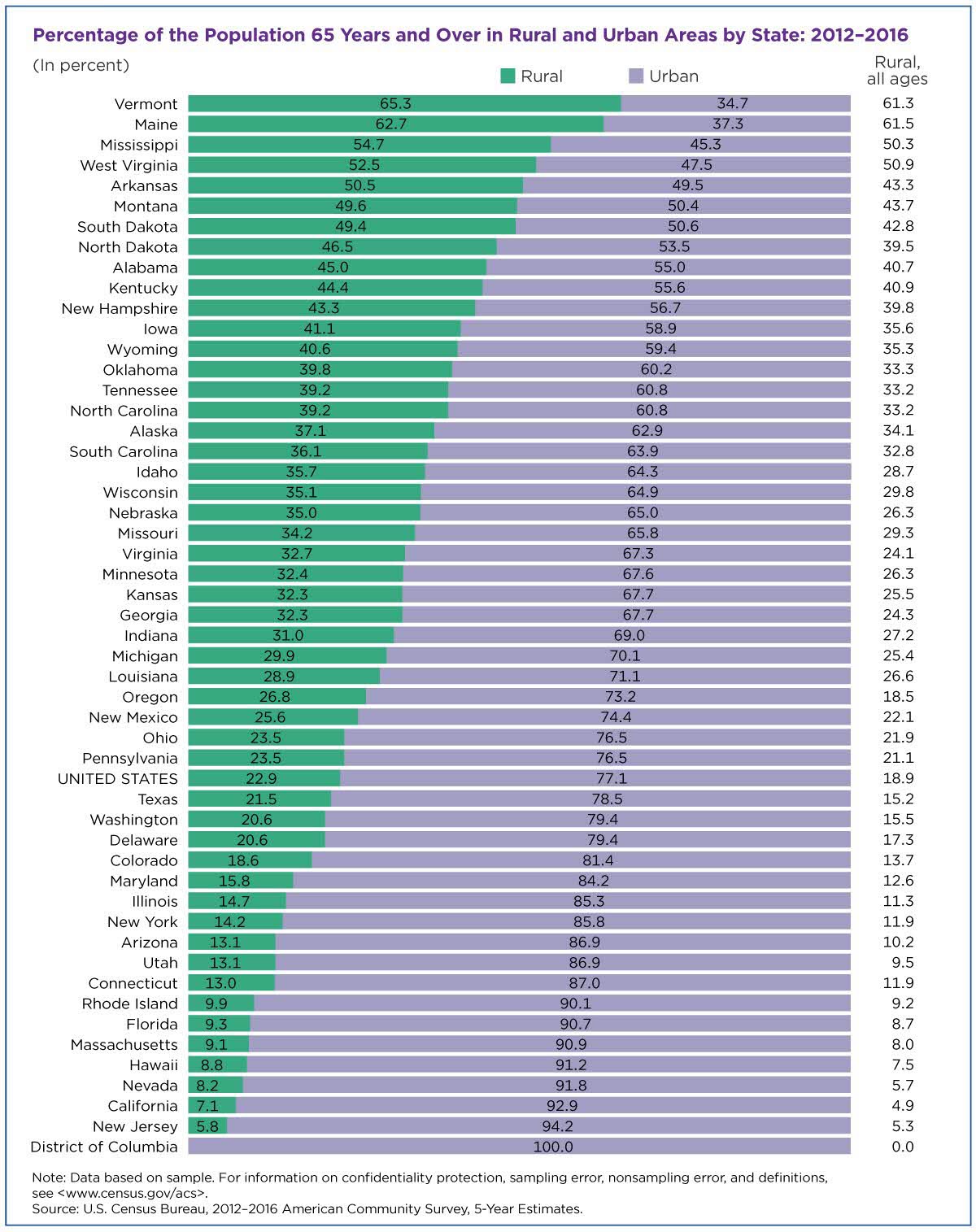
More than 1 in 5 older Americans live in rural areas, many concentrated in states where more than half of their older populations are in rural areas. A new report, The Older Population in Rural America: 2012-2016, shows that 17.5% of the rural population was 65 years and older compared to 13.8% in urban areas.
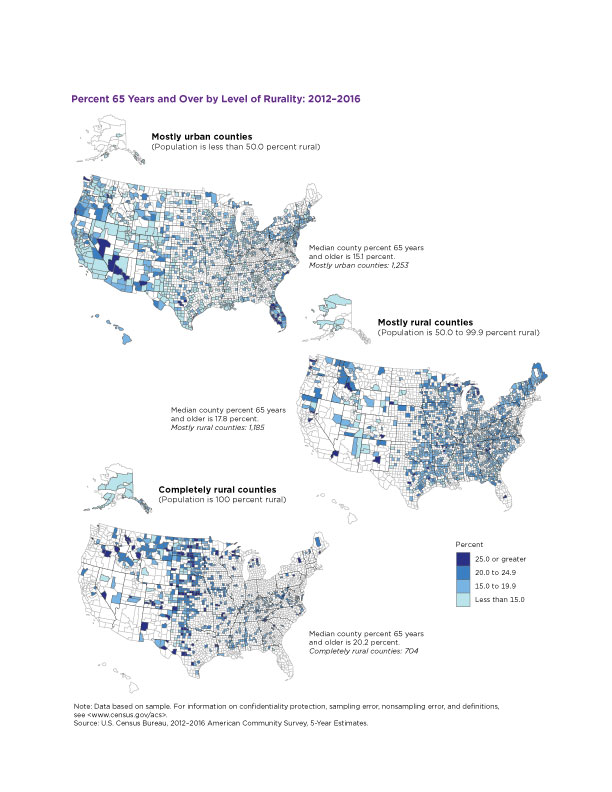
The share of the population 65 years and older in completely rural counties was the highest in the middle of the country, forming a path from North Dakota to Texas.
This report is unique because it looks at the older population by level of rurality instead of simply by metropolitan or non-metropolitan status. According to the 2012-2016 American Community Survey (ACS) data, there were 46.2 million older people in the United States — 10.6 million of them in areas designated as rural. This population is spread across urban and rural landscapes in ways that shape the nation at a time when graying continues as more baby boomers turn 65.
Where They Live
The mostly urban counties were fairly evenly scattered across the country with the exception of a cluster with high concentrations in Florida and along the Southwest. The mostly rural counties with high concentrations were primarily located in the eastern half of the United States. The share of the population 65 years and older in completely rural counties was the highest in the middle of the United States, forming a path from North Dakota to Texas.
 State by State
In contrast, the District of Columbia (0.0%), New Jersey (5.8%) and California (7.1%) had the smallest percentages.
 There Is Old and There Is Older
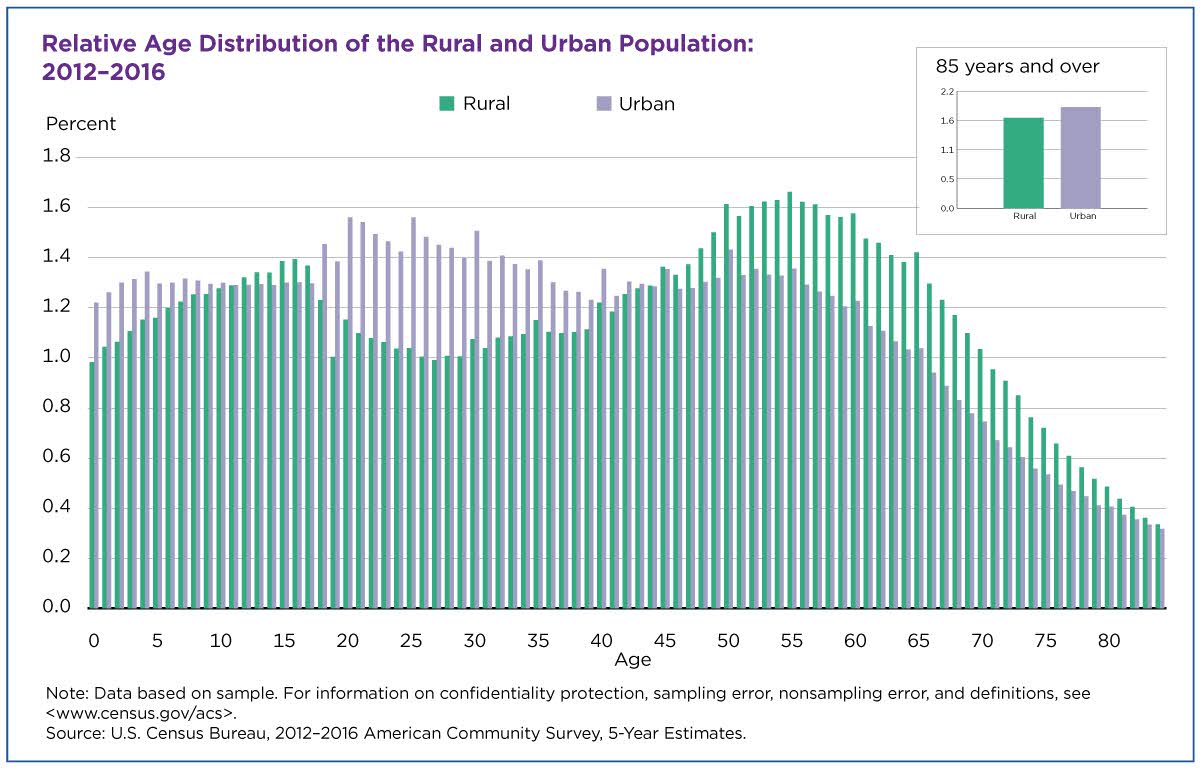
Clear differences in age distributions exist between rural and urban areas. The largest rural population shares (the tallest green bars in the figure) were apparent starting just before age 50 and continuing to around age 62. The largest shares of the urban population (the tallest purple bars) were apparent in the youngest ages and then again from ages 18 to the late 30s. Differences nearly disappeared approaching the oldest ages (85 and older).
 Gender Differences
There are many more older men relative to women in rural areas compared with urban areas. One of the reasons is that mostly men seek rural farming and mining jobs when they’re in their 20s and 30s and many stay, aging in place. Other factors include different life expectancy for men and women and by urban/rural status, and domestic migration patterns, particularly for retired married couples.
How They Live
Aging brings change, including retirement, widowhood and health status. These changes can all influence living arrangements of the older population. The largest share of older people in both rural and urban areas lived in households with others, although the percentage was smaller for those in urban areas (68.7%) than in rural areas (75.9%). Individuals living alone in a household made up the next largest share, accounting for 22.3% of those in rural areas and 27.6% in urban areas. The share of urban population 65 years and older living in skilled-nursing facilities was 3.1% compared to only 1.4% of people in rural areas. This may signal an unmet demand for skilled-nursing facility options in rural areas that will increase as baby boomers age.
Amy Symens Smith is a senior demographer focusing on sex, age and gender identity in the Census Bureau’s Special Population Statistics Area. Edward Trevelyan is a demographer-statistician in the Foreign Born branch.
A London Journey Through the World of Codebreaking, Ciphers and Secret CommunicationsEditor’s Note: Before reading about London’s Science Museum, you might take a stroll online at the National Security Agency’s National Cryptologic Museum here in the United States – below: World War 2: U.S. Navy Cryptanalytic Bombe London’s Science Museum launched a major new exhibition exploring communications intelligence and cyber security over the course of 100 years. Top Secret: From ciphers to cyber security marks the centenary of GCHQ, the UK’s Intelligence, Security and Cyber agency which was first acknowledged in law in 1994. Through never-before-seen objects, interactive puzzles and first-person interviews, the exhibition explores the challenges of maintaining digital security in the 21st century and the unique technologies used throughout the history of one of the UK’s intelligence agencies. Sir Ian Blatchford, Director of the Science Museum Group, said: ‘With the help of GCHQ, our expert advisors on the exhibition, we are privileged to reveal some of the previously hidden histories of the UK’s intelligence community. By exhibiting over 100 remarkable objects, we aim to engage visitors with the people and technologies that keep us safe, at a time when cyber security has never been more important to people’s everyday lives.’ The exhibition also explores the work of GCHQ’s National Cyber Security Centre (NCSC) which works to defend against cyberattacks. Visitors will be able to see a computer infected with the WannaCry ransomware which, in 2017, affected thousands of people and organisations including the NHS. Jeremy Fleming, Director GCHQ said: ‘This unique collaboration between GCHQ and the Science Museum is a great way to mark our Centenary and give visitors previously-unseen insights into how GCHQ has helped protect the UK over the past 100 years. For the first time the public will be given a glimpse into our secret history of amazing intelligence, world-leading innovation, and most of all brilliant people. And — as the threats to the UK become more diverse and more complex – it’s a chance to encourage the next generation of recruits. Because at GCHQ we believe that with the right mix of minds anything is possible.’ The exhibition includes the story of the encryption technology used by the Krogers who, until their arrest in the 1960s, were part of the most successful Soviet spy ring in Cold War Britain. Visitors will also be able to see the remains of the crushed hard drive alleged to contain top secret information which was given by Edward Snowden to The Guardian in 2013. Exhibited for the first time in public is the 5-UCO, one of the first electronic and fully unbreakable cipher machines. It was developed to handle the most secret messages during the Second World War, including sending Bletchley Park’s decrypted Enigma messages to the British military in the field and was in use into the 1950s. This ultra-secret machine was previously believed to have been destroyed. Visitors to the exhibition will also discover the story of the Lorenz machine. Mistakes made by a German radio operator while using a Lorenz machine enabled workers at Bletchley Park to break the Enigma code, bringing the Allies one step closer to winning the war. Right, Enigma Machine M1070, on loan from GCHQ Secure telephones that were at the cutting-edge of innovation played a crucial role for Britain during the Cold War. The Pickwick telephone was developed to keep transatlantic communication secure between John F. Kennedy and Harold Macmillan during the Cuban Missile Crisis in 1962. By the 1980s secure telephone systems were portable, and visitors will be able to see Margaret Thatcher’s secure briefcase telephone, which was used to communicate the course of action to the British Ministry of Defence during the Falklands War in 1982. Right, Pickwick secure telephone system used by President John Kennedy and PM Harold MacMillan during Cuban Missile Crisis in 1962 An interactive puzzle zone within the exhibition gives visitors the opportunity to test their own codebreaking skills and explore first-hand the skills required to succeed in the world of GCHQ. The exhibition is supported by Principal Funder DCMS, Principal Sponsors Raytheon, Avast and DXC Technology, Major Sponsor QinetiQ, Associate Funder The Hintze Family Charitable Foundation, and supported by Keith Thrower, with special thanks to Michael Spencer and NEX Group. The exhibition’s Media Partner is The Telegraph. Editor’s Note: To mark the 80th anniversary of the outbreak of the Second World War, Imperial War Museum has released concept sketches of the new Second World War and Holocaust Galleries which will open at IWM London in 2021. Hopefully, we could go! |