Blog

  • The Story of the Beautiful: Freer, Whistler and Their Points of Contact

    Peacock room

    The story of the beautiful is already complete — Hewn in the marbles of the Parthenon — And broidered, with the birds, upon the fan of Hokusai.

    —James McNeill Whistler,
    Ten O’Clock Lecture, 1885

    Smithsonian’s Freer Gallery of Art and Wayne State University in Detroit have launched a new online resource, “The Story of the Beautiful: Freer, Whistler & Their Points of Contact,” a comprehensive guide to James McNeill Whistler’s Peacock Room and its dynamic history. The Peacock Room, an elaborately painted former dining room and one of the most famous masterpieces in the Freer’s collection, celebrates its 90th anniversary of being on public view in 2013. “The Story of the Beautiful” at peacockroom.wayne.edu, provides visitors with a deeply contextualized way to understand the room, its contents and its narratives, using more than 400 digital objects and a wealth of archival materials.princess wall

    Users can explore two compelling 360-degree virtual versions of the room: one as it looked in Victorian London, filled with Chinese blue-and-white porcelain of the Kangxi era,the other as it appeared in 1908 after museum founder Charles Lang Freer reassembled it in Detroit and filled its shelves with subtly glazed ceramics from all over Asia. By clicking on each object in the room, visitors can zoom in on high-resolution images. Interactive maps and timelines, supplemented by letters, diary entries and vintage photographs from the Charles Lang Freer Papers, provide insight into Freer’s life story and his approach to collecting.

    Project coordinators from the Freer’s American Art department and the Wayne State Library’s New Media and Information Technology Department intend to offer the site as a major resource for scholars, teachers and students, as well as a deeper experience for museum-goers. The artwork and period documents were part of Freer’s original bequest to the Freer Gallery, while Wayne State University, which now owns Freer’s Detroit mansion, provided the technical expertise to build the website.

    “This sitemakes an architectural and decorative icon of the Aesthetic movement universally accessible in a way that we couldn’t previously,” said Lee Glazer, project lead and curator of American art at the Freer and Sackler galleries. “The inclusion of so many layers of visual and archival material is not only exciting, but also is invaluable to further research.”

  • Love and Marriage

    Americans believe that love is the main foundation of marriage. Most who never have been married say they would like to be at some point in their lives. However, statistics show Americans aren’t rushing to the altar, and the US marriage rate is at an all-time low — only 51% of adults were married in 2011, according to US Census Bureau statistics.

    The romantic ideal of marriage plays out in survey data that show whether they are married or not, Americans are more inclined to choose “love” as a reason for marriage than any other factor. In a 2010 Pew Research Center survey, love wins out over “making a lifelong commitment,” as well as “companionship,” “having children,” and “financial stability” as a very important reason to wedWhyGetMarried

    Among married people, 93% say love is a very important reason to get married; 84% of unmarried people say so. Men and women are equally likely to say love is a very important reason to get married.

    But love only goes so far. Most Americans cast cold water on a central premise of many a song or poem, that each person in the universe has only one true love. About seven-in-ten (69%) people do not agree with that notion; only 28% do. Among those who do agree, men (31%) are slightly more likely to do so than women (26%). Young and old, married and unmarried are equally skeptical.

    Do You Want to Marry?

    Especially for those who have never wed, marriage remains a life goal. About six-in-ten (61%) men and women who have never married say they would like to get married, according to the 2010 Pew Research survey. Only 12% say they do not want to marry and 27% are not sure.

    That same survey found that a trip to the altar is not so appealing for those who have been there before.  Among divorced adults, only 29% say they would like to marry again, with women more likely than men to say they do not want another trip down the aisle. Among widowed men and women, only 8% want to wed again.

    Men and women’s attitudes about marrying for the first time are not different among young adults. But among never-married adults ages 30 to 50, men (27%) are more likely than women (8%) to say they do not want to marry.

  • Deemed Unreliable by the GAO: VA Health Care Outpatient Medical Appointment Wait Times

    What GAO Found

    In brief, GAO found that (1) VHA’s reported outpatient medical appointment wait times are unreliable, (2) there was inconsistent implementation of certain elements of VHA’s scheduling policy that could result in increased wait times or delays in scheduling timely medical appointments, and (3) VHA is implementing or piloting a number of initiatives to improve veterans’ access to medical appointments.Medal of Honor winner

    Specifically, VHA’s reported outpatient medical appointment wait times are unreliable because of problems with correctly recording the appointment desired date — the date on which the patient or provider would like the appointment to be scheduled — in the VistA scheduling system. Since, at the time of our review, VHA measured medical appointment wait times as the number of days elapsed from the desired date, the reliability of reported wait time performance is dependent on the consistency with which VA medical centers (VAMC) schedulers record the desired date in the VistA scheduling system. However, aspects of VHA’s scheduling policy and related training documents on how to determine and record the desired date are unclear and do not ensure replicable and reliable recording of the desired date by the large number of staff across VHA who can schedule medical appointments, which at the time of our review was estimated to be more than 50,000.

    During our site visits, we found that at least one scheduler at each VAMC did not record the desired date correctly, which, in certain cases, would have resulted in a reported wait time that was shorter than the patient actually experienced for that appointment. Moreover, staff at some clinics told us they change medical appointment desired dates to show clinic wait times within VHA’s performance goals. Although VHA officials acknowledged limitations of measuring wait times based on desired date, and told us that they use additional information, such as patient satisfaction survey results, to monitor veterans’ access to medical appointments, reliable measurement of how long veterans wait for appointments is essential for identifying and mitigating problems that contribute to wait times.

    Photograph, Wikipedia: United States Army Staff Sergeant Clinton Romesha in Afghanistan in 2009. Romesha received the Medal of Honor award from President Barack Obama in a ceremony at the White House on 11 February 2013.

  • A Comprehensive Look at George Bellows

    A work of art can be any imaginable thing, and this is the beginning of modern painting.
    — George Bellows, 1923

    By Val Castronovo

    George Bellows, a sprawling retrospective at The Metropolitan Museum of Art, is nothing if not comprehensive.  The show, which closes on February 18, pays tribute to the versatility of one of the leading members of the Ashcan School, who died prematurely of a ruptured appendix at the age of 42. Emma in a Purple Dress

    Most of us think of George Bellows (1882-1925) as a realist painter of tough, gritty working-class subjects — boxers duking it out in shady athletic clubs, tenement kids from New York’s Lower East Side swimming in the East River. But as this well-curated show of 100 works takes pains to illustrate, Bellows had extraordinary range and energy. He painted urban landscapes, but bucolic ones too. And he painted seascapes and portraits (genteel ladies and common folk alike), New York City’s parks, rivers and beaches, in addition to suburban polo grounds and Newport’s tennis casino.

    A six-foot-tall athlete with a talent for baseball, he dropped out of Ohio State in 1904 at the end of his junior year and moved to New York, where he hoped to find work as an illustrator. He immediately came under the influence of Robert Henri (1865-1929), the founder of the rebel American art group The Eight and a teacher at the New York School of Art, where Bellows enrolled.  

    Henri became a life-long mentor. He urged his students to cast off the fussy precepts of the conservative National Academy of Design and enter the modern world. Art was “close at hand, waiting to be discovered within the teeming grid of New York City,” Charles Brock writes in an introductory essay in the show’s catalogue.  “Henri encouraged his students to experience this new life directly and on their own terms, and to forge their own individual styles in response to it.” 

    In his early period, Bellows painted his subjects from memory, rarely using models or drawings.  He would take long walks with his artist-friend Eugene Speicher, taking the measure of the Brooklyn Bridge, the Bowery and the docks along the East River, and recording his impressions later on canvas at his studio. 

    His paintings of slum dwellers, dock workers and urban realities inspired the label “Ashcan School,” Brock writes, but he was not actually a member of Henri’s pioneering group The Eight, which had a groundbreaking show at the Macbeth Gallery in 1908.  His work departed from academic tradition on the one hand, and was rooted in it on the other. He drew critical inspiration from the European Masters — El Greco, Goya, Hals, Velazquez, and Manet — whose work he studied at museums, especially The Metropolitan Museum.  But he never actually traveled outside the US to study the works of the Europeans.

    “[I]nsider and outsider, old master and young innovator,” Bellows painted it like he saw it, notably chronicling the construction of New York’s Pennsylvania Railroad Station in a series of dramatic excavation canvases that depict nothing other than a void — a giant hole — in vivid contrast to his crowd pictures of Coney Island, Madison Square Park, Times Square and the Lower East Side.Stag at Sharkey's

    His subject matter and style worked hand in hand.  He employed quick, rough brushstrokes that conveyed energy and verve, none so much as in his boxing series, which he worked on from 1907 to 1909.  Stag at Sharkey’s (1909), completed when he was just 27, is one of his most famous works.  A prizefight set in retired fighter Tom Sharkey’s athletic club — a bar near Bellows’ studio at Broadway and 66th Street — the painting shows two pugilists locked in a violent struggle.  The low vantage point gives viewers the feeling of being close to the action.  The boxers and the referee, full-figured renderings, are bathed in a bright light that serves to heighten the drama between the ropes; virtually all else fades to black, and we are left to gaze at naked male aggression.  “I just wanted to paint two men trying to kill each other,” he said.

  • Encountering Unusual Headwinds: Fed Reserve Vice Chair Yellen Explains the Painfully Slow Recovery for America’s Workers

    Editor’s Note: Earlier this year we published Fed Vice Chair Yellen’s speech, perhaps not the usual ‘senior site’s’ fare, but then we’re never influenced by popular subjects being generated by other sites. However Ms. Yellen is now being touted as a possible successor to that other speech-making Fed figure, Ben Bernanke, whose speech highlighting his background caught our attention years ago.

    “Grandma Friedman was a wonderful cook, and if you dig deep enough into the archives of the Charlotte Observer, you will find a large photo of a much younger me under the headline, “Ben Loves Grandma’s Blintzes,” together with her recipe for that dish. Unfortunately, my grandmother died when I was thirteen, and when my grandfather came to live with us in Dillon, the regular trips to Charlotte ended. I am pleased to say, though, that my connection to this city has since been re-established, as my parents have retired to Charlotte, and my brother (a lawyer in town) and his family live here, too. So I still feel like an honorary Charlottean as well as a Carolinian.”

     Vice Chair Janet L. Yellen at the “A Trans-Atlantic Agenda  for Shared Prosperity” conference sponsored by the AFL-CIO, Friedrich Ebert Stiftung, and the IMK Macroeconomic Policy Institute, Washington, DC; February 11, 2013

    A Painfully Slow Recovery for America’s Workers: Causes, Implications, and the Federal Reserve’s Response

    Thank you for the opportunity to speak to you today about the Federal Reserve’s efforts to strengthen the recovery and pursue a goal that it shares with the labor movement: maximum employment.1 Janet Yellen, Fed Vice Chair

    As an objective of public policy, maximum employment doesn’t appear in the US Constitution, in any presidential decree, or even in the mission statement of the Labor Department. A law passed in 1946 made it a general goal for the US government, but so far the Federal Reserve is the only agency assigned the job of pursuing maximum employment. The 1977 law spelling out that responsibility also assigned the goal of stable prices, and we call this combination of objectives the Federal Reserve’s dual mandate.2 

    With so many people today unable to find work, it might seem odd to highlight such an ambitious and distant goal for employment. I do so because the gulf between maximum employment and the very difficult conditions workers face today helps explain the urgency behind the Federal Reserve’s ongoing efforts to strengthen the recovery. My colleagues and I are acutely aware of how much workers have lost in the past five years. In response, we have taken, and are continuing to take, forceful action to increase the pace of economic growth and job creation.

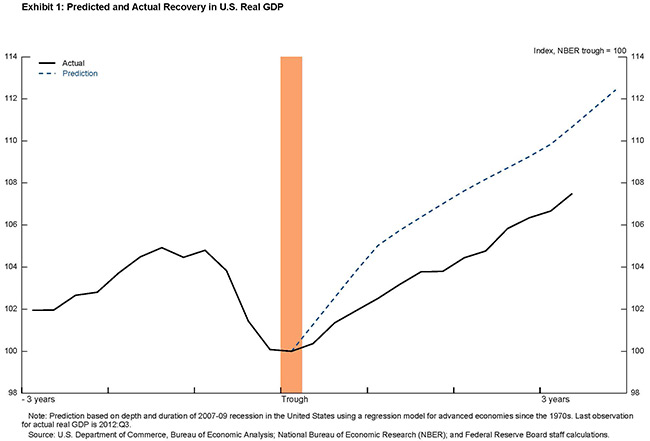
    In the three years after the Great Recession ended, growth in real gross domestic product (GDP) averaged only 2.2 percent per year. In the same span of time following the previous 10 US recessions, real GDP grew, on average, more than twice as fast — at a 4.6 percent annual rate.3 So, why has the economy’s recovery from the Great Recession been so weak?

    The slow recovery was preceded, of course, by the deepest recession since the end of the Second World War. The bursting of an unprecedented housing bubble, together with the financial crisis that followed, dealt a huge blow to demand. These developments robbed homeowners of wealth built over a generation, impaired their access to credit, decimated retirement savings, and shattered the confidence of consumers. Businesses slashed capital spending and payrolls, and real GDP contracted by 4.7 percent, more than twice the average for the 10 other recessions since World War II. The Great Recession was also the longest postwar recession — it lasted 18 months, compared with an average of 10 months for the others.

    The experience of the United States and other advanced economies suggests that deeper recessions are usually followed by stronger-than-average recoveries. While it’s also true that longer recessions tend to result in weaker recoveries, even after accounting for this factor, this recovery has been significantly weaker than past experience would have predicted.

    The dashed line in exhibit 1 shows how real GDP would have been expected to increase in this recovery, based on the experience of the United States and other advanced economies and given the depth and duration of the Great Recession.4 The gap between the actual and the predicted path of real output gives a sense of how much economic performance has lagged in this recovery. But the implications of this result may seem a little abstract, so let me illustrate the same idea in a way that tries to show the burden that workers continue to bear in this slow recovery.

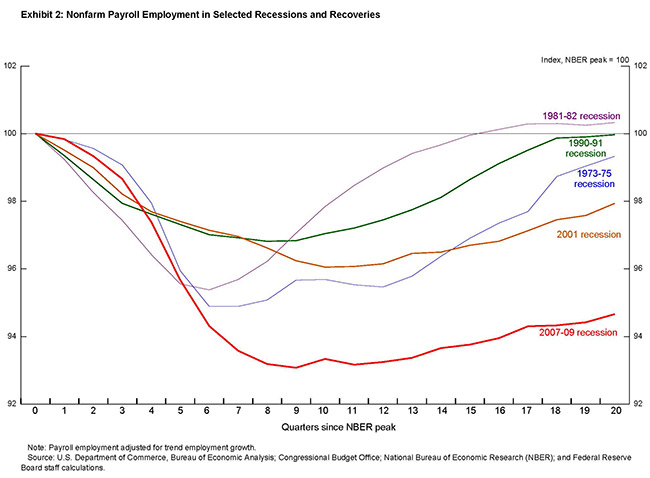
    Exhibit 2 shows how employment has declined and recovered following several previous recessions. The employment measure attempts to control for the fact that demographic changes and other factors have altered the trend, or potential, workforce over the years. For example, in the 1970s, the pool of potential workers was expanding as baby boomers and an increasing share of women moved into the labor force, such that employment needed to rise relatively quickly just to absorb these additional workers. More recently, the aging of the population has put downward pressure on labor force participation, so employment hasn’t had to grow as quickly to keep pace with the potential workforce.

    Even after making this adjustment, however, the Great Recession stands out both for the magnitude of the job losses that attended the downturn and for the weak recovery in employment that occurred after the recession ended.
  • Senate Continues to Consider Reauthorizing the Violence Against Women Act; Congressional Bills Introduced Including Homeland Security and Abortion

    Last week on February 7, 2013, the Senate began consideration of the Violence Against Women Reauthorization Act (WAVA, S. 47). The Senate is scheduled to resume consideration of the measure on February 11. The bill, sponsored by Sen. Patrick Leahy (D-VT), would authorize about $660 million annually for FY2014 through FY2018 for programs that address domestic and sexual violence in the US. The text of S. 47 is available here.

    The Senate approved similar legislation (S. 1925) in April 2012 (see Women’s Policy Inc, The Source, 4/27/12) and the House approved its version of the bill (H.R. 4970) in May 2012. However, the House and Senate bills both expired at the end of the 112th Congress.   (Right,  Pringle-Patric House, located at 1316 E. High Street in Springfield, Ohio. Built in 1877 and since converted into a women’s shelter, it is listed on the National Register of Historic Places. Wikipedia)Pringle Patric House

    The table below compares certain provisions in S. 1925 and S. 47.

    The table below compares certain provisions in S. 1925 and S. 47.


    Provision

    S. 1925 (112th Congress)

    S. 47 (113th Congress)

    Authorizes $222 million annually for the STOP [Services-Training-Officers-Prosecutors] grant program for FY2014 through FY2018

    YES

    YES

    Requires at least 20 percent of STOP grants funds be spent on programs that specifically address sexual assault

    YES

    YES

    Authorizes $73 million annually for the Grants to Encourage Arrest Policies and Enforce Protection Orders (GTEAP) program

    YES

    YES

    Authorizes $12 million annually to address violence on college campuses

    YES

    YES

    Requires colleges and universities to distribute procedures and policies regarding dating violence, rape, stalking, and sexual assault

    YES

    YES

    Authorizes grant money to be spent on services for victims who have difficulty accessing traditional services due to their sexual orientation or gender identity

    YES

    YES

    Gives federally recognized American Indian tribes concurrent criminal jurisdiction over non-Native American offenders for cases involving domestic or dating violence if the defendant lived or worked in the Indian country of the tribe, is married to a member of the tribe, or is in an intimate relationship with a member of the tribe

    YES

    YES

    Authorizes $5 million annually to support tribal efforts to combat domestic violence

    YES

    YES

    Increases the number of U visas available for immigrant victims of domestic violence and sexual assault

    YES

    NO

    Requires minimum prison sentence of at least five years for those convicted of sexual assault

    YES

    NO

    Requires 75 percent of grants under the Debbie Smith DNA Backlog Grant Program to be used to reduce DNA evidence backlogs

    NO

    YES

    Requires seven percent of Debbie Smith DNA Backlog Grant Program funding to be used to conduct audits of untested DNA

    NO

    YES

    Requires Department of Justice to establish Sexual Assault Forensic Evidence Registry within one year of bill’s enactment

    NO

    YES

  • Veronica Fake

     by Ferida Wolffmovie poster the glass key

    Does anyone outside of Hollywood remember Veronica Lake (1922-1970)?* She was an actress (females weren’t classified as actors back then) who made most of her films in the 1940s, which was just a tad, though not by much, before my movie-viewing time. She influenced a whole generation of women. Her long, wavy blond hair was draped over her right eye in what was called the peek-a-boo style that sparked many female copycats and lots of male admirers; she was a pin-up girl for many a soldier during World War II.

    The Glass Key is a 1942 film noir, directed by Stuart Heisler and based on the novel of the same name by Dashiell Hammett. The story had previously been adapted for film in 1935. Wikipedia

    I never had wavy hair growing up. I had pencil straight bangs and braids. My mother (maybe she was influenced by Veronica Lake) would give me home permanents that lasted until the first rain. Then my hair reverted to its natural, stick-straightness. Of course, I was never in style. Curly hair was in back then so it was obvious that I was out.

    Skip ahead a couple of decades, well, three to be exact, when my brown hair started to turn gray and lo and behold – waves.  That was fine. A little pizzazz added to the pulled-back hippie hairdo I tended toward. It was a nice change.

    Over the next few years I tended toward shorter cuts I thought more flattering and they were certainly easier to maintain. Then, for some reason, my mostly gray hair began trying its darnedest to imitate Veronica Lake’s style. My bangs developed a deep wave and the ends flipped up in a way that almost begged to me to let them grow. At first I ignored that request because it meant I would have to change my style but my bangs persisted, becoming so unmanageable I feared they would poke someone in the eye. I gave finally in and let my hair grow.

    I still am not blond and I certainly don’t aspire to pin-up status but no one told that to my hair. If left uncombed, it will wiggle its way sensually down my back, its deep waves intertwining the gray with what is left of the brown. I don’t wear it loose, however; I don’t relish the thought of being a Veronica Fake. I am back to barretting it at my neck most days and twisting it up for fancier occasions. Fortunately, my husband likes it that way so I am actually getting compliments.

    Who would have thought that hair could be so opinionated? It used to be reasonable, letting me do pretty much what I wanted with it. But then I guess we change in many ways as we age. Ideas we held in our twenties shift with experience and perspective. Foods we loved as teens often become indigestible later on (gluten sensitivity and lactose intolerance have become watchwords for a more mature generation). If our brains and stomachs can have opinions, why not our hair?I married a Witch

    *Lake was one of the models for the animated character of Jessica Rabbit in the 1988 film Who Framed Roger Rabbit, especially for her hairstyle. In the 1997 film L.A. Confidential (based on James Ellroy’s 1990 novel), Kim Basinger won the Academy Award for Best Supporting Actress for her portrayal of a prostitute who is a Veronica Lake look-alike, and who is complimented by a police officer who tells her, “You look better than Veronica Lake”.

    ©2013 Ferida Wolff for SeniorWomen.com

  • Life in the Kingdom of Chaos Where Treasures and Pretties Were In a Royal Mess

    by Roberta McReynolds

     Once upon a time there was an imperial matriarch who reigned over the Kingdom of Chaos. The queen presided with a stubborn ferocity and insisted on fortifying her castle walls with buttresses of cardboard boxes bursting at the seams with mystifying collections. Her secondary defense was to encircle her throne with stacks of catalogs and newspapers, filing cabinets, and all manner of eclectic ‘treasures and pretties’. By all accounts … it was a royal mess.  White Queen in Burton's Alice

    Despite the regular warnings from Her Majesty’s chief advisors, she refused to believe her empire was in jeopardy and staunchly rejected offers of assistance. She perceived her advisors as adversaries and proclaimed that their declaration of aid, extended in the best interests of her health and welfare, was a personal attack on her sovereignty, “Off with their heads!” Furthermore, she forever refused to acknowledge that in truth, she was her own worst enemy. Out of respect for privacy (along the lines of the Witness Protection Program might be closer to the truth), the queen shall be henceforth referred to as Aunt Mildred.

    Predictably, the situation ultimately reached a decisive episode with her declining ability to make sensible decisions or care for herself physically. Aunt Mildred became quite ill; unable to make a complete recovery, she relapsed and ended up transported by Ye Olde Ambulance Company to the emergency room. Her life (and ours) literally changed overnight.

    Mildred’s independent living status in her apartment (aka the Kingdom of Chaos) at a senior retirement community ended abruptly. She spent the next couple of weeks in the hospital, followed by a transfer to a skilled nursing and rehabilitation facility for over a month. Then it was a one-way ticket to small ‘not so royal’ accommodations in an assisted living facility on the recommendations from doctors, a social worker, and host of other professionals. Mildred could no longer care for herself. She was a fall risk and now needed oxygen. Her tendency to self-medicate was beyond dangerous. We eventually filled several grocery bags with out-dated prescription and over-the-counter drugs to be destroyed. Aunt Mildred never saw her apartment, or the bulk of her ‘treasures’, again. Quite frankly, my husband and I wish we could say the same.

    This tale, regrettably, does not conclude with the customary phrase ‘… and they lived happily ever after’. Instead of a fairy tale ending, it detoured into a nightmare. Mildred’s chronicle didn’t have to morph into a miserable sequel, but a little friendly counsel from the queen’s former chief advisors may help you avert a similar scenario. 

    Before facing the challenges of managing the affairs of another person’s life, I’d like to point out that the first step was actually locating crucial documents in the Kingdom of Chaos. There is no kind way to say this, but Aunt Mildred is a certifiable hoarder. If it were not for the fire marshal’s routine inspection of her apartment (she had boxes stacked high enough to touch the fire repression sprinklers located in the ceiling), conditions would have been even worse.

    It isn’t as though we hadn’t tried to address the situation repeatedly. If you haven’t found yourself in the unpleasant situation of begging with a quarrelsome ‘squirrel’ to part with ten plastic spatulas because there is simply no more space, count your blessings. (Peace talk negotiations resulted in a tenuous compromise which allowed her to keep her two favorites, by the way.) Coping with someone’s irrational, emotion-fueled attachment to material objects of little or no intrinsic value is exhausting work. Unsupervised shopping expeditions and easy access to cut-rate mail order catalogs made the constant river of stuff flowing into her apartment impossible to dam, or even monitor on a regular basis. Besides, it’s touchy to balance respect for a person’s right to live independently and deciding when it’s time to intervene.

    Photograph of Anne Hathaway as the White Queen in Tim Burton’s 2010 adaptation. Wikipedia

  • Shopping at the Museum: NYC’s Historical Society

    A favorite museum of ours in New York City is the New-York Historical Society. Their online shop is appealing and quite different, stocked with unique items, many of them inspired by their own exhibitions. Products range from Tiffany-style lamps, to retro dresses and handbags based on their own spectacular Audubonred polka dot betsycollection, which is the largest single repository of Auduboniana in the world.

    The Red Polka Dot Betsy dress is a case in point. The retro rage is not dying, at least here in the San Francisco Bay Area.  “Our adorable little red and white polka dot dress features a fitted waistline, scoop neckline, full circle skirt, and a back zip. The white collar runs both front and back. White piping adorns the cap sleeves. Made in USA.” Measurements for sizes are right on the page to use. There are also  Navy Polka Dot Marion and Black and Red Bow dresses to chose from.

    The Audubon Embracing Heart necklace carries the inscription: I have wished for thee, every day, every moment. “This delicate pendant is inscribed with a quotation from John James Audubon’s 1827 letter to his wife, Lucy Bakewell Audubon. Audubon’s words are wrapped around a softly organic heart shape in polished sterling silver. The lobes of the heart are formed of open arms in a delicate embrace. The pendant, created by the New-York Historical Society, comes in a gift box with historical information on John James Audubon. Audubon heart

    “Often separated from John James during their 43-year marriage, once for three years, Lucy was the human, emotional center of Audubon’s universe. On the occasion of this letter, after a long absence, John James reassures Lucy that he loves her and has never doubted her goodwill towards him.

    “Audubon’s letter read: ‘I have wished for thee every day, every moment; and yet at my present age I have postponed daily with what thou callest prudence to write for thee positively to come [to England]. I feel quite convinced that it is thy wish to join me. Did I think differently for a moment, my travels would cease and my happiness would be only a vapor.’ Liverpool, England, 5 December 1827.

    Mrs. Lincoln’s Dressmaker: The Unlikely Friendship of Elizabeth Keckley and Mary Todd Lincoln might be a likely diversion during President’s Day weekend, especiall if you’ve seen the Academy Award nominated movie Lincoln:  “Few events can stir up a scandal more than an autobiography of a First Lady’s confidante. In 1868, a controversial tell-all called Behind the Scenes introduced readers to Elizabeth Hobbs Keckley. Mrs. Keckley was a former slave who had been Mary Todd Lincoln’s dressmaker and friend during the White House years, and in the aftermath of President Lincoln’s assassination.”Mrs Lincoln's Dressmaker book

    “The book exposed Mary’s marriage and her erratic behavior, along with confidential opinions of many in high society. The airing of the Lincoln’s ‘dirty laundry’ meant humiliation for Mary and her family, and Elizabeth’s reputation was destroyed. This outcome would have been unimaginable in 1867, when Mary declared in a letter, ‘I consider you my best living friend.’ How could such a bond have developed between a woman born into slavery and the First Lady of the United States? Mrs. Lincoln’s Dressmaker answers this question by chronicling the extraordinary lives of these women.”

  • Congressional Bills Introduced: Pay Equality, Repealing the Healthcare Act & 50th anniversary of the Sixteenth Street Baptist Church Bombing

    Employment

    S. 168—-Sen. Tom Harkin (D-IA)/Health, Education, Labor, and Pensions (1/29/13)—A bill to prohibit discrimination in the payment of wages on account of sex, race, or national origin, and for other purposes.

    H.R. 438—-Del. Eleanor Holmes Norton (D-DC)/Education and the Workforce (1/29/13)—A bill to prohibit discrimination in the payment of wages on account of sex, race, or national origin, and for other purposes.Eleanor Holmes Norton

    Health

    S. 177—-Sen. Ted Cruz (R-TX)/Read the first time (1/29/13)—A bill to repeal the Patient Protection and Affordable Care Act and the Health Care and Education Reconciliation Act of 2010 entirely.

    Judiciary

    H.R. 447—-Rep. Trent Franks (R-AZ)/Judiciary (2/1/13)—A bill to prohibit discrimination against the unborn on the basis of sex or race, and for other purposes.

    Miscellaneous

    S. 186—-Sen. Richard Shelby (R-AL)/Banking, Housing, and Urban Affairs (1/30/13)—A bill to award posthumously a Congressional Gold Medal to Addie Mae Collins, Denise McNair, Carole Robertson, and Cynthia Wesley, in recognition of the 50th anniversary of the bombing of the Sixteenth Street Baptist Church, where the four little black girls lost their lives, which served as a catalyst for the Civil Rights Movement.

    December 5, 2012: Midlife Women’s Health

    November 15, 2012: Women Veterans: Staying Connected After Military Service

    October 17, 2012: Kinship Care: Challenges and Opportunities

    From Women’s Policy Inc.

     A Letter from Senators Patrick Leahy and Mike Crapo to their colleagues in the Senate:

    Dear Colleague: We hope  you will join us as cosponsors of S. 47, the Violence Against Women Reauthorization Act of 2013, which we introduced [in January 2013]. For almost 18 years, the Violence Against Women Act (VAWA) has been the centerpiece of the Federal Government’s commitment to combat domestic violence, dating violence, sexual assault, and stalking. It has been extraordinarily effective, and the annual incidence of domestic violence has fallen by more than 50 percent since this landmark law was first passed.