Blog

  • Reviewing How Homeland Security Cares for Unaccompanied Alien Children

     UN Refugee Agency photoChildren on the Run

    What GAO* Found

    Within the Department of Homeland Security (DHS), US Customs and Border Protection (CBP) has issued policies and procedures to evaluate, or screen, unaccompanied alien children (UAC) — those under 18 years old with no lawful immigration status and no parent or legal guardian in the United States available to provide care and physical custody — as required by the Trafficking Victims Protection Reauthorization Act of 2008 (TVPRA). However, CBP’s Border Patrol agents and Office of Field Operations (OFO) officers who screen UAC have not consistently applied the required screening criteria or documented the rationales for decisions resulting from screening. Specifically, under TVPRA, DHS is to transfer UAC to the Department of Health and Human Services (HHS), but may allow UAC from Canada and Mexico to return to their home countries, that is, to be repatriated, if DHS determines that UAC (1) are not victims of a severe form of trafficking in persons, (2) are not at risk of trafficking upon return, (3) do not have a fear of returning due to a credible fear of persecution, and (4) are able to make an independent decision about returning.

    GAO found that agents made inconsistent screening decisions, had varying levels of awareness about how they were to assess certain screening criteria, and did not consistently document the rationales for their decisions. For example, CBP policy states that UAC under age 14 are presumed generally unable to make an independent decision, but GAO’s analysis of CBP data and a random sample of case files from fiscal year 2014 found that CBP repatriated about 93 percent of Mexican UAC under age 14 from fiscal years 2009 through 2014 without documenting the basis for decisions. Providing guidance on how CBP agents and officers are to assess against UAC screening criteria could better position CBP to meet legal screening requirements, and ensuring that agents document the rationales for decisions would better position CBP to review the appropriateness of these decisions.

    DHS has policies in place to implement UAC care requirements, such as providing meals, and GAO’s observations and interviews at 15 CBP facilities indicate that CBP generally provided care consistent with these policies at the time of GAO’s visits. However, DHS does not collect complete and reliable data on care provided to UAC or the length of time UAC are in DHS custody.

    GAO analyzed available data on care provided to nearly 56,000 UAC apprehended by Border Patrol in fiscal year 2014 and found that agents documented 14 of 20 possible care actions for fewer than half of the UAC (the remaining 6 actions were documented for more than 50 percent of the UAC). Also, OFO has a database to record UAC care, but officers at most ports of entry do not do so.

    Developing and implementing processes to help ensure agents and officers record UAC care actions would provide greater assurance that DHS is meeting its care and custody requirements. Further, the interagency process to refer and transfer UAC from DHS to HHS is inefficient and vulnerable to errors because it relies on e-mails and manual data entry, and documented standard procedures, including defined roles and responsibilities, do not exist. DHS and HHS have experienced errors, such as assigning a child to two shelters at once, and holding an empty bed for 14 days at a shelter while HHS officials had placed the child elsewhere. Jointly developing a documented interagency process with defined roles and responsibilities could better position DHS and HHS to have a more efficient and effective process to refer, transfer, and place UAC in shelters.

    Why GAO Did This Study

    From fiscal years 2009 through 2014, DHS apprehended more than 200,000 UAC, and the number of UAC apprehended in fiscal year 2014 (about 74,000) was more than four times larger than that for fiscal year 2011 (about 17,000). On the journey to the United States, many UAC have traveled thousands of miles under dangerous conditions.

    The Violence Against Women Reauthorization Act of 2013 included a provision for GAO to, among other things, review how DHS cares for UAC. This report examines, among other things, the extent to which DHS has developed policies and procedures to (1) screen all UAC as required and (2) care for all UAC as required. GAO reviewed TVPRA and other legal requirements, DHS policies for screening and caring for UAC, fiscal year 2009 through 2014 apprehension data on UAC, and 2014 Border Patrol UAC care data. GAO also randomly sampled and analyzed case files of Mexican UAC whom Border Patrol apprehended in fiscal year 2014. GAO interviewed DHS and HHS officials in Washington, D.C., and at Border Patrol and OFO facilities in Arizona, California, and Texas selected on the basis of UAC apprehension data.

    What GAO Recommends

    GAO recommends that DHS, among other things, provide guidance on how agents and officers are to apply UAC screening criteria, ensure that screening decisions are documented, develop processes to record reliable data on UAC care, and document the interagency process to transfer UAC from DHS to HHS. DHS concurred with the recommendations.

    For more information, contact Rebecca Gambler at (202) 512-8777 or gamblerr@gao.gov.

    *About GAO

    The U.S. Government Accountability Office (GAO) is an independent, nonpartisan agency that works for Congress. Often called the “congressional watchdog,” GAO investigates how the federal government spends taxpayer dollars. The head of GAO, the Comptroller General of the United States, is appointed to a 15-year term by the President from a slate of candidates Congress proposes. Gene L. Dodaro became the eighth Comptroller General of the United States and head of the U.S. Government Accountability Office (GAO) on December 22, 2010, when he was confirmed by the United States Senate. He was nominated by President Obama in September of 2010 from a list of candidates selected by a bipartisan, bicameral congressional commission. He had been serving as Acting Comptroller General since March of 2008.
    Full Biography
    More on the CG Selection Process

    Our Mission is to support the Congress in meeting its constitutional responsibilities and to help improve the performance and ensure the accountability of the federal government for the benefit of the American people. We provide Congress with timely information that is objective, fact-based, nonpartisan, nonideological, fair, and balanced.

    Our Core Values of accountability, integrity, and reliability are reflected in all of the work we do. We operate under strict professional standards of review and referencing; all facts and analyses in our work are thoroughly checked for accuracy. In addition, our audit policies are consistent with the Fundamental Auditing Principles (Level 3) of the International Standards of Supreme Audit Institutions.
  • Utterly Unsuitable

    Gottex suits by the poolThe week ahead 
    Holds lots of dread: 
    I have to buy a bathing suit. 
    I’d be a dope otte

    To have much hope 
    Of finding fit (don’t mention cute). 
    In fact if my long search is fruitless 
    I may well have to dive in suitless.

    Julia Sneden writes and rhymes about bathing suit shopping:  It’s an annual chore for most people, this business of buying a bathing suit. For me, it comes around every six months or so. With older women and men doing water aerobics and swimming laps, wouldn’t you think the bathing suit manufacturers would twig to the idea that there’s a huge market out here? We buy suits more often than teenagers do, because we’re harder on them.

    Gottex suits by the pool, 2012. Wikimedia Commons

    Read More…

  • Heirs’ Property Challenges Families, States


    Mount Pleasant

    Exploring the waterway marshes: Mount Pleasant, Charleston County, South Carolina. B. Childress, Wikimedia Commons

     In Mount Pleasant, a suburb of Charleston on the South Carolina coast, 72-year-old Richard Mazyck only recently acquired the title to the land on which he’s lived his entire life.

    The land once belonged to Mazyck’s father, and when he died it was passed down to Richard and his four sisters and brothers. But the elder Mazyck did not have a will, leaving his African- American descendants with what is known as heirs’ property. Without a deed, the heirs are unable to develop the land and are at risk of losing it entirely.

    This type of succession — property passed without a will — stems from the Reconstruction era, when African-Americans gained property rights. At that time, African-Americans often did not create wills to establish formal ownership for future generations because they were denied access to the legal system, did not trust it or could not afford it.

    Across the country, states are identifying family properties passed down without deeds. Some of them are taking action to ensure that property owners can retain their land and its value.

    Six states — Alabama, Arkansas, Connecticut, Georgia, Montana and Nevada — have adopted versions of the Uniform Partition of Heirs Property Act, a draft bill being shopped to state legislatures by the nonprofit Uniform Law Commission to make it easier to divide property and preserve family wealth as the owners multiply over generations.

    The problem with passing down property without a formal legal record is that any single owner can petition the court for a forced sale of the property. Over time, as the number of owners reaches into the dozens, the risk of a money grab increase and family members become targets for real estate developers looking to score property below market value in popular locations.

    Mazyck and his siblings, whose land is not far from beach resorts, were able to evenly divide their 5 acres about three years ago with the assistance of the Center for Heirs’ Property Preservation, a Charleston nonprofit that helps families to establish formal land ownership. With a proper deed, a family can leverage its equity and qualify for home improvement loans that were impossible to get with no official living owner.

    “It’s much easier now than before,” Mazyck said. “I can get anything I want now through the bank because everything is in my name. [My siblings] all are happy with it now because they’ve got something they can call their own.”

    Before they split up their property, Mazyck and his siblings were challenged by a property tax burden. Each having built or contributed to various structures on the land, the siblings had a hard time agreeing on how much of the tax each owed.

    “[My father’s] house was the only house on the land,” Mazyck said. “He used to do a little bit of farming, but people started building on the land. Everybody had a section, but it wasn’t in anybody’s name.”

    Having generations of landowners all entitled to the same tract of land challenges families whose co-owners may disagree on how or whether to preserve it, said Tish Lynn, resource development coordinator for the heirs’ center.

    A distant family member looking for some money, for instance, could try to force a sale contrary to the wishes of other family members. Developers eager to capitalize on attractive and profitable properties could buy a single share, become the newest member of the family, and try to force a sale.

  • Alice Bowman: A Mission to Pluto, Among a Gender-Balanced Team

    Alice BowmanAs New Horizons Mission Operations Manager (MOM) and group supervisor of the Johns Hopkins University Applied Physics Laboratory (APL) Space Department’s Space Mission Operations Group, Alice Bowman’s most interesting days at work are the ones where the unexpected happens. Fortunately for her, in the world of deep-space exploration, that potential exists almost every day. After 23 years in the field of space, Bowman has learned a lot about making the most of the daily twists and turns of the missions she manages. One of the most important lessons translates easily to daily life:  “You just can’t overreact when things happen, you have to stay calm,” says Bowman.

    To illustrate her point, she recounts a story about the first time New Horizons (APL’s mission to Pluto) went into “safe mode.” The spacecraft experienced some problems, telemetry was lost, and alarms were sounding in mission operations center. “Your first reaction is always to try to fix things right away … but sometimes, waiting for the spacecraft to take care of itself for a certain period of time — like it’s programmed to — is what you need to do,” says Bowman. “In the case of New Horizons, waiting gave us insight about what was going on and time to plan how we could best resolve the issue.”

    Bowman hasn’t always been so knowledgeable about spacecraft (a physics and chemistry major in college, she started her career analyzing infrared detectors in the defense industry), but she has always been driven. As a child, she sat down with the other eight-year-olds in her neighborhood at 5:30 each evening to watch Lost in Space and she was riveted to the screen. She knew she’d be a space explorer one day — there was really no question in her mind.

    “I never felt like I couldn’t do anything I wanted,” said Bowman. “I was determined to be like the folks I admired on Star Trek and Lost in Space.” And, while she’s never donned a spacesuit, Bowman is thrilled to spend her days in the field of space— “making history” as APL’s first female MOM.

    For Bowman, it is tough to name her most remarkable day at work; after all, dealing with space exploration of the planets is remarkable in itself. But thoughtfully, she describes the short time frame in which New Horizons reached Jupiter in the mission’s initial phases on its trip to Pluto and how amazed the team was when they saw the spectacle as it was captured by the imaging instruments.

    “The imaging of the planet, its moons and its rings, was like nothing we’d ever seen before,” said Bowman. “Our team was exhausted by the process of getting to that phase, but when those first images came back, it was all worth it and we were re-energized. We even captured the volcano on Io (one of Jupiter’s moons) erupting.”

    The daily creativity necessary for MESSENGER’s mission to Mercury is also notable in Bowman’s mind. “Mercury is hard to get to, and to save propellant for more science observations, the team’s gotten very innovative using the solar panels (solar sailing) to correct smaller trajectory errors; this has allowed us to make minute changes in course without the use of propellant, she says.

    In her downtime, Bowman is a clarinetist and bassist who enjoys collaborating outside of the Laboratory with others, including her husband, Robert, a mandolin and guitar player, and son, Noah, a banjo, guitar, and harmonica player, who share her passion for music. “My work-life can be unpredictable, but every other Wednesday my husband and I host a community outreach jam session at the West Laurel Senior Center. No matter how busy the day was, I am always glad when I get there,” she says.

    The collaborative relationship and dedication to a craft that she shares with her fellow musicians is similar to the close relationship of the small teams of APL space scientists and engineers working on extraordinary missions like MESSENGER and New Horizons. “We spend a lot of time and long hours together during the missions,” says Bowman. “As a result, we form very close team bonds focused on a shared common goal.” 

    The Women Who Power NASA’s New Horizons Mission to Pluto

    When Fran Bagenal began her career working on NASA’s Voyager mission to the outer planets, she was among just a handful of women on the team. But that didn’t phase her. “That’s just how it was,” she explains, adding that she was focused on particles and plasma. “Space physics was just my way of exploring the solar system.”  Now, as the particles and plasma science team leader on the New Horizons mission to Pluto, her response to the relative abundance of women on the team is met mostly with a shrug. “This isn’t remarkable — it’s just how it is.”

  • Elaine Soloway’s Rookie Widow Series: Jealousy At The Gym; A Resting Place In The Garden of Eden; From Third Wheel to Driver’s Seat

    Jealousy At The Gym

    Health Club

    “I thought you said you’d never get married again.” It is my deceased husband Tommy who startles me awake.

    “Where did you get the idea I’m getting married,” I say. His voice, which started in a dream, shifted me from prone to upright in bed.
     
    “I saw you at the health club. Heard your conversation with your trainer, Kim. You were asking her to introduce you to some guy.”
     
    “I thought you hated the East Bank Club,” I said, referring to the posh fitness place I tried to get Tommy to join. “What were you doing there?”
     
    “Keeping an eye on you,” he said.
     
    “Look,” I said. “I’m still wearing my wedding ring and I have no intention of ever taking it off.” I raised my left hand to the ceiling, assuming the image could break through the stucco and reach my complaining husband.
     
    As I waited for his response, I thought back to the day more than 14 years ago when he and I walked across Chicago’s Ashland Avenue to Service Merchandise where we purchased our $25 gold bands.  After our wedding in Las Vegas, where we placed them on each other’s finger under the guidance of an ecumenical minister and 16 guests, I never took the ring off.
     
    “Listen, Tommy,” I said. “I don’t ever want to marry again. You are my last husband. But, would you mind if I started to date? It’s been nearly a year, and I’m beginning to feel the need for a male companion. I miss the ‘what did you do today’ conversations and a guy on my arm.”
     
    There was silence from my celestial spouse. Although in the last years of his life I had become accustomed to his aphasia, in our imaginary conversations, I had returned him to full voice. That’s why this pause bothered me. Was he angry and retreating from our beloved dialogues, or was he contemplating my question?
     
    “You change your mind so much,” he said, ignoring my excuse.
     
    “I won’t debate that,” I said. I counted on my easy agreement to let me off the hook.
     
    “I heard you tell your daughters and your friends you were glad you rented a small apartment because there’d be no room for anyone else in it. Did you mean that?”
     
    ‘True,” I said. “But, I’m talking about dating someone, not having them move in with me.”
     
    “Well, it was hard for me to hear you asking your trainer to play cupid,” Tommy said. “You can understand that.”
     
    “Of course I do, honey,” I said. “But, I’m spending too many nights at home; me and TV. When you were alive, and we watched shows together, that was one thing. But, I’ve continued our tradition in spades. Now, with Apple TV and Netflix, I’m more tied to the set than ever.”
     
    “What’s wrong with that?” he asked.
     
    I smiled as I recalled our evenings on our two couches. Each of us stretched out, watching our favorite shows night after night.
     
    “No, honey, you’re right,” I said. “I loved every minute of our marriage. And I know I’ll never find another guy who wants to sit home and watch TV with me.”
     
    “Well, it seems like you’re trying hard to replace me,” he said. “I also heard you asking your two lawyer friends to keep an eye out for a single man your age.”
     
    Now I was rankled. Tommy disdained my health club in favor of his plain YMCA. Oh, he liked the golf center all right, and he enjoyed running its track on winter days. But when I posited joint membership, he turned up his nose. Now, it appears I can’t get him away from the place.
     
    “Okay, you’re right,” I said. “I did ask Jimmy and John to keep me in mind. I’ve known both of them for years and they’re my same age. I thought they’d be good matchmakers.”
     
    “They’re both Jewish, aren’t they? Is that what you’re looking for? Finished with Gentiles are you?”
     
    “No, no, honey,” I said. “I didn’t specify a religion. In fact, I wouldn’t mind someone who’s not Jewish. You and I were in-tune, despite our different faiths.”
     
    Another pause from above, had I convinced Tommy of my innocent need for a companion, and not a husband? Had he retreated to his heavenly home, contented he would never be replaced?
     
    Then came that voice that I can still hear clearly. “Listen, sweetheart, I’m really just teasing you. It makes me happy to hear you’re thinking about dating. That means you haven’t soured on men; that my part in your life has you seeking another me.”
     
    “Never another you,” I said.

  • An Invisible Barn Materializes; A Thought-provoking Folly

    By 

    Invisible Barn

    Environmental artist Xavier Cortada encounters the Invisible Barn, a thought-provoking folly. Image Sagehen Creek Field Station

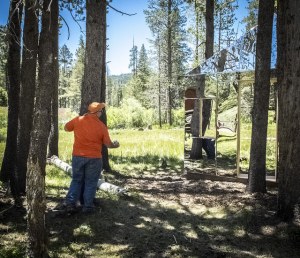
    Take a forest stroll at the National Reserve System’s of California’s Sagehen Creek Field Station, and you will encounter an Invisible Barn. The structure’s edges fade into the open air, until angled glimpses of tree trunks reveal a roof or wall. Surprise, then amusement tickle your brain as it wrestles with the sight of a building disappearing into the forest.

    “Many architects and designers consider nature as just a background. We thought it could be interesting to flip this. We liked seeing a built structure that would be part of a bigger environment: nature,” said designer Seung Teak Lee (aka Tech) of design firm stpmj. “We started to look for a way for a man-made structure to lose its shape but emphasize the background, nature.”

    Tech originally conceived the barn with fellow architect Mi Jung Lim in response to a competition to construct a ‘folly’ for a New York City park.

    Invisible Barn

    Seung Teak Lee describes the Folly competition that for which he designed the barn. Image  Sagehen Creek Field Station

     For their folly, Tech and Lim focused on a grove of similar-sized, evenly spaced trees in the park. They noticed that the tree trunks disoriented viewers in their midst. The designers determined to have their folly strengthen this disorientation. They achieved this by wrapping the structural confection with reflective paneling to make some objects appear to vanish. At the same time, the reflections expand the visual boundary of the grove.

    Yet the barn goes beyond visitors literally reflecting on their position in nature, Tech says. “It’s more about the delicate dynamics among a man-made structure, the natural environment, and users.”

    Though not selected for the competition, the Invisible Barn triggered design conversations around the globe. Tech and Lim were soon fielding invitations to build the barn from places such as London, Paris, New York, and Chengdu.

    Invisible Barn

    The trees surrounding the barn add to the illusion of invisibility. Image Seung Teak Lee

    The NRS’s Sagehen Creek Field Station rose to the top of this list for several reasons. The reserve’s forest setting included layers of randomly positioned trees that could support the illusion of invisibility.  But it was the enthusiasm of reserve managers Jeff Brown and Faerthen Felix that carried the day. “Through conversation with Jeff and Faerthen we knew they were interested in art, science, and the natural environment, which matched our vision. And we liked that Sagehen has addressed real-world problems in a highly collaborative and interdisciplinary manner, and has reached out to broad audiences to solve them.”

    Invisible Barn

    Reserve director Jeff Brown talks to visitors about the barn, while steward Dan Sayler builds in the background. Image Sagehen Creek Field Station

    The barn was constructed over a period of about four weeks this spring. Sagehen steward Dan Sayler poured the foundation and framed the building. Tech and a helper completed the exterior paneling and weatherproofing, then added the reflective film. The resulting structure is tall but only three feet at its widest, providing just enough space for a visitor to sit inside and peer out at the forest.

  • 4th of July Scout Report: Retraction Watch, Slate’s Audio Book Club, Plant Lovers, Genealogists Resources, Boston Massacre Perspectives and Poughkeepsie Regatta

    Cornell Boathouse as Built 1890 


    Photo,  Marist: Archives & Special Collections: Poughkeepsie Regatta

    25 Years of Hubble

    ·https://webcast.stsci.edu/webcast/detail.xhtml?talkid=4418&parent=1

    The Hubble Space Telescope was launched into low Earth orbit on April 25, 1990, supported by NASA funding that began in the 1970s. While the initial phase of the mission encountered problems (the main mirror was incorrectly manufactured and needed to be repaired), by 1993 Hubble was sending back some of the most magnificent images of the universe that humans have ever seen. This two-hour presentation by Frank Summers, of the Space Telescope Science Institute (STScI), offers an overview of the history, trials, and accomplishments of NASA’s first Great Observatory. The talk is available for free streaming online. In addition, the slides, which include phenomenal images taken from Hubble, can be downloaded in PDF format. For educators teaching astronomy, and for anyone with a fascination for space exploration, this is a valuable presentation.

     
    Finding and Using Health Statistics

    ·http://www.nlm.nih.gov/nichsr/usestats/index.htm

    Finding and using health statistics has become requisite for a number of careers in the past several decades. It’s also a worthwhile skill for anyone navigating the increasingly complex world of health care and medicine. This free online course from the U.S. National Library of Medicine is divided into three related parts: About Health Statistics, Finding Health Statistics, and Supporting Material. Selecting any of these tabs opens to a table of contents. From there, readers can follow the course page by page. For instance, About Health Statistics begins by reviewing the importance of health stats, moves on to their uses, and then speaks about sources for the gathering of statistics, such as population surveys and registers of diseases. 

     
    Women in Science and Mathematics (WiSM)

    ·http://www.eiu.edu/wism/index.php

    While the express goal of this website is to recruit and retain women students in sciences and mathematics at Eastern Illinois University, there is plenty of good information on the site for the rest of us. Readers may like to start with Further Reading, where they can link to media coverage of women in science from around the web. From there, they may select Biographies of Women in Science, where they can access dozens of biographies of women who have made contributions to fields as diverse as chemistry, primatology, biophysics, and astronomy. In addition, the site features links to half a dozen other websites on the topic, from the Smithsonian’s photo portraits of women scientists to the San Diego Supercomputer Center’s coverage of women scientists from around the world. 

     
    Slate’s Audio Book Club

    ·http://www.slate.com/articles/arts/the_audio_book_club.html

    Katy Waldman hosts Slate’s Audio Book Club, an engaging podcast where she facilitates monthly discussions about distinctive literary titles with expert book lovers from around the country. Recent guests have included a senior editor at Slate, an editor from the New York Times Book Review, a writer at the Atlantic, and Choire Sicha, co-founder of the popular culture site, the Awl. Discussions have ranged from wowed to perplexed to incensed to critical, but as these lovers of books have taken on such titles as Helen MacDonald’s soulful memoir, H Is for Hawk, or Paula Hawkins’ best-selling thriller, Girl on the Train, the overall mood is one of careful consideration and, above all, appreciation for the art form.

  • European Americans Embrace Positive Feelings, While Chinese Prefer a Balance of Feelings

    By Clifton B. Parker

    Emoticon in coffee mug

    Wikimedia Commons photograph

    European Americans prefer positive feelings over negative ones while Chinese tend to experience a balance between the two, new Stanford research shows.

    “Culture teaches us which emotional states to value, which can in turn shape the emotions we experience,” said Stanford psychology Professor Jeanne Tsai, director of the Culture and Emotion Lab on campus. Stanford psychology postdoctoral fellow Tamara Simswas the lead author on the research paper, which was published in the Journal of Personality and Social Psychology.

    Sims noted that a number of studies by other researchers have shown that people from Chinese and other East Asian cultures are more likely to feel both negative and positive – or “mixed emotions” – during good events, such as doing well on an exam.

    On the other hand, Americans of European descent are more likely to just feel positive during good events. Tsai said this is explained by cultural differences in models of the “self.” Americans tend to be more individualistic and focus on standing out, whereas Chinese tend to be more collectivistic, focusing on fitting in.

    “In multicultural societies like ours, this can lead to deep misunderstandings,” Tsai said.

    For instance, Americans might view Chinese who feel bad during good events as being depressed, when in fact they are feeling how their culture expects them to feel.

    In an interview, Sims said, “Although Americans know what it’s like to look for the good in the bad – the silver lining – they are less likely to see the bad in the good, compared to Chinese.”

    Previous research has not examined the role that emotional values play in this difference. Tsai said this new research focuses on how much people in two different cultures want to maximize positive emotions and minimize negative ones.

    The researchers conducted four different studies: with European Americans, Chinese Americans in the United States, and Chinese in Hong Kong and Beijing.

    ‘Focusing on the positive’

    The participants, totaling 690, were given questionnaires that assessed their emotions, values and how much they ideally wanted to feel positive relative to negative emotions.

    In two of the studies, for example, participants carried handheld devices that beeped randomly during the day. When they beeped, participants rated how they ideally wanted to feel and how they actually felt at that moment.

    Those studies showed that European Americans and Chinese Americans experienced fewer mixed emotions than Hong Kong and Beijing Chinese, and that those differences were related to how much those people wanted to maximize their positive emotions and minimize their negative ones.

    In another study, European American and Hong Kong Chinese participants watched TV clips – from the X Factor, a musical competition series – and were asked to rate “How positive are you feeling right now?” and “How negative are you feeling right now?” on a 5-point scale.

    The clips they watched differed in how well the contestants performed. The viewers were asked to put themselves into the shoes of the contestants.

    Before watching the clips, half of the participants were instructed to focus on the positive but not the negative, whereas the other half were instructed to focus on both.

    The people who were instructed to focus on the positive – but not the negative – were less likely to experience mixed emotions during the clips.

    Overall, Tsai and Sims said, the findings provide evidence that the more people want to maximize positive feelings and minimize negative ones, the less likely they are to experience the bad with the good.

    Tsai said that because people are often unaware of how cultural ideas and practices shape emotions, many assume that everyone wants to feel the same way.

    Previous research by Tsai and Sims focused on doctor-patient connections, and the role that wanting to feel different types of positive emotions – excitement vs. calm – has on these relationships. This latest research concerns the degree to which people want to feel positive relative to negative emotions.

    This subject, they suggested, has implications for other research on mixed emotions. For example, Stanford psychology Professor Laura Carstensen has found that as people in the United States grow older, they experience more mixed emotions.

  • Looking the Wrong Way: People Determined to Make the Past the Single Measure of the Present

    Duc de Berry Book of Hours

    by Joan L. Cannon 

    While it’s natural to think more about the past when you have a long one, I’m disturbed now by people who seem to be determined to make the past virtually the single measure of the present. Their heads seem to be turned backward.

    I have a friend who claims no art worthy of the name has been created since WW I. Just an example: his first question of almost every call is to ask what not contemporary I may have read or seen. Especially he is disdainful of contemporary cinema and a devotee of Turner Classic Movies. The suggestion that he may be depriving himself of unexpected satisfactions gets me absolutely nowhere. The only things I believe he looks forward to are visits with his small grandson. 

    Probably most old people rely on recall to remind them of happy times. Our deepest sympathies are with those who have lost that past. The ones who trouble me, though, are the few who seem incapable of gaining any real pleasure, not just from the present, but from considering even a short future.

    Page from the calendar of the Très Riches Heures showing the household of John, Duke of Berry exchanging New Year gifts. The Duke is seated at the right, in blue. Wikimedia Commons

    Unless one is already ill, it doesn’t seem unreasonable to look forward a year or two, even with little knowledge of or interest in electronics or space exploration, since there’s so much else mankind is learning every hour. I confess to absolute fascination with exploration of a universe that’s so much larger than we were brought up to believe and with a microcosm right here that is almost infinitely smaller than we knew when I was a child.

    Perhaps I can’t look forward to great grandchildren, but I do look forward to a graduate degree for one granddaughter. I’m also foolish enough to look forward to planting next year’s annuals in the perennial bed I started two Junes ago. I’m often amazed and thrilled by the new writers I’m reading. Aside from how mannered and relatively artificial the old movies are, they leave me cold most of the time because I’ve become accustomed to the naturalistic dialog of current fashion. I really appreciate the artistry that went into creating those more formal films, but they don’t penetrate to the same level that much of what’s contemporary can. With that, I have to smother the tendency to make comparisons with the incomparable  — say Shakespeare or Galsworthy.

    What will the weather be tomorrow? Will I see that eight-point buck strolling by my window again? I mustn’t forget to record the next Masterpiece Theater episode. I have to remember to move the Japanese painted fern to a better location. Trivial or major things and events can provide the strength and above all, the curiosity that leads to the necessary joie de vivre (or at least its counterfeit) to get up in the morning.

    What disturbs me the most, however, is that people with that inverted outlook deprive themselves of so much that is exciting and beautiful and even beneficial just because they refuse to sample it. They remind me of my husband’s horror at the thought of eating raw shellfish — until on a business trip, his client ordered his meal for him, beginning with a dozen oysters on the half shell. To belabor a metaphor, my husband was mindful of which side his bread was buttered on, tasted the oysters, and thereafter considered them one of nature’s most savory gifts.

    The best may be in the past for many of us; I can’t subscribe to Alexander Pope’s attitude that this is the best of all possible worlds, but that doesn’t mean there isn’t a likelihood that much remains to prove that many things are better now, especially in healing arts and technology than what we used to have. A quiet thoroughfare without carbon pollution may have been better to have one’s house beside than a blacktopped highway for semis, but thousands would miss the possibilities available if they could travel fifty miles in a day as we can without thinking about it.

    If there is more artistry in a medieval manuscript than in a desktop-produced brochure, it isn’t necessarily true that every word on a printed page is worthless because it’s new. The best literature of today doubtless owes as much to ancient texts and turn of the century styles as computer programming owes to Pythagoras or Einstein. That’s not an argument against its present value.

    It’s not a cop-out to look ahead and try not to be obsessed by what has gone and can’t be recalled; it’s a way to make a day worth living. Not many can claim to know when the last of those days will be for them. There seems something foolish about trying to move through even a day without looking ahead. I’d be afraid of running straight (perhaps fatally) into an avoidable stone wall (I live in New England) or over a cliff and losing tomorrows I don’t yet want to miss.

    ©2015 Joan L. Cannon for SeniorWomen.com

  • Hear Ye, Hear Ye: Middle Class Economics Rewarding Hard Work by Restoring Overtime Pay

    Overtime Book

    Overtime Book, 1887. Factory accounts, their principles and practice. Emile Garcke and J. M. Fells

    “Of course, nothing helps families make ends meet like higher wages … We still need to make sure employees get the overtime they’ve earned.”

    – President Barack Obama, State of the Union Address, January 20, 2015

    Middle class economics means that a hard day’s work should lead to a fair day’s pay.  For much of the past century, a cornerstone of that promise has been the 40-hour workweek.  But for decades, industry lobbyists have bottled up efforts to keep these rules up to date, leaving millions of Americans working long hours, and taking them away from their families without the overtime pay that they have earned. Business owners who treat their employees fairly are being undercut by competitors who don’t.

    Today (June 30, 2015), President Obama announced that the Department of Labor will propose extending overtime pay to nearly 5 million workers. The proposal would guarantee overtime pay to most salaried workers earning less than an estimated $50,440 next year. The number of workers in each state who would be affected by this proposal can be found here.

    The salary threshold guarantees overtime for most salaried workers who fall below it, but it is eroded by inflation every year.  It has only been updated once since the 1970s, when the Bush Administration published a weak rule with the strong support of industry.  Today, the salary threshold remains at $23,660 ($455 per week), which is below the poverty threshold for a family of four, and only 8 percent of full-time salaried workers fall below it.

    President Obama directed the Secretary of Labor to update regulations relating to who qualifies for overtime pay so that they once again reflect the intent of the Fair Labor Standards Act, and to simplify the rules so they’re easier for workers and businesses to understand and apply.  Following months of extensive consultations with employers, workers, unions, and other stakeholders, the Department of Labor developed a proposal that would:

    • Raise the threshold under which most salaried workers are guaranteed overtime to equal the 40th percentile of weekly earnings for full-time salaried workers.  As proposed, this would raise the salary threshold from $455 a week ($23,660 a year) – below the poverty threshold for a family of four – to a projected level of $970 a week ($50,440 a year) in 2016.
    • Extend overtime pay and the minimum wage to nearly 5 million workers within the first year of its implementation, of which 56 percent are women and 53 percent have at least a college degree. 
    • Provide greater clarity for millions more workers so they – and their employers – can determine more easily if they should be receiving overtime pay.
    • Prevent a future erosion of overtime and ensure greater predictability by automatically updating the salary threshold based on inflation or wage growth over time.