
My Surprising Garden
Editor’s Note: We must admit, a day without an onion is a bland one. We love all onions, garlic, shallots and their relatives. Have you had someone in your family enter the house or kitchen and ask, “What smells so good?” Chances are, they’re talking about the onions cooking.
What Are Shallots – Shallots vs Green Onions – Good Housekeeping
How to Cook with Green Garlic | Bon Appetit
The Best Shallot Substitutes for When You Don’t Have Time to Shop …
What Research Says About How Bad Information Spreads Online
Image from Martin Péchy; Pexels.com
This article was first published by Harvard Business Review. Minor edits were made in accordance with Journalist’s Resource’s editorial style.
As false news has become a global phenomenon, scholars have responded. They’ve ramped up their efforts to understand how and why bad information spreads online — and how to stop it. In the past 18 months, they’ve flooded academic journals with new research and have raised the level of urgency. In a March 2018 article, titled “The Science of Fake News,” in the prestigious journal Science, 16 high-profile academics came together to issue a call to action, urging internet and social media platforms to work with scholars to evaluate the problem and find solutions.
Much of what researchers have learned in this short time helps to answer three important questions — about how much misinformation people consume, why they believe it, and the best ways to fight it.
How far does misinformation reach?
Researchers are still trying to get a clear picture of how many people are influenced by false news and its digital reach. For now, they have been able to make estimates on the basis of survey data, geography, and other sources.
For example, a 2017 study in the Journal of Economic Perspectives examined the consumption of false news in the US during the months leading up to the 2016 presidential election. In a survey of 1,208 U.S. adults, 15 percent said they remembered seeing false news stories, and 8 percent acknowledged seeing one of these stories and believing it. The study’s authors — Hunt Allcott, an associate economics professor at New York University, and Matthew Gentzkow, an economics professor at Stanford University — estimated that US adults, on average, “read and remembered on the order of one or perhaps several fake news articles during the election period.”
Earlier this year, the Reuters Institute for the Study of Journalism at the University of Oxford released a report showing that false news sites appear to have a limited reach in Europe. For instance, in France, where Russians are accused of trying to interfere with the most recent presidential election, most of the false news sites studied reached 1 percent or less of the country’s online population each month in 2017. However, when researchers looked at how people interacted with false news on Facebook — via shares and comments, for example — “a handful of false news outlets in [the] sample generated more or as many interactions as established news brands.”
Strong Evidence that Hotter Weather Increases Both Suicide Rates and the Use of Depressive Language on Social Media
By Michelle Horton
Suicide rates are likely to rise as the earth warms, according to new research published July 23 in Nature Climate Change. The study, led by Stanford economist Marshall Burke, finds that projected temperature increases through 2050 could lead to an additional 21,000 suicides in the United States and Mexico.

New Stanford research shows that higher temperatures increase suicide rates in the United States and Mexico. (Image credit: iStockphoto/beer5020)
“When talking about climate change, it’s often easy to think in abstractions. But the thousands of additional suicides that are likely to occur as a result of unmitigated climate change are not just a number, they represent tragic losses for families across the country,” said Burke, assistant professor of Earth system science in the School of Earth, Energy & Environmental Sciences at Stanford.
Researchers have recognized for centuries that suicides tend to peak during warmer months. But, many factors beyond temperature also vary seasonally — such as unemployment rates or the amount of daylight — and up to this point it has been difficult to disentangle the role of temperature from other risk factors.
“Suicide is one of the leading causes of death globally, and suicide rates in the US have risen dramatically over the last 15 years. So better understanding the causes of suicide is a public health priority,” Burke said.
To tease out the role of temperature from other factors, the researchers compared historical temperature and suicide data across thousands of US counties and Mexican municipalities over several decades. The team also analyzed the language in over half a billion Twitter updates or tweets to further determine whether hotter temperatures affect mental well-being. They analyzed, for example, whether tweets contain language such as “lonely,” “trapped” or “suicidal” more often during hot spells.
The researchers found strong evidence that hotter weather increases both suicide rates and the use of depressive language on social media.
“Surprisingly, these effects differ very little based on how rich populations are or if they are used to warm weather,” Burke said.
For example, the effects in Texas are some of the highest in the country. Suicide rates have not declined over recent decades, even with the introduction and wide adaptation of air conditioning. If anything, the researchers say, the effect has grown stronger over time.
Effect of climate change
To understand how future climate change might affect suicide rates, the team used projections from global climate models. They calculate that temperature increases by 2050 could increase suicide rates by 1.4 percent in the US and 2.3 percent in Mexico. These effects are roughly as large in size as the influence of economic recessions (which increase the rate) or suicide prevention programs and gun restriction laws (which decrease the rate).
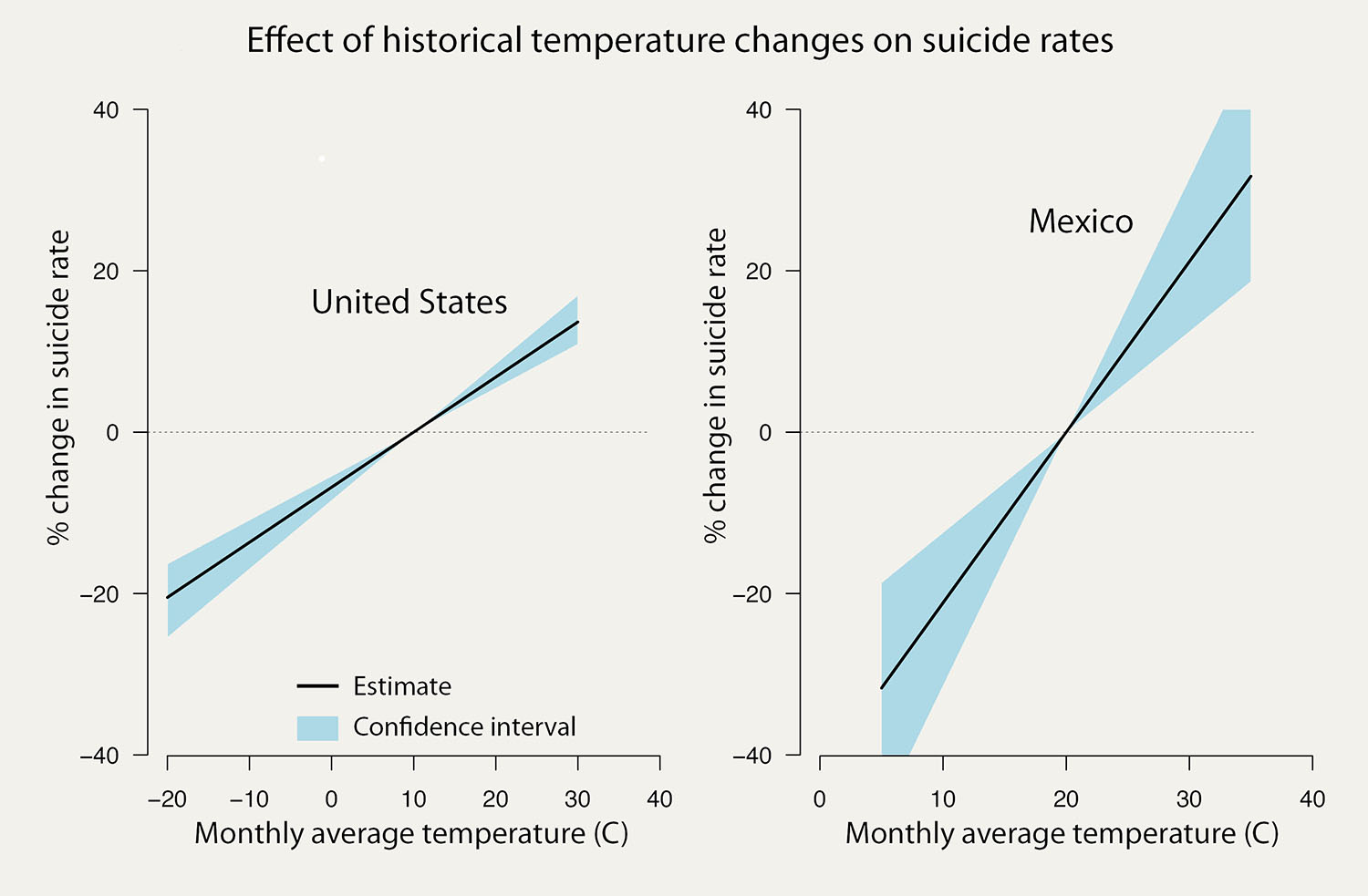
Effects of historical temperature changes on suicide rates are shown for the U.S. and Mexico. (Image credit: Marshall Burke)
“We’ve been studying the effects of warming on conflict and violence for years, finding that people fight more when it’s hot. Now we see that in addition to hurting others, some individuals hurt themselves. It appears that heat profoundly affects the human mind and how we decide to inflict harm,” said Solomon Hsiang, study co-author and associate professor at the University of California, Berkeley.
The authors stress that rising temperature and climate change should not be viewed as direct motivations for suicide. Instead, they point out that temperature and climate may increase the risk of suicide by affecting the likelihood that an individual situation leads to an attempt at self-harm.
“Hotter temperatures are clearly not the only, nor the most important, risk factor for suicide,” Burke emphasized. “But our findings suggest that warming can have a surprisingly large impact on suicide risk, and this matters for both our understanding of mental health as well as for what we should expect as temperatures continue to warm.”
Marshall Burke is also a fellow at the Center on Food Security and the Environment, Stanford Woods Institute for the Environment, Freeman Spogli Institute for International Studies, and Stanford Institute for Economic Policy Research. Solomon Hsiang is also a faculty research fellow at the National Bureau of Economic Research. Other Stanford co-authors include Sanjay Basu, assistant professor of medicine, and Sam Heft-Neal, research scholar at the Stanford Center on Food Security and the Environment. Additional co-authors are from Pontificia Universidad Católica de Chile, Vancouver School of Economics, and the University of California, Berkeley. The research was partially supported by the Stanford Woods Institute for the Environment.
Census Bureau Research: Shhh….I Make More than My Husband: Spouses Report Earnings Differently When Wives Earn More
By Misty Heggeness
When wives earn more than their husbands do, a puzzling thing can happen: Husbands say they earn more than they are and wives underreport their income.
New Census Bureau research shows that the incomes couples report on Census Bureau surveys do not always match their IRS filings. The Census Bureau is working to improve the quality of reported earnings by comparing an individual’s survey response with their reported response from another source.
When a wife earns more, both husbands and wives exaggerate the husband’s earnings and diminish the wife’s.
“Wage and earnings data underlie a majority of federal statistics on income, inequality and poverty, and are critical for understanding the pulse of the nation and overall well-being of individuals in society,” said Bruce Meyer, economist at the Census Bureau and McCormick Foundation Professor at the University of Chicago Harris Public Policy School.
According to this research, societal expectations about the roles played in married-couple relationships may be a factor in what people report for their earnings. Social norms can drive expectations and behavior, including how we report information about ourselves to others.
“We made a critical finding that adds to the understanding of gender norms and the quality of income statistics, in particular, wage gaps among different-sex married couples,” said Marta Murray-Close, economist at the Census Bureau and co-author of the study.
Researchers used survey responses from the Current Population Survey’s Annual Social and Economic Supplement. They found that when wives earn more than their husbands, husbands report earnings that are 2.9 percentage points higher when they respond to surveys compared to what’s in their tax filings.
Who Really Earns More?
Take a husband in Fargo, N.D., who lives in a household where the wife earns more. If he reported annual earnings of $30,000, he would tell the Census Bureau he earned more — an average $30,870 during that same year. That’s $870 more than his earnings as reported by his employer(s).
The gap is 1.5 percentage points lower for wives who make more than their husbands.
Let us say, for example, that the same man’s wife earns $40,000. On average, her reported earnings would be equivalent to $39,400, around $600 less than she actually earned. The overall impact on family earnings for this household is about $300 more than their employer-reported earnings.
Different Answers From Husbands And Wives
Does it matter whether the husband or wife responds to the survey? The answer is yes.
We analyzed survey reported earnings based on whether the response came directly from the survey respondent or a proxy, such as their spouse answering the question for them.
When a wife earns more, both husbands and wives exaggerate the husband’s earnings and diminish the wife’s. But, husbands overstate their own earnings less than wives do, and wives devalue their own earnings less than husbands do.
In other words, survey reports of earnings are more heavily influenced by gender norms when earnings are reported by a person’s spouse.
How Society Influences Earnings Data
These differences can impact our understanding of national statistics on income, inequality and poverty. In this analytical sample, around 1 in 4 couples (22.9 percent) live in nontraditional marriages where the wife earns more than the husband does.
As nontraditional marriages become more common, self-reported earnings data could become less reliable if individuals continue to be influenced by social norms in their reporting.
The findings demonstrate the importance of understanding societal norms and their influence on data collection and survey responses. Using alternative sources of data helps confirm the accuracy of surveys.
The world of big data and administrative records is becoming more important. The research also provides evidence that building systems and structures that rely on alternative data sources and mechanisms — rather than just self-reported survey responses — should continue.
Misty Heggeness is Senior Advisor for Evaluations & Experiments in Research and Methodology at the Census Bureau.
The Impact of Trade and Tariffs on the United States Key Findings From the Tax Foundation; Steve Rattner Charts
Port of Oakland, aerial photograph from a SWA flight inbound to OAK from PDX; Daniel Parks, Wikipedia
• Trade barriers such as tariffs raise prices and reduce available quantities of goods and services for U.S. businesses and consumers, which results in lower income, reduced employment, and lower economic output.
• Measures of trade flows, such as the trade balance, are accounting identities and should not be misunderstood to be indicators of economic health. Production and exchange – regardless of the balance on the current account – generate wealth. • Since the end of World War II, the world has largely moved away from protectionist trade policies toward a rules-based, open trading system. Post-war trade liberalization has led to widespread benefits, including higher income levels, lower prices, and greater consumer choice. • Openness to trade and investment has substantially contributed to US growth, but the US still maintains duties against several categories of goods. The highest tariffs are concentrated on agriculture, textiles, and footwear.
• The Trump administration has enacted tariffs on imported solar panels, washing machines, steel, and aluminum, plans to impose tariffs on Chinese imports, and is investigating further tariffs on Chinese imports and automobile imports.
• The effects of each tariff will be lower GDP, wages, and employment in the long run. The tariffs will also make the U.S. tax code less progressive because the increased tax burden would fall hardest on lower- and middle-income households.
• Rather than erect barriers to trade that will have negative economic consequences, policymakers should promote free trade and the economic benefits it brings.
Erica York Analyst FISCAL FACT No. 595 June 2018
TAX FOUNDATION | 2 Introduction Trade barriers, such as tariffs, have been demonstrated to cause more economic harm than benefit; they raise prices and reduce availability of goods and services, thus resulting, on net, in lower income, reduced employment, and lower economic output. Since the end of World War II, the world has largely moved away from protectionist trade policies toward a rules-based, open trading system. This widespread reduction in trade barriers has contributed to economic prosperity in many ways, including large increases in trade activity and accompanying gains in economic output and income. Openness to trade and investment has substantially contributed to U.S. growth, but the U.S. still maintains duties against several categories of goods. The overall effective rate of these tariffs appears low, but varies widely across categories of goods. The highest duties apply to clothing, apparel, and footwear; some of the lowest apply to aircrafts, spacecrafts, and live animals. This paper provides a brief overview of tariffs, the basic economics of trade and barriers to trade, and explains why the trade balance shouldn’t be viewed as an indicator of economic health. Then the paper reviews the current United States Harmonized Tariff Schedule and recent developments in United States tariff policies. Overview of Tariffs Tariffs are a type of excise tax that is levied on goods produced abroad at the time of import. They are intended to increase consumption of goods manufactured at home by increasing the price of foreign-produced goods. 1 Generally, tariffs result in consumers paying more for goods than they would have otherwise in order to prop up industries at home. Though tariffs may afford some short-term protection for domestic industries that produce the goods subject to tariffs by shielding competition, they do so at the expense of others in the economy, including consumers and other industries.2 As consumers spend more on goods on which the duty is imposed, they have less to spend on other goods—so, one industry is propped up to the disadvantage of all others. This results in a less efficient allocation of resources, which can then result in slower economic growth. Tariffs also tend to be regressive in nature, burdening lower-income consumers the most. 1 Jagdish Bhagwati, “Protectionism,” in David R. Henderson, ed., The
WASHINGTON — The National Retail Federation today issued the following statement from President and CEO Matthew Shay in regard to U.S. tariffs on $34 billion of Chinese goods set to take effect Friday.
“With tariffs against China taking effect, American consumers are one step closer to feeling the full effects of a trade war. These tariffs will do nothing to protect U.S. jobs, but they will undermine the benefits of tax reform and drive up prices for a wide range of products as diverse as tool sets, batteries, remote controls, flash drives and thermostats. And students could pay more for the mini-refrigerator they need in their dorm room as they head back to college this fall.
“We strongly urge the administration to abandon its plans for tariffs on another $200 billion in Chinese imports, which would destroy thousands of American jobs and raise prices on virtually everything sold in our stores. Reining in China’s abusive trade policies is a goal shared by many countries, but a strategy based on unilateral tariffs is the wrong approach and it has to stop.”
About NRF
The National Retail Federation is the world’s largest retail trade association. Based in Washington, D.C., NRF represents discount and department stores, home goods and specialty stores, Main Street merchants, grocers, wholesalers, chain restaurants and internet retailers from the United States and more than 45 countries. Retail is the nation’s largest-private sector employer, supporting one in four U.S. jobs — 42 million working Americans. Contributing $2.6 trillion to annual GDP, retail is a daily barometer for the nation’s economy. NRF.com
A Curmudgeon’s Complaint: Should There Be a Convention For the Preservation of Real Literature?
Edward Lear sketches dated 15 May 1864, from Paddy Leigh Fermor collection.jpg; Wikipedia
Recently a writer friend told me of a plot premise that she’d thought of. It involved a woman going to the store to pick up a chicken, but she picks up the butcher instead. I thought of the sources for chickens these days and realized that a place where I would be most likely to buy one would offer no opportunity for meeting the butcher, let alone picking him up.
When I was growing up, even in New York City, we had a local grocery store. The proprietor’s name was Mr. Lovelock. The worn floorboards were covered in sawdust. Every customer had to negotiate around the black and white cat who always occupied the center of the space between the door, the counters, and the shelves. When my mother had chosen what she wanted, we would go home to await a delivery by a lad who must have been about fourteen. There’s not much of that sort of customer relationship around these days. I’m eager to see how my writer friend’s story will develop, and where it will be set.
To be at the far end of your life tends to make you think backward perhaps more than is good for the morale. So many changes that happened in the last century and this one have come about at the speed of a 100-yard Olympic sprint, and many are of marvelous consequence for those who have lived to see them. On the other hand, that pace has exacted a price, which is the leisure to contemplate details. Those details are of personalities, eccentricities, individualities, and the most obvious pleasures of the natural world which are rapidly becoming a backdrop. When using the word “leisure” I imply the time and freedom for appreciation.
I’m distressed by the fact that I miss half the birdsong around us because it’s being drowned out by diesel eighteen-wheelers. I can barely see the mountains because of air pollution, and I have to watch my dog to be sure he isn’t getting into some area treated with chemicals to discourage weeds. As for buying the chicken, I have to pick one out from twenty others so encased in shrink-wrap I can’t tell them apart except for the weight indicated on the labels. Nowadays, if I’m willing to pay over $10 a pound instead of under $3, I can get a “free-range organic” bird, but even then I won’t have the feet available for broth that would be like what I imagine mothers hand out to cold sufferers.
Real chicken soup is a thing of the past. I mind having to pay extra to get carrots with tops, lemons one-by-one, local tomatoes in August. A can of baked beans isn’t even just a can of baked beans; now I have to choose among several different versions for use with different accompaniments. I admit it’s nice to be able to get “ethnic” and “gourmet” foods, but where’s the cheese wheel from which you could get a slice cut to order and so sharp it made your tongue sting when you tasted the sample offered on the blade of a knife half the size of a machete?
One of my biggest plaints is directed at the tendency to enlarge everything, especially restaurant portions and publishers. Does anyone among the latter have anything they will admit is a “mid-list” today? They can’t afford one anymore. An editor no longer can browse the slush pile for something that might be to his or her individual taste and take a flier on it. As for fiction: the formulas for success (read enormous sales) have multiplied. Does the story have a thriller pace? Check. Plenty of sex, preferably explicit and at least somewhat unconventional? Check. Violence? Check. Shocking characters, scenes, plots? Check. Or, perhaps to fit into another category, it may need to be gently bland, without a suggestion of the unpleasant realities of life and certainly no more than a hint of sex, and make every character call regularly and verbally on the Almighty. Even the category romances of my day have become less rather than more convincing.
What has happened to verisimilitude? I can only be grateful for the authors who, having managed to get into print, are the exceptions to prove those rules cited above. My feeling, though, is that they are too few, and if one can find their work at all, it doesn’t get the recognition it deserves.
Is it time to organize, to shout while waving a banner inscribed with the names of literary artists, to rebel? Should there be a convention for the preservation of real literature? If only we had Mark Twain or Voltaire to make the campaign speeches, Aristotle or Kant to force us to entertain enough thought to allow some expansion of minds. Even Edward Lear and W. S. Gilbert might be fun to listen to so we could figure out how to enjoy jokes. There isn’t enough poetry around in spite of the legions of willing small independent publishers, largely because it’s hard to convince a customer that the price of a chapbook is worth it.
The trouble is, we don’t have the millions of dollars it would take to make us heard. Maybe we should try to start an online fundraising effort dedicated to the proposition that independent publishers of books and periodicals should have the same proportion of public support that goes to Public Radio and Television, both of which have already had to succumb to at least “institutional” advertising.
Farewell Harold Ross, and all your ilk. You’re missed.
© Joan L. Cannon for SeniorWomen.com
Stateline: These Pills Could Be Next US Drug Epidemic, Public Health Officials Say
Clonazepam (traded as Klonopin), diazepam (Valium) and alprazolam (Xanax) are among the most sold drugs in a class of widely prescribed anti-anxiety medications known as benzodiazepines. Public health officials warn the pills should be used only in the short term and should never be mixed with opioids or alcohol; The Pew Charitable Trusts
By: Christine Vestal, Stateline, Pew Charitable Trusts
The growing use of anti-anxiety pills reminds some doctors of the early days of the opioid crisis.
Considered relatively safe and non-addictive by the general public and many doctors, Xanax, Valium, Ativan and Klonopin have been prescribed to millions of Americans for decades to calm jittery nerves and promote a good night’s sleep.
But the number of people taking the sedatives and the average length of time they’re taking them have shot up since the 1990s, when doctors also started liberally prescribing opioid painkillers.
As a result, some state and federal officials are now warning that excessive prescribing of a class of drugs known as benzodiazepines or “benzos” is putting more people at risk of dependence on the pills and is exacerbating the fatal overdose toll of painkillers and heroin. Some local governments are beginning to restrict benzo prescriptions.
When taken in combination with painkillers or illicit narcotics, benzodiazepines can increase the likelihood of a fatal overdose as much as tenfold, according to the National Institute on Drug Abuse. On their own, the medications can cause debilitating withdrawal symptoms that last for months or years.
Public health officials also warn that people who abruptly stop taking benzodiazepines risk seizures or even death.
With heightened public awareness of the nation’s opioid epidemic, some state and local officials are insisting that these anti-anxiety medications start sharing some of the scrutiny.
“We have this whole infrastructure set up now to prevent overprescribing of opioids and address the need for addiction treatment,” said Dr. Anna Lembke, a researcher and addiction specialist at Stanford University. “We need to start making benzos part of that.”
“What we’re seeing is just like what happened with opioids in the 1990s,” she said. “It really does begin with overprescribing. Liberal therapeutic use of drugs in a medical setting tends to normalize their use. People start to think they’re safe and, because they make them feel good, it doesn’t matter where they get them or how many they use.”
“What we’re seeing is just like what happened with opioids in the 1990s.”
Dr. Anna Lembke, researcher and addiction specialist STANFORD UNIVERSITY
The number of adults filling a benzodiazepine prescription increased by two-thirds between 1996 and 2013, from 8 million to nearly 14 million, according to a review of market data by Lembke and others in the New England Journal of Medicine. Despite the known dangers of co-prescribing painkillers and anti-anxiety medications, the rate of combined prescriptions nearly doubled between 2001 and 2013.
Since then, prescriptions for benzodiazepines may have leveled off or declined slightly, according to recent data from a market research firm that tracks prescription drug sales, the IQVIA Institute for Human Data Science. At the same time, opioid prescribing has dropped by more than a fifth.
Still, Lembke said, the level of prescribing is much higher than it was in the mid-1990s and benzo dependence appears to be rising based on her own clinical observations.
First marketed in the early 1960s, benzodiazepines have been cyclically abused throughout their history. What’s notable now, Lembke said, is that overuse of benzos is coinciding with overuse of opioids.
But a newly formed group of researchers and pharmacologists, the International Task Force on Benzodiazepines, wrote in an editorial that recent negative publicity has made it difficult for many doctors around the world to prescribe medications they consider essential.
Some scientific articles “achieved a common goal that negative propaganda frequently reaches: they aroused suspicion of benzodiazepines and suggested difficulties in using them, while overlooking their benefits,” the pharmacologists said. (Three of the 17 co-authors reported having consulted for or received support from drug companies.)
Psychiatrists, including Lembke, agree that relatively inexpensive benzodiazepines can be effective at relieving acute cases of anxiety and sleeplessness.
Physicians agree that benzos should not be used long term to solve psychiatric problems. Research indicates that use of the drugs for more than a few weeks can cause tolerance, including withdrawal symptoms between doses, and physical and psychological dependence.
“Doctors need to be informed that the medications should be prescribed for no more than two to four weeks. They were always meant to be short term.”
Dr. Christy Huff, co-director BENZODIAZEPINE INFORMATION COALITION, UTAH
To raise awareness of benzodiazepines’ dangers, Hawaii, Pennsylvania and New York City have issued prescribing guidelines that limit the duration of Xanax, Valium and other benzo prescriptions, similar to many state guidelines for opioids.
In addition, the Massachusetts Legislature this month passed a wide-ranging opioid bill that included benzodiazepines as a class of restricted drugs.
Nationwide, most states require doctors and pharmacists to track opioid prescribing through online databases that monitor patients who receive them and doctors who prescribe them. Benzodiazepines are not included in half of the states, according to an analysis of state laws by The Pew Charitable Trusts, which also supports Stateline.
Mounting Dangers
As prescriptions for benzodiazepines have grown since the late 1990s, so have deaths, according to a study at Montefiore Medical Center in New York. The National Institute on Drug Abuse reports that overdose deaths involving benzodiazepines quadrupled from 2002 to 2015.
New highly potent forms of benzodiazepines that are illicitly traded are also causing overdose deaths, addiction doctors say. Adding to the dangers, the Drug Enforcement Administration has reported that the deadly synthetic drug fentanyl has been found in counterfeit forms of Xanax.
Xanax and Valium were involved in more than 30 percent of opioid overdose deaths between 2010 and 2014, far more than cocaine and methamphetamines, according to the Centers for Disease Control and Prevention. In some parts of the country, the prevalence of Xanax in drug overdose autopsy reports was even higher.
Xanax for the past several years has been found in more overdose autopsies in Kentucky than any specific opioid, according to Dr. Kelly Clark, president of the American Society of Addiction Medicine and an addiction doctor who lives in the state. “In fact, community mental health centers in Louisville stopped prescribing Xanax because it is such a common drug of abuse and so dangerous in combination with alcohol and opioids,” she said in an interview with Stateline.
Better Information
Researchers and patient advocates argue more needs to be done to educate medical students and inform doctors and patients about the drugs’ dangers.
Dr. Christy Huff, who is in recovery from dependence on Xanax, co-directs the Utah-based Benzodiazepine Information Coalition. The nonprofit advocates for stronger warnings for patients who take Xanax and other benzos, as well as better education for prescribing physicians.
“Our population of patients is experiencing extremely difficult withdrawals, and they have neurological injuries because of unsafe prescribing,” Huff said. “Doctors need to be informed that the medications should be prescribed for no more than two to four weeks. They were always meant to be short term.”
In 2016, the Food and Drug Administration issued a warning about the dangers of combining opioids and benzodiazepines. That prompted many doctors to force patients to choose one drug over the other without warning them about the potential symptoms of withdrawal such as seizures or even death, Huff said.
“Patients who are on the medications should be given the choice of how and when they are tapered off,” she said. “Too many doctors are taking people off their prescriptions too rapidly.”
The benzo task force wrote in its editorial that it was developing research that it hoped would support preserving the drugs as a valuable part of the medical arsenal.
Gender News: City of New York Agrees to Pay $20.8 Million to Settle Federal Discrimination Charges Made by Registered Nurses
New York State Nursing Association photo
Federal Suit Alleges City Discriminated Against City-Employed Registered Nurses and Midwives by not Recognizing their Work as “Physically Taxing”
Acting Assistant Attorney General John Gore for the Justice Department’s Civil Rights Division and Richard P. Donoghue, United States Attorney for the Eastern District of New York, today announced a proposed settlement with the City of New York to compensate City-employed registered nurses and midwives who were subjected to discrimination because they are women. The United States Attorney’s Office for the Eastern District of New York filed the proposed settlement along with a complaint in federal district court. According to the allegations of the complaint, the City failed to recognize that the work of predominantly-female registered nurses and midwives was “physically taxing,” while deeming other predominantly-male occupations “physically taxing.” As a result, City employees in the predominantly-male “physically taxing” jobs were allowed to retire with full pensions as early as age 50, while registered nurses and midwives, who are predominantly female, had to wait until age 55 or 57 to retire with full pensions.
“This Settlement Agreement will provide significant relief to a class of female nurses and midwives employed by the City of New York who were harmed by the City’s discriminatory employment practices,” said Acting Assistant Attorney General John Gore. “We applaud the United States’ Attorney’s Office for the Eastern District of New York for prosecuting this matter and acknowledge the City of New York’s commendable efforts in ensuring that this matter was brought to resolution without protracted litigation.”
“City nurses and midwives care for sick and injured adults, juveniles, and infants through long days and nights under difficult circumstances, and rightfully should be recognized as doing physically taxing work,” said U.S. Attorney Donoghue. “Equal treatment under law means just that, equal treatment and this Office is committed to ensuring that women are treated fairly and equitably in the workplace.” He also thanked the Equal Employment Opportunity Commission (EEOC) for its investigative work prior to referring this matter to the U.S. Attorney’s Office.
Beginning in 1968, the City allowed certain City employees with 25 years of service the option of retiring with full pensions beginning at the age of 50, if the employees worked in jobs the City deemed “physically taxing.” At that time, the City refused to recognize the work of registered nurses and midwives, which was performed mostly by women, as “physically taxing,” but did recognize as physically taxing work performed mostly by men in occupations such as Emergency Medical Specialist – EMT, Exterminator, Motor Vehicle Dispatcher, Window Cleaner, Foremen, and Plumbers.
Beginning in 2004, the New York State Nurses Association (NYSNA), a labor union representing City-employed registered nurses and midwives, began requesting that the City recognize the work of registered nurses and midwives as physically taxing and also allow NYSNA’s qualifying members the option of retiring as early as age 50. The City denied that request in 2004, and again in 2006 and 2008. Thereafter, NYSNA and four of its members filed complaints with the EEOC. The EEOC determined there was reason to believe that the City had discriminated against the nurses when it failed to recognize registered nurse and midwife occupational titles as “physically taxing” in 1968, and again when NYSNA made its requests in 2004, 2006 and 2008. The EEOC then referred the matter to the U.S. Attorney’s Office.
The settlement applies to a proposed class of approximately 1,665 registered nurses and midwives hired by the City from Sept. 15, 1965, through March 31, 2012. Subject to court approval, the City would pay these registered nurses and midwives, who would otherwise have been eligible to retire at an earlier age, between $1,000 and $99,000, depending upon their years of qualifying service and the number of years earlier they would have been eligible to retire. The settlement also provides for the City to pay attorney’s fees and an additional $100,000 to the four nurses who initiated the EEOC complaint which led to today’s result.
This matter was handled by Eastern District of New York Assistant United States Attorneys John Vagelatos and Michael J. Goldberger.
US Justice Department: Former Second Chance Body Armor President Settles False Claims Act Case Related to Defective Bullet Proof Vests; Russian Woman Accused of Being an Agent
Editor’s Note and Update: We had signed up for Justice Department releases before the remarks of Deputy Director Rosenstein in relation to the 12 person indictment of Russians. This release was received today and again illustrated the persistence and resources brought to bear in their investigations. We thought you’d be interested in another investigation on the part of the department responsible for the Muller investigation.* We have just received another release accusing a Russian woman of conspiracy as an agent of the Russian Federation: Russian National Charged in Conspiracy to Act as an Agent of the Russian Federation Within the United States
Office of Public Affairs
Richard C. Davis, the founder and former president and CEO of Michigan-based Second Chance Body Armor, Inc., agreed to resolve claims under the False Claims Act in connection with his role in the sale of defective Zylon bullet-proof vests purchased by the United States for federal, state, local and tribal law enforcement agencies, the Justice Department announced today. Mr. Davis will relinquish his interest in $1.2 million in assets previously frozen by the United States and will pay an additional $125,000 to the United States. This settlement is based on Mr. Davis’ ability to pay.
Second Chance sold body armor to state, local and tribal law enforcement agencies reimbursed by the Department of Justice’s Bulletproof Vest Partnership (BVP) program and to federal agencies under contracts with the General Services Administration. The United States alleged that Second Chance’s vests were defective due to the loss of their ballistic capability when exposed to heat and humidity. The United States also alleged that by 2001, Davis was aware that Second Chance’s Zylon body armor was degrading at what he described as a “disappointing” rate.
The United States further alleged that, rather than using a $6 million payment from Toyobo Co. Ltd., the manufacturer of Zylon fiber, to fix the degradation problem, Second Chance pocketed the money and Davis and other Second Chance owners began meeting with various investment bankers in an effort to sell Second Chance. These efforts to sell the company allegedly stopped after a Forest Hills, Pennsylvania police officer was shot through his Second Chance Zylon vest in June 2003. Second Chance filed for bankruptcy in 2004 and was liquidated.
Subsequent tests by the National Institute of Justice (NIJ) of Zylon-containing vests found that more than 50 percent of used vests could not stop bullets that they had been certified to stop. The performance of Second Chance Zylon vests were reported to be among the worst. The NIJ removed all Zylon-containing vests from its list of compliant products, and Zylon is no longer used in ballistic vests.
“The Department of Justice will pursue those who attempt to fraudulently profit at the expense of the United States, particularly when the stakes are life or death,” said Acting Associate Attorney General Jesse Panuccio. “Bullet proof vests protect the brave men and women of our nation’s law enforcement community, and those who manufacture and sell these products have a solemn duty to ensure their safety and efficacy.”
Out of It: The Proposal, Hook-Ups, Dating Apps,Virginity and Sexual Mores
The Stolen Kiss, late 1780s, Jean Honoré Fragonard; The Hermitage Museum, St. Petersburg. Collection of the King of Poland, Stanislaw-August Poniatowski, 1895
I admit it. I like the Olive Garden. I know that’s not cool. I also know that “cool” is no longer in; but, then, neither am I. In fact, I’m so out of it, I still have an AOL email address, which apparently is pitifully “yesterday.” I have no idea why. I find it more reliable and user-friendly than two other au courant email addresses I use from time to time.
Those are just a couple of examples of how out of touch I am with contemporary thinking. Here are more:
If you offered me a million dollars to name a current pop star or song, your money would be safe. I don’t have a clue.
Also, I am appalled by TV shows like The Bachelor and The Bachelorette that encourage their contestants to forego their individual rooms to spend a night together in a “fantasy suite” after just a few dates. Even worse is Love Connection where a couple is sent on a “romantic” overnight assignation after only one blind date. I thought it couldn’t get any sleazier than that, but this season a new show, The Proposal, has debuted featuring an even more outrageous scenario. Within an hour, a slate of ten contestants is quickly winnowed down to one, who then becomes engaged to a mystery man or woman, who has been hidden behind a pod until the end. Before the climactic engagement, the couple has spent a total of less than five minutes or so talking to each other. What’s next? A program where a marriage of strangers will be consummated, on camera, before the first commercial break?
And I really don’t understand apps like Tinder that enable guys and gals to dial up an immediate “hook-up” with an unknown partner as easily as ordering delivery of a pizza. In fact, people give more thought to their choice of pizza toppings than to these casual encounters where there is no attraction, no commitment, no common interests, except one — indulging in spur-of-the-moment sex with a complete stranger, and no desire to ever see that stranger again, Don’t these people worry about STDs or the fact that their partner for the next hour or less could possibly be an ax murderer — or maybe married to one who might not be happy with his/her spouse’s hobby?
I’m so out of it, I remember when still being a virgin at the ripe old age of, say, 21 wasn’t considered shameful, but the word “virgin” was. It was never spoken in mixed company, and it was assumed all brides were “pure” when they walked down the aisle. To be honest, I’m still a bit shocked to read about weddings in which the couple’s children are participants. When I was in middle school, we all had autograph books in which we collected signatures and pithy sayings. A popular verse was, “First comes love; then comes marriage; then comes Susie” (or whoever) “with a baby carriage.” Marriage before a baby? What a quaint concept! Instead, today we see dozens of single women proudly displaying their baby bumps in the pages of People every week. As for those bumps, apparently the more prominent the better these days. To that end, dresses/skirts/pants must be stretched as tightly as seems possible over the protruding belly — and then pulled tighter still. I feel sorry for the poor baby who must feel Spanx-bound. Weren’t the former loose maternity togs more comfortable for both mother and child?
And how about wedding ceremonies that unite two people of the same sex? Actually, I know a wonderful gay couple, so this is one innovation I support. Don’t tell my priest! Although he probably doesn’t care. He may be too busy defending himself against charges we never believed were possible back in the day.
Wait! How did I ever go from the Olive Garden to a discussion of sexual mores? Oh, I remember. While I was enjoying my Fettucine Alfredo there last night, a couple in the next booth were engaging in an XXX-rated PDA, oblivious to everything else — including their own entrees.
They didn’t know what they were missing. The fettuccine was delicious.
©2018 Rose Madeline Mula for SeniorWomen.com

