Blog

  • Still Learning: Lessons From a Lifetime in the Classroom — September Song


    by Julia SnedenSt George Utah

    Editor’s Note: In advance of Election Day when changes to Boards of Education might be on the ballot, we felt Julia Sneden’s article well timed.

    Labor Day has come and gone, and from now until next summer, one quarter of the United States — students and teachers — will be in school almost every weekday. The rest of us will probably think about our schooling at least once a day, whether in anger or gratitude or love. Our teachers have marked us, happily or unhappily; our studies have enlarged us or frustrated us; our classmates have had a profound effect on how we perceive ourselves. Every American who has been there considers him/herself an expert on the subject of school.

    And why not? You can’t spend six to eight hours a day, 180 days a year, for a minimum of ten to twelve years in a school system without having an opinion on its good and bad aspects. Unfortunately, many of us dwell on the latter. I spent a lot of time disliking school when I was young, even though I was a good student. My husband, who was an even better student, adored every school he ever entered, even when his teachers were not charismatic. The difference seems to be that his schools had smaller classes, and curricula that included art, drama, and music, which brought an amount of joy into his schooling.

    Teaching is almost our family business. I’m the daughter and stepdaughter of teachers; I’m married to a teacher; I am the mother of a teacher, the sister of a teacher, and I myself am a retired teacher. I came to the profession through the back door, having asserted my independence early on by announcing that I would never be a teacher. I managed to hold out until I had developed a fairly successful separate career and had borne three children, but then I discovered the rewards of watching my own offspring learn. I was not, I hasten to add, home schooling them. I was just being their mother. But parents are a child’s first teachers, and they’re probably the most important ones. By the time my youngest son was ready for school, I decided to be paid for what I’d learned to love: the process of teaching and watching little children learn. I never looked back, and taught for 25 years, and loved it.

    Read the rest of Julia Sneden’s Essay

  • Regret is a Gambler’s Curse: “If you don’t feel any regret, you are getting close to the world of addictive or antisocial behavior”

    What goes through a gambler’s mind after she’s placed her bet?

    It’s not just the anticipation of a big payoff or doubts about the wisdom of her bet. It’s also regretting about previous bets, both won and lost, according to the University of California, Berkeley, neuroscientists.

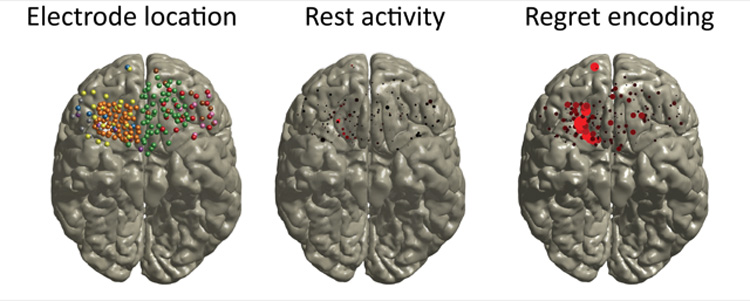
    comparison of brain regions

    Activity in the orbitofrontal cortex during a gambling experiment, as recorded by electrode meshes placed directly on the surface of the brain. On the left, the dots indicate the positions of the electrodes in each of the 10 subjects, distinguished by color. During normal activity (middle), the electrodes (black dots) show little activity (red) in the OFC region that deals with regret. During the betting game, however (right), after learning the outcome of the bet, many electrodes record activity in the area where we feel regret (red).

    “Right after making a choice and right before finding out about the outcome, the brain is replaying and revisiting nearly every feature of what happened during the previous decision,” said senior author Ming Hsu, an associate professor in the Haas School of Business and Helen Wills Neuroscience Institute at UC Berkeley. “Instead of ‘I just gambled but maybe I shouldn’t have,’ it is, ‘Last round I gambled and that was a really good choice.’ Or, ‘I played it safe last time but should have gone for it.’”

    The UC Berkeley study is one of a small but growing number of studies that record fast human brain activity – a thousand measurements per second – to reveal the complex array of operations underlying every decision we make, even those that may seem trivial.

    The researchers focused on the brain’s orbitofrontal cortex, long-known to be involved in reward processing and social interactions. Indeed, it was one of the main sites of damage in the well-known case involving 19th-century railroad worker Phineas Gage, whose left frontal cortex was destroyed after an explosion drove an iron bar through his head. The damage altered his personality, making him impulsive and uninhibited – seemingly a man who didn’t regret any act, no matter how disastrous the outcome.

    In recent decades, the orbitofrontal cortex has been shown to be involved in how people value their choice options, how much regret they felt, how much risk they were taking and how valuable their choice was, all of which guide future choices or help someone appraise how good or bad the outcome was.

    As shown in this study, however, the orbitofrontal cortex spends much of the time replaying aspects of past decisions. In particular, when people play a gambling game, the main driver of activity in the orbitofrontal cortex is the regret they feel from losing or the regret, after winning, of not having bet more.

    click on image to play gambling game

    Want to try the gambling game yourself? Click on the image to try your hand. (Demo created by Chris Wong, UC Berkeley)

  • Mortality in Puerto Rico after Hurricane Maria: Funded by the Harvard T.H. Chan School of Public Health and Others

    family sharing the only room they have left after Hurricane Maria destroyed their home

    Puerto Rico Treasury Department Agents, and a Puerto Rico Ports Authority Agent deliver food and water to a family sharing the only room they have left after Hurricane Maria destroyed their home in the mountains around Utuado, Puerto Rico; photo credit U.S. Department of Agriculture Master Sgt. Joshua DeMotts/1st Combat Camera Squadron. The National Center for Biotechnology Information, PubMed 

    Kishore N1Marqués D1Mahmud A1Kiang MV1Rodriguez I1Fuller A1Ebner P1Sorensen C1Racy F1Lemery J1Maas L1Leaning J1Irizarry RA1Balsari S1Buckee CO1.

    Abstract

    BACKGROUND:

    Quantifying the effect of natural disasters on society is critical forrecoveryof public health services and infrastructure. The death toll can be difficult to assess in the aftermath of a major disaster. In September 2017, Hurricane Maria caused massive infrastructural damage to Puerto Rico, but its effect on mortality remains contentious. The official death count is 64.

    METHODS:

    Using a representative, stratified sample, we surveyed 3299 randomly chosen households across Puerto Rico to produce an independent estimate of all-cause mortality after the hurricane. Respondents were asked about displacement, infrastructure loss, and causes of death. We calculated excess deaths by comparing our estimated post-hurricane mortality rate with official rates for the same period in 2016.

    RESULTS:

    From the survey data, we estimated a mortality rate of 14.3 deaths (95% confidence interval [CI], 9.8 to 18.9) per 1000 persons from September 20 through December 31, 2017. This rate yielded a total of 4645 excess deaths during this period (95% CI, 793 to 8498), equivalent to a 62% increase in the mortality rate as compared with the same period in 2016. However, this number is likely to be an underestimate because of survivor bias. The mortality rate remained high through the end of December 2017, and one-third of the deaths were attributed to delayed or interrupted health care. Hurricane-related migration was substantial.

    CONCLUSIONS:

    This household-based survey suggests that the number of excess deaths related to Hurricane Maria in Puerto Rico is more than 70 times the official estimate. (Funded by the Harvard T.H. Chan School of Public Health and others.).

    Donald J. Trump


    @realDonaldTrump


    3000 people did not die in the two hurricanes that hit Puerto Rico. When I left the Island, AFTER the storm had hit, they had anywhere from 6 to 18 deaths. As time went by it did not go up by much. Then, a long time later, they started to report really large numbers, like 3000…

  • Two Exhibits: Veiled Meanings, Fashioning Jewish Dress and Contemporary Muslim Fashions

    Woman's coat

    Woman’s coat (detail). Bukhara, Uzbekistan, late nineteenth century. Brocaded silk, ikat-dyed silk and cotton lining. The Israel Museum, Jerusalem. Photo © The Israel Museum, Jerusalem by Mauro Magliani

    The first comprehensive US exhibition is drawn from the Israel Museum’s world-renowned collection of Jewish costumes. Veiled Meanings: Fashioning Jewish Dress from the Collection of The Israel Museum, Jerusalem, shown at San Francisco’s Contemporary Jewish Museum displays more than 100 articles of clothing spanning the eighteenth to twentieth centuries, drawn from over twenty countries across four continents. Arranged as complete ensembles or shown as stand-alone items, the sumptuous array of apparel offers an exceptional opportunity for American audiences to experience many facets of Jewish identity and culture through rarely seen garments.

    Married woman’s ensemble. Salonika, Ottoman Greece, early twentieth century. Silk, brocaded and ribbed, cotton lace,  The Israel Museum, Jerusalem;  Photo © The Israel Museum, Jerusalem by Mauro Magliani

    Married woman’s ensemble


    The extraordinary range of textile designs and clothing on display illuminates the story of how diverse global cultures have thrived, interacted, and inspired each other for centuries. The featured clothing represents Jewish communities from Afghanistan, Algeria, Denmark, Egypt, Ethiopia, Germany, Georgia, Greece, India, Iran, Iraq, Iraqi Kurdistan, Israel, Italy, Libya, Morocco, Poland, Romania, Tunisia, Turkey, the United States, Uzbekistan, and Yemen, with the majority of pieces originating from North Africa, the Middle East, and Central Asia. Foregrounding color, texture, function, artistry, and craftsmanship, Veiled Meanings offers an incisive and compelling examination of diversity and migration through the lens of fashion.

    The Israel Museum is the repository of the most comprehensive collection of Jewish costume in the world. Its holdings provide a unique testimony to bygone communities, to forms of dress and craft that no longer exist, and to a sense of beauty that still has the power to enthrall. This touring version of The Israel Museum’s original exhibition Dress Codes, was developed for The Contemporary Jewish Museum and The Jewish Museum in New York, which are the only two venues to exhibit Veiled Meanings in the United States to date.

    “The CJM is pleased to present the first West Coast showing of this magnificent exhibition of costumes and textiles made and worn by people of Jewish heritage all around the world,” says Lori Starr, Executive Director, The CJM. “Certainly, visitors will delight in the beauty and craftsmanship of these garments, but will also truly be struck by both the vast diversity of the Jewish global diaspora and by how much commonality there is in the dress of other world religions and cultures. With the deYoung’s exhibition, Contemporary Muslim Fashion, on view at the same time, San Francisco is going to be a destination this fall for anyone interested in what clothing tells us about culture.”

    Veiled Meanings offers an opportunity to consider the language of clothing in all its complexity — to what extent our choice of dress is freely made and how our surroundings affect our decisions. The exhibition focuses on how clothing balances the personal with the social, how dress traditions distinguish different Jewish communities, and how they portray Jewish and secular affiliations within larger societal and global contexts.

    Historical, geographic, social, and symbolic interpretations will be included within the context of four thematic sections:

    Exposing the Unseen, the largest section in the exhibition, magnifies the fine and often hidden details of clothing, the many layers and extraordinary craftsmanship that comprise an ensemble, and the symbolic embellishments that define a garment’s purpose. Exquisite linings, embroideries worn beneath outer garments, and other hidden components attest to the importance accorded to beauty and fine craftsmanship even when those details were enjoyed only by the wearer. Even some aspects of clothing visible to all were appreciated only by those familiar with local motifs and their meanings. Visitors will be able to view the lavish ikat lining of a Bukharan coat; embellished bodices worn by Baghdadi Jews in Calcutta; and men’s sashes from Morocco and Iraqi Kurdistan. Also examined is the tension between the desire to reveal and the dictum to conceal. Paradoxically, these often elaborately crafted modesty garments drew attention to the physical attributes they were intended to obscure.

    Through the Veil focuses on veils and wraps worn by Jewish women in Afghanistan, Iraq, and Uzbekistan, demonstrating the influence of local Islamic culture on Jewish dress. While covering a woman’s body and face, veils and wraps revealed important aspects of her identity, such as religion, status, or place of origin. Wraps of this type were once a universal custom in parts of the Middle East and Central Asia, and remain prominent within many Muslim communities today. A unique example of a wrap worn by Jews exclusively is the Herati chador. The chador originated from Muslim Iran and was brought to Afghanistan by Mashhadi crypto Jews that fled from Iran to Herat following persecution at the beginning of the nineteenth century. In Herat this became identified with Jewish women differentiating them from the Muslim women who wore the burka. The extent to which a woman is concealed by her clothing remains a timely issue.

    Articles of clothing used in tribute are included in the section entitled Clothing that Remembers. Garments often serve to perpetuate the memory of the dead — at times after being repurposed or redesigned to fulfill this new role — as in the transformation of lavishly embroidered Ottoman Empire bridal dresses into commemorative Torah ark curtains. In other cases, the memory enshrined in clothing is personal, marking a rite of passage. For example, until the mid-twentieth century, it was customary in Tétouan, Morocco, for a bridal couple to wear their shroud tunics under their wedding clothes, in order to recall the transience of life.

    The final section, Interweaving Cultures broadly examines the migration of Jewish communities and the effects of acculturation. Jewish costume often transmitted styles, motifs, crafts, and dress-making techniques from one community to another as Jews migrated across Europe, Asia, and the Americas. The ensembles presented also reflect the political and social changes that occurred in the regions where Jews settled. From Spain to Morocco, from the Ottoman Empire to Algeria, from Baghdad to Calcutta, clothing styles developed from the melding of imported and local fashions, materials, and craftsmanship.

    The costumes displayed here reveal how clothing from distant locations and cultures influenced both Jewish fashion, and non-Jewish dress, frequently resulting in innovative and often eclectic creations. Wherever they settled, the Jewish people usually wore similar dress to that of the surrounding society, making this collection an opportunity to present a diverse array of global encounters. As modernization began to take hold, handcrafted fabrics were frequently used along with industrially produced textiles — or were replaced by them. A highlight of this section is an Iranian deep purple silk, velvet, and cotton outfit from the early twentieth century that incorporates elements from the Parisian ballet — a short and flared ballet-like skirt is paired with matching pants to ensure modesty.

    Within Interweaving Cultures, a vast subgroup of garments celebrates the diversity of clothing worn in Jewish marriage ceremonies around the world. One or two generations ago, a rich variety of color and composition often comprised the ceremonial dress of Jewish brides and grooms. Celebrating the confluence of multiple time periods and traditions, this subsection features a brocaded silk sari worn by a bride in India’s mid-twentieth century Bene Israel community; the undergarments of a trousseau from Rome; the colorful “Great Dress” originating from Spain and worn by Jewish women in coastal Morocco; and a 1947 wedding gown from New York made of silk satin and embellished with early nineteenth-century Burano lace and pearls, among others.

    Ido Bruno, Anne and Jerome Fisher Director of the Israel Museum, Jerusalem says of the exhibition, “Our interdisciplinary collection assembled over decades brings to life communities that have been scattered all over the world and no longer exist. The story of the Jewish wardrobe allows us to understand the origins and the narration of Jewish creativity, as well as the ways that communities differ from and integrate with their neighbors more broadly, which is what makes this exhibition so relevant to audiences worldwide.”

    The Veiled Meanings: Textile Lab is an educational annex to the exhibition that will be located in The Museum’s Stephen and Maribelle Leavitt Yud Gallery. The Textile Lab delves into the craftsmanship and embellishment of the fabrics and explores local connections to the clothing traditions. The space offers opportunities to weave, to play with draping and dressing, and to embroider. It features a listening station with interviews of community members from the regions represented in the exhibition, a community-driven photo montage, and pop-up programs with textile artists, musicians, and Jewish community members from Middle Eastern and North African heritage.
  • The Source for Women’s Issues in Congress: Hearings Ahead: Better Data and Better Outcome Reducing Maternal Mortality in the US

    Appropriations— This week, the House is likely to consider H.R. 5895, a minibus that contains the FY2019 Energy and Water; Legislative Branch; and Military Construction, Veterans’ Affairs, and Related Agencies spending bills.Sen. Kamala Harris
     
    Hearings: Health— On Friday, the House Energy and Commerce Subcommittee on Health will hold a hearing, “Better Data and Better Outcomes: Reducing Maternal Mortality in the U.S.”

    Bills Introduced: 

    Health (including the moment that Senator Harris questioned Kavanaugh about his stance on Roe v. Wade)

    S. 3363—Sen. Kamala Harris (D-CA)/Finance (8/22/18)—A bill to support states in their work to end preventable morbidity and mortality in maternity care* by using evidence-based quality improvement to protect the health of mothers during pregnancy, childbirth, and in the postpartum period, and to reduce neonatal and infant mortality*, to eliminate racial disparities in maternal health outcomes, and for other purposes.

    S. 3369—Sen. Tammy Baldwin (D-WI)/Health, Education, Labor, and Pensions (8/23/18)—A bill to require that group and individual health insurance coverage and group health plans provide coverage for treatment of a congenital anomaly or birth defect.

    S. 3392—Sen. Kirsten Gillibrand (D-NY)/Health, Education, Labor, and Pensions (8/28/18)—A bill to address maternal mortality and morbidity.

    H.R. 6689—Rep. Collin Peterson (D-MN)/Energy and Commerce; Ways and Means; Education and the Workforce (8/28/18)—A bill to require that group and individual health insurance coverage and group health plans provide coverage for treatment of a congenital anomaly or birth defect.

    H.R. 6698—Rep. Alma Adams (D-NC)/Energy and Commerce (9/4/18)—A bill to support states in their work to end preventable morbidity and mortality in maternity care by using evidence-based quality improvement to protect the health of mothers during pregnancy, childbirth, and in the postpartum period, and to reduce neonatal and infant mortality, to eliminate racial disparities in maternal health outcomes, and for other purposes.

    Human Trafficking

    H.R. 6729—Rep. Ann Wagner (R-MO)/Financial Services (9/6/18)—A bill to allow nonprofit organizations to register with the secretary of the Treasury and share information on activities that may involve human trafficking or money laundering with financial institutions and regulatory authorities, under a safe harbor that offers protections from liability, in order to better identify and report potential human trafficking or money laundering activities.

    Military

    S. 3426—Sen. Brian Schatz (D-HI)/Armed Services (9/7/18)—A bill to require the secretary of Defense to establish an initiative on improving the capacity of military criminal investigative organizations to prevent child sexual exploitation, and for other purposes.

    Miscellaneous

    S. 3359—Sen. Kamala Harris (D-CA)/Banking, Housing, and Urban Affairs (8/21/18)—A bill to posthumously award a Congressional Gold Medal to Aretha Franklin in recognition of her contributions of outstanding artistic and historical significance to culture in the United States.

    S. Res. 614—Sen. Tina Smith (D-MN)/Judiciary (8/22/18)—A resolution honoring the life and legacy of former Member of Congress Coya Knutson.

    S. Res. 615—Sen. Gary Peters (R-MI)/Considered and agreed to (8/22/18)—A resolution honoring the life and legacy of Aretha Franklin and the contributions of Aretha Franklin to music, civil rights, and the City of Detroit.

    H.R. 6681—Rep. Brenda Lawrence (D-MI)/Financial Services (8/24/18)—A bill to posthumously award a Congressional Gold Medal to Aretha Franklin in recognition of her contributions of outstanding artistic and historical significance to culture in the United States.

    STEM 

    S. 3370—Sen. Ted Cruz (R-TX)/Homeland Security and Governmental Affairs (8/23/18)—A bill to designate the area between the intersections of 3rd Street, Southwest and E Street, Southwest and 4th Street, Southwest and E Street, Southwest in Washington, District of Columbia, as “Hidden Figures Way,” and for other purposes.

    Tax Policy

    S. 3412—Sen. Deb Fischer (R-NE)/ Finance (9/7/18)—A bill to extend the employer credit for paid family and medical leave, and for other purposes.

    Violence Against Women

    H. Res. 1045—Del. Eleanor Holmes Norton (D-DC)/Oversight and Government Reform (8/28/18)—A resolution expressing support for the designation of September 2018 as National Campus Sexual Assault Awareness Month.

    H.R. 6701—Rep. Ted Poe (R-TX)/Financial Services (9/4/18)—A bill to require the secretary of Housing and Urban Development to improve services for survivors of domestic violence, dating violence, sexual assault, or stalking.

    *Maternal Mortality Ratehttps://www.cia.gov/library/publications/the-world-factbook/fields/2223.html

    Text courtesy of the Women’s Congressional Policy Institute

  • The Making of Masterpiece Theater’s The Miniaturist and Petronella Oortman’s Dolls’ House in Amsterdam’s Rijksmusum

    The Oortmann Doll house at the Rijksmuseum

    Dolls’ House of Petronella Oortman, Rijksmuseum, Amsterdam, Netherlands; Wikipedia. Wood, oak, cedar wood, palisander, walnut, tortoiseshell, tin, glass, marble, copper, stone, silk and velvet


    Mystery and foreboding are the mood of The Miniaturist, a sumptuous three-part period thriller premiering on Masterpiece on Sunday, September 9. But beauty and light are, too, and it’s in this spirit that we elucidate six surprising behind-the-scenes must-knows of the series that The Guardian (UK) calls “mesmerizing.”

    1.  The Book
    Author Jessie Burton, an Oxford graduate, and actress, was working as a personal assistant when inspiration for her first novel, The Miniaturist, struck. And she wasn’t even finished writing it when 11 publishers competed in a bidding war to snatch The Miniaturist up!. Almost immediately upon its publication, the gripping historical novel became an international publishing sensation, topping bestseller lists and eventually selling over one million copies in 37 countries.

    2.  The Inspiration
    Burton’s inspiration for The Miniaturist was a dollhouse that the author saw on display in Amsterdam’s Rijksmuseum* when she was on vacation in 2009. Made in 1689 for the real Petronella Oortman, the dollhouse was a detailed, elaborate, and precise replica of the Dutch woman’s own home. Fascinated by the exquisite furnishings for a doll’s house cost as much as the home in which it was displayed, Burton couldn’t help but wonder “Why?” That answer and her research led to The Miniaturist.

    3.  As Seen In…
    Actress Anya Taylor-Joy helms her first Masterpiece lead as Petronella (Nella) Oortman, the young penniless aristocrat who arrives in Amsterdam ready to assume the role of wife to her wealthy (and strangely absent) new husband. But it’s actually not Taylor-Joy’s first time on a Masterpiece Theater; before her astonishing breakout performance in The Witch (2015) and her leading role in M. Night Shyamalan’s Split (2017), she appeared in the Endeavour Season 2 episode, Nocturne!

    4.  A Masterpiece Theater Favorite Returns
    The Miniaturist‘s mysterious Marin, a severe and fiercely intelligent foil to her brother Johannes, is played by actress Romola Garai. Masterpiece fans may remember Garai from her portrayal of Millie Appleyard, nurse to an ailing Winston Churchill, in Churchill’s Secret (2016). And who could forget Garai as the marvelously oblivious matchmaker Emma Woodhouse Jane Austen’s Emma (2010), also on Masterpiece?

  • Shaping America at the American Precision Museum: How the Machinists and Tool Builders Influence American History

    American Precision Museum

    The American Precision Museum is located in the renovated 1846 Robbins & Lawrence factory on South Main Street in Windsor, Vermont.  Photo: AmericanPrecision.org

    >man at machine sm3Shaping America

    “Our new exhibit, Shaping America, explores how the machinists and tool builders of this region’s “Precision Valley” influenced the course of American history, helping drive rapid industrialization, the emergence of the United States as a world power, and the development of our consumer culture. This opening signals the completion of our multi-year exhibit project.  There are associated videos with this exhibit.  Click Here to view those videos, or if you would like to look at the videos from home use this link.” 

    The Tool Revolution – Section I

    Blanchard Lathe Distler 250
    Gunstock Lathe

    The Tool Revolution tells the story of innovators in Windsor, Vermont, in the 1840s at the forefront of the push to create interchangeable parts and the American System of Manufacturing.  Collaborating with the foremost machine designers in America, and establishing a center for best practice in the most advanced industry of the day, they changed the world.

    Arming the Union – Section II

    sm 1861 lockplate smSpecial Model 1861 Rifle-musket Photo: First Light Studios

    During the Civil War, northern factories produced 1.5 million new rifles, along with tens of thousands of carbines and pistols. How did they do it? How was it possible, in the early 1860s, to rush that many weapons onto the battlefield?

    A large part of the answer is found at a factory building in Windsor, Vermont — the Robbins & Lawrence armory that now houses the
    American Precision Museum 


    milling machine sm

    Index Milling Machine

    Here, using state-of-the-art machinery, skilled workers labored in round-the-clock shifts, making rifles for the Union Army and producing machinery for the other major gunmakers, including the Springfield Armory, Colt, Remington, Sharps, and the Providence Tool Company.

    be special model 1861 rifle musket smSpecial Model 1861 Rifle-musket Photo: First Light Studios

    “Arming the Union” includes rifling machines, lathes, iron planers, and milling machines that produced thousands of gun parts — all alike and interchangeable. Civil War rifles and pistols are displayed alongside the machinery used to make them and alongside photos and biographies of the men who designed and operated the machines. There are activities and demonstrations to help visitors understand how the machinery works, and how the new technology helped win the war.


    Consumer Culture and Industrial Might – Section III

    APM poster sm2

    Consumer Culture and Industrial Might

    In the years following the Civil War, the tools of armory practice were put to work making consumer goods. As new products emerged, toolmakers improved their own tools and techniques to meet new needs. Machine tools served as the backbone of American industry. They were used in plants that built automobiles, airplanes and a vast selection of consumer products. From the tool revolution of the 1800s to advanced manufacturing today, technical innovation has shaped who we are and how we live.

    Editor’s Note: Don’t overlook the shop at the Museum, which includes a book, Rosie’s Mom. Inspired by her work at the APM as consulting curator, Carrie Brown wrote the story of the often overlooked and forgotten women factory workers of WWI. Carrie Brown Ph.D. (Northeastern University Press) 288 pgs.

     Rosie’s Mom

     Edwin A. Battison, American Precision Museum Founder

    The American Precision Museum owes its existence to the foresight of its founder, Edwin Albert Battison. In 1966, he was nearing retirement from the Smithsonian, when he learned that the Robbins & Lawrence Armory, an outstanding example of mid-19th-century factory architecture, was in danger of demolition. Aware of the significance of this building from childhood, he enlisted the help of US Senator Ralph Flanders and persuaded the owner, Central Vermont Public Service, to sell it for a future museum for the sum of one dollar. Battison became the museum’s first director, a position he held until 1991.

    BattisonHoffVermont Governor Philip H. Hoff, Ed Battison and Fay Kingsbury

    Edwin Albert Battison was born on September 28, 1915, in Windsor, Vermont. Coming of age during the Depression, he had to forgo a college education and began working in the machine tool industry, first with the Cone Automatic Machine Tool Company (the forerunner of Cone Blanchard) and then with the Fellows Gear Shaper Company in Springfield, Vermont.

    Battison read widely and in his spare time collected artifacts from the American Industrial Revolution, but especially old clocks and watches. Wanting to know more about his burgeoning horological collection, he contacted the Smithsonian Institution in Washington, DC,  and was offered the Curatorship of Clocks and Watches.

    Later, as Curator of Mechanical Engineering, Battison was to travel overseas for the Smithsonian and gain a global perspective on the machine tool industry. Teaching a course on technology at the University of Pennsylvania and now with access to major academic libraries, as well as the national archives, he could pursue his research interests and even challenge some of the wide-spread beliefs held in his field. One such belief was that Eli Whitney invented interchangeable parts in manufacturing muskets for the U.S. government. By personally examining the muskets in question and archives, he was to debunk this and publish the results of his findings in the Smithsonian Magazine.

    At the American Precision Museum, Battison worked tirelessly to build a first-rate collection of machine tools to rival that of the Smithsonian. He acquired working models, including the famed Aschauer Collection, as well as rifles, sewing machines, and typewriters of historic significance to Windsor and the Precision Valley. Battison also created a comprehensive library and archive to support the collections; began publishing the newsletter, Tools & Technology; and with the support of the Association for Manufacturing Technology established the Machine Tool Hall of Fame.

    From his Washington years, he learned the importance of recognition of the site’s significance as a means of ensuring its long-term preservation. The National Park Service designated the Robbins & Lawrence Armory a National Historic Landmark in 1966. In 1987, the American Society of Mechanical Engineers recognized it as the First International Mechanical Engineering Heritage Site and Collection.

    In 2006, to commemorate his service, the museum honored him as its Founder, First Director, and Trustee Emeritus at the annual meeting on July 22, 2006 in Windsor, in his 90th year.

    On Monday, January 12, 2009, he died at the age of 93. 

    Shirley J. Grainger
    Board of Advisors


  • Often Referred To, Rarely Consulted: The 25th Amendment to the US Constitution; But The Constitutionality of Presidential Succession Has Been Challenged, Too

    *Editor’s Note: We assume that the Brett Kavanaugh hearings will join the Senate Judiciary Committee’s list of hearings at some point if you’ve missed them but here is another source:
    Go to the Government Publishing Office for written documents following the hearings themselves, when recorded and released:
     

    TWENTY-FIFTH AMENDMENT

    PRESIDENTIAL VACANCY, DISABILITY, AND INABILITY

    Section 1. In case of the removal of the President from office or of his death or resignation, the Vice President shall become President.

    Section 2. Whenever there is a vacancy in the office of the Vice President, the President shall nominate a Vice President who shall take office upon confirmation by a majority vote of both Houses of Congress.

    Section 3. Whenever the President transmits to the President pro tempore of the Senate and the Speaker of the House of Representatives his written declaration that he is unable to discharge the powers and duties of his office, and until he transmits to them a written declaration to the contrary, such powers and duties shall be discharged by the Vice President as Acting President.

    Section 4. Whenever the Vice President and a majority of either the principal officers of the executive departments or of such other body as Congress may by law provide, transmit to the President pro tempore of the Senate and the Speaker of the House of Representatives their written declaration that the President is unable to discharge the powers and duties of his office, the Vice President shall immediately assume the powers and duties of the office as Acting President.

    Thereafter, when the President transmits to the President pro tempore of the Senate and the Speaker of the House of Representatives his written declaration that no inability exists, he shall resume the powers and duties of his office unless the[p.1992]Vice President and a majority of either the principle officers of the executive department or of such other body as Congress may by law provide, transmit within four days to the President pro tempore of the Senate and the Speaker of the House of Representatives their written declaration that the President is unable to discharge the powers and duties of his office. Thereupon Congress shall decide the issue, assembling within forty–eight hours for that purpose if not in session. If the Congress within twenty–one days after receipt of the latter written declaration, or, if Congress is not in session within twenty–one days after Congress is required to assemble, determines by two–thirds vote of both Houses that the President is unable to discharge the powers and duties of his office, the Vice President shall continue to discharge the same as Acting President; otherwise, the President shall resume the powers and duties of his office.

    PRESIDENTIAL SUCCESSION

    The Twenty-fifth Amendment was an effort to resolve some of the continuing issues revolving about the office of the President; that is, what happens upon the death, removal, or resignation of the President and what is the course to follow if for some reason the President becomes disabled to such a degree that he cannot fulfill his responsibilities? The practice had been well established that the Vice President became President upon the death of the President, as had happened eight times in our history. Presumably, the Vice President would become President upon the removal of the President from office. Whether the Vice President would become acting President when the President became unable to carry on and whether the President could resume his office upon his recovering his ability were two questions that had divided scholars and experts. Also, seven Vice-Presidents had died in office and one had resigned, so that for some twenty percent of United States history there had been no Vice President to step up. But the seemingly most insoluble problem was that of presidential inability — Garfield lying in a coma for eighty days before succumbing to the effects of[p.1993]an assassin’s bullet, Wilson an invalid for the last eighteen months of his term, the result of a stroke — with its unanswered questions: who was to determine the existence of an inability, how was the matter to be handled if the President sought to continue, in what manner should the Vice President act, would he be acting President or President, what was to happen if the President recovered. Congress finally proposed this Amendment to the States in the aftermath of President Kennedy’s assassination, with the Vice Presidency vacant and a President who had previously had a heart attack.

  • Ruby Violet Payne-Scott’s Work Was Recognized as the Mathematical Foundation of Future Research in Radio Astronomy but Then She Married

    By W.M. Goss and Claire HookerDr. Ruby Violet Payne-Scott

    This article was published in Australian Dictionary of Biography, Volume 18, (MUP), 2012

    Ruby Violet Payne-Scott (1912-1981), physicist, radio astronomer and schoolteacher, was born on 28 May 1912 at Grafton, New South Wales, elder child of Cyril Hermann Payne-Scott, a London-born accountant, and his Sydney-born wife Amy Sarah, née Neale.  After attending Sydney Girls’ High School, Ruby obtained first-classhonoursin mathematics and physics at the University of Sydney (B.Sc., 1933; M.Sc., 1936; Dip.Ed., 1938).  She won the Norbert Quirk prize for mathematics and, jointly with R. H. Healey, the Deas Thomson and Walter Burfitt scholarships for physics.

    Despite the scarcity of employment during the Depression, Payne-Scott secured work as a physicist with the cancer research committee at the University of Sydney, where her research concentrated on a recently discovered cancer treatment, radiation.  She completed a master’s thesis on the wave-length-distribution of the scattered radiation in a medium traversed by a beam of X- or gamma rays.  Unable to find further scientific work, she turned toteaching, at Woodlands Church of England Girls’ Grammar School, Adelaide.  In 1939 she was appointed librarian with Amalgamated Wireless (Australasia) Ltd in Sydney.  The only woman on the professional staff, she was soon conducting research on problems in receiver design.

    In 1941 Payne-Scott and Joan Freeman, along with other young engineers from AWA familiar with research on receivers and transmission, were hired by the division of Radiophysics of the Council for Scientific and Industrial Research (Commonwealth Scientific and Industrial Research Organization) to conduct research into a new, secret defensive weapon, radar.  Payne-Scott’s war research on small-signal visibility on radar displays and the accurate measurement of receiver noise factors brought her into close contact with the group leader, Joseph L. Pawsey.  Both were interested in reports of extra-terrestrial radio signals — a previously unimaginable phenomenon — and the two conducted what may be fairly termed the first radio astronomy experiment in the southern hemisphere by making an 11-cm observation of the sky in 1944.

    URSI Group

    International Union of Radio Science conference at the University of Sydney, photo likely taken 11 August 1952

    After World War II ended Payne-Scott, Pawsey and others from the radiophysics division formed one of only two teams of scientists in the world to use survey work to investigate this ‘cosmic static’, which was found to emanate from the sun, radio nebulae and other astronomical objects.  As a result, Australia became a world leader in radio astronomy, with Payne-Scott playing a central role alongside other pioneers such as Bernard Mills and John Bolton.  Payne-Scott’s research focused on solar noise, particularly its correlation with sunspot activity, which allowed her to investigate more fully the structure and character of the new types of non-thermal emission from the solar corona.  She played a central role in the discovery of Type I, II and III bursts — the latter two related to plasma emission processes.

    Payne-Scott’s most significant contribution to radio astronomy was to demonstrate, with Pawsey and Lindsay McCready, that the distribution of radio brightness across the sky could be treated mathematically as a two-dimensional sum of an infinite series of simple waveforms of varying frequency known as the ‘Fourier components’ of the distribution, and that therefore the components could be computed by performing a ‘Fourier transform’.  This work published in Proceedings of the Royal Society of London, series A, vol. 190, 12 August 1947,wasrecognised as the mathematical foundation of future research in radio astronomy.

    On 8 September 1944 at the district registrar’s office, Ashfield, Payne-Scott married William Holman Hall, a telephone mechanic.  In 1950 CSIRO management officially heard of her marriage.  Since public service rules at the time required women to resign upon marriage, she lost her permanent position and became a temporary employee — a loss of status she indignantly protested in keeping with her fearless, unconventional character and passionate commitment to her political views.  She left CSIRO and radio astronomyin1951,whenshe was expecting her first child.

    Feisty, self-confident and immensely capable, Payne-Scott was known for stridently engaging her colleagues in political discussions, during which she vehemently espoused her left-wing opinions (she was a member of the Communist Party of Australia).  She confronted inequality and injustice wherever she perceived it.  Unrestricted by conventional dress for women — she daringly wore shorts to work — she was an avid bushwalker and home renovator with her husband.  From 1963 to 1974 she taught mathematics and science at Danebank Church of England School for Girls, Hurstville.  Survived by her husband and their son and daughter, she died of presenile dementia on 25 May 1981 at Mortdale and was cremated.  Her son Peter Hall, FRS, is an eminent mathematician; her daughter Fiona a well-known artist and photographer.

    The Life and Times of Ruby Payne-Scott (1912-1981); Posted on September 20, 2016You can watch Professor Sharon Bell’s presentation here: Ruby Payne-Scott Keynote 2016

    Editor’s Note: This post was inspired by The New York Times article, Overlooked No More: Ruby Payne-Scott, Who Explored Space With Radio Waves. Payne-Scott helped establish the field of radio astronomy by using radio waves to detect solar bursts, but she was forced to resign after she got married.

  • Nomination of the Honorable Brett M. Kavanaugh to be an Associate Justice of the Supreme Court of the United States; Nomination Hearing

    Code Pink demonstrator

    May 9, 2006, Judicial Nomination Hearing from C-Span: https://www.c-span.org/video/?192420-1/brett-kavanaugh-testifies-dc-circuit-confirmation-hearing-2006# ….“Mr. Kavanaugh testified at a hearing on his nomination as a judge on U.S. Circuit Court of Appeals for the District of Columbia. Among the issues he addressed were his qualifications and service as White House counsel, his rating by the American Bar Association, and various legal matters in which the administration had been involved during his tenure as counsel. Many members expressed frustration with his vague answers to specific questions. “

    Editor’s Note:  From Scotus Blog:  (We will live-blog at this link, where readers can sign up for an email notification when we begin the live blog. Our coverage of Judge Brett Kavanaugh’s nomination to the Supreme Court is available at this link.)

    Full Committee

    DATE: Tuesday, September 4, 2018 

    TIME: 09:30 AM EST
    LOCATION: Hart Senate Office Building 216
    PRESIDING: Chairman Grassley 

    Witnesses: Introducers

    1. The Honorable Rob Portman

      United States Senator
      State of Ohio 
    2. Ms. Lisa S. Blatt

      Partner, Arnold & Porter
      Washington, DC

    Panel I

    1. The Honorable Brett M. Kavanaugh


    Panel II

    Panel III

    1. Majority

       
    2. Minority

       
    3. Ms. Louisa Garry, Teacher

      Friends Academy
      Locust Valley , NY
    4. Professor Akhil Amar, Sterling Professor of Law and Political Science

      Yale Law School
      New Haven, CT
    5. The Honorable Cedric Richmond, U.S. Representative, Louisiana, 2nd District

      Chairman, Congressional Black Caucus 
    6. Ms. Rochelle Garza, Managing Attorney

      Garza & Garza Law
      Brownsville, TX
    7. Ms. Elizabeth Weintraub, Advocacy Specialist

      Association of University Centers on Disabilities
      Silver Spring, MD
    8. Ms. Alicia Baker

      Indianapolis, IN
    9. Professor Melissa Murray, Professor of Law

      New York University School of Law
      New York, NY

    Panel IV

    1. Minority

       
    2. Majority

       
    3. Mr. A.J. Kramer, Federal Public Defender

      Office of the Federal Public Defender for the District of Columbia
      Washington, DC
    4. Ms. Maureen E. Mahoney, Former Deputy Solicitor General of the United States

      Washington, DC
    5. Mr. Kenneth Christmas, Executive Vice President, Business & Legal Affairs

      Marvista Entertainment
      Los Angeles, CA
    6. Ms. Aalayah Eastmond

      Parkland, FL
    7. Mr. Jackson Corbin

      Hanover, PA
    8. Mr. Hunter LaChance

      Kennebunk, ME
    9. Ms. Melissa Smith, Social Studies Teacher

      U.S. Grant Public High School
      Oklahoma City, OK

    Panel V

    1. Majority 
    2. Ms. Monica Mastal, Real Estate Agent

      Washington, DC
    3. Professor Adam White, Executive Director

      The C. Boyden Gray Center for the Study of the Administrative State Antonin Scalia Law School George Mason University
      Arlington, VA
    4. Minority 
    5. Mr. John Dean, Former Counsel to the President

      President Richard M. Nixon 
    6. Professor Rebecca Ingber, Associate Professor of Law

      Boston University School of Law
      Boston, MA
    7. Professor Lisa Heinzerling, Justice William J. Brennan Jr. Professor of Law

      Georgetown University Law Center
      Washington, DC
    8. Professor Peter Shane, Professor Law Moritz College of Law

      Ohio State University
      Columbus, OH