Right, AK-47 assault rifle; the El Paso weapon was reported to be a semi-automatic civilian version used in the El Paso shooting; Wikimedia image

British Medical Journal 2019; 364 doi:
https://doi.org/10.1136/bmj.l542
(Published 06 March 2019)Cite this as: BMJ 2019;364:l542
Abstract
Discussion
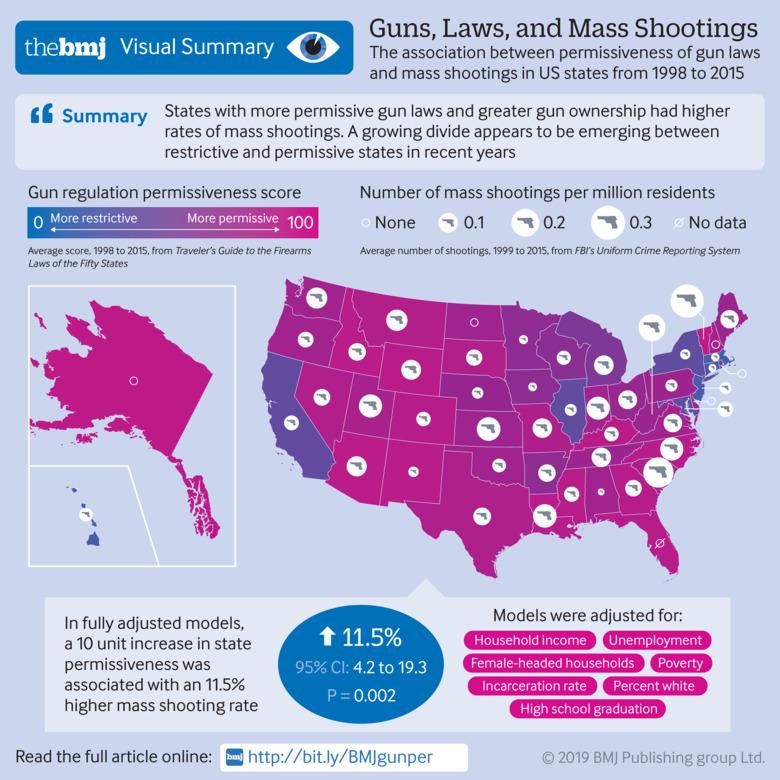
Our analyses show that US state gun laws have become more permissive in recent decades, and that a growing divide in rates of mass shootings appears to be emerging between restrictive and permissive states. A 10 unit increase in the permissiveness of state gun laws was associated with an approximately 9% higher rate of mass shootings after adjusting for key factors. A 10% increase in gun ownership was associated with an approximately 35% higher rate of mass shootings after adjusting for key factors. On the absolute scale, this means that a state like California, which has approximately two mass shootings per year, will have an extra mass shooting for every 10 unit increase in permissiveness over five years. It will also have three to five more mass shootings per five years for every 10 unit increase in gun ownership. These results were also consistent across multiple analyses and when stratified as to whether or not mass shootings were committed by someone in a close relationship with the victims.
Previous research
These associations between state gun laws, gun ownership, and mass shootings are analogous to what was found in previous research for other types of gun injuries.678910 To develop effective state gun laws, the underlying cause of the association with rates of mass shootings needs to be identified. Perhaps as a result of outside pressures, relatively few specific gun laws have been scientifically studied, much less proven effective, for gun violence outcomes in general, and mass shootings in particular.235 Domestic violence and suicide are commonly connected to mass shooting events, so state gun laws involving restraining orders and extreme risk protection orders may be valuable first opportunities for scientific evaluation.3637 Non-legislative approaches, such as environmental modifications, policing practices, and bystander training, could also be worthy of evaluation in potentially preventing and reducing the tragic impacts of mass shootings.38394041 As with other large-scale, population-wide solutions to relatively infrequent mass health threats, both legislative and non-legislative approaches should be carefully studied for their potential beneficial effects as well as any unintended consequences that could emerge. This caveat is applicable here given the low rate of mass shootings compared with daily shooting events, although certain solutions could benefit both events.4243444546
Strengths and limitations
There are several limitations to our study. Our study design incorporated a time series component, lagged variables, and multiple covariate adjustment strategies, and was primarily able to show broad associations between state gun laws, gun ownership, and mass shootings. The potential for omitted variable biases and reverse causation remain and future analyses are encouraged to build on our work by testing the before-and-after effects of enactment or repeal of gun laws in specific states, or both, alongside appropriately matched control states.
In addition, the state restrictiveness-permissiveness score we used has not been validated. However, this score had a wide range (0-100), was determined by legal professionals for use by actual gun owners, had nearly two decades of consistent data, and was highly correlated with other similar state-level scales that had been previously used (r=0.85).6 State gun laws and the enforcement of these laws can be difficult to separate and our measure of state gun laws might not reflect differing levels of enforcement among states with comparable restrictiveness-permissiveness scores.
There are concerns about potential under-reporting in the Uniform Crime Reporting System Supplemental Homicide reports due to some states failing to consistently report. However, these under-reported data would likely bias our results toward the null. If errors were randomly distributed, then there would be non-differential misclassification, leading to an underestimate of our association. Alternatively, if there is differential misclassification, evidence points to it being among more permissive states (such as Alabama, Nebraska, and Florida) most likely leading to, if anything, underestimation in the associations we found. Despite this, improved reporting systems for mass shootings, including better tracking of whether mass shooters legally possessed their firearms or crossed state lines to obtain their weapons, or both,4748 are needed to further improve the accuracy and detail of future analyses.
Conclusion and future directions
The permissiveness or restrictiveness of state gun laws is associated with the rate of mass shootings in the US. States with more permissive gun laws and greater gun ownership have higher rates of mass shootings, and a growing divergence is noted in recent years as rates of mass shootings in restrictive states have decreased and those in permissive states have increased. Better data collection on mass shootings and more studies that test changes to specific state gun laws, compared with states that have not made changes, are necessary based on our findings, the general increase in state gun law permissiveness, and the pressing need reduce mass shootings in the US.
What is already known on this topic
-
More permissive state gun laws and higher levels of gun ownership are associated with higher levels of gun homicide and gun suicide in the US
What this study adds
-
States with more permissive gun laws and greater gun ownership have higher rates of mass shootings
-
There is a growing divergence in recent years as rates of mass shootings in restrictive states have decreased and those in permissive states have increased
Footnotes
-
Contributors: All authors participated in the writing, editing, creation, and approval of this paper. PMR assembled the data, conducted the analyses, and wrote and edited the original manuscript. CCB first conceptualized the paper and participated in data preparation, analysis, writing, and editing. All authors had full access to the data in the study and can take responsibility for the integrity of the data and the accuracy of the data analysis. PMR is the guarantor. The corresponding author attests that all listed authors meet authorship criteria and that no others meeting these criteria have been omitted.
-
Funding: No extramural funding.
-
Competing interests: All authors have completed the ICMJE uniform disclosure form at www.icmje.org/coi_disclosure.pdf and declare: no support from any organization for the submitted work; no financial relationships with any organisations that might have an interest in the submitted work in the previous three years; no other relationships or activities that could appear to have influenced the submitted work.
-
Ethical approval: Owing to the aggregated nature of the count data used in the study, the Institutional Review Board at Columbia University determined that the study was exempt.
-
Patient consent: Not applicable.
-
Data sharing: Statistical code and dataset available from the corresponding author.
-
The lead author (PMR) affirms that this manuscript is an honest, accurate, and transparent account of the study being reported; that no important aspects of the study have been omitted; and that any discrepancies from the study as planned have been explained.
This is an Open Access article distributed in accordance with the Creative Commons Attribution Non Commercial (CC BY-NC 4.0) license, which permits others to distribute, remix, adapt, build upon this work non-commercially, and license their derivative works on different terms, provided the original work is properly cited and the use is non-commercial. See: http://creativecommons.org/licenses/by-nc/4.0/.
Leave a Reply
You must be logged in to post a comment.