Dublin International Airport, Ireland. Aer Lingus self check-in machines. Wikimedia, Marek Slusarczyk
Report to Congressional Committees
GAO-19-683: Published: Sep 17, 2019. Publicly Released: Sep 17, 2019.
Additional Materials
When travel plans go awry, airline passengers may take out their frustrations on customer service agents. We surveyed 104 customer service agents. About half said passengers had verbally threatened them and 10% said passengers had physically assaulted them in the past year.
We spoke with stakeholders (including prosecutors and airport police) who said current assault laws and law enforcement resources — primarily at the state and local levels — were generally sufficient to deal with these incidents. Airlines are also required under a new federal law to develop employee assault prevention and response plans for handling such incidents.
Number of Customer Service Agents Reporting Passenger Aggression Incidents, 2019

- Full Report:
Editor’s Note: We also found the following Communications Workersof America 2017 report regarding this issue:
CWA Campaign Restores Protections for Airline Agents Against Assault and Abuse
Thursday, January 12, 2017
Washington, D.C. — A longtime campaign and nationwide effort by the tens of thousands of passenger service agents represented by the Communications Workers of America (CWA) to protect all airline employees from physical and verbal abuse by passengers has succeeded. A law passed in 2002 outlined criminal fines and jail times for the assault of airline and airport employees engaged in security responsibilities. Passenger service agents, although covered by the intent of the law, were denied those protections.
CWA brought this issue to then Senator John Kerry in 2002 with clear language that should have been applied to all airport employees with security duties. However, the language was subsequently interpreted to apply only to law enforcement personnel and TSA employees. CWA knew the statute was intended to cover passenger service agents, and took action.
As a result of this decision, and CWA’s work to ensure these safeguards, passenger service agents at every airport in the nation now can be assured that “air rage” incidents they face as they perform their critical safety roles will be prosecuted. Agents at all airports regularly endure luggage and equipment thrown at them, as well as punches, slaps, and verbal abuse from angry passengers. Without the protections of federal law, these workers had little recourse and abusive passengers usually faced no consequences.
States Flubbed the Rollout of Their Health Insurance Exchanges. Now They’re Ready to Try Again
The launch of President Barack Obama’s Affordable Care Act was marred by the performance of the newly created state health insurance marketplaces.
With generous federal financial support, many states created these markets, also called exchanges, based on soaring promises: Individuals and small businesses could compare policies. They could get federal subsidies. It would be easy to sign up. And if people’s income declined, they could enroll in their state’s Medicaid plan.
It didn’t work out that way. Websites didn’t work. Data couldn’t be accessed. Call centers were overwhelmed, and states spent millions on quick fixes, many of which failed.
Hawaii, Nevada and Oregon abandoned plans to operate their independent marketplaces and instead relied on the federal marketplace, Healthcare.gov. Other states, including California, Colorado, Massachusetts, Maryland and Washington, spent millions of dollars to overcome problems with technology.
The experience so rattled states that seven years later, only 11 of them, plus Washington, DC, operate independent marketplaces. The rest either use the federal marketplace or a federal-state partnership.
But now at least six states — Maine, New Mexico, New Jersey, Nevada, Oregon and Pennsylvania — are creating their own marketplaces or seriously considering doing so.
Officials in those states insist they can avoid past failures and state-focused websites can help more residents get insurance. They believe they can piggyback on the successes of other states, and knowing their population and geography better positions them to increase enrollment and possibly reduce their residents’ premiums.
In recent years, experts say, vendors have developed software and other technology to make the online sign-up systems work.
“A lot of kinks have been worked out, and the ability to set up marketplaces that run effectively and efficiently has gone up,” said Jeanne Lambrew, commissioner of the Department of Health and Human Services in Maine, which hopes to launch its own exchange in 2021.
“We know much more now than states knew back in 2013,” said Lambrew, who was Obama’s deputy assistant for health policy and one of his top aides in the implementation of the ACA, including Healthcare.gov.
The states creating their own marketplaces or considering it have Democratic governors, some of whom recently succeeded Republicans. All but Pennsylvania have Democratic legislatures.
But notable Republicans also are supporting the shift to a state-based model. The previous governor in Nevada, Republican Brian Sandoval, initiated the effort in his state. And the Republican House majority leader in Pennsylvania, Bryan Cutler, has been a strong supporter of the move there.
The final Pennsylvania bill passed both chambers this year without a negative vote. Cutler said creating a state marketplace is consistent with traditional GOP values.
“Our philosophy is that local control is always best,” he said in an interview. “Time and again, it’s proven that states can do it better and cheaper than the federal government.”
The U.S. Department of Health and Human Services has not signaled any opposition to state-based exchanges, and Cutler pointed out that President Donald Trump, in an executive order issued the day he took office, trumpeted his administration’s intent to “afford the States more flexibility and control to create a more free and open healthcare market.” That executive order, however, pertained to his goal of repealing the ACA, which has so far eluded him.
HHS did not respond to a Stateline request for comment.
Lowering Premiums
A recent report by the National Academy for State Health Policy presented evidence that state-based health insurance exchanges enrolled more residents and kept premiums lower than Healthcare.gov. The decline in marketplace enrollment since 2016 has largely been driven by states using the federal marketplace, the report found.
While enrollment in the federal exchange declined by 3.7% this year, the report found, it increased in state-based exchanges by less than 1%. And while premiums increased by 71% on the federal exchange between 2016 and 2018, a period in which many health policy experts say Trump administration actions destabilized health insurance markets, the report found premiums in state exchanges increased by 40%.
Soon after taking office, the Trump administration slashed funding for advertising and consumer assistance designed to boost participation in the federal exchange. The administration also shortened the enrollment period for Healthcare.gov to six weeks. In some states with their own exchanges, enrollment stayed open for months. Colorado allowed enrollment year-round.
In an email to Stateline, Marlene Caride, commissioner of the New Jersey Department of Banking and Insurance, cited the Trump administration’s actions against Obamacare as one of the main reasons the state plans to run its own exchange starting next year.
“Clearly, activities at the federal level to undermine the ACA have created significant challenges for states,” Caride wrote.
Jessica Altman, Pennsylvania’s insurance commissioner, said she is confident her state’s marketplace, which it hopes to launch in 2021, will be superior to the federal marketplace.
“We know our markets and our consumer and our carriers best,” Altman said in an interview. “We believe we can leverage that information to make the experience of seeking health insurance more consumer-friendly and provide plans that are more affordable.”
Altman said the money Pennsylvania saves by running its own marketplace will allow it to add to the 400,000 state residents who get their individual coverage through the federal marketplace now, though she couldn’t say how many more people might enroll. She also said the shift will allow the state to extend open enrollment beyond the six weeks allowed under federal rules.
States also can do a better job in outreach efforts than the federal government, Altman said. A state exchange can gather reams of data about potential enrollees, which officials could use to better target their marketing. For example, the state could detect people who filled out most of an application but didn’t complete it, or young people about to turn 26 and become ineligible for their parents’ insurance plans.
“We understand that people who are uninsured in Philadelphia may be different from people in the rural areas of Pennsylvania,” Altman said. “We know who those people are and how we can better reach them. Even when the federal government was doing outreach and marketing, they were fairly one-size-fits-all.”
States Get More Time to Decide If They Will Run Their Own Health Insurance Exchanges
enroll consumers each year unless they opt out.
That is especially important, Korbulic said, now that the Trump administration has raised the possibility of ending that feature, which she said is popular with Nevadans, on the federal marketplace.
States that develop their own exchanges also can use the assessment fees that the federal government collects on insurance premiums sold in the federal marketplace. Altman estimated that would bring Pennsylvania an additional $88 million a year. She said that around $30 million to $35 million would go toward operating the state exchange.
Much of the remainder would go to the establishment of a state reinsurance fund, which would be used to pay health insurance claims for patients with exorbitant medical bills. That in turn should result in lower premiums for everyone else, according to a study by Oliver Wyman, a New York consulting firm, and commissioned by Altman’s office.
Moving to a state marketplace, the study estimated, could result in an overall decrease in insurance premiums of up to 10%.
Several states making the shift to a state-based exchange said they consulted with more experienced states and their vendors as they developed plans.
“Nevada spent two years working with our colleagues in other state-based exchanges,” said Janel Davis, spokeswoman for the state exchange, “looking at the mechanics of their operations to understand not only what would be required for Nevada’s own implementation, but also to understand what efficiencies could be achieved.”
But there are risks, cautioned Sarah Lueck, a senior health policy analyst at the Center for Budget Policy and Priorities, a progressive research and policy institute based in Washington, D.C.
“It’s still an expensive and risky proposition,” Lueck said — one that will have an obvious barometer for success.
“You don’t want to see a decrease in enrollment.”
Weekly Legislative Update and Meetings: “Taking Military Domestic Violence Out of the Shadows;” A Bill to Require Federal Law Enforcement Agencies to Report On Cases of Missing or Murdered American Indians
Floor Action:
Appropriations — This week, the Senate may consider S. 2474, the FY2020 Defense spending bill.
The House is scheduled to consider a congressional resolution (as-yet-unnumbered) to extend federal funding through November 21.
STEM — On Wednesday, the House is scheduled to consider S. 239, the Christa McAuliffe Commemorative Coin Act, and H.R. 1396, the Hidden Figures Congressional Gold Medal Act.


Right: Christa McAuliffe experiences weightlessness during KC-135 Flight, NASA
Mark-Ups:
Appropriations — On Tuesday, the Senate Appropriations Subcommittee on Agriculture, Rural Development, Food and Drug Administration (FDA), and Related Agencies will mark up the FY2020 Agriculture, Rural Development, FDA, and Related Agencies spending bill (as-yet-unnumbered).
The Senate Appropriations Subcommittee on Financial Services and General Government will mark up the FY2020 Financial Services and General Government spending bill (as-yet-unnumbered).
Also on Tuesday, the Senate Appropriations Subcommittee on Transportation, Housing and Urban Development, and Related Agencies will mark up the FY2020 Transportation, Housing and Urban Development, and Related Agencies spending bill (as-yet-unnumbered).
On Thursday, the Senate Appropriations Committee will consider the FY2020 Agriculture, Rural Development, FDA, and Related Agencies; Financial Services and General Government; and Transportation, Housing and Urban Development, and Related Agencies spending bills.
Veterans — On Wednesday, the House Veterans’ Affairs Committee will consider reauthorization of the Women Veterans’ Task Force.
Hearings:
Employment — On Thursday, the House Education and Labor Subcommittee on Civil Rights and Human Services will hold a hearing, “Examining the Policies and Priorities of the Equal Employment Opportunity Commission (EEOC) and the Office of Federal Contract Compliance Programs (OFCCP).”
Military — On Wednesday, the House Armed Services Subcommittee on Military Personnel will hold a hearing, “Shattered Families, Shattered Service: Taking Military Domestic Violence Out of the Shadows.”
BILLS INTRODUCED: SEPTEMBER 9-13, 2019
Employment
H.R. 4257 — Rep. David Scott (D-GA)/Agriculture (9/9/2019) — A bill to require the Commodity Futures Trading Commission to establish an Office of Minority and Women Inclusion, and for other purposes.
S. Res. 306 — Sen. Jacky Rosen (D-NV)/Commerce, Science, Transportation (9/10/19) — A resolution reaffirming the commitment to media diversity and pledging to work with media entities and diverse stakeholders to develop common ground solutions to eliminate barriers to media diversity.
H. Res. 549 — Rep. Val Demings (D-FL)/Energy and Commerce (9/10/19) — A resolution reaffirming the commitment to media diversity and pledging to work with media entities and diverse stakeholders to develop common ground solutions to eliminate barriers to media diversity.
Swedish Design, Color and Comfort: Furniture, Glass, Textiles and Ceramics by Swedish Designers From the Late 1920s to the Early 1960s
Under Ekvatorn (Beneath the Equator) (detail), designed 1941. Josef Frank (Swedish, b. Austria, 1885–1967) and Svenskt Tenn (Sweden, est. 1924). Linen: plain weave, printed; 193 x 125.7 cm. The Harold T. Clark Educational Extensions Fund
Devoted to themes of national heritage, color, nature, and abstraction, the new installation Color and Comfort: Swedish Modern Design at the Cleveland Art Museum features a large cache of rarely seen mid-century furnishing fabrics from the museum’s permanent collection. The exhibition also includes works of furniture, glass, and ceramic designed by important Swedish industrial designers from the late 1920s to the early 1960s. Iconic pieces by the most prolific designer of that period, Josef Frank, are shown among rare examples from a multitude of other artisans, including Viola Gråsten, sisters Gocken and Lisbet Jobs, Stig Lindberg, Sven Markelius, and Elizabeth Ulrick.
With the goal to modernize the household furnishings industry after the First World War, designers across Europe sought to make traditional, handcrafted decoration accessible not only through innovations in industrial manufacturing practices — such as larger, wider looms and machine-capable printing — but also through design, with appealing patterns that were affordable to produce.
In Sweden the push toward simple, economical living attracted young artisans eager to revolutionize the home furnishings industry. In the early 1930s one such émigré was architect and designer Josef Frank, who left Austria as the persecution of Jews mounted. Typical of industrial designers of that era, Frank worked in several sectors of the furnishings industry, designing furniture and textiles for multiple companies. His influential work included brightly colored, naturalistic patterns based on botanical prints by 18th-century Swedish botanist Carl Linnaeus. Moved by the beauty and detail of these prints, Frank used them to decoupage the outside of cabinets and as inspiration for his own textile patterns. Examples of both can be seen in this installation, showing his proficiency in design application.
Frank found kindred spirits in Sweden, especially among young professional women working in the fields of interior decoration and home furnishings. His collaboration with Estrid Ericson, founder of Stockholm-based manufacturer Svenskt Tenn, exposed his work to a broad audience through exhibitions and installations in department stores worldwide, including Kaufmann’s in Pittsburgh. Soon his work became synonymous with the best of Swedish and Scandinavian design, attracting the attention of critics and curators alike. Frank’s particular mode of organic, sinewy, naturalistic patterns laden with bright, contrasting colors on creamy white or inky, dark backgrounds also influenced other designers eager to embrace this popular stylized motif.
Detail of Melodi (Melody) designed 1947. Stig Lindberg and Nordiska Kompaniet. Linen: plain weave, printed; 94.6 x 78.1 cm. Gift of Mrs. B. P. Bole, Mr. and Mrs. Guerdon S. Holden, Mrs. Windsor T. White, and the L. E. Holden Fund
After the Second World War, design in Sweden took two divergent paths: one sought to reclaim the historical heritage appropriated by National Socialism during the war through traditional patterns and decoration, and the other followed the strongly modernist trends in contemporary architecture. Evocative examples of both styles are found in the CMA’s collection and help articulate a particularly Swedish sensibility synonymous with trends throughout Scandinavia during the 1950s and ’60s.
The bright colors in contrasting patterns that Frank made famous before the war can be seen in the abstract designs he later favored. In these works, pure geometry becomes distorted in wavy, less rigid lines carefully synchronized with how these textiles would look as a curtain bunched at a window or upholstered on a couch.
The same palette and use of abstract patterning is evident in the examples of Swedish glass and ceramics on view in the installation. Innovations in glassblowing and machine finishing allowed manufacturers to produce works of high artistic quality at relatively affordable prices, in much the same way the textile industry had transformed the availability of well-designed fabrics. All of these works enhance our understanding of the role of Swedish interior furnishings in uplifting and brightening an otherwise spartan existence that prevailed during both the economic depression of the 1930s and the lean postwar decades.
These remarkable examples represent an even larger group of works gathered during the period by the CMA’s education department for its Extensions program, which brought art to schools and libraries throughout northeast Ohio for more than 75 years. More recently, the textiles have been the subject of study for a class of graduate students from the CMA-CWRU joint program in art history and museum studies. Their research informed the development of this exhibition and has led to a much better understanding of the context of these works and their designers.
Again, don’t forget the Cleveland Museum of Art Shop.
Living Longer, Too? Native-born Californians Who Live Near Large Immigrant Populations Eat Healthier Foods
By Chloe Reichel, Journalist’s Resource
September 10, 2019
Native-born Americans who live in Los Angeles County neighborhoods with a higher proportion of immigrants tend to eat less fast food and more fruits and vegetables than those who live in local neighborhoods with a lower proportion of immigrants, new research finds. They also have lower body mass indices and rates of hypertension.
The study, forthcoming in Preventive Medicine, builds on scholarship on what researchers call the “healthy immigrant effect,” a term used to describe the tendency for US immigrants to have better health than native-born peers of comparable socioeconomic status.
Other research finds that native-born Americans who live in neighborhoods with a higher proportion of immigrants tend to live longer.
What if these effects stem from a neighborhood’s food options? That’s what the authors of this forthcoming paper explore.
Lisa Bronner: Five Life Habits for Healthy Skin – The Foundation of Healthy Skin Begins with Habits That May Appear Unconnected
Put the lotion down. Healthy skin does not start there. Nor does it begin with the right cleanser, exfoliator, masque, peel, toner, or micellar water. Rewind your steps until you’re out of the bathroom.
The foundation of your healthy skin begins with five life habits that may appear unconnected to skincare.
There’s a kind of desperation that surfaces in the skincare aisle when you’re looking for that for that one product which will perfect tired, dreary skin. However, if you don’t have these skincare basics in place you’ll be disappointed — no matter how much money or magic you spend in the beauty aisle. You may even find that with these five steps pricey products will be unnecessary.
Nothing I’m about to say here is new. Sometimes in our pursuit of perfection, we forget to start with the basics. Furthermore, the benefits of each of these habits reach far beyond the skin. You will find increased overall healthfulness as well as mental agility and emotional balance.
1. Sleep. I used to think that sleep was for people who didn’t have anything better to do. However, no beauty treatment will make up for simple lack of sleep.
I’m talking the full recommended 7+ hours. And don’t give me the, “Well, I only need four.” If your skin is dragging, if it’s dull, if your eyes are puffy, or if acne, psoriasis, eczema plague you, then sleep is exactly where you need to start the healing process. It is the first line of defense. In my grandfather’s classic phrase, “Enjoy only 2 cosmetics, enough sleep & Dr. Bronner’s ‘Magic Soap’.”
Sleep increases blood flow and production of the human growth hormone which in turn contributes to collagen production, relaxes facial muscles that foster lines, aids regeneration of skin cells, rebalances body moisture to reduce puffy eyes and reduces overall inflammation that triggers problems such as psoriasis, acne, and eczema. A study in The British Medical Journal says it best: “Our findings show that sleep deprived people appear less healthy, less attractive, and more tired compared with when they are well rested.”
“But I can’t go to sleep!! I have too much to do,” you say. Your skin is saying the exact same thing. Your wakeful conscious self is getting in the way. Go to sleep so that your body can get to work.
Tip: Schedule your sleep. Set yourself a “go to sleep” alarm for 8½ hours before your “need to get up” alarm.
2. Drink water. Although common sense backs this up there’s a surprising lack of research to support drinking water for skin health. Plain water is fine, fairly free, and doesn’t produce waste.)
The recommended 8 cups a day is just a guideline. What you need depends on size, activity level, weather and other circumstances. Thirst is the unquestioning indicator, but sometimes we all too easily ignore it.
Why: A symptom of dehydrated skin is loss of skin elasticity which means dehydrated skin cells are dry, flaky, and prone to wrinkling. With adequate hydration the skin can pull more water into cells to plump up and tighten them, making skin smoother and firmer, with fewer facial lines or visible cellulite.
Tip: Fill a pitcher or jug each morning with your daily amount of water. Set a goal to finish it by day’s end. Each time you want to consume anything — from a cup of coffee to a full meal — drink a glass of water first. You may find you eat less because what you mistook for hunger was actually thirst.
Fraud Alert: Genetic Testing Scam Issued by US Department of Health and Human Services Office of Inspector General
The US Department of Health and Human Services Office of Inspector General is alerting the public about a fraud scheme involving genetic testing.
Genetic testing fraud occurs when Medicare is billed for a test or screening that was not medically necessary and/or was not ordered by a Medicare beneficiary’s treating physician.
Scammers are offering Medicare beneficiaries “free” screenings or cheek swabs for genetic testing to obtain their Medicare information for identity theft or fraudulent billing purposes. Fraudsters are targeting beneficiaries through telemarketing calls, booths at public events, health fairs, and door-to-door visits.
Beneficiaries who agree to genetic testing or verify personal or Medicare information may receive a cheek swab, an in-person screening or a testing kit in the mail, even if it is not ordered by a physician or medically necessary.
If Medicare denies the claim, the beneficiary could be responsible for the entire cost of the test, which could be thousands of dollars.
Protect Yourself
- If a genetic testing kit is mailed to you, don’t accept it unless it was ordered by your physician. Refuse the delivery or return it to the sender. Keep a record of the sender’s name and the date you returned the items.
- Be suspicious of anyone who offers you “free” genetic testing and then requests your Medicare number. If your personal information is compromised, it may be used in other fraud schemes.
- A physician that you know and trust should assess your condition and approve any requests for genetic testing.
- Medicare beneficiaries should be cautious of unsolicited requests for their Medicare numbers. If anyone other than your physician’s office requests your Medicare information, do not provide it.
- If you suspect Medicare fraud, contact the HHS OIG Hotline.
Related Material: Senior Medicare Patrol’s Information on Genetic Testing Fraud
Last updated: August 13, 2019
Data Note: A Look At Swing Voters Leading Up To The 2020 Election
Ashley Kirzinger, Audrey Kearney, Mollyann Brodie, Charlie Cook, and Amy Walter, Henry J. Kaiser Family Foundation
Key Findings
- Three in ten voters are swing voters, meaning they haven’t made up their minds about who they plan to vote for in the 2020 presidential election. While swing voters look similar to their decided counterparts on many demographics, they tend to be younger, more moderate, and less engaged on national politics. Nearly one-fourth of swing voters say they didn’t vote in the 2018 election (22%) or in the 2016 presidential election (24%).
- It is important to note that not all “swing voters” could potentially change their vote to support the other party’s candidate. About half of swing voters (16% of all voters) are truly persuadable. These voters either say they are undecided about who they plan to vote for (8%) or say that while they are probably going to vote for either President Trump or the Democratic nominee, there is a chance they will vote for the other party’s candidate (8%). The other share of swing voters (14% of all voters) say that they are probably going to vote for either President Trump or the Democratic nominee and there is no chance they will vote for the other party’s candidate. While they say there is no chance they will vote for the other party’s candidate, they could choose to not vote at all. In other words, these folks may not change their minds to support another candidate, but if they don’t like what they see from the party they like, they could just stay home.
- Many factors could influence voters’ decisions to either vote for President Trump or the Democratic nominee or even stay home on Election Day. This analysis finds issues like climate change, health care, immigration, or the economy could influence swing voters’ vote choice in 2020. Democrats may have the edge on three issues among swing voters: climate change (38 percentage point advantage), health care (18 percentage points), and immigration (10 percentage points) while President Trump, on the other hand, may have the edge on the economy (12 percentage points). As the 2020 presidential campaign continues, this data indicates that Democrats may benefit more when the focus is on climate change, health care, and immigration, while President Trump may have the advantage on the economy among this group of swing voters. Yet, it is important to note that if the economy slows down significantly, the edge that President Trump has on the economy may dissipate.
- The issue of health care means different things to voters on different sides of the aisle. Nearly half (44%) of swing voters who prefer the Democratic nominee on health care offer responses related to increasing access to health insurance coverage as the reason why they support the Democratic nominee on this issue. Swing voters who prefer President Trump on health care do not appear to be rallying behind a single health care issue but offer varying responses. Lowering the amount people pay for health care ranks high for both sets of swing voters (19% and 16%, respectively).
-
Who Are The 2020 Swing Voters?
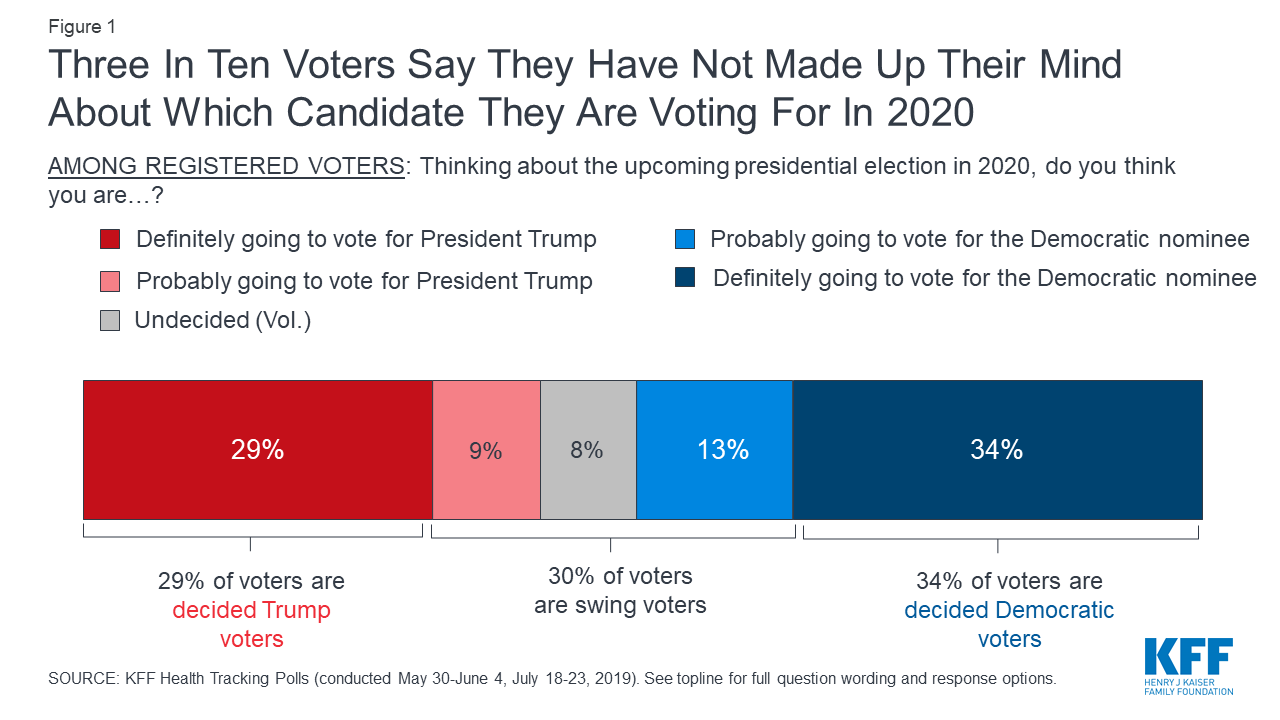
Nearly two-thirds of voters say they have already made up their minds about which candidate they plan to vote for. About one-third of voters (34%) say they are “definitely” going to vote for the Democratic nominee while three in ten (29%) say they are “definitely” going to vote for President Trump. This leaves three in ten voters as the crucial voting block known commonly as “swing voters.” This group of voters either say they are “probably” going to vote for President Trump (9%), “probably” going to vote for the Democratic nominee (13%), or say they are undecided about how they will vote (8%).
Figure 1: Three In Ten Voters Say They Have Not Made Up Their Mind About Which Candidate They Are Voting For In 2020
It is important to note that not all “swing voters” could potentially change their vote to support the other party’s candidate. Among voters who say they are probably going to vote for either President Trump or the Democratic nominee, few say there is “a chance” they will vote for the other party’s candidate. Among all voters, 5% say they will probably vote for President Trump but there is “a chance” they will vote for the Democratic nominee, while 3% of all voters say they will probably vote for the Democratic candidate but there is “a chance” they will vote for President Trump.
A Comprehensive Outreach on Monetary Policy At a Fed Listens Event: “How can we help you better understand our work so you can hold us accountable?”
September 04, 2019
Introductory Remarks
Governor Michelle W. Bowman at a Fed Listens Event sponsored by the Federal Reserve Bank of St. Louis, St. Louis, Missouri.
In keeping with the purpose of Fed Listens, I would like to spend most of our time in conversation, but I do want to offer a few thoughts about why the Fed is reaching out to seek a broad range of views, and what we are trying to achieve.
This kind of comprehensive outreach on monetary policy is new for the Fed. For many decades, there was a sense at the Board that the public wasn’t interested or willing to dive into the complexities of monetary policy. That view has changed in a fundamental way, especially in the aftermath of the financial crisis when it was urgently important that the public understand what we were doing. So we began explaining as accessibly and clearly as we could what we were doing and why. Now we are listening broadly as well.
Since I became a Board member almost a year ago, it’s become clear to me that people not only are willing to engage on complex economic issues, they also want to know that their concerns are being taken into account on issues that affect their financial well-being.
The movement toward greater transparency and public engagement is ongoing, and advancing that effort is one of my top priorities.
At the same time, we recognize that clear communication of our policies actually helps us achieve our goals. When we communicate our views on the economic outlook and our expectations for where interest rates may be heading, consumers and businesses take that information into account when making decisions on spending, investment, and hiring. For that reason, our policy communications are themselves an important part of the Fed’s toolkit for influencing the direction of the economy.
Fed Listens is a natural outcome of this commitment to public engagement.
Legislators and Community Leaders Debating Ways to Boost the Number of Children Who Are Up to Date on School-Mandated Vaccinations
September 1, 2019
In June, New York became the fifth state to require its schoolchildren to be vaccinated despite their parents’ religious beliefs or philosophical objections.
Amid a surge in measles cases nationwide this year, legislators and community leaders are debating ways to boost the number of kids who are up to date on their school-mandated shots. Many have focused on restricting or eliminating vaccination exemptions based on religion or personal opinions, which are common and have been offered by school districts across the United States for decades.
But three recent academic studies suggest this might not be the most effective way to improve childhood vaccination rates. In fact, the research indicates banning these exemptions could backfire.
Scholars studied student vaccination rates in California, the nation’s most populous state, and discovered that when parents cannot get an exemption based on their personal beliefs, some seek other ways for their children to stay in school while skipping one or more vaccinations. The researchers also learned that while California lawmakers have targeted personal belief exemptions, which are used by a relatively small group of students, a larger group of children is being allowed to enter kindergarten on a “conditional status” basis with incomplete vaccinations.
In 2014 — the year before California passed a law eliminating vaccine exemptions based on personal beliefs, including religious beliefs — 13,254 California kindergarteners used these exemptions to forgo vaccinations. Meanwhile, another 36,411 kindergarteners were admitted to school on a conditional basis, according to the research.
Paul L. Delamater, the lead researcher on one of the three studies and the co-author of another, says helping conditional status students finish getting their shots would be a more effective way to boost vaccination rates than banning personal belief exemptions.
Also, he says, it likely would be easier to encourage the parents of conditional status students to get their kids up to date than it would be to convince parents who want their children to be able to opt out of the vaccine requirement.
“Trying to focus on parents who are not vaccine hesitant first may be a good way forward,” says Delamater, a fellow at the Carolina Population Center who’s also an assistant professor at the University of North Carolina at Chapel Hill. “I think parents with real vaccine hesitancy are going to search for ways to not vaccinate their children.”