Author: SeniorWomenWeb

  • Annual Report to the Nation Part 2: New Cancer Diagnoses Fell Abruptly Early In the COVID-19 Pandemic

    Lung cancer diagnoses fell from March 2020 to May 2020, one of six major cancer types to experience a dip during the early part of the pandemic. Monica Bertagnolli

    “These missed opportunities for early cancer detection are alarming, particularly for those vulnerable populations that continue to face significant barriers in accessing cancer care,” said Monica M. Bertagnolli, M.D., director of the National Cancer Institute (NCI), right. “This report highlights the urgency in helping all Americans get back on track with their cancer care so that we can avoid unnecessary deaths and complications from cancer. That’s exactly why expanding cancer screening access and awareness is a key priority of the Biden-Harris administration’s Cancer Moonshot.”

    This study is the largest to date using population-based data from central cancer registries to assess the impact of the COVID-19 pandemic on cancer incidence (new diagnoses of cancer) in the United States. The report appeared September 27, 2023, in Cancer.

    The Annual Report to the Nation on the Status of Cancer is a collaborative effort among NCI, part of the National Institutes of Health; the Centers for Disease Control and Prevention (CDC); the American Cancer Society; and the North American Association of Central Cancer Registries to provide information about cancer occurrence and trends in the United States. Part 1 of the latest report, which focused on national cancer statistics, was released in October 2022.

    Part 2 of the latest report focuses on annual-report-to-the-nation-part-2-new-cancer-diagnoses-fell-abruptly-early-in-the-covid-19-pandemicduring the first year of the COVID-19 pandemic. The authors suggest that these changes were due in part to interruptions in medical care. In particular, early 2020 saw a decline in cancer screenings. In addition, diagnoses made as a result of early symptoms or in the course of routine medical visits may have been delayed when people held off on seeing their doctors.  

    The authors analyzed cancer incidence data for 2015 to 2020 using data from select population-based cancer registries that participate in CDC’s National Program of Cancer Registries or NCI’s Surveillance, Epidemiology, and End Results (SEER) Program.

    The authors compared the number of newly diagnosed cases of cancer in 2020 with what was expected based on previous years. They looked at female breast, lung, and colorectal cancers, which are often diagnosed through screening tests or other forms of early detection that may have been disrupted by the pandemic; thyroid and prostate cancers, which are often diagnosed incidentally; and pancreatic cancer, which is usually diagnosed when the patient presents with symptoms. The authors also compared the volume of electronic pathology reports sent to central cancer registries in 2020 with the volume sent in 2019.

    From March to May 2020, new cases of all six cancer types fell sharply. By July 2020, however, diagnoses of all cancer types except prostate cancer had returned to pre-pandemic levels, with little difference between observed and expected numbers during the second half of the year.

    Over the same period in early 2020, the volume of electronic pathology reports also declined steeply before returning to pre-pandemic levels. Because these reports are transmitted automatically to cancer registries, the findings suggest that the decline in new cancer diagnoses was not due to delays in reporting caused by pandemic disruptions but rather to missed screenings and delays in other cancer-related procedures.

    The authors also looked at declines in new cancer cases by cancer stage at diagnosis, sex, age, and population group. For each cancer type in the study, new cases of early-stage cancers fell more sharply than new cases of advanced cancers. The declines were greatest for the cancers typically diagnosed through screening (female breast, lung, and colorectal cancer). For example, 7,147 cases of early-stage colorectal cancer were expected to be diagnosed in 2020, but only 5,983 cases were diagnosed — meaning that potentially more than 16% of early-stage colorectal cancer cases weren’t caught.

  • Women’s Congressional Policy Institute Legislative Update Including a Bill to Provide Loan Deferment for Borrowers And Survivors of Sexual Harassment, Stalking and Assault

    Bills Introduced: September 18-22, 2023

    Madeline Dean

    Education 

    S. 2872 –– Sen. John Fetterman (D-PA)/Health, Education, Labor, and Pensions (09/20/2023) –– A bill to amend the Higher Education Act of 1965 to provide for the deferment of loans for borrowers who are survivors of sexual harassment, stalking, and assault.

    H.R. 5588 –– Rep. Madeleine Dean (D-PA)/Education and the Workforce (09/20/2023) –– A bill to provide for the deferment of loans for borrowers who are survivors of sexual harassment, stalking, and assault. 

    (Right), Rep. Madeleine Dean, center, in blue,  (D-Pa)

    Employment

    H.R. 5578 –– Rep. Jan Schakowsky (D-IL)/Education and the Workforce; House Administration; Oversight and Accountability; Judiciary (09/19/2023) –– A bill to extend protections to part-time workers in the areas of family and medical leave and to ensure equitable treatment in the workplace.

    Family Planning 

    H.R. 5540 –– Rep. Doug Lamborn (R-CO)/Ways and Means (09/18/2023) –– A bill to provide birth mothers and adoptive families with access to an annually updated list of adoption agencies that are licensed and not-for-profit in states across the United States.

    Family Support 

    H.R. 5581 –– Rep. Jennifer McClellan (D-VA)/Ways and Means (09/20/2023) –– A bill to authorize grants for demonstration projects to support mothers and families during, pregnancy, childbirth, and the postpartum period by increasing access to short-term child care, and for other purposes.  

    Health

    S. 2879 –– Sen. Tammy Duckworth (D-IL)/Finance (09/21/2023) –– A bill to address the increased burden that maintaining the health and hygiene of infants and toddlers, medically complex children, and low-income adults or adults with disabilities who rely on adult incontinence materials and supplies place on families in need, the resultant adverse health effects on children and families, and the limited child care options available for infants and toddlers who lack sufficient diapers and diapering supplies, and for other purposes.

    H.R. 5644 –– Rep. Barbara Lee (D-CA)/Energy and Commerce; Ways and Means (09/21/2023) –– A bill to address the increased burden that maintaining the health and hygiene of infants and toddlers, medically complex children, and low-income adults or adults with disabilities who rely on adult incontinence materials and supplies place on families in need, the resultant adverse health effects on children and families, and the limited child care options available for infants and toddlers who lack sufficient diapers and diapering supplies, and for other purposes. 

    H. Res. 713 –– Rep. Rosa DeLauro (D-CT)/Oversight and Accountability (09/21/2023) –– A resolution recognizing the importance of diapers to infant health and family well-being, and expressing support for the designation of the week of September 18-24, 2023, as “National Diaper Need Awareness Week”. 

  • Jo Freeman Writes: END FOSSIL FUELS NOW Marchers Tell Biden

    climate.nasa.gov
     
    Credit: NASA’s Earth Observatory/Lauren Dauphin
     
    by Jo Freeman
      
    A coalition of national and local organizations brought approximately 15,000 people to NYC to demand that President Joe Biden end the use of fossil fuels.  On Sunday, September 17 they marched from Columbus Circle across Manhattan to rally half a mile from the United Nations. 
     
    This was the first day of Climate Week, which is held every year at the beginning of the United Nations General Assembly in New York City. President Biden will address that Assembly on Tuesday.  A UN Climate Ambition Summit will be held on Wednesday, September 20.   Biden will be meeting with other Heads of State that day as well.
     
    The march’s message was exclusively aimed at Biden even though he has been moving the US away from the use of fossil fuels.  The signs and speeches were sharply critical.  None mentioned Republicans, who are major barriers to Biden’s efforts.
     
    The rare exception was a large banner which said (NYC Mayor) ERIC ADAMS IS A REPUBLICAN.  The banner was carried by a group from New York Communities for Change  wearing orange t-shirts.  Their distaste for Eric Adams has nothing to do with the environment or fossil fuels.  It is a result of his statement that asylum seekers will “destroy” NYC.
     
    Sunday’s rally was one of several hundred protests held in 54 counties with the message that global warming must STOP.  It was the largest climate march in NYC in four years.
     
    The walk via 52nd  Street had to repeatedly expand and contract as parked cars and closed off lanes limited those who could walk an entire block.  A dozen pedicabs carried passengers with signs in the bike lane.  Sometimes the marchers were so tightly packed they could barely move. Sometimes they were widely spaced.
     
    Lots of colorful signs and props waited their turn at Columbus Circle, but not all of them made it to the end of the march. Those that did were deposited outside the rally area in order not to block the view.
     
    First Avenue was blocked off from 51st to 54th Street for the rally.  A jumbotron was set up at 52nd Street for those who stayed to hear the speakers. That space would never have held the 75,000 people that rally organizers claimed as participants, but was plenty for the twelve to fifteen thousand who actually came. It was practically empty when the rally broke up near 5:00 p.m.

  • Women’s Congressional Policy Institute: Child Trafficking, Increasing Survivors Benefits for Disabled Widows, Widowers, Surviving Divorced Spouse


    Bringing women policymakers together across party lines to advance

    issues of importance to women and their families.

    Weekly Legislative Update

    September 11, 2023

    Bills Introduced: September 5-8, 2023


    Human Trafficking  


    S. 2744—Sen. Catherine Cortez Masto (D-NV)/Commerce, Science, and Transportation (09/07/23)—A bill to provide grants to transit operators and airports for human trafficking awareness, education, and prevention efforts, and for other purposes.


    Social Security/Retirement 


    S. 2741—Sen. Robert P. Casey (D-PA)/Finance (09/07/23) — A bill to increase survivors benefits for disabled widows, widowers, and surviving divorced spouses, and for other purposes. 


    Veterans 


    S. Res. 328—Sen. Joe Manchin (D-WV)/Judiciary (09/05/23)—A resolution designating April 5, 2023, as “Gold Star Wives Day.”


    This Week: September 11-15, 2023


    Floor Action: 


    The House and Senate are in session. 


    Appropriations- On Wednesday, the House is expected to begin consideration of H.R. 4365, the FY2024 Defense spending bill.  


    This week, the Senate is scheduled to consider a “minibus” spending package that will include S. 2131, the FY2024 Agriculture, Rural Development, Food and Drug Administration, and Related Agencies spending bill; S. 2127, the Military Construction, Veterans Affairs, and Related Agencies spending bill; and S. 2437, the Transportation, Housing and Urban Development, and Related Agencies spending bill.  


    Hearings: 


    Child Protection- On Wednesday, the House Judiciary Subcommittee on Crime and Federal Government Surveillance will hold a hearing, “Children are Not for Sale: Examining the Threat of Exploitation of Children in the U.S. and Abroad.” 


    Human Trafficking- On Thursday, the House Foreign Affairs Subcommittee on Global Health, Global Human Rights, and International Organizations will hold a hearing, “Children are not for Sale– Global Efforts to Address Child Trafficking.”  


  • IRS Announces Sweeping Effort to Restore Fairness to Tax System With Inflation Reduction Act Funding

    New  compliance efforts focused on increasing scrutiny on high-income, partnerships, corporations and promoters abusing tax rules on the books IRS

    Agency focus will shift attention to wealthy from working-class taxpayers; key changes coming to reduce burden on average taxpayers while using Artificial Intelligence and improved technology to identify sophisticated schemes to avoid taxes

    IR-2023-166, Sept. 8, 2023

    WASHINGTON — Capitalizing on Inflation Reduction Act funding and following a top-to-bottom review of enforcement efforts, the Internal Revenue Service announced today (Friday, the 8th of September) the start of a sweeping, historic effort to restore fairness in tax compliance by shifting more attention onto high-income earners, partnerships, large corporations and promoters abusing the nation’s tax laws.

    The effort, building off work following last August’s IRA funding, will center on adding more attention on wealthy, partnerships and other high earners that have seen sharp drops in audit rates for these taxpayer segments during the past decade. The changes will be driven with the help of improved technology as well as Artificial Intelligence that will help IRS compliance teams better detect tax cheating, identify emerging compliance threats and improve case selection tools to avoid burdening taxpayers with needless “no-change” audits.

    As part of the effort, the IRS will also ensure audit rates do not increase for those earning less than $400,000 a year as well as adding new fairness safeguards for those claiming the Earned Income Tax Credit. The EITC was designed to help workers with modest incomes. Audit rates of those receiving the EITC remain at high levels in recent years while rates dropped precipitously for those with higher income, partnerships and others with more complex tax situations. The IRS will also be working to ensure unscrupulous tax preparers do not exploit people claiming these important tax credits.

    “This new compliance push makes good on the promise of the Inflation Reduction Act to ensure the IRS holds our wealthiest filers accountable to pay the full amount of what they owe,” said IRS Commissioner Danny Werfel. “The years of underfunding that predated the Inflation Reduction Act led to the lowest audit rate of wealthy filers in our history. I am committed to reversing this trend, making sure that new funding will mean more effective compliance efforts on the wealthy, while middle- and low-income filers will continue to see no change in historically low pre-IRA audit rates for years to come.”

    “The nation relies on the IRS to collect funding for every critical government mission — from keeping our skies safe, our food safe and our homeland safe. It’s critical that the agency addresses fundamental gaps in tax compliance that have grown during the last decade,” Werfel added. “There is a sea change taking place at the IRS in every aspect of our operations. Anchored by a deep respect for taxpayer rights, the IRS is deploying new resources towards cutting-edge technology to improve our visibility on where the wealthy shield their income and focus staff attention on the areas of greatest abuse. We will increase our compliance efforts on those posing the greatest risk to our nation’s tax system, whether it’s the wealthy looking to dodge paying their fair share or promoters aggressively peddling abusive schemes. These steps are critical for the future of the nation’s tax system.”

    For the broader compliance work going on across the IRS, this will be an expansive effort with more details to be announced in the weeks and months ahead. Key elements of this new effort include:

    Major expansion in high-income/high wealth and partnership compliance work

    Prioritization of high-income cases. In the High Wealth, High Balance Due Taxpayer Field Initiative, the IRS will intensify work on taxpayers with total positive income above $1 million that have more than $250,000 in recognized tax debt. Building off earlier successes that collected $38 million from more than 175 high-income earners, the IRS will have dozens of Revenue Officers focusing on these high-end collection cases in FY 2024. The IRS is working to expand this effort, contacting about 1,600 taxpayers in this category that owe hundreds of millions of dollars in taxes.

    Expansion of pilot focused on largest partnerships leveraging Artificial Intelligence (AI). The complex structures and tax issues present in large partnerships require a focused approach to best identify the highest risk issues and apply resources accordingly. In 2021, the IRS launched the first stage of its Large Partnership Compliance (LPC) program with examinations of some of the largest and most complex partnership returns in the filing population. The IRS is now expanding the LPC program to additional large partnerships. With the help of AI, the selection of these returns is the result of groundbreaking collaboration among experts in data science and tax enforcement, who have been working side-by-side to apply cutting-edge machine learning technology to identify potential compliance risk in the areas of partnership tax, general income tax and accounting, and international tax in a taxpayer segment that historically has been subject to limited examination coverage. By the end of the month, the IRS will open examinations of 75 of the largest partnerships in the U.S. that represent a cross section of industries including hedge funds, real estate investment partnerships, publicly traded partnerships, large law firms and other industries. On average, these partnerships each have more than $10 billion in assets.

    Greater focus on partnership issues through compliance letters. The IRS has identified ongoing discrepancies on balance sheets involving partnerships with over $10 million in assets, which is an indicator of potential non-compliance. Taxpayers filing partnership returns are showing discrepancies in the millions of dollars between end-of-year balances compared to the beginning balances the following year. The number of such discrepancies has been increasing over the years. Many of these taxpayers are not attaching required statements explaining the difference. This effort will focus on high-risk large partnerships to quickly address the balance sheet discrepancy. Prior to the IRA, the IRS did not have the resources needed to follow up and engage with all the large partnerships with such discrepancies. However, the IRS will soon have the resources and plan in place to ramp up this effort. It will begin in early October when the IRS will start mailing around 500 partnerships. Depending on the response, the IRS will add these to the audit stream for additional work.

    Priority areas for targeted compliance work in FY 2024

    The IRS has launched numerous compliance efforts to address serious issues being seen. Some of these, like abusive micro-captive insurance arrangements and syndicated conservation easement abuses, have received extensive public attention. But much more work continues behind the scenes on other issues.

    Among some of the additional priority areas the IRS will be focused on that will touch the wealthy evaders include:

    Expanded work on digital assets. The IRS continues to expand efforts involving digital assets, including work through the John Doe summons effort and last month’s release of proposed regulations of broker reporting. The IRS Virtual Currency Compliance Campaign will continue in the months ahead after an initial review showed the potential for a 75% non-compliance rate among taxpayers identified through record production from digital currency exchanges. The IRS projects more digital asset cases will be developed for further compliance work early in Fiscal Year 2024.

  • National Archives Foundation: Archives Experience, A Republic, If You Can Keep It

    Washington, DC 

    In September, the National Archives will present free public programs at the National Archives Museum in Washington, DC, at its Presidential Libraries nationwide and online. Programs this month include book talks with award-winning authors and live concerts as well as Civics for All of US offerings

    • Removing the Crown

     Welcome to the Archives Experience debut series: A Republic, If You Can Keep It. In celebration of Constitution Day, we’re chronicling the creation of this document — but these aren’t the stories we’ve all heard before. Instead, we’ll look at how the National Archives holdings show just how close we came to an entirely different form of government and how “We the People” triumphed in the end.

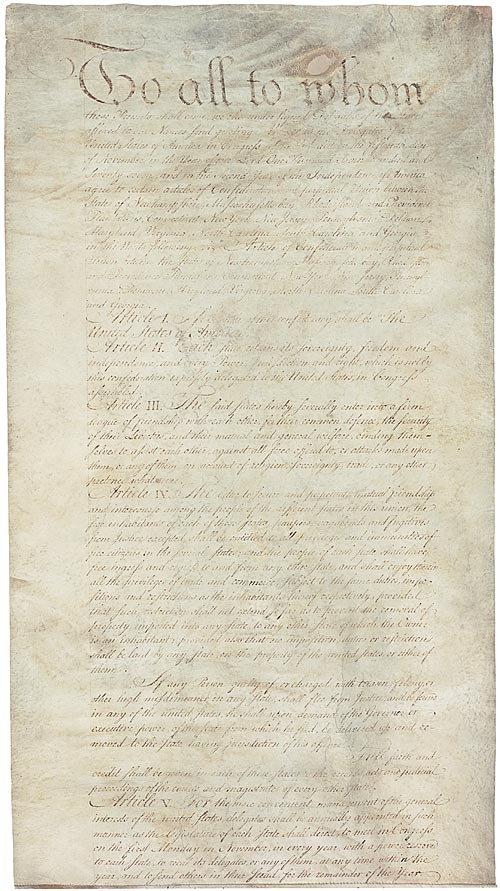
    Our first attempt at self-governing was a failure. Eager to shed the absolute rule of monarchy, the Founding Fathers at first created a loose association of states, technically under one government, but not at all united.
    As a result, some thought the pendulum had swung too far. By the time the Founders gathered to address the shortcomings of the Articles of Confederation, some of them were back to advocating for a monarch to and set us on the right course.
    This is the story of how the United States avoided instituting monarchy…


    The Magna Carta, the charter of liberties granted by King John of England in 1215, is the foundation of individual rights in Anglo-American law. Agreed upon in June of that year at Runnymede, the document affirmed that the king was subject to the charter and that if he did not conform to its clauses, his barons were authorized to declare war on him. The Magna Carta represented the English barons’ first step toward demolishing the principle of vis et voluntas, or “force and will,” by which the English monarch had reigned up until that point. Thus it was established that the king was subject to the laws of men, rather than ruling by absolute power.

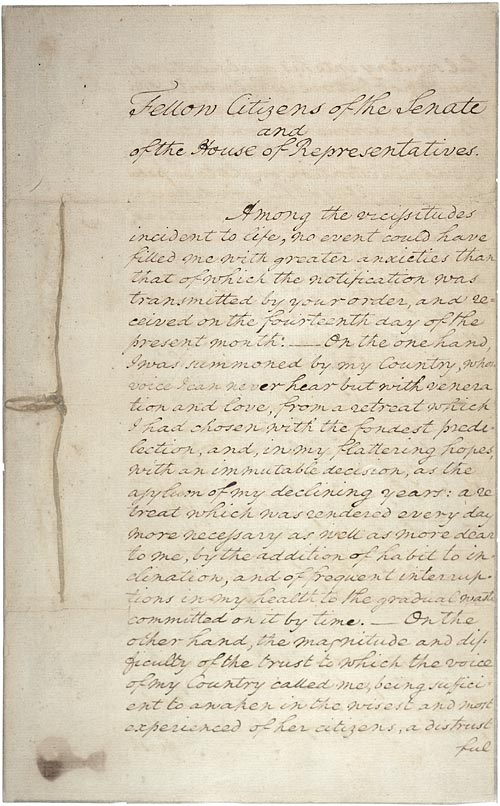
    George Washington’s inaugural address
    NARA’s Milestone Documents


    Magna Carta
    NARA’s Milestone Documents


    Articles of Confederation
    NARA’s Milestone Documents


    When the American colonists revolted against the tyranny of the British crown, they chose George Washington to lead the Continental Army. Aged 43 when he accepted his command, Washington had already played many different roles—soldier, scholar, gentleman, land surveyor, planter, slave owner, legislator, and Virginian, which means, above all, he was an aristocrat. He led the army in the fight against the British from 1775 until the Revolutionary War ended in 1783.
    On May 22, 1782, after the British had surrendered at Yorktown but before the Treaty of Paris had been finalized, one of Washington’s officers, Lewis Nicola, wrote him a letter proposing that he become king of the new nation. Nicola reasoned that the nations that had attempted a republican form of government—Venice, Genoa, and Holland—had not been successful, while monarchies such as Britain had worked out rather better. We do not have a record of the general’s reply, but we do know of his actions, which speak louder than words. George Washington most emphatically did not want to become King George I of America.


    On December 4, 1783, Fraunces Tavern on Broad Street in New York City hosted an elaborate dinner for General George Washington, at which he bade his fellow officers farewell. He then traveled by horseback to Annapolis, Maryland, where the Continental Congress was meeting. On December 23, he addressed the congress and formally resigned his military commission, handing over the original document, which was dated June 15, 1775, to the assembled delegates. Many who witnessed this event wept.

  • Rose Madeline Mula: It Was Here a Minute Ago

    It Was Here a Minute Ago                                                                              Rose Madeline Mula                                                        

    by Rose Madeline Mula                                                           

    Most people have time to watch TV, read trashy novels, meander through malls, gossip on the phone, nap, daydream … 

    Not me.  I can’t indulge in such frivolous pursuits.  I’m too busy looking for things I’ve misplaced.

    In the time I’ve spent searching for lost keys, glasses, my pearl earrings, my favorite chili recipe, I could have written one of those trashy novels other people find time to read.  Instead, I can only dash off this short article  which is a real exercise in futility since I won’t have time to send it to any publishers.  I’ll be too busy looking for something.  Like my car.

    Yes, my car.  I’m always losing it … on city streets, parking lots, and once in front of my own house.  I used to rent a garage from the neighbors across the street, you see.  One night I came home late, and instead of driving into the garage, I parked smack up against a stairway that leads up an embankment to my house.  The next morning, a slave to habit, I headed for the garage.  No car!  It must have been stolen!  I rushed back across the street to call the police, but something stopped me.  My car. It was blocking the stairs.  I had actually had to squeeze past it a few minutes earlier when I went to the garage.

    I thought no one could ever top that.  But, of course, someone did.  At church last Sunday the priest’s homily concerned memory lapses.  He told about a friend who had driven to Canada for a vacation.  After a few days, he flew home — and promptly reported his car stolen because it wasn’t there.

    I know my “stolen” car story is true.  It happened to me.  But this parable from the pulpit is hard to believe.  Still, would a priest make something up?  Sure.  Some even write trashy novels.  (Sorry, Father Greeley).

    I’m walking on thin ice here.  I don’t want to hurt any feelings in high places.  I rely on people at the top, mainly Saint Anthony and Saint Jude, when I’m really desperate to find something.  Scoff if you will.  Whenever I ask, they always come through and lead me directly to whatever had been missing.  So what’s my problem?  Why do I spend hours searching for misplaced miscellany?  Why don’t I just call on Tony or Jude at the outset?  Because I feel guilty diverting them from more important matters.  Like listening to all those people begging for help in finding a cure for cancer, world peace, lost hope …

    By comparison, locating that travel size bottle of shampoo that I bought for my last trip, for example, is ridiculously trivial.  I sure would like to know what happened to it though.  I clearly remember taking it out of the shopping bag and putting it on my bed, along with everything else I was packing.  Then, somehow, it disappeared.  I stripped the bed.  I checked the floor around the bed, under the bed — even the bedsprings.  That was six months ago, and it hasn’t turned up yet.  Not a trace.  Maybe the dog stole it.  But if she did, she never used it;  she still looks grungy.  Baffling.

    It’s not surprising that when describing me people often use the phrase, “She’s lost it.”  They’re right. 

    In more ways than one.

    Copyright Rose Madeline Mula

  • Jo Freeman Reviews: Revolutionary Feminists: The Women’s Liberation Movement in Seattle; A Good Read and Reference Book

     
    Revolutionary Feminists: The Women’s Liberation Movement in Seattle
                                   Revolutionary Feminists

    by Barbara Winslow
    Durham, NC: Duke University Press, 2023, xi + 248 pages plus 13 illustrations
    Paperback, $26.95
    Cloth, $102.95

    Jo Freeman Reviews

    The women’s liberation movement (wlm) flowered in the late 1960s. Seattle was one of the seeds, as one of five cities in North America where small groups formed independently, without an outsider bringing the news from someplace else. It pollinated much of the Northwest.

    According to Barbara Winslow, Seattle Radical Women was founded in October 1967 by women with roots in the Old Left, where “the Woman Question” had been one of many issues, and the New Left, whose younger members brought energy and excitement.  She describes the many left wing groups of that period in which wlm sprouted.   

    As was true elsewhere, wlm groups divided and multiplied.  Within two years there were three independent women’s liberation organizations.  As was not true elsewhere, the founders, and most of their followers, thought of themselves as revolutionaries before they became feminists.  

    They brought much of their left wing politics and perspective into the new movement. There were many fights and splits, but the divide between “politicos” and “feminists” that consumed wlm groups elsewhere was not one of them.

    Washington was a progressive state. In 1967 it was a step ahead of most of the country on matters of race and sex, but it was a baby step.  Men were still in charge and expected women to serve the interests of men.   

    As a progressive state it was one of the first to hold a Referendum on abortion. In the months leading to the November 1970 vote, the Voice for the Unborn placed ads against loosening the limits on abortion.  Women’s liberation engaged in zap actions against those ads, putting the issue on the front pages.  That transformed the debate from a health-care problem to a woman’s right to control her own reproduction.  After Referendum 70 passed with 56.5 percent of the vote, the movement continued to expand, creating multiple reproductive control services.

    Feminists began attacking male chauvinism directly.  There was a biker bar with a sign saying “This is a man’s bar.  Women will be tolerated only if they refrain from excessive talking.”  Women ripped it down. A visiting UW professor talked about using his bed to recruit women into the New Left.  Wlm graffitied his house. “Women were incensed” at men’s blasé reactions to multiple rapes at a 1970 rock festival, where the Hell’s Angels were in charge of security.  Almost every incident brought more women into the movement, as well as more feminist groups, which often sought to specialize in a particular function or service.

  • The Guggenheim Museum Exhibits and Store in New York City; Works & Process Commissions on Tour

    audience


    Experimental Art in South Korea, 1960s–70s
    September 1, 2023–January 7, 2024

    Opening in September 2023, the Guggenheim Museum presents Experimental Art in South Korea, 1960s–70s. This is the first exhibition in North America to explore the influential art practices, often referred to as Experimental Art (silheom misul), that emerged in South Korea in the decades following the Korean War (1950–53). Spanning the 1960s and the ’70s, it examines a group of loosely affiliated artists whose artistic production reflected and responded to the rapidly changing, globalizing sociopolitical and material conditions that shaped South Korea. The Guggenheim’s show presents the artists’ pioneering approach to materials, process, and performance, and features major historic pieces across various mediums including painting, sculpture, ceramics, photography, video, installation, and film to illustrate how artists harnessed the power of contemporary languages of art to explore pressing sociohistorical and metaphysical issues.

    Experimental Art in South Korea, 1960s–70s offers an unprecedented opportunity to experience the creativity and breadth of this remarkable generation of Korean artists. The exhibition is the result of a collaborative research effort between the Solomon R. Guggenheim Museum, New York, and the National Museum of Modern and Contemporary Art, Korea (MMCA). It is co-organized by Kyung An, Associate Curator, Asian Art, Guggenheim Museum, and Soojung Kang, Senior Curator, MMCA. Going Dark: The Contemporary Figure at the Edge of Visibility October 20, 2023 – April 7, 2024

    Going Dark: The Contemporary Figure at the Edge of Visibility is a major exhibition that brings together a multigenerational group of artists who engage the “semi-visible” figure — representations that are partially obscured, including, in some cases, literally darkened. In its inherent tension between clarity and occlusion, the semi-visible figure is a site of great material complexity and experimentation. This exhibition suggests that the concept of “going dark” is a tool used by artists to reflect enduring and urgent questions surrounding both the potential and the discontents of social visibility. Across media — painting, photography, sculpture, video, and installation — Going Dark names, charts, and makes meaning of the semi-visible figure, arguing for its significance in contemporary art as a genre of unique conceptual and formal power. This exhibition will occupy the six ramps of the museum’s iconic rotunda space.

    Going Dark: The Contemporary Figure at the Edge of Visibility is organized by Ashley James, Associate Curator, Contemporary Art. The Thannhauser Collection Ongoing Bequeathed to the museum by the German-Jewish art dealer and collector Justin K. Thannhauser and his widow, Hilde Thannhauser, the Thannhauser Collection includes a selection of late nineteenth- and early twentieth-century paintings, works on paper, and sculpture that represents the earliest works in the Guggenheim holdings. As artists sought to liberate art from academic genres and introduce contemporary subject matter, avant-gardists such as Paul Cézanne, Édouard Manet, and Vincent van Gogh investigated novel materials and methods, setting the stage for the development of radical new styles. The Thannhauser Collection is organized by Megan Fontanella, Curator, Modern Art and Provenance.

    About the Solomon R. Guggenheim Museum

    The Solomon R. Guggenheim Foundation was established in 1937 and is dedicated to promoting the understanding and appreciation of modern and contemporary art through exhibitions, education programs, research initiatives, and publications. The international constellation of museums includes the Solomon R. Guggenheim Museum, New York; the Peggy Guggenheim Collection, Venice; the Guggenheim Museum Bilbao; and the future Guggenheim Abu Dhabi. An architectural icon and “temple of spirit” where radical art and architecture meet, the Solomon R. Guggenheim Museum is now among a group of eight Frank Lloyd Wright structures in the United States recently designated as a UNESCO World Heritage site. To learn more about the museum and the Guggenheim’s activities around the world, visit guggenheim.org

    The Guggenheim Store: 

    https://www.guggenheimstore.org/?_ga=2.80955607.1103350809.1693334991-1777102284.1693334960


    Works & Process Commissions on Tour

    Ephrat Asherie Dance: UNDERSCORED with NYC Club Legends
    Sept 29–Oct 1: The Momentary, Bentonville, Arkansas
    Oct 19: USC Visions & Voices, Los Angeles

    LaTasha Barnes’s The Jazz Continuum
    Nov 17–18: The Kennedy Center, Washington, D.C.
    Jan 19–20: UMS, Ann Arbor, Michigan

    Ladies of Hip-Hop: Black Dancing Bodies – SpeakMyMind
    Sept 14: National Gallery of Art, Washington, D.C.
    Sept 16: The Kennedy Center, Washington, D.C.

    Les Ballet Afrik: New York Is Burning by Omari Wiles
    Sept 14–15: American Dance Festival, North Carolina

    The Missing Element featuring The Beatbox House
    Sept 14: National Gallery of Art, Washington, D.C.

    Music From The Sole’s I Didn’t Come to Stay
    Jan 12–13: Celebrity Series, Boston

    Rose: You Are Who You Eat by John Jarboe
    Sept 14–23: FringeArts, Philadelphia

  • A Proclamation on Women’s Equality Day 2023 and the 100th Anniversary of the Introduction of the Equal Rights Amendment

    sculpture womens rights pioneers


    America is the only Nation in the world based on an idea — the idea that all people are created equal and deserve to be treated equally throughout their lives.  We have never fully lived up to that idea, but we have never walked away from it either.  On Women’s Equality Day, we honor the pioneering suffragists who persisted through decades of struggle to finally win American women the right to vote, and we celebrate the advocates and everyday heroes who have continued the long march for equality ever since.  On this day, we recommit to delivering a better future for all of America’s daughters and for our Nation.

    Right:  Women’s Rights Pioneers Monument by Meredith Bergmann

    The 19th Amendment was certified 103 years ago, but more remained to be done — especially for women of color, many of whom fought for the right to vote for another four decades until the Voting Rights Act passed in 1965.  Today, women still face discrimination and threats to their health and safety, as well as gaps in pay, access to health care, and caregiving responsibilities.  These gaps are often even greater for women and girls of color.  Last year, the Supreme Court overturned Roe v. Wade, eliminating a woman’s constitutional right to make fundamental decisions about her own body and putting women’s health and lives at risk.  And we are facing new efforts to suppress the fundamental right to vote and undermine our democracy.

    My Administration is committed to realizing the promise of the suffragists, who knew that equality begins at the ballot box and requires women to have a seat at the table.  That is why we will keep fighting to pass the John Lewis Voting Rights Advancement Act to restore and strengthen the Voting Rights Act and the Freedom to Vote Act to ensure fair Congressional maps give all Americans an equal chance to be heard.  It is also why I have delivered on my promise to build an Administration that looks like America — with courageous leaders like Vice President Kamala Harris and the record number of women who serve in our Nation’s first gender-equal Cabinet leading the way.  I have also appointed more Black women to Federal appellate courts — including the first Black woman on the Supreme Court, Justice Ketanji Brown Jackson — than all prior Presidents combined.  And I established the White House Gender Policy Council to advance gender equity and equality across all domestic and foreign policy.

    Equality also means ensuring women’s economic security — and I am pleased that a majority of the record 13 million jobs we have added to our economy since I took office are held by women.  We are working to ensure women have access to opportunities in sectors like manufacturing and construction, where women have long been underrepresented.  I also signed an Executive Order to eliminate discriminatory pay practices and advance pay equity.  I have fought for safe and healthy workplaces, including by signing into law long-overdue protections for pregnant, postpartum, and nursing workers.  I signed an Executive Order with the most comprehensive set of actions ever to support caregivers and expand child- and long-term care, and we have made other historic investments in affordable child care while requiring firms that receive significant Federal dollars to ensure that high-quality child care is available so parents can actually take the new jobs that we are creating.

    We have to ensure women’s physical safety as well.  As a United States Senator, I wrote the Violence Against Women Act to not only change the laws but also the culture that had allowed the scourge of domestic violence, sexual assault, and other forms of gender-based violence to persist in America.  As Vice President and now as President, I have worked to reauthorize and strengthen that law, improving law enforcement training, increasing support for survivors, addressing online harassment and abuse, expanding services for LGBTQI+ survivors, and more.  I have also pushed to improve our military justice system, signing into law and implementing bipartisan reforms to better prevent and respond to sexual assault, sexual harassment, and domestic violence in the Armed Forces. 

    This year, we also mark the 100th anniversary of the introduction of the Equal Rights Amendment.  It is long past time to definitively enshrine the principle of gender equality in the Constitution, and I will continue to fight for the Equal Rights Amendment as I have throughout my career.  Together we can and must build a future where our daughters have all the same rights and opportunities as our sons, where all women and girls have a chance to realize their God-given potential, and where we can finally realize the full promise of America for all Americans.  May we be a Nation worthy of the abilities and ambitions of our women and girls.

    NOW, THEREFORE, I, JOSEPH R. BIDEN JR., President of the United States of America, by virtue of the authority vested in me by the Constitution and the laws of the United States, do hereby proclaim August 26, 2023, as Women’s Equality Day.  I call upon the people of the United States to celebrate and continue to build on our country’s progress toward gender equality and to defend and strengthen the right to vote.

    IN WITNESS WHEREOF, I have hereunto set my hand this twenty-fifth day of August, in the year of our Lord two thousand twenty-three, and of the Independence of the United States of America the two hundred and forty-eighth.

                                  JOSEPH R. BIDEN JR.


    1:30:30
    White House Office of Management and Budget Director Shalanda Young is the keynote speaker at Rep. Steny Hoyer’s (D-MD) 21st annual Women’s …
    C-SPAN · 2 hours ago