Author: SeniorWomenWeb

  • Republican Staff Report Issued December 2, 2019: Report of Evidence in the Democrats Impeachment Inquiry in the House of Representatives

    House of Representatives

    The House Chamber, also known as the “Hall of the House of Representatives,” is a large assembly room located in the center of the US. Capitol’s south wing; Flickr

    Republican Staff Report Prepared for Devin Nunes, Ranking Member, Permanent Select Committee on Intelligence;

    Jim Jordan, Ranking Member, Committee on Oversight and Reform

    Michael T. McCaul, Ranking Member, Committee on Foreign Affairs

    https://assets.documentcloud.org/documents/6564763/2019-12-02-Report-of-Evidence-in-the-Democrats.pdf 


    EXECUTIVE SUMMARY

    On November 8, 2016, nearly 63 million Americans from around the country chose Donald J. Trump to be the 45th President of the United States. Now, less than a year before the next presidential election, 231 House Democrats in Washington, D.C., are trying to undo the will of the American people.* As one Democrat admitted, the pursuit of this extreme course of action is because they want to stop President Trump’s re-election.†

    Democrats in the House of Representatives have been working to impeach President Trump since his election. Democrats introduced four separate resolutions in 2017 and 2018 seeking to impeach President Trump.‡ In January 2019, on their first day in power, House Democrats again introduced articles of impeachment.§ That same day, a newly elected Congresswoman promised to an audience of her supporters, “we’re going to go in there and we’re going to impeach the [expletive deleted].”** Her comments are not isolated. Speaker Nancy Pelosi called President Trump “an impostor” and said it is “dangerous” to allow American voters to evaluate his performance in 2020.††

    The Democrats’ impeachment inquiry is not the organic outgrowth of serious misconduct; it is an orchestrated campaign to upend our political system. The Democrats are trying to impeach a duly elected President based on the accusations and assumptions of unelected bureaucrats who disagreed with President Trump’s policy initiatives and processes. They are trying to impeach President Trump because some unelected bureaucrats were discomforted by an elected President’s telephone call with Ukrainian President Volodymyr Zelensky. They are trying to impeach President Trump because some unelected bureaucrats chafed at an elected President’s “outside the beltway” approach to diplomacy.

    The sum and substance of the Democrats’ case for impeachment is that President Trump abused his authority to pressure Ukraine to investigate former Vice President Joe Biden, President Trump’s potential political rival, for President Trump’s benefit in the 2020 election. Democrats say this pressure campaign encompassed leveraging a White House meeting and the release of U.S. security assistance to force the Ukrainian President to succumb to President Trump’s political wishes. Democrats say that Mayor Rudy Giuliani, the President’s personal attorney, and a “shadow” group of U.S. officials conspired to benefit the President politically.

    The evidence presented does not prove any of these Democrat allegations, and none of the Democrats’ witnesses testified to having evidence of bribery, extortion, or any high crime or misdemeanor.

    Editor’s Note: Please read the rest of the Executive Summary here:

    https://assets.documentcloud.org/documents/6564763/2019-12-02-Report-of-Evidence-in-the-Democrats.pdf

  • Julia Sneden: The Comfort Zone of Yardley’s English Lavender Soap, Merle Norman Sun Cream, Fleers Double Bubble Gum, Miner’s Lettuce, A Bosky Dell, A Granddaughter’s Hand in Mine

     Madeleines

    Recette pour la Madeleine, Wikimedia Commons by MairieSY

    by Julia Sneden

    During the early ’90’s, a seemingly spontaneous movement developed in the world of food and food magazines. A rebellion against all that French “nouvelle cuisine” swept restaurants all over the country. All of a sudden, little shreds of haricots verts placed strategically next to tiny tournedos were out, and “comfort food” was in. Farewell, nouvelle; hello, mashed potatoes and pot roast.

    Alas, mashed potatoes (or for that matter potatoes of any kind) really do ring my bell. The comfort foods I love best are without exception fattening, fattening, fattening. My mother was a wonderful cook, and a high point of any day was the call to the dinner table, but dinner wasn’t the only temptation for a chubby little girl. There was homemade bread for breakfast, and homemade soups at lunch. There were nibbles of fresh apricots as my grandmothers and great aunt put up the harvest from our small orchard (87 quart jars of canned apricots means a lot of nibbles). We may have been short on sweets because of wartime restrictions on sugar, but every now and again Mother gave in and baked “hermits,” those cakey little cookies. She was serious about nutrition, however, so she laced them with nuts and raisins, and probably sweetened them with a tiny sliver of maple sugar, because a cousin in Vermont used to send us five-pound blocks of it. What richness!

    I can relate to Proust and his madeleines, the taste of which transported him immediately to his childhood. Saturdays at our house meant waking up deliciously late to the sound of the orange juicer and the smell of pancakes (or waffles) and maple syrup. Later in the morning came the smell of fresh bread baking, and the sound of the Metropolitan Opera on the radio (in California, the live broadcast began at 10:30 a.m.). To this day, when I smell fresh bread, I am instantly back in the home of my childhood, and the sound of opera rings in my head.

    Those five senses that give us information about the world around us are truly inter-connected and incredibly potent. Scents can trigger memories of tastes or sights. A sight like an early morning fog can recall to me the sound of a foghorn in the bay, even though I no longer live near water. Holding my grandmother’s silver napkin ring in my hands brings to my mind the beloved sound of her voice and laughter.

    While it’s possible for our sense memories to trigger pleasure-giving endorphins in our brains, they can also activate whatever is the opposite of endorphins. They sometimes revive unpleasant memories as well as happy ones: the smell of chalk dust transports me to my algebra classroom, circa 1950, where an unmourned, sarcastic teacher made my life extremely uncomfortable.

    It seems to me, however, that the senses are never more powerful than when they deliver to us a message of delight by association. Sight, hearing, touch, taste, and smell can lever us into a comfort zone all our own, a sudden feeling of well being, often without our ever recognizing what has put us there. If you take a second to appreciate your feelings, though, you may be amused by what triggers them.

    Here are a few of my favorite paths of entry into the comfort zone:

    Sounds
    Coffee being poured into my cup first thing in the morning, a sound eminently civilized and welcoming.
    Rain on the roof at night.

    The voice of a beloved friend or relative (but oddly enough, not a tape recording of my sons’ voices when they were little. That one unsettles me).

    The strange muffling of sounds in a redwood grove.

    Laughter, as long as it’s spontaneous and genuine and not unkind.

    Surf, especially surf on rocks.

    Sight: 
    The San Francisco Bay Area, from an airplane: hills, brown or green depending on the season; water; bridges; long views. It is home, even after 35 years away.

    Lights in a house at night, or on a dark day. 

    A fire in the fireplace.  

    Smiles.

    Anything that has just been cleaned.

    The small valley and woods behind my house. The neighbors call it “Possum Hollow,” but my word-loving mother refers to as “a bosky dell.” 

    The face (hands, body) of anyone I love.

    The street view of the house I have lived in for almost 30 years.

    Touch: 
    A granddaughter’s hand in my hand, or her head pressing against my arm. My baby grandson’s weight in my arms. 

    My own bed after a trip. 

    My late father’s well-worn pocket knife, held in my hand, or the gold nosepiece from my great Aunt Martha’s pince nez which has long since been separated from the lenses, and which I occasionally clip onto the bridge of my nose for no reason except that I have come across it in my jewelry case and want to remember her for a few moments. 

    When I was small, the ribbon of a beloved blanket. Nowadays, the feel of a soft, old cotton shirt that I will wear until it shreds.

    A hug from anyone I love.

    Smell:  
    Certain spices, like cinnamon or cloves, and the scent of ginger cookies in the oven.

    Ocean air or high mountain air. 

    Tea with lemon in it. 

    A forest, especially if it’s redwoods.

    Yardley’s English lavender soap. 

    Merle Norman Sun Cream, a flesh-colored salve my grandmothers and great aunt used to smear on me when we went to the beach. Among the small items I have from my great aunt’s dresser is a small, cut glass receptacle with a silver lid. When I lift the lid and sniff the empty glass, it still gives off the salty smell of Merle Norman Sun Cream.

    Fleers Double Bubble Gum. To those of us who were children during the war, and had no chewing gum, the re-introduction of bubble gum was a big event. I can remember cramming my mouth full and producing bubbles the size of my head. No wonder my older brother would pretend not to know me when I was blowing and popping bubbles as we walked down the street! I quit chewing it when I hit my teens, but every now and then, I get a whiff of something like it and remember the fun.

    Taste: 
    A clean mouth. 

    Miner’s lettuce, a small, wild leaf that grows in the California hills. I used to nibble on it straight out of the field, and I can still recall its astringent freshness. 

    Turkey: For kids reared during the war, when meat was rationed and “organ meats” and Spam filled our tables, turkey was a Big Deal. I didn’t know what steak was until long after the rationing ended, but turkey was on our table at both Christmas and Thanksgiving, and to this day it tastes like a treat, even the leftovers!

    Pumpkin pie, because of its association with holidays.

    Anything my mother cooks. Absolutely anything, although at 93 she no longer cooks much.

    Chocolate. 

    Bread.

    And, again, that first cup of morning coffee, the one that gets the blood flowing and reminds me that I’m glad to be alive and in the comfort zone.

    ©Julia Sneden for SeniorWomen.com

    Julia Sneden was a writer, friend, wife, mother, Grandmother, care-giver and Senior Women Web’s Resident Observer.  Her career  included editorial work for Sunset Magazine, 20th Century Fox and Universal Studios as well as teaching. Julia was a passionate opponent of this country’s educational system, which she felt was floundering. She is greatly missed as the heart of this website and this editor’s friend of fifty years.

  • Federal Reserve Chair Jerome H. Powell: Building on the Gains from the Long Expansion: Spreading the Benefits of Employment

    At the Annual Meeting of the Greater Providence Chamber of Commerce, Providence, Rhode Island 

    Over the past year, my colleagues and I on the Federal Open Market Committee (FOMC) have been conducting a first-ever public review of how we make monetary policy. As part of that review, we held Fed Listens events around the country where representatives from a wide range of groups have been telling us how the economy is working for them and the people they represent and how the Federal Reserve might better promote the goals Congress has set for us: maximum employment and price stability. We have heard two messages loud and clear. First, as this expansion continues into its 11th year — the longest in U.S. history —economic conditions are generally good. Second, the benefits of the long expansion are only now reaching many communities, and there is plenty of room to build on the impressive gains achieved so far.

    These themes show through in many ways in official statistics. For example, more than a decade of steady advances has pushed the jobless rate near a 50-year low, where it has remained for well over a year. But the wealth of middle-income families—savings, home equity, and other assets—has only recently surpassed levels seen before the Great Recession, and the wealth of people with lower incomes, while growing, has yet to fully recover.1

    Fortunately, the outlook for further progress is good: Forecasters are generally predicting continued growth, a strong job market, and inflation near 2 percent. Tonight I will begin by discussing the Fed’s policy actions over the past year to support the favorable outlook. Then I will turn to two important opportunities for further gains from this expansion: maintaining a stable and reliable pace of 2 percent inflation and spreading the benefits of employment more widely.

    Monetary Policy and the Economy in 2019
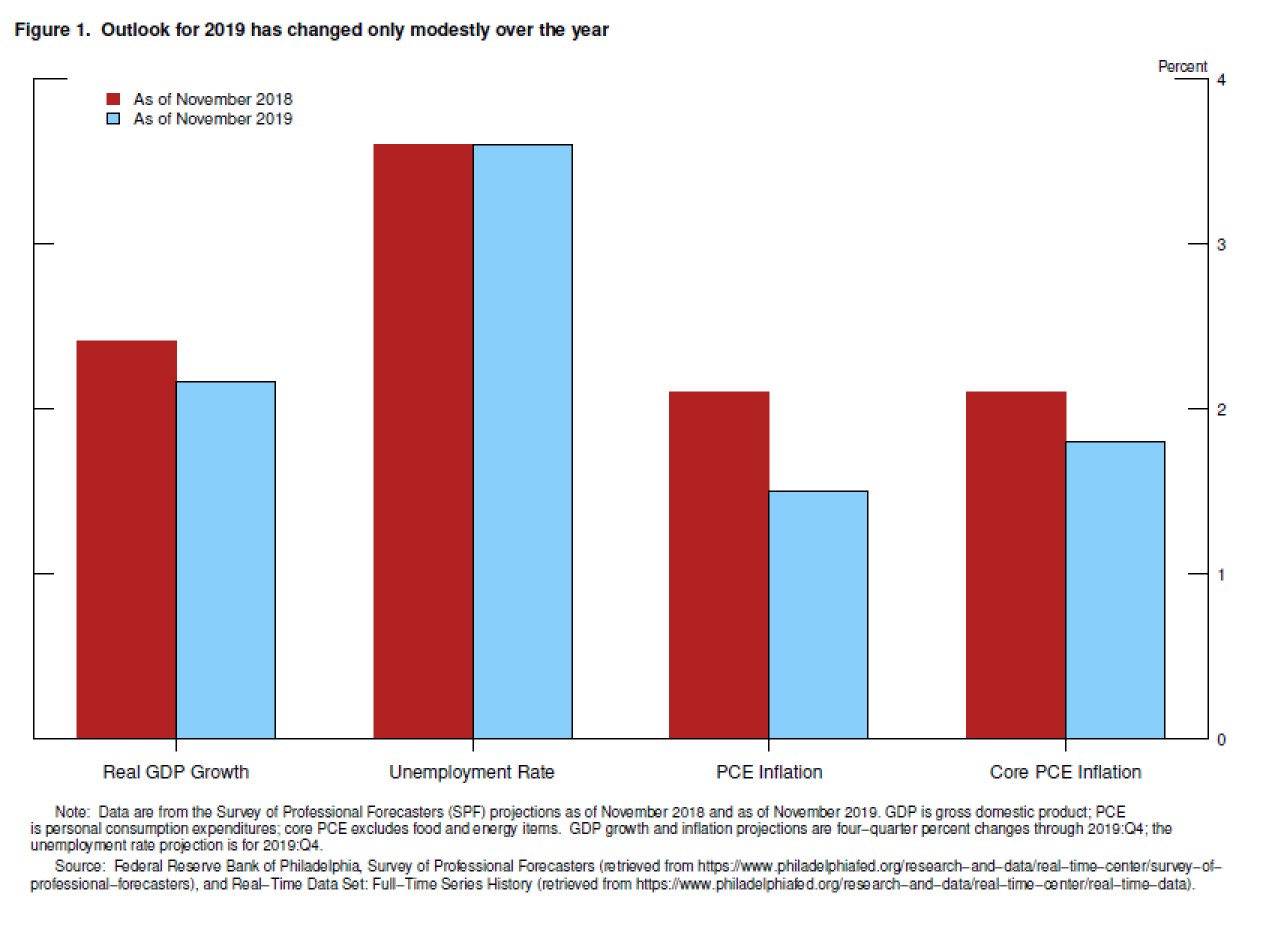
    We started 2019 with a favorable outlook, and over the year the outlook has changed only modestly in the eyes of many forecasters (figure 1). For example, in the Survey of Professional Forecasters, the forecast for inflation is a bit lower, but the unemployment forecast is unchanged and the forecast for gross domestic product (GDP) is nearly unchanged.2 The key to the ongoing favorable outlook is household spending, which represents about 70 percent of the economy and continues to be strong, supported by the healthy job market, rising incomes, and solid consumer confidence.

    While events of the year have not much changed the outlook, the process of getting from there to here has been far from dull. I will describe how we grappled with incoming information and made important monetary policy changes through the year to help keep the favorable outlook on track.

  • Jo Freeman: The Equal Rights Amendment is BAAACK! Much Has Changed Since the First ERA Was Proposed 98 Years Ago

    ERA Poster for making Calls

     Illustration for ERA on WE Are Woman.us website, IllinoisWould you make a few calls for the ERA too?

    By Jo Freeman 

    The Equal Rights Amendment is back before Congress. This time there is a serious possibility that Congressional action may lead to ratification – which will then go to the federal courts.

    First introduced into Congress in 1923, the Equal Rights Amendment was intended to do away with the plethora of state laws which restricted women’s property rights, disadvantaged them under state family laws, or barred them from holding office or serving on juries. Proposed by the National Woman’s Party, it was not aimed at those laws enacted to protect women from sweatshop conditions. However, the overwhelming conclusion of legal authorities was that the amendment would nullify or throw open to question all sex- specific laws. 

    The NWP worked with other women’s organizations to come up with mutually acceptable language but agreement could not be reached. The NWP concluded that protective labor laws limited women’s opportunities and should be abolished. In 1943 the language was revised to read “Equality of rights under the law shall not be denied or abridged by the United States or by any State on account of sex.” 

    Women’s organizations battled for fifty years over the importance of equality vs. protection. By 1970 the issue of protective labor laws applying only to women was pretty much moot. Soon labor unions, which had been the staunchest opponents of the ERA, ceased their opposition. On March 22, 1972 the ERA was approved by Congress and sent to the states for ratification. The resolution clause set a deadline of seven years for ratification. Such a clause was first added to the 18th Amendment when it was sent to the states in 1917. It has been part of the resolution clause of most (but not all) proposed amendments since then.

    In 1972, few thought the deadline would be a problem. But it was. Conservative women were frightened by the idea of equal rights. The Supreme Court’s 1973 decision limiting a state’s ability to restrict abortion gave birth to a powerful movement against it. This movement saw the ERA as a threat. The kind of constituent pressure that M.C.s had felt at the national level legislators felt at the state level, but for the opposite position. After seven years the ERA was three states short of the necessary 38 for ratification. In 1978 Congress extended the deadline until June 30, 1982. No more states ratified. The ERA appeared to be dead.

    A few years ago interest revived. Nevada and Illinois were persuaded to ratify. Whether this is constitutionally permissible or not is an open question. On November 5th Virginia elected a Democratic majority to both houses heightening expectations that it will become the 38th state to ratify the ERA.Jackie Spier's official photo

    In the meantime a resolution to remove the deadline from the original 1972 resolution was introduced into the House by Rep. Jackie Speier (D CA). On November 13, the House Judiciary Committee marked-up the bill. Only a few Republicans attended. They all spoke against it, mostly claiming that the ERA would make it impossible to restrict abortion. “Sex” has replaced “protection” as the primary rationale against equality.

    Judiciary Committee Chair Jerrold Nadler (D NY) led off with a powerful statement on why the ERA was still needed. He specifically said that the ERA “includes discrimination based on sexual orientation and gender identity.” This is important legislative history if the ERA does become the 28th Amendment. Other Democrats on the Committee also read statements in favor of the ERA, citing history and economics.

    After an hour and a half of Members reading statements, H.J. Res. 79 passed by 21-11 in a strict party line vote. Even the lone woman among the Republicans voted no. 

    Much has changed since the first ERA was proposed 98 years ago. As was true for the 19th Amendment, its supporters were mostly Republicans, including Alice Paul, who spent the rest of her life trying to add an ERA to the U.S. Constitution. In the 1970s the Chairman of the House Judiciary Committee, was Emanuel Celler of Brooklyn, NY, who was determined to keep the ERA from ever being voted on by the full House. Now the Committee Chair is Jerry Nadler, whose district is partially in Brooklyn, and is just as determined to add the ERA to the US Constitution.

    © 2019 Jo Freeman for SeniorWomen.com


  • Updated: Presidio Discovery, Tunnel Tops, San Francisco – When Nancy Pelosi Isn’t Gavelling In the House of Representatives She Cares For the Bay Area

    Friday, Nov 22, 2019 

     
    Community leaders, students from Presidio Early Education School, and Speaker of the House Nancy Pelosi recently helped us break ground on the Presidio Tunnel Tops, which will bring 14 new acres of vistas, trails, play areas, and gardens to The Presidio. During the event, attendees took buckets of dirt and dumped in onto the Tunnel Tops land to commemorate the kick off to construction at the site.

    This was a big moment for The Presidio, and presenters talked about the impact this new parkland will have on our parks and our community. Speaker of the House Nancy Pelosi said, “This is something quite spectacular and it takes us to a new level of park example for the rest of the country, new level of beauty, new level of inspiration, but most importantly, a new level of involving new people.” City Librarian Michal Lambert also shared, “This unique destination will afford our community a place to be inspired and connect with nature, but also serve as a safe and inclusive space for youth and families to explore and to experience nature-based education opportunities.”

    Below, I-YEL Intern, Dylan Nepomuceno and his mother pose with Speaker Pelosi at the Presidio Tunnel Tops ground-making celebration. Photo by Paul Myers/Parks Conservancy

    Nancy with Youth intern

    The Tunnel Tops design will feature reclaimed wood from the park and we’re planting 100,000 native plants in the area, helping to make it a biodiversity hotspot in the park. We’re excited to move forward on this project with our partners at the Golden Gate Parks Conservancy, Golden Gate National Recreation Area, and James Corner Field Operations.

    Learn more about the Tunnel Tops Project >>

    Watch this brief video about the Groundmaking event that brought together community members, project supporters, and community leaders >>

    Tunnel Tops rendering

  • The Curbstone Curse: The Fear of the Tumble

    by Rose Madeline MulaClooney at Torino

    One of my favorite sayings is: Whether you think you can or you think you can’t, you’re right

    I have proven this to be true many times in my life.  These magic words helped me achieve so many goals that logic deemed unlikely, if not impossible.  Recently, however, I have been struggling with a problem I have been unable to conquer. This time, no matter how forcefully I tell myself “I think I can,” the truth is I can’t.

    George Clooney, Torino; Wikimedia Commons

    This particular challenge is proving to be unsurmountable — literally.

    It’s a 3-inch curbstone.  I have had a couple of falls recently. The time before last, I broke my shoulder.  When the orthopedic doctor finally discharged me after a series of follow-up visits, I asked him if I had any restrictions. 

    “Yes,” he said. “Don’t fall.”  So of course I did — at the door of my building when I got home. And of course I couldn’t get up. 

    Fortunately, two neighbors happened by and got me to my feet, or I would still be there waiting for the season’s first snow to cover me.

     The battery of my cell phone had died, and no I don’t have an emergency call pendant, and yes I will get one.

    Meanwhile, the fear of tumbling again has made me so paranoid that I am paralyzed when faced with something as innocuous as a curb.  I can get one foot on top of it, but the mere thought of raising the second foot off the ground to complete the task turns me to stone, even if I have a cane to support me. Despite my age and the fact that I have had two hip replacements and two creaky should-have-been-replaced-but-never-were knees, I know I am able to perform this ridiculously simple action physically. Of course I can. But unless I have a railing, tree trunk, signpost, trash barrel, or the arm of a helpful passer-by to hold onto, my brain won’t let me.

    And it’s not just curbstones.  My phobia has extended to even very low-incline ramps.  As for escalators, forget about them. Not only are the steps moving, but so is the handrail.  You might as well ask me to scale Everest without the help of a Sherpa.

    It’s not that I’m not trying to conquer this irrational fear.  I signed up for a series of physical therapy sessions to help my balance (and my unbalanced mind); and for a while I thought it was going to work.  After a few weeks, my wonderful, incredibly patient therapist actually had me stepping over shoe-box size obstacles she had set up at intervals on the floor. I couldn’t believe it!  I was cured! Not.

    The next time I went to therapy, those shoe boxes looked like they could have housed Gulliver’s boots, with lots of room to spare. My heart pounded, I started sweating profusely.  I could not have walked over them if George Clooney was waiting for me on the other side with outstretched arms. And I love George!

    I begged my therapist to let me do the exercise inside an area with parallel bars so I could grab them if I lost my balance, but she said that would not help me gain confidence.  Instead she marked out a grid on the floor with tape for me to maneuver around. Tape. Flat on the floor. Unbelievably, I couldn’t do it. This wasn’t possible, I thought. I mean, I could walk if there was no tape on the floor, but I could not step over the stupid tape! To make matters worse, that night while surfing the Net, I stumbled (bad choice of words!) upon a story about a woman just a few years younger than me who wins medals running hurdles!

    I obviously need help.  A psychiatrist? A hypnotist??  A lobotomist???

    Wait! Before I resort to brain surgery, there’s one more thing I can try.  A plea to Saint Anthony. In the past he has helped me find many lost items — my cell phone, my keys, my glasses — even my car in a five-story parking garage.  Maybe he can also help me find my lost confidence!

    It’s worth a shot.

    ©2019 Rose Madeline Mula for SeniorWomen.com


    Editor’s Note:  Rose Mula’s most recent book is Confessions of a Domestically-Challenged Homemaker &  Other Tall Tales, available at Amazon.com and other online booksellers.  Grandmother Goose: Rhymes for a Second Childhood is available as an e-book on Amazon.com for the Kindle and at BarnesandNoble.com for the Nook; the paperback edition is available, too.   Her website is rosemadelinemula.com.  
  • Weekly Legislative Update, Nov. 11 – 15th: MOMS Act, Health Quality Improvement Act, Human Trafficking, Improving Corporate Governance through Diversity Act of 2019, Family Violence Prevention

    Floor Action:

    Appropriations — This week, the House is scheduled to consider a continuing resolution (as-yet-unnumbered) to fund the government through December 20. The current CR (P.L. 116-59) expires on November 21.

     
    Employment — On Monday, the House will consider several bills, including H.R. 5084, the Improving Corporate Governance through Diversity Act of 2019. 

     Senator Dianne Feinstein introduced a bill to reauthorize the Violence Against Women Act of 1994*

    Mark-Ups: Dianne Feinstein

    Health — On Tuesday, the House Energy and Commerce Committee will consider several bills, including H.R. 4995, the Maternal Health Quality Improvement Act, and H.R. 4996, the Helping Medicaid Offer Maternity Services (MOMS) Act. 

    Bills Introduced 

    Abortion
     
    S. 2836 — Sen. Patty Murray (D-WA)/Health, Education, Labor, and Pensions (11/12/19) — A bill to prohibit the secretary of Health and Human Services from taking any action to implement, enforce, or otherwise give effect to the final rule, entitled “Protecting Statutory Conscience Rights in Health Care; Delegations of Authority.”
     
    H.R. 5036 — Rep. Chris Pappas (D-NH)/Energy and Commerce (11/12/19) — A bill to prohibit the secretary of Health and Human Services from taking any action to implement, enforce, or otherwise give effect to the final rule, entitled “Protecting Statutory Conscience Rights in Health Care; Delegations of Authority.”
     
    Employment
     
    S. 2845 — Sen. Joni Ernst (R-IA)/Health, Education, Labor, and Pensions (11/13/19) — A bill to repeal certain limits on leave for married individuals employed by the same employer.
     
    H.R. 5075 — Rep. Katie Porter (D-CA)/Education and Labor; Oversight and Reform; House Administration (11/13/19) — A bill to repeal certain limits on leave for married individuals employed by the same employer.
     
    S. 2858 — Sen. Jerry Moran (R-KS)/Commerce, Science, and Transportation (11/14/19) — A bill to require the administrator of the Federal Motor Carrier Safety Administration to establish an advisory board focused on creating opportunities for women in the trucking industry, and for other purposes.
     
    H.R. 5118 — Rep. Rick Larsen (D-WA)/Transportation and Infrastructure (11/15/19) — A bill to establish a program to carry out public service campaigns which promote transportation career opportunities and improve diversity in the workforce.
     
    Human Trafficking
     
    H.R. 5080 — Rep. Ross Spano (R-FL)/Judiciary; Foreign Affairs (11/14/19) — A bill to establish a rebuttable presumption that certain federal offenses were induced by coercion if a defendant was the victim of trafficking when such offense was committed, and for other purposes.

  • Updated: Continuation of House Select Committee on Intelligence Hearings: Williams, Vindman, Volker, Morrison, Sondland, Ms. Cooper & Mr. Hale; Dr. Hill

    Impeachment Inquiry: Ambassador Volker & Mr. Morrison, 116th Congress (2019-2020)

    Committee: House Intelligence (Permanent)
    Related Items: Data will display when it becomes available.
    Date: Wednesday November 20, 2019 (9:00 AM EST)
    Location: 1100 Longworth House Office Bldg, Washington, D.C.
    Website: https://intelligence.house.gov/
     

    Impeachment Inquiry: Ms. Cooper & Mr. Hale, 116th Congress (2019-2020)

    HOUSE COMMITTEE HEARING

    Committee: House Intelligence (Permanent)
    Related Items: Data will display when it becomes available.
    Date: Wednesday November 20, 2019 (2:30 PM EST)
    Location: 1100 Longworth House Office Bldg, Washington, D.C.
    Website: https://intelligence.house.gov/
  • Survival Architecture and the Art of Resilience: Linda Gass at the Museum of Craft and Design

    Linda Gass: and then this happened…

    December 19, 2019 – May 3, 2020

    https://i2.wp.com/sfmcd.org/wp-content/uploads/2019/09/Gass.DogpatchSeaLevelRiseAll-768x489.jpg?ssl=1

    Linda Gass, Dogpatch: Impact of Climate Change and Sea Level Rise; 2019 silk crepe de chine, silk dyes and water soluble resist, polyester or wool batting, silk broadcloth, rayon embroidery thread, polyester thread 

    December 19, 2019–May 3, 2020

    Guest curated by Randy Jayne Rosenberg of Art Works for Change (AWFC) this exhibition follows the idea that addressing climate change must include ensuring durable, long-term housing solutions for vulnerable populations. For example, participating artist Tina Hovsepian’s Cardborigami (2016) installation showcases her lightweight and sustainable cardboard shelters that are big enough for two people to sleep in and can fold small enough to carry. In a similar vein, the projects and design concepts in the exhibition highlight how we need to rethink and develop robust housing designs that are flexible, resilient, and adaptable to survive the future effects of a changing environment.

    The exhibition at the Museum of Craft and Design in San Francisco aims to make concepts accessible to a general audience and to address climate change through four centralized themes that reflect key characteristics about survival architecture: Circular — the importance of creating structures made of materials that can be used and reused indefinitely; Portable — the ability to create easily moveable  and nomadic dwellings; Visionary — forward-thinking ideas that can radically change the way we think about shelter; and Resilient — structures that can adapt to adverse and dynamic circumstances.

    Science, technology, architecture, and art converge within the exhibition to question the nature of what it means to survive climate change and natural disasters. How do we design and retrofit our built world to adapt to increased uncertainty and do it affordably? How do we produce dwellings that have a full life cycle of durability pre-, during, and post-disaster?

    Climate change represents a vastly different kind of environmental challenge, requiring out-of-the-box thinking in how we adapt to and survive the expected onslaught of extreme weather and other disruptions,” said Rosenberg. “Artists are uniquely adept at re-envisioning our world and how we relate to it, as this exhibition shows.”

    Editor’s Note: Shop Linda Gass’s Environmental Art 

  • A Pew Research Report: Most Americans Find Cohabitation Acceptable, Even for Couples Who Don’t Plan to Get Married

    Marriage and Cohabitation in the US

    The share of adults who have lived with a romantic partner is now higher than the share who have ever been married; married adults are more satisfied with their relationships, more trusting of their partners


    As more U.S. adults are delaying marriage – or forgoing it altogether – the share who have ever lived with an unmarried partner has been on the rise. Amid these changes, most Americans find cohabitation acceptable, even for couples who don’t plan to get married, according to a new Pew Research Center survey. Even so, a narrow majority says society is better off if couples in long-term relationships eventually get married.

    The survey also examines how adults who are married and those who are living with an unmarried partner are experiencing their relationships. It finds that married adults are more satisfied with their relationship and more trusting of their partners than those who are cohabiting.

    Amid changes in marriage and cohabitation, wide acceptance of cohabitation, even as many Americans see societal benefits in marriage

    The share of U.S. adults who are currently married has declined modestly in recent decades, from 58% in 1995 to 53% today. Over the same period, the share of adults who are living with an unmarried partner has risen from 3% to 7%. While the share who are currently cohabiting remains far smaller than the share who are married, the share of adults ages 18 to 44 who have ever lived with an unmarried partner (59%) has surpassed the share who has ever been married (50%), according to a Pew Research Center analysis of the National Survey of Family Growth (NSFG).1

    Older adults are more likely to see societal benefits in marriage


     Young adults are particularly accepting of cohabitation – 78% of those ages 18 to 29 say it’s acceptable for an unmarried couple to live together, even if they don’t plan to get married – but majorities across age groups share this view. Still, even among those younger than 30, a substantial share (45%) say society is better off if couples who want to stay together long-term eventually get married. Roughly half of those ages 30 to 49 say the same, as do majorities of those ages 50 and older.

    Views about marriage and cohabitation are also linked to religious affiliation. About three-quarters of Catholics (74%) and white Protestants who do not self-identify as born-again or evangelical (76%) say it’s acceptable for an unmarried couple to live together even if they don’t plan to get married. By contrast, only 47% of black Protestants and 35% of white evangelical Protestants share this view. And while half or more across these groups say society is better off if couples who want to stay together long-term eventually get married, white evangelicals are the most likely to say this (78% do so). Among those who are not religiously affiliated, fully nine-in-ten say cohabitation is acceptable even if a couple doesn’t plan to get married, and just 31% say society is better off if couples who want to stay together eventually get married.