When courier Brent Williams makes his daily deliveries around [Seattle] here, he runs into one persistent problem: There’s almost nowhere to use the restroom. Most public buildings are closed under the pandemic, and restaurants and coffee shops that have shifted to carry out service won’t let him use their facilities.
“It’s hard to find any place where I can use the restroom,” Williams said, speaking outside a library in the Seattle’s Ballard neighborhood that has reopened its restrooms to the public.
Right: A Sanisette on the boulevard Sébastopol in Paris
The library is one of five citywide to have opened their doors, and other parts of the city have almost no options for those who need to relieve themselves or wash their hands.
“I understand why some people downtown will duck into an alleyway,” he said. “There’s nowhere else to go, and I’m not going to do it in my pants.”
The lack of restrooms has become an issue for delivery workers, taxi and ride-hailing drivers and others who make their living outside of a fixed office building. For the city’s homeless, it’s part of an ongoing problem that preceded COVID-19.
“It’s gone from bad to worse,” said Eric, who lives in an encampment near Interstate 5. (Eric asked to be identified only by his first name.) “It’s definitely much, much harder.”
A nearby pet supply store used to let homeless people use the restroom, but that changed during the pandemic. Conditions improved markedly when the city placed a portable restroom and handwashing station near the camp, but Eric said many more parts of town still lack similar amenities.
Against CDC Guidance, Some Cities Sweep Homeless Encampments
“It doesn’t smell like urine out here anymore,” he said. “Forty to fifty people having to [urinate] and [defecate] every day, what do you expect? I’m surprised we don’t see these [portable stations] all over the place.”
Seattle officials say the city has set up 32 portable toilets during the pandemic, bringing the total to 114 citywide. Another 107 restrooms are available at city parks. At the five reopened library restrooms, nearly 6,000 patrons have taken advantage of the facilities, according to the library system, which has been tracking usage.
But advocates for the homeless say the city has come nowhere close to meeting the need.
Majorities Across Parties Want Congress to Prioritize Funding for COVID Testing, Tracing, and PPE
Most Say Things Will Get Worse Before They Get Better, and Just Over Half Now Say Their Mental Health is Worse Because of Coronavirus Worry and Stress
As state and local officials prepare for the new school year amid the COVID-19 pandemic, parents with children who normally attend school overwhelmingly prefer that schools wait to restart in-person classes to reduce infection risk (60%) rather than open sooner so parents can work and students can return to the classroom (34%), the latest KFF tracking poll finds. Parents of color (76%) are even more likely than white parents (51%) to prefer that schools wait to return to in-person classes.
With President Trump calling for schools to reopen and threatening to withhold federal funds from schools that don’t do so, there is a big partisan divide – with 87% of Democrats and 59% of independents preferring schools open later while 60% of Republicans prefer that schools open sooner.
The cautious approach to reopening schools may reflect a lack of confidence that schools have the resources to do so safely. Large majorities of the public (71%) say the public schools in their area need more resources to comply with public health recommendations around reopening, and 66% of parents say the same thing about their own child’s school.
“It’s a no-win choice for parents, but most are erring on the side of protecting kids, teachers and families by delaying school reopening and keeping kids home,” KFF President and CEO Drew Altman said.
The poll also shows how parents are pulled in both directions at once on the issue of school reopening.
Most parents with a child who normally attends school are worried about teachers and staff getting sick from coronavirus (79%) and children being unable or unwilling to comply with physical distancing practices (73%). But, nearly as many are worried about their child (70%) or themselves or a family member (69%) getting sick from coronavirus and that their child’s school will be unable to comply with public health recommendations (66%).
However, if schools don’t reopen, about two thirds say they worry about their children falling behind socially and emotionally (67%) and academically (65%). About half say they worry about losing income because they can’t go to work (51%) and not being able to pay enough attention to their kids while working at home (47%). Smaller shares worry about not getting needed social services (40%), and not having access to technology needed for online learning (31%), and their child not having enough food to eat (24%).
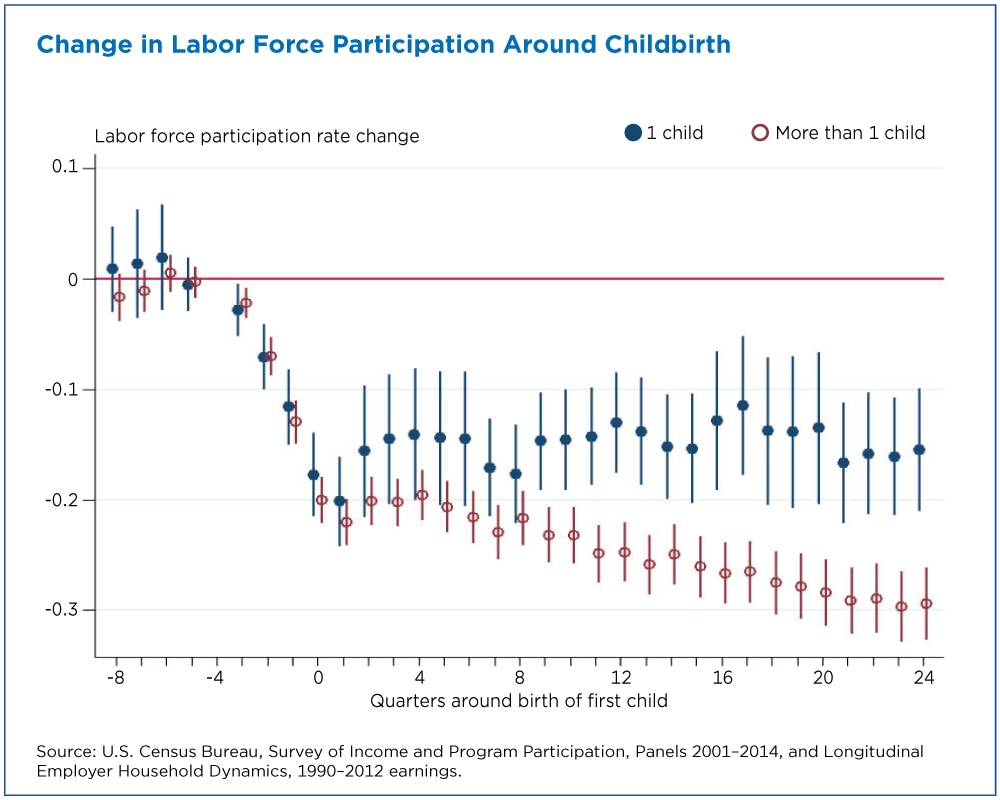
When working women have children, they experience a permanent setback in their likelihood of working and a big but temporary drop in earnings.
New US Census Bureau research shows that the share of women who are working falls by 18 percentage points in the quarter they give birth to their first child, as illustrated in the figure below.
For women who only have one child, the rate of workforce participation remains at a lower level than before birth, but stabilizes. However, subsequent births decrease workforce participation further.
Photo, right, from GlassDoor and BrightHorizons Care Direct
For women who only have one child, the rate of workforce participation remains at a lower level than before birth, but stabilizes. However, subsequent births decrease workforce participation further.
For mothers who continue to work, earnings fall by an average of $1,861 in the first quarter after birth relative to earnings pre-pregnancy or in early pregnancy (three quarters before the birth).
But earnings recover to pre-birth levels by the fifth quarter after birth, and rise by an average of $101 per quarter for the next six years.
Captain Charles E. Yeager, the Air Force pilot who was the first man to fly faster than the speed of sound, sits in the cockpit of the Bell X-1 supersonic research aircraft – Department of Defense. Department of the Air Force, 1948. Wikimedia Commons
Just reading about Chuck Yeager’s autobiography brought to mind the number of autobiographies and/or memoirs out there (what’s the difference?) and reiterates the question of why one writes these things.
If you’ve lived an adventurous, unique, dangerous, miserable or talented life — of course. If you’ve attracted the public eye, gained fame, naturally people want to know all they can find out about you. If you’re the first to break the sound barrier, the best poet of your generation, the discoverer of antisepsis, of course what you’ve done will be interesting to strangers.
Then I think of those who feel such pressure to commit words to paper that they write with some kind of compulsion to readers they don’t know. Why is it important to them to have strangers read their words? If someone else decides to commit their deeds to history, they don’t have to worry about self-aggrandizement.
The ones I wonder about with enormous sympathy are those who are compelled to write about themselves. (Recognize anyone?) It’s too simple to make the motivation sheer egoism; some other impetus must be there.
Think of the poets and novelists and playwrights whose words sink into the consciousness of thousands and even millions and remain there, as emblems, guides, beacons of hope or warnings of disasters, and the excuse (as if one is needed) presents itself. Maybe there’s information or a revelation for some unknown viewer that you can provide, even if it’s not earth-shaking. Besides, we all know more about ourselves than we do about anyone else.
I’ve lived a life that is unique in the sense that every single one, like every single snowflake, is singular, but without any outstanding characteristics. In spite of that, I want to talk about it.
Of course, the person with whom I always did speak of it is no longer available. It’s a bit like losing part of your own hearing to lose the ear that could always be counted on to listen to what you had to say. Nothing in your own voice sounds acceptable after that. To your own ear or eye, every word is weakened by half, and I sense it would be reasonable to forget about it and try to write mystery thrillers or category romances. That way, I might even be able to make a few dollars.
And still, in spite of everything, there’s pressure to let something loose that I might know that someone else has still to learn, or something I’ve noticed that someone else hasn’t thought of, and that might tickle the imagination or stimulate the intellect or conjure a useful memory and make someone’s else’s day a tiny bit brighter.
It’s embarrassing to feel the itch forever to justify this impulse. The more years I get to feel it, though, the more insistent seems the impulse is for me to scratch it.
Confrontation at the Edmund Pettus Bridge, Selma, 7 March 1965. John Lewis on the right in a white coat/PRIO.org/Spider Martin, Birmingham News, Two Minute Warning
“When you look back, the year that Barack Obama was born 50 years ago, black people and white people in the American South couldn’t sit together on a bus or on a train or in a waiting room. And we changed that.” NPR
“Speak up, speak out, get in the way,” said Lewis, who appeared frail but spoke in a strong voice. “Get in good trouble, necessary trouble, and help redeem the soul of America.”
Often called “one of the most courageous persons the Civil Rights Movement ever produced,” John Lewis has dedicated his life to protecting human rights, securing civil liberties, and building what he calls “The Beloved Community” in America. His dedication to the highest ethical standards and moral principles has won him the admiration of many of his colleagues on both sides of the aisle in the United States Congress.
He has been called “the conscience of the U.S. Congress,” and Roll Call magazine has said, “John Lewis…is a genuine American hero and moral leader who commands widespread respect in the chamber.”
He was born the son of sharecroppers on February 21, 1940, outside of Troy, Alabama. He grew up on his family’s farm and attended segregated public schools in Pike County, Alabama. As a young boy, he was inspired by the activism surrounding the Montgomery Bus Boycott and the words of the Rev. Martin Luther King Jr., which he heard on radio broadcasts. In those pivotal moments, he made a decision to become a part of the Civil Rights Movement. Ever since then, he has remained at the vanguard of progressive social movements and the human rights struggle in the United States.
As a student at Fisk University, John Lewis organized sit-in demonstrations at segregated lunch counters in Nashville, Tennessee. In 1961, he volunteered to participate in the Freedom Rides, which challenged segregation at interstate bus terminals across the South. Lewis risked his life on those Rides many times by simply sitting in seats reserved for white patrons. He was also beaten severely by angry mobs and arrested by police for challenging the injustice of Jim Crow segregation in the South.
Editor’s Note: To commemorate the 100th anniversary of the 19th Amendment and women’s constitutional right to vote, buildings and landmarks across the country will light up in purple and gold on August 26, 2020 as part of the nationwide Forward Into Light Campaign, named in honor of the historic suffrage slogan … The Women’s Suffrage
“Forward through the Darkness, Forward into Light.”
In April 2017, Congress passed legislation to create the Women’s Suffrage Centennial Commission (S.847) “to ensure a suitable observance of the centennial of the passage and ratification of the 19th Amendment to the Constitution of the United States providing for women’s suffrage.”
The original bill, sponsored by Senator Tammy Baldwin of Wisconsin, garnered bi-partisan support, with each female member of the U.S. Senate acting as a co-sponsor. The legislation details that the Commission will meet at least once every six months until it terminates on April 15, 2021. Congress appropriated $4 million for the Commission to perform its duties.
2020 Symposium: 100 Years of Women Voting
_____________
Gaining the franchise was just the beginning.Over six weeks, distinguished speakers will discuss the impact of women in American government and public life over the last century.
No matter where you are, you can attend our 2020 symposium. The rescheduled program will be conducted as a virtual series, and will cover all of the topics planned for the original event.
Weekly sessions will begin on August 27. Registration will open soon — newsletters!
The 1937 baseball season is now in full swing and the nation’s fans are daily cheering their favorite diamond stars. Baseball’s heroes come and go, but few people have a better record of the game’s great ones than the card collector . . . For Ruth and Gehrig and other present-day celebrities we must turn to the various candy and gum cards issued during the past few years. While intended primarily for the younger fans, they are of equal interest to all who love our national game.
— Jefferson R. Burdick
The more than thirty thousand baseball cards collected by Jefferson R. Burdick represent the most comprehensive collection outside of the Baseball Hall of Fame in Cooperstown, New York. The cards also illustrate the history of the game — from the dead-ball era at the turn of the nineteenth century to the golden age and modern era of the sport. Baseball cards were first used as advertising inserts by tobacco companies beginning in the late 1800s. Burdick’s earliest cards were incorporated into a series called Champions of the World, produced by Allen & Ginter Tobacco. These illustrate players like Mike “King” Kelley, “Cap” Anson, and Charles Comiskey. The most magnificent card in the collection is the rare and pristine 1910 Honus Wagner card from the White Border series. Only fifty-seven copies of this card are known to exist because Wagner is believed to have pulled them from the tobacco products, unhappy that they would entice boys to buy the product. Wagner’s act may have instigated the shift from the advertising of baseball primarily in tobacco to including the inserts within more youth-friendly gum and candy goods.
Editor’s Note: We noticed recently the attention now being paid to letting hair go gray. Examples of women sporting straight or curly examples of their gray tresses are showing up in magazines and occasionally on television. We decided to rerun Julia’s article when she made note of this phenomenon a number of years ago.
The other night, while listening to the voice of yet another high-pitched, nasal, female newscaster, my husband suddenly snapped: “Pauline Frederick, where are you now that we need you?”
Photo: Spotted in Germany 2018 because of long grey hair (most older woman here have it short) and the colour matched poncho; Tobias “ToMar” Maier
For those of you too young to remember her, Pauline Frederick was a pioneer in broadcast journalism, one of a very few female news commentators. Her extraordinary career stretched from 1939-1980. She did a stint as a UN reporter; she worked as an anchorwoman for ABC and for PBS. She was a woman of formidable intelligence, a reporter whose careful, calm delivery bespoke knowledge of her subjects, and integrity in reporting them. She had a beautifully modulated voice and her diction was precise without being fussy. The latter well-remembered attributes were what triggered my husband’s snarl. Sometimes it seems as if the people who hire women for television news desks have tin ears. The least they could do is to send those young women out for voice lessons.
When I was about 12, I was made to take speech lessons because I spoke very rapidly and sloppily. I remember my teacher grabbing the sides of my rib cage and saying: “You must breathe to support the voice! Don’t let your chest rise; feel your ribs expand out to the side!” She maintained stoutly that it’s possible to lower the register of every voice, if only one learns to breathe right and “relax the instrument, child!”
My diction improved as I discovered how to slow down, and I soon learned to escape my teacher’s fury by carefully articulating things like the second “t” in “twenty” and by not gulping a quick ‘n’ at the end of words ending in “ing.” As for nasality, she would croon: “Open the throat. Feel the vowel in your vocal chords, not in your nose.”
Of course my French teacher kept urging us to do the exact opposite, pinching the bridge of her nose and crying: “Feel the ‘inh’ vibrating up here, girls!” — but that’s another story. In any event, I was lucky to learn early on how to control and project my voice.
There are probably plenty of reasons that TV newswomen tend to have shrill voices. Lack of experience plays a part. Excitement or stage fright can both translate as tension that sends voices even higher. After all, most of our newswomen are very young. The tendency to pair older, male anchormen with pretty young women is almost universal. I will concede that TV has done a good job of hiring women of color or of differing ethnicity. It’s much easier to find racial diversity among women newscasters, I think, than among male newscasters.
It seems to me that what’s really missing is female newscasters who are over 40. Once they hit that magic mark, they are relegated to interview shows, or TV news magazines like “60 Minutes” or “Dateline NBC.”
I mean no disrespect to those very accomplished women, but I can’t help noting that not a one of them has let her hair go honestly gray.
The other day, I watched as one broadcaster interviewed a newswoman who had delivered one newscast bald. She had been treated for cancer, and during her chemotherapy and radiation treatments had been wearing a wig to disguise the fact that her hair was falling out. When she finally finished the treatments, she shaved off what was left of her hair, and announced to her employers her intention to appear bald on screen. To their credit, they were supportive. To her credit, it was a one-time appearance because, she said: “If I continued to appear on screen bald, my baldness itself would become news, and detract from the news I was delivering.” Her single appearance was, she said, so that her audience would know what she had been through and that she was now all right. For her interview and for all future newscasts, she wore her wig.
The US Supreme Court rejected arguments that the president is immune from investigative and criminal proceedings while he is in office. (Photo: US Bureau of Land Management)
The US Supreme Court today (Thursday, July 9) rejected efforts by President Donald Trump to shield his business and financial records from scrutiny by prosecutors in New York and Congress, but sent the closely watched cases back to lower courts for further consideration.
Berkeley Law Dean Erwin Chemerinsky, one of the nation’s leading scholars of the US Constitution, said in an interview that the decisions uphold the fundamental principle that the president is subject to legal oversight.
Trump and his attorneys had argued that he is shielded from criminal investigations while in office.
But the Supreme Court ruled 7-2 that Manhattan District Attorney Cyrus Vance has the right to see tax and financial records as part of an investigation into the role of Trump and the Trump Organization in paying hush funds to two women who claimed they had affairs with him before he was elected president.
In a second 7-2 ruling, the court said efforts by Congressional committees to see Trump financial records need to be reassessed by lower courts in light of separation of powers issues. In effect, that prevents Congress from reviewing the records pending a final judicial resolution.
Erwin Chemerinsky is the dean of UC Berkeley’s law school
Berkeley News: What is the significance and likely impact of today’s decisions?
Erwin Chemerinsky: The significance of these cases is in reaffirming that no one, not even the president, is above the law. The immediate impact is that the cases will go back to the lower court for further proceedings.
Would it be correct to conclude that today’s decisions amount to a legal loss, but a short-term political victory, for President Trump?
I think the New York grand jury subpoena case is a legal loss for President Trump. The congressional subpoena case is a partial loss and partial victory; the court did not give Trump the absolute immunity he wanted, but it did provide more protection than the congressional committees wanted.
I don’t think it is a political victory for Trump, because no matter what the court decided, it was going to lead to more litigation, which will keep his tax returns secret beyond the election.
What happens next? The president has fought to keep this information private and off-limits to Congress and the public. Does he have incentive to continue this fight?
President Trump, for whatever reason, desperately does not want this information to become public. He is sure to keep fighting in the courts, especially to make sure that it does not become public before the November election.
If Trump were to lose the election, will the cases lose their practical importance?
If Trump loses, the cases remain important as precedents for the future. But learning the financial information about Donald Trump obviously is much less important if he is not in office.
Did the founders ever envision a scenario in which a president, to this extent, would contest the power of Congress and others to conduct oversight?
I am very skeptical of trying to guess what the framers intended, as to situations and a world that they could not have imagined. But we know that the framers were very distrustful of executive power. If they could be asked, I think they overall would be pleased with today’s decisions.
The Consumer Financial Protection Bureau (Bureau) settled with Timemark, Inc., a company based in Deerfield Beach, Florida, that provides debt-relief services to consumers with federal student-loan debt, and with its owners and officers, Timothy Lenihan, Sr., Mark Nagler, and Casey Gassaway. The Bureau alleged that the defendants charged illegal advance fees in violation of the Telemarketing Sales Rule (TSR) to consumers who were seeking to renegotiate, settle, reduce, or alter the terms of their loans. If entered by the court, the proposed order memorializing the settlement will permanently ban defendants from providing debt-relief services and impose a judgment totaling approximately $3.8 million in consumer redress and civil money penalties.
The Bureau’s complaint, which was filed in federal district court for the Southern District of Florida, alleged that from 2016 through October 2019, the defendants used telemarketing campaigns to convince more than 7,300 consumers to pay up to $699 in fees to file paperwork to reduce or eliminate their monthly payments for their federal student loans, through loan consolidation, forgiveness, or income-driven repayment plans. The U.S. Department of Education, however, offers these options to student loan borrowers for free. Moreover, under the TSR, it is illegal to request or receive any fees for debt-relief services sold through telemarketing before the terms of the debt are altered or settled, and the consumer has made at least one payment pursuant to the new arrangement. The Bureau alleges that the defendants violated the TSR because they requested and received payments from consumers within a few days, or at the latest, within 30 days of their enrollment—before the terms of the debts were altered.
If entered by the court, under the terms of the proposed order, the defendants would be permanently banned from providing debt-relief services. The order would impose a judgment on the defendants, jointly and severally, in the amount of about $3.8 million for consumer redress. Full payment of this amount will be suspended if, within 10 days after the order is entered, Timemark pays $5,000, Nagler pays $7,000, and Gassaway pays $10,000. The full amount of redress was suspended because of defendants’ limited ability to pay more based on sworn financial statements. The defendants would also be required to each pay a $1 civil money penalty, in light of their financial circumstances. Whenever the Bureau collects a civil money penalty through an enforcement action, that penalty is deposited into the Bureau’s Civil Penalty Fund. Assuming continued available funds, the Bureau will work to provide full redress to eligible harmed consumers from this fund.