Senior Women Web

  • Culture and Arts
    • Art and Museums
    • Theater and Film
    • Literature and Poetry
    • Photography and Auctions
    • Dance
    • Music
    • Festivals and Culture
    • History
  • Relationships and Going Places
    • Meeting Places and Romance
    • Grandparenting
    • Travel
    • Transportation
  • Home and Shopping
    • Entertaining
    • Home
    • Garden
    • Gift Shopping
    • Shop for Home
    • Shop for Yourself
    • Shop for Children
    • Shop for Garden
  • Money and Computing
    • Computing
    • The Internet
    • Employment
      • Employment Links
    • Money
    • Moving and Retirement
  • Health, Fitness and Style
    • Health and Science
      • Health Links
    • Beauty
    • Style and Fashion
    • Sports and Fitness
  • News and Issues
    • Issues
    • Interests
    • Politics
    • Government
    • Media
    • Legal
    • Learning
    • Women of Note

Author: SeniorWomenWeb

  • Whistleblower Complaint: In the Matter of MURPHY, BRIAN PRINCIPAL DEPUTY UNDER SECRETARY DEPARTMENT OF HOMELAND SECURITY OFFICE OF INTELLIGENCE & ANALYSIS

    Whistleblower Reprisal Complaint DHS Seal
    September 8, 2020

    INTRODUCTION

    This complaint concerns retaliatory actions taken or threatened to be taken against a longtime public servant, Brian Murphy (“Mr. Murphy”). The retaliatory actions were taken and/or threatened to be taken in light of at least five sets of protected disclosures made by Mr. Murphy between March 2018 and August 2020. The protected disclosures that prompted the retaliatory personnel actions at issue primarily focused on the compilation of intelligence reports and threat assessments that conflicted with policy objectives set forth by the White House and senior Department of Homeland Security (“DHS”) personnel.

    As set forth below, the identified protected communications were made through Mr. Murphy’s chain of command, as well as to the DHS Office of Inspector General (“OIG”). Notably, Mr. Murphy made protected communications to his immediate supervisor and some of the very Responsible Management Officials (“RMOs”) who ultimately took (or threatened to take) retaliatory action against Mr. Murphy.

    A thorough investigation will establish that the actions taken or threatened to be taken against Mr. Murphy were done in reprisal for his protected disclosures. Therefore, we respectfully request that DHS OIG promptly institute the required investigation. The relief requested is set forth below.

    JURISDICTION
    As a Senior Executive Service employee within DHS, Mr. Murphy is protected by the implementing regulations of PPD-19, as well as the Whistleblower Protection Enhancement Act of 2012 and the National Defense Authorization Act of 2013. DHS OIG possesses clear jurisdiction over these matters. 2

    ELEMENTS OF STANDARDS OF PROOF

    The elements of reprisal are the following: (1) the information at issue is that which the individual reasonably believes is evidence of a violation of law, rule or regulation, or is an abuse of authority; (2) the individual made a protected disclosure regarding this information, namely to the OIG or an authorized official at DHS; (3) a personnel action is taken, threatened or withheld in reprisal for the protected disclosure; and (4) a causal connection exists between the protected communication and the personnel action. The elements must be established by a preponderance of the evidence for a complaint to be deemed substantiated. Mr. Murphy’s complaint satisfies all four elements. The burden is on DHS officials to prove that the same adverse personnel actions (whether taken or threatened to be taken) would have occurred even if there had been no protected communications. See, e.g., Whitmore v. Dep’t of Labor, 680 F.3d 1353, 1367 (Fed. Cir. 2012); Figueroa v. Nielsen, 423 F. Supp. 3d 21 (S.D.N.Y. 2019); Miller v. Dep’t of Justice, 842 F.3d 1252 (Fed. Cir. 2016)(once complainant establishes prima facia case, burden of proof shifts to U.S. Government to establish personnel actions taken, threatened, or withheld would have occurred absent protected communication).

    BACKGROUND OF THE COMPLAINANT

    From March 2018, until July 31, 2020, Mr. Murphy held the DHS position of Principal Deputy Under Secretary in the Office of Intelligence and Analysis (“DHS I&A”). Effective August 1, 2020, however, he was retaliatorily demoted to the role of Assistant to the Deputy Under Secretary for the DHS Management Division.

    In his DHS I&A position, Mr. Murphy was responsible for all intelligence activities in DHS and was the principal advisor to the Secretary for Homeland Security and the Director of National Security. Mr. Murphy’s primary mission sets included Counterterrorism, Cyber, 3 Transnational Organized Crime, Counterintelligence, Economic Security, Support to State and Local Officials, and Training.

    Prior to joining DHS, Mr. Murphy had more than two decades’ worth of public service experience. He served on active duty in the United States Marine Corps (“USMC”) from 1994 until 1998, and received an honorable discharge with the rank of 1st Lieutenant. He joined the Federal Bureau of Investigation (“FBI”) on August 15, 1998, and served as a Special Agent, where he worked on a variety of criminal and national security matters, including assignment to the New York Field Office on September 11, 2001, when our country was attacked by terrorists. With a Master’s degree in Islamic Studies almost completed, Mr. Murphy volunteered to be reactivated by the USMC and subsequently served for six months in Iraq in 2004, where he saw extensive combat and received the Combat Action Ribbon. He returned to the FBI in March 2005, completed his Master’s degree in May of 2005, and served without incident at the Bureau until his transition to DHS on March 5, 2018. His final title at the FBI was that of Section Chief for Partner Engagement in the Intelligence Division.

    Editor’s Note: Continue the document at: 

    DEPARTMENT OF HOMELAND SECURITY OFFICE OF INSPECTOR GENERAL

    In the Matter of MURPHY, BRIAN PRINCIPAL DEPUTY UNDER SECRETARY DEPARTMENT OF HOMELAND SECURITY OFFICE OF INTELLIGENCE & ANALYSIS Complainant.

    Whistleblower Reprisal Complaint September 8, 2020

    murphy_wb_dhs_oig_complaint9.8.20.pdf


    Complaint – House Permanent Select Committee on Intelligence

    intelligence.house.gov › uploadedfiles › murphy_wb_d…


    PDF

    2 days ago – From March 2018, until July 31, 2020, Mr. Murphy held the DHS position of Principal. Deputy Under Secretary in the Office of Intelligence and …

    Images for murphy_wb_dhs_oig_complaint9.8.20.pdf


    /24


    September 10, 2020
  • WWII, People’s War, An Archive of of World War II Memories, Written by the Public, Gathered by the BBC: Women’s Volunteer Groups

    Fact File: Women’s Volunteer Groups

    May 1938 – present, http://www.bbc.co.uk/history/ww2peopleswar/medals for wvs

    In 1938, with the outbreak of World War II looking more and more likely, the Home Secretary Sir Samuel Hoare decided to establish a women’s voluntary organisation to assist in the event of possible future air attacks. On 16 May, the Women’s Voluntary Service for Air Raid Precautions (WVS) was founded. Hoare asked the energetic and determined Lady Reading, who had been a nurse during World War One, to run the WVS.

    Medal created and awarded by the British Government c. 1961, image 

    When war broke out in September 1939, the WVS already had 165,000 members. Their work quickly diversified into helping in all areas of the Home Front, and their name was soon changed to the WVS for Civil Defence. One of their earliest tasks was to assist with the evacuation of one and a half million mothers and children from large cities to the country. The WVS also provided food and clothing for thousands of refugees from occupied Europe. 

    When German air raids on British towns and cities began, the WVS was heavily involved in providing support for those whose homes had been bombed. They organised rest centres, prepared food and ensured there were washing facilities and new clothes for bomb victims. Later in the war, they staffed Incident Inquiry Points to give information about the dead and injured to relatives and friends. They also supported the emergency services dealing with the effects of the bombing, running mobile canteens for firemen and rescue workers.

    WVS members staffed hostels, clubs and communal feeding centres called ‘British Restaurants’ and undertook welfare work for troops. When American troops began to arrive in Britain in 1942, the WVS ran 200 ‘British Welcome Clubs’ all over the country in attempt to bridge the divide between the troops and British civilians.

    The WVS volunteers were often responsible for the running of salvage drives to generate raw materials for the war effort, including the collection of aluminium saucepans and kitchen utensils, and the removal of iron railings from public buildings. They also organised clothing exchanges where children’s clothes could be swapped for larger sizes.British women working for the WVS

    By the end of 1941, the WVS had enrolled its millionth member. Many were older women, as younger women were called up into the services or to do essential war work. It offered them an opportunity to use abilities and energies which before the war would have been contained in the home.

    Apart from a small administrative staff, WVS members were unpaid and had to buy their own uniform. This was designed by the London fashion designer Digby Morton, and consisted of green coats and dresses with burgundy cardigans, green and burgundy scarves, and felt hats.

    At the end of the war, the Home Office announced that the WVS should continue for ‘possibly two years’. In fact, the WVS continues to this day, providing support in emergencies and carrying out welfare services, particularly for elderly people. In 1966 the organisation was awarded royal status, becoming the Women’s Royal Voluntary Service (WRVS).

    Women of the Women’s Voluntary Service run a Mobile Canteen in London, 1941

    NAAFI

    Women could also volunteer to work for the Navy, Army and Air Force Institutes, known as the NAAFI. This had been founded in 1921 to sell goods to servicemen and their families, and to run recreational establishments for the armed forces. The NAAFI grew quickly during World War Two, at its largest running 10,000 outlets, including 900 mobile shops.

    The fact files in this timeline were commissioned by the BBC in June 2003 and September 2005.

    Editor’s Note from Wikipedia: Overseas WWVS, Organisations, https://en.wikipedia.org/wiki/Royal_Voluntary_Service

    The WVS model proved to be so successful that other countries around the world set up their own versions during the war, with the assistance of the British WVS. The most successful of these was formed in 1942 in India, especially in Bengal, which had during the war a membership of over 10,000 and continued into the 1950s. In the US the American Women’s Voluntary Services was started soon after the start of the war by an American woman who had been working with the WVS in Northampton, England. WVS organisations were also set up in Canada and Australia.

    September 9, 2020
  • Rose Madeline Mula Writes: Look Who’s Talking

    By Rose Madeline Mula

    Do you talk to your dog?  Apparently that’s fairly common, especially with human contact reduced during the Covid 19 pandemic; and there’s no need to be concerned — unless your dog talks back.  It is pretty strange, however, if you speak to Fido in baby talk.  Since every one of his years is said to equal seven of yours, he may well be chronologically older than you and may think you’ve lost it if you ask him if Mumsy’s or Daddum’s Poochie-Pie wants to go walkies. And please stop asking him who’s a good boy. Do you expect him to say Rover next door?

    I, of course, am much too intelligent to converse with pets.  Actually, I don’t have any. (Though I have been known to accost strangers’ puppies on the street:  “Hi, Cutie! What’s your name?”)

    I also talk to my appliances. Just yesterday I had a heated (no pun intended) argument with my air conditioner. “Are you kidding me? You picked the hottest day of the year to quit?! You’re only 17 years old, for heaven’s sake.  When I was 17, I had tons of energy!” Fortunately, my reprimand shamed it into working again after I bought it a $300 capaciCapacitorstor. Hey, better than $5,000+ for the funeral and replacement I had been warned might be necessary. 

    Capacitors, right … Wikipedia

    I also have regular encouraging pep talks with my washer, dryer, and dishwasher — and last week with my microwave oven.  “I’m sorry,” I apologized. “I know you deserve a vacation, but now just isn’t a good time.  My arthritic knees are really acting up, and I can’t bend safely to use my regular oven…”  (A shameful sympathy appeal)… “Besides, it’s so slow; and you do such a fantastic job in a fraction of the time! I don’t know how I ever managed without you before we met!” (I’m a great believer in positive reinforcement.)

    I also plead with my aging fridge frequently — generally after I’ve just done a monster grocery shopping.  “Don’t fail me now, Frosty,” I beg.  “I just filled you to capacity with three hundred dollars worth of essentials!” (Yes, ice cream and frozen lasagna are essential.)

    I’d like to tell you that these conversations are all in my head, but truthfully they’re spoken — and at a fairly high volume. Neighbors passing my door must think I’m breaking all the pandemic isolation rules and hosting dozens of possibly-infected people daily.

    The above, of course, are one-way conversations.  My TV, however, is another story.  It instigates interactive arguments with me constantly.  I’ll turn it on, ready to stimulate my brain with an educational documentary or simply enjoy a relaxing romantic comedy or another “Big Bang Theory” rerun; and suddenly it interrupts with BREAKING NEWS — usually a report of a new political debacle, which I am compelled to challenge verbally and loudly — and at great length.  

    My TV is the only appliance that makes me spew four-letter words that would horrify my parents, who would never believe their sweet, ladylike daughter even knew such obscenities. I certainly never heard them at home growing up. On the other hand, if they knew the object of my wrath, I ‘m sure they would feel my curses are justified — and they would actually be proud of me.

    I also often have conversations with myself, many of which can be characterized as verbal abuse. “Stupid!” I berate myself as I fall off an unstable step stool… “Idiot!” I scream when burning my hand grabbing a hot pan handle.  Often neither of those insults are strong enough.  I have to double them:  “Stupid idiot!” I explode when a bowl slips from my hand spilling tomato sauce on my newly-shampooed carpet.

    There’s no end to the list of calamities I commit that justify my scolding.  But I’m not always a shrew.  I also lavish praise on myself when warranted.  “This is really good!” I tell my computer when I’m happy with a paragraph I’ve written, or “Mmmm! Yummy!” on those rare occasions when I’ve actually cooked something edible.

    I also talk to my blood pressure monitor (“That can’t be right!”); my check book register (“Wait a minute! I’m sure my balance is way higher than that!”); and my smart phone and smart watch, which are too smart for me.  I have no idea what they’re trying to tell me.

    Then, of course, there’s Alexa.  She’s great, and always available to answer my questions, serenade me with my favorite music, play games, or just chat.  If she wants to get my attention, she’ll flash a yellow light at me until I acknowledge her so she can warn me of possible impending flash floods or tornados in my area or simply to tell me that Amazon has delivered yet another package to my door.  I’ve actually come to think of her as a friend.  No, you don’t have to send out an emergency summons for the guys with a strait jacket.  I really haven’t lost it yet.  I do know she’s not a real person and just a disembodied voice, and I don’t go so far as wearing a mask in her presence or keeping six feet away; but I do always say “Please” and “Thank you” so she won’t think me rude.

    Ooops! There’s my phone.  I’m so excited!  I’ll get to talk to a human being! 

    ©2020 Rose Madeline Mula for SeniorWomen.com

    Editor’s Note:  Rose Mula’s most recent book is Confessions of a Domestically-Challenged Homemaker &  Other Tall Tales, available at Amazon.com and other online booksellers.  Grandmother Goose: Rhymes for a Second Childhood is available as an e-book on Amazon.com for the Kindle and at BarnesandNoble.com for the Nook at $2.99; the paperback edition is available for $9.95.   


    September 7, 2020
  • Audit Report of Inspector General: Home Processing Readiness of Election and Political Mail During the 2020 General Elections

    Aug312020

     Report Number: 20-225-R20  Type: Audit Reports  Category: Election and Political MailDelivery / Mail Processing  6 Comments

    Objective

    Our objective was to evaluate the Postal Service’s readiness for timely processing of Election and Political Mail for the 2020 general elections.

    Findings

    While the Postal Service has made progress in preparing for the 2020 general election, there are concerns surrounding integrating stakeholder processes with Postal Service processes to help ensure the timely delivery of Election and Political Mail. These potential concerns include:

    • Ballots mailed without barcode mail tracking technology;
    • Ballot mailpiece designs that result in improper processing;
    • Election and Political Mail likely to be mailed too close to the election, resulting in insufficient time for the Postal Service to process and deliver the mailpieces;
    • Postmark requirements for ballots; and
    • Voter addresses that are out of date.

    Resolving these issues will require higher level partnerships and cooperation between the Postal Service and various state officials, including secretaries of state and state election boards. Timely delivery of Election and Political Mail is necessary to ensure the integrity of the U.S. election process.

    Stakeholder-Related Election Mail Issues

    The Postal Service has frequently communicated to state election officials the importance of ballot mailpiece tracking and design, the required timeframes for processing and delivering mail, and the importance of updating voter addresses. They have designated area and district Political and Election Mail coordinators to conduct outreach to state and local election officials and published a toolkit for election officials to facilitate voting by mail. Further, the Postal Service has altered their normal processes to accommodate for the timely processing of Election and Political Mail, such as requiring postmarks on all ballots, prioritizing the pickup, processing, and delivery of Election and Political Mail, and diverting resources as necessary. However, as mentioned in the Timeliness of Ballot Mail in the Milwaukee P&DC Service Area audit, issues surrounding these items continue to occur.

    • The Postal Service, mailers, and election boards are not able to track ballot envelopes that do not have barcodes. According to Postal Service management, some election boards have chosen to continue using excess stock of ballot envelopes without barcodes and some lack the funding for integrating the use of barcodes in their mailing process. Based on data analyzed from the 2018 general election season, about 31.1 million ballots were cast by mail, but only 4.1 million (13 percent) Election Mail mailpieces used mail tracking technology.
    • Some election boards continue using ballot envelope designs which can cause mail processing machines to return ballots to voters. This can occur when the ballot envelope contains more than two addresses, as well as when addresses are located on both sides of the envelope.
    • Mailers, election boards, and voters are likely to mail Election and Political Mail too close to an election. This could result in insufficient time for the Postal Service to process and deliver the mailpieces within prescribed delivery standards, and still meet state deadlines for receiving ballots from voters. The Postal Service suggests election offices send ballots as First-Class Mail, and while First-Class Mail only takes 2 to 5 days to be delivered, the Postal Service recommends election offices send ballots to voters at least 15 days prior to an election. This is to ensure time for the ballot to reach the voter and for the voter to complete and return the ballot. However, 48 states and the District of Columbia have absentee ballot request deadlines less than 15 days in advance of an election. According to Postal Service management, during the primary election season, election boards mailed over 1 million ballots to voters within 7 days of an election. This put these ballots at high risk by not allowing sufficient time for delivery to voters and their subsequent delivery back to the election boards.
    • Postmarking provides an official date stamp for ballots; however, ballot postmarking policies vary by state. Although 29 states do not currently require postmarks on absentee ballots, the states that do require them have different timeframes for when ballots must be postmarked or received to be counted. In anticipation of an increase in voting by mail during the November 2020 general election, some states have recently updated their postmark requirements.
    • States have different requirements and timeframes for updating their voter registries. Some states only update voter address information every two years and run the risk of using outdated addresses for their registered residents who have moved. This can cause absentee ballots intended for voters to be returned to election officials as undeliverable.

    When mailers, states, and election boards do not follow recommended best practices to prepare, process, and track Election and Political Mail sent to voters, there is an increased risk the mail may not be delivered timely.

    Readiness for Timely Processing

    Since our prior audits, the Postal Service has improved internal communication between headquarters and mail processing facilities, and developed online Election and Political Mail training. However, the amount of identifiable Election and Political Mail delivered on-time nationwide was 94.5 percent from April 2020 through June 2020, a decrease of 1.7 percentage points compared to the same time period in 2018.

    The seven P&DCs we reviewed that were processing Election and Political Mail for special or primary elections did not always comply with Election and Political Mail readiness procedures. Specifically:

    • While all seven facilities performed some level of certification that they were clear of Election and Political Mail in their facility at the end of the day, five of the facilities did not fully comply during the two weeks leading up to the election. Specifically, facilities either did not complete, properly complete, or timely complete the daily certification. Further, even though the Oklahoma and Baltimore P&DCs certified they were clear of Election and Political Mail daily, we identified approximately 200 ballots at the Oklahoma City P&DC and 68,000 Political Mail mailpieces at the Baltimore P&DC that had not been processed.
    • Six of the seven facilities did not always complete daily self-audits of Election and Political Mail readiness. The self-audit verifies readiness to receive and process Election and Political Mail and includes items such as verifying daily all-clear checks, evaluating the setup of a staging area, and logging the arrival of Election and Political Mail.
    • None of the seven facilities used the Postal Service’s Operational Clean Sweep Search Checklist. This checklist provides a list of specific areas to check when searching for Election and Political Mail within the mail processing facility.
    • Six of the seven facilities used their own variation of the Election and Political Mail logs, which were missing key information such as mail class and the date/time it was cleared from the operation. The logs help track Election and Political Mail as it moves through the Postal Service’s network.

    These issues occurred due to a lack of management oversight and unclear guidance regarding who is responsible for completing all-clear certifications, checklists, and logs; who ensures issues are resolved; and how often these items should be completed and maintained. Not completing and using these tools could result in processing delays and lower service performance. An analysis of data determined the total number of identifiable Election and Political Mail mailpieces not delivered on time from April 2020 through June 2020 for the seven P&DCs was about 1.6 million (8 percent) of 20.2 million mailpieces.

    In addition, we noted that while postmarks are not required on all mailings and are intended to be a revenue protection mechanism to prevent the reuse of postage, the Postal Service has directed personnel to postmark all ballots to assist state election boards. However, we found that ballots are not always being postmarked as required and it is a challenge for the Postal Service to ensure full compliance. Some ballots did not receive a postmark due to: (1) envelopes sticking together when processed on a machine; (2) manual mail processing; or (3) personnel unaware that all return ballots, even those in prepaid reply envelopes, need to receive a postmark. Without a postmark on return ballots mailed by voters, a ballot could be rejected and a vote not counted. The Postal Service reissued guidance on July 29, 2020 and held a webinar reiterating to employees that all ballots sent by voters must have a postmark. The Postal Service is also currently evaluating the proper postmarking procedures for situations where a ballot is received at a delivery unit with no postmark, but there is evidence that it was processed by the Postal Service on or before election day. Therefore, we are not making a recommendation regarding this issue.

    Best Practices

    We identified several best practices employed at various locations to improve readiness for processing Election and Political Mail. These practices include:

    • Political and Election Mail coordinators obtaining an estimate of Election and Political Mail volume and drop off dates in advance from mailers which helped inform facilities of potential staffing requirements.
    • Facilities obtaining sample ballot envelopes to test in mail processing machines.
    • Facilities using work floor monitors to display important Election and Political Mail information, such as upcoming election dates and deadlines.
    • States, such as Colorado, paying independent contractors to track ballots and provide alerts during each step of the voting process – from ballot printing to acceptance by election officials.
    • Election officials creating colored absentee ballot return envelopes to make identifying return ballots easier for the Postal Service, election offices, and voters.

    Recommendations

    We recommended management:

    • Leverage established partnerships with state and local election officials to work toward creating a separate, simplified mail product exclusively for Election Mail that would support uniform mail processing, including mandatory mailpiece tracking and proper mailpiece design. Until this new product is developed, continue to prioritize the processing of Election Mail consistent with past practices.
    • Ensure mail processing facilities perform an accurate daily certification that they are clear of Election and Political Mail using the Operational Clean Sweep Search Checklist.
    • Clearly define roles, responsibilities, and oversight to ensure that the Political and Election Mail Audit Checklist is completed; and define timeframes for completion during election season.
    • Ensure mail processing facilities use and maintain the standardized Election and Political Mail log for each operation.
    • Implement best practices identified during our audit and continue educating election officials on identified best practices to increase nationwide Election and Political Mail readiness.

    Read full report

    September 5, 2020
  • Ferida Wolff’s Backyard: Hostas and Us; Waving Beans

    Editor’s Note: Ferida has a story in a forthcoming book due out November 3rd: https://www.simonandschuster.com/books/Chicken-Soup-for-the-Soul-Age-Is-Just-a-Number/Amy-Newmark/9781611590715


    Hostas and UsHostas


    We planted hostas in pots in our front yard last year hoping to keep away the animals that were munching on the leaves. It seems to have worked. The hostas had a few leaves nibbled on but not many and this season they were full of flowers! Each time I thought they were finished, new buds opened up and they are sending out shoots for new plants as well. The plants seem to really like where they are. And that is mostly in the shade.

    I enjoy watching plants grow. Each season brings something to appreciate whether it is flowers hinting at beauty before they burst forth or leaves opening up to drink on the sun or even a struggling plant coming into its own. The African Violet  sitting in a pot on my kitchen windowsill is in its second blossoming, a joy for me to see.

    I try not to casually dismiss each plant’s possibilities of expressing itself. I feel the same about people. We each have the possibility of offering the best of ourselves and especially in this difficult pandemic time, I hope that consideration of others is part of our social interaction. I notice lately that neighbors are waving and smiling when I take a walk, a friendly and welcome but sensitive distant greeting.

    So even though I can’t individually be with everyone who follows Ferida’s Backyard, let me at least express my appreciation for my readers. I look forward to us all being healthy, productive, and blossoming once again.   

    How to plant hostas in a pot:

    https://www.youtube.com/watch?v=woi8wdyHzK4

    More info about hostas:

    https://www.youtube.com/watch?v=UVbo4zTpbXk

    ©2020 Ferida Wolff for SeniorWomen.com

    Editor’s Note: From the American Hosta Society: 

    In East Asia, hostas have been grown in gardens for centuries. Chinese documents mention hostas as early as the Han Dynasty 206 BC-220 AD, and in Japan they show up in scripts preceding the Nara period beginning in 710 AD. The 1829-1830 importations of hostas by Philipp von Siebold started hosta cultivation in the West, first in Europe in the early 1830s, and they reached North America just a few years after, a clear indication of their popularity. Although planted in gardens, even parks and cemeteries here and there, hostas did not attain the fame and popularity other perennials like daylilies had. This may have to do with the fact that most available hostas had plain green leaves and only a few variegated hostas were available. In the 1930s a few hosta enthusiasts realized that some of the hostas at hand had developed variegated leaves and interest in our favorite shade perennial began to develop.

    Two individuals living hundreds of miles apart, became the founders of The American Hosta Society, now numbering nearly 3,000 members. The idea of a plant society dedicated to hostas was conceived by Alex J. Summers, then of Long Island, New York, and Eunice V. (Mrs. Glen) Fisher of Oshkosh, Wisconsin. Based on the pioneering work done by Mrs. Frances R. Williams, a professional landscape architect, who in the 1930s transferred all of her gardening energies to the genus Hosta, a few enthusiasts in the Midwest and on the East Coast established collections of hostas and began “spreading the gospel” to other gardeners.

    September 3, 2020
  • Stateline: Fearing Delays and Chaos, Swing States Weigh Early Counting of Mail-In Ballots

    Currier and Ives Print 

    The age of brass. Or the triumphs of woman’s rights. Print shows women lining up at a ballot box. A man, on the far right, is holding a baby at the end of the line. Contributor Currier & Ives.Created / Published[New York] : Currier & Ives, 1869

    By: Elaine S. Povich, Stateline, an initiative of The Pew Charitable Trusts

    The cumbersome and sometimes slow counting of an expected record number of mail-in ballots — especially in some crucial swing states — could delay results and open the door to challenges in this year’s elections.

    In 13 states and the District of Columbia, including the closely contested battlegrounds of Pennsylvania and Michigan, election officials can’t start processing absentee ballots until Election Day, and in three more states they can’t start until the polls close. With millions of such ballots anticipated, that’s a daunting, if not impossible, task to perform quickly.

    And with many more voters using mail-in ballots for the first time, mistakes such as failing to sign the envelope or sending it too late likely will lead to a larger share of rejected ballots.

    The possible result: vote counts that aren’t complete for days or even weeks, creating an opportunity for candidates, parties, members of the media or others to sow doubts about the legitimacy of the process.

    Election officials and lawmakers in some states, including Michigan and Pennsylvania, are trying to alter counting procedures to avoid that outcome. But time is running short to alter the rules, and changing election procedures on the fly may create confusion.

    Some states already have updated their laws this year to permit tabulation before polls close on Election Day, according to the National Conference of State Legislatures (NSCL). Delaware enacted legislation allowing tabulation to begin on the 30th of the month preceding the election through Election Day, but only for 2020. Louisiana enacted a law allowing parishes with more than 1,000 voters to process absentee ballots the day before Election Day and tabulate ballots on Election Day before polls close.

    County commissioners in Pennsylvania, which doesn’t allow processing of absentee ballots until Election Day, are pushing the legislature to set a 21-day “pre-canvass period” during which they could verify bar code and voter information on envelopes and remove and flatten the ballots. 

    “Opening all of them on Election Day while we are still trying to administer an in-person vote is challenging,” said Lisa Schaefer, executive director of the County Commissioners Association of Pennsylvania, which is leading the effort. “Only allowing us to begin that work on Election Day makes it very likely we will not have results available on election night.”

    September 1, 2020
  • FactCheck.org’s Weekly Update, August 29, 2020

    Trump, Hahn Mischaracterize Data on COVID-19 Convalescent Plasma Posted on Wednesday, August 26th, 2020

    In a hyped press briefing the eve before the Republican National Convention, President Donald Trump falsely said that convalescent plasma had been “proven to reduce mortality by 35%,” even though the therapy has not yet been shown to be effective for COVID-19.

    Trump Touts Misleading and Flawed Excess Mortality Statistic Posted on Monday, August 24th, 2020

    On six separate occasions, President Donald Trump has claimed that Europe’s excess mortality during the COVID-19 pandemic is 33% to 40% higher than America’s. But that’s only possible when cherry-picking numbers or ignoring Europe’s larger population.

    FactCheck.org On the Air

     
    Video: Discussing FactChecking the Democratic Convention Posted on Tuesday, August 25th, 2020

    FactCheck.org Deputy Managing Editor Robert Farley spoke with WBAL-TV in Baltimore and seven other Hearst TV stations around the country about fact-checking the Democratic convention.

    FactCheck Posts

     
    Video: FactChecking Trump’s Big Speech Posted on Friday, August 28th, 2020

    In this video, we review five false, misleading or exaggerated claims from President Donald Trump’s acceptance speech on Aug. 27 at the Republican National Convention.

    Trump’s Talking Points Posted on Monday, August 24th, 2020

    A compendium of the president’s falsehoods and factual distortions that may be repeated during the convention.

    Debunking False Stories

     
    Posts Distort Facts on Jacob Blake Charges Posted on Friday, August 28th, 2020

    Posts on social media falsely claim that the man shot by police in Kenosha, Wisconsin, “wouldn’t have been shot if he was still in prison for raping the 14 year old.” There’s no evidence he was ever charged with such a crime — let alone convicted and imprisoned. Jacob Blake was charged in July with sexually assaulting an adult woman, but has not been convicted.

    Social Media Posts Use Graphic, Unrelated Photos to Smear BLM Protesters Posted on Friday, August 28th, 2020

    Posts circulating on social media this summer falsely claimed that Black Lives Matter activists were responsible for the beating of five elderly white people shown in the posts’ photos. But the pictures have been online for at least five years — and most early uses identify the photos as originating in South Africa.

    Meme Recycles Conspiracy Theory on California Wildfires Posted on Wednesday, August 26th, 2020

    A baseless conspiracy theory on Facebook suggests that the California wildfires were started by a “powerful laser.” The meme spreading the theory uses the same photos that circulated in 2018 to advance a similar claim.

    Misleading Claim Swirls Over Pledge of Allegiance at DNC Posted on Wednesday, August 26th, 2020

    The prime-time programming for the Democratic National Convention every night on TV included a recital of the Pledge of Allegiance, including the phrase “under God.” Two individual Democratic caucuses omitted those words during daytime meetings — prompting claims that misleadingly suggested they were dropped throughout the convention.

    Posts Distort Impact of Biden’s Tax Plan on Middle-Income Earners Posted on Tuesday, August 25th, 2020

    Facebook posts falsely claim that under Joe Biden, the “tax rate on a family making 75000 dollars would go from 12% to 25%.” Biden’s proposal does not call for a tax increase on those making less than $400,000, though analysts say an increased corporate tax rate could effectively result in a small tax increase for middle-income earners. 

    False Claims on Corporate Donations to Black Lives Matter Posted on Tuesday, August 25th, 2020

    Posts on social media repeat an error reported by Lou Dobbs on Fox Business in July, claiming that major corporations were donating large sums of money to Black Lives Matter. The companies have pledged support for racial equality initiatives, but haven’t specified Black Lives Matter as a beneficiary.

    Articles

     
    Final Night of the Republican Convention Posted on Friday, August 28th, 2020

    President Donald Trump accepted his party’s nomination in a speech filled with familiar falsehoods.

    Republican Convention Night 3 Posted on Thursday, August 27th, 2020
    Ask FactCheck

    Q: Are hospitals inflating the number of COVID-19 cases and deaths so they can be paid more?

    A: Recent legislation pays hospitals higher Medicare rates for COVID-19 patients and treatment, but there is no evidence of fraudulent reporting.

    Read the full question and answer
     
    View the Ask FactCheck archives
    August 29, 2020
  • Jo Freeman Reviews: Joni Ernst Daughter of the Heartland: My Ode to the Country That Raised Me

    Book Review:Daughter of the Heartland

    Joni Ernst

    Daughter of the Heartland: My Ode to the Country that Raised Me

    New York: Simon & Schuster, 2020; 220 pages

    by Jo Freeman 

    Joni Ernst describes herself as a “farmer, soldier, mother, Senator.” Born in 1970, Ernst greatly benefitted from the doors opened by the 1960s women’s liberation movement, becoming the first woman to be elected to Congress from Iowa. Girls born in 1970 were still expected to be wives and mothers and not much more. However, Ernst attributes much of her “grit” to growing up on a farm where she drove a tractor and castrated hogs.

    Military Service is a major part of her identity. She joined ROTC in college, and the Army Reserve after graduating in 1993. She shifted to the Iowa National Guard where she remained until 2015. During the Iraq War she was sent to Kuwait where she experienced combat first hand. All these experiences put serving veterans high on her personal priority list. Ernst doesn’t recognize that had the feminist movement not broken a few glass ceilings none of these doors would have opened. She does acknowledge the importance of military discipline in shaping her life. 

    As a determined woman, she has many Iowa ancestors, including Carrie Chapman Catt, whose “winning plan” brought us the 19th Amendment, Arabella Mansfield, the first woman in the country to join a state bar (in 1869), and Mary Louise Smith, the first woman to chair the Republican National Committee (in 1974).

    Her route into politics was a traditional one. She was asked by the local Republican Party to run for auditor in her home county — a traditional woman’s office. In a county so small that everyone knew everyone else her credentials as a female combat veteran from an established farm family made her an easy choice. She was also a logical choice to replace the woman state Senator when she resigned to run for Lt. Governor.

    It was Lt. Governor Kim Reynolds who pushed her to run for the US Senate when the incumbent Democrat announced he would not run for re-election. She knew that the National Senatorial Republican Committee was looking for women. Ernst was elected to the Senate in 2014 and Reynolds moved up to become Iowa’s first woman Governor when the incumbent resigned in 2017. 

    In the Senate, Ernst was given red carpet treatment from the leadership. The new Majority Leader, Mitch McConnell, asked her to give the Republican response to Obama’s 2015 State of the Union address after she had barely been sworn in. She spoke at the 2020 virtual Republican Convention on Wednesday (along with Gov. Reynolds). 

    Ernst primarily sees herself as an Iowan, a “daughter of the heartland.” She would never call herself a feminist because that is a dirty word in the Republican Party. She’d rather see the world through the eyes of a mother. But she’s a very non-traditional mother, not only having worked at “men’s jobs” most of her life, but in her pride that her daughter went to West Point, aspiring to a career in the military. She had many of the experiences that turn women into feminists, including a rape and spousal abuse. Her’s and her mother’s divorces taught her how important it is for women to not be dependent on men.

    While not a feminist, among Ernst’ priorities is being “a voice for women.” She advises young women on how to handle “male-dominated atmospheres.” On issues other than “sex” (e.g. abortion, gay rights) she has feminist views (e.g. federal support for child care). She devotes an entire chapter to how Congresswomen look out for each other, “collaborate on legislation and often overcome divisive partisanship.” She thinks more like the few Republican women Senators of the 1950s-70s than the Republican men of today.

    Ernst is running for re-election, so in many ways this is a political memoir. Since her Democratic opponent is also a woman, this should be an election to watch.

    Copyright © 2020 by Jo Freeman for SeniorWomen.com

    Jo has been watching the Republican Convention in Brooklyn. She hopes virtual conventions don’t become the norm. 

    August 27, 2020
  • New Economic Challenges and the Fed’s Monetary Policy Review by Chair of the Federal Reserve Jerome H. Powell

    August 27, 2020

    Chairman Powell

    Chair Jerome H. Powell

    At “Navigating the Decade Ahead: Implications for Monetary Policy,” an economic policy symposium sponsored by the Federal Reserve Bank of Kansas City, Jackson Hole, Wyoming (via webcast)

    • Share

    Thank you, Esther, for that introduction, and good morning. The Kansas City Fed’s Economic Policy Symposiums have consistently served as a vital platform for discussing the most challenging economic issues of the day. Judging by the agenda and the papers, this year will be no exception.

    For the past year and a half, my colleagues and I on the Federal Open Market Committee (FOMC) have been conducting the first-ever public review of our monetary policy framework.1 Earlier today we released a revised Statement on Longer-Run Goals and Monetary Policy Strategy, a document that lays out our goals, articulates our framework for monetary policy, and serves as the foundation for our policy actions.2 Today I will discuss our review, the changes in the economy that motivated us to undertake it, and our revised statement, which encapsulates the main conclusions of the review.

    Evolution of the Fed’s Monetary Policy Framework
    We began this public review in early 2019 to assess the monetary policy strategy, tools, and communications that would best foster achievement of our congressionally assigned goals of maximum employment and price stability over the years ahead in service to the American people. Because the economy is always evolving, the FOMC’s strategy for achieving its goals—our policy framework—must adapt to meet the new challenges that arise. Forty years ago, the biggest problem our economy faced was high and rising inflation.3 The Great Inflation demanded a clear focus on restoring the credibility of the FOMC’s commitment to price stability. Chair Paul Volcker brought that focus to bear, and the “Volcker disinflation,” with the continuing stewardship of Alan Greenspan, led to the stabilization of inflation and inflation expectations in the 1990s at around 2 percent. The monetary policies of the Volcker era laid the foundation for the long period of economic stability known as the Great Moderation. This new era brought new challenges to the conduct of monetary policy. Before the Great Moderation, expansions typically ended in overheating and rising inflation. Since then, prior to the current pandemic-induced downturn, a series of historically long expansions had been more likely to end with episodes of financial instability, prompting essential efforts to substantially increase the strength and resilience of the financial system.4

    By the early 2000s, many central banks around the world had adopted a monetary policy framework known as inflation targeting.5 Although the precise features of inflation targeting differed from country to country, the core framework always articulated an inflation goal as a primary objective of monetary policy. Inflation targeting was also associated with increased communication and transparency designed to clarify the central bank’s policy intentions. This emphasis on transparency reflected what was then a new appreciation that policy is most effective when it is clearly understood by the public. Inflation-targeting central banks generally do not focus solely on inflation: Those with “flexible” inflation targets take into account economic stabilization in addition to their inflation objective.

    Under Ben Bernanke’s leadership, the Federal Reserve adopted many of the features associated with flexible inflation targeting.6 We made great advances in transparency and communications, with the initiation of quarterly press conferences and the Summary of Economic Projections (SEP), which comprises the individual economic forecasts of FOMC participants. During that time, then–Board Vice Chair Janet Yellen led an effort on behalf of the FOMC to codify the Committee’s approach to monetary policy. In January 2012, the Committee issued its first Statement on Longer-Run Goals and Monetary Policy Strategy, which we often refer to as the consensus statement. A central part of this statement was the articulation of a longer-run inflation goal of 2 percent.7 Because the structure of the labor market is strongly influenced by nonmonetary factors that can change over time, the Committee did not set a numerical objective for maximum employment. However, the statement affirmed the Committee’s commitment to fulfilling both of its congressionally mandated goals. The 2012 statement was a significant milestone, reflecting lessons learned from fighting high inflation as well as from experience around the world with flexible inflation targeting. The statement largely articulated the policy framework the Committee had been following for some time.8

    Motivation for the Review
    The completion of the original consensus statement in January 2012 occurred early on in the recovery from the Global Financial Crisis, when notions of what the “new normal” might bring were quite uncertain. Since then, our understanding of the economy has evolved in ways that are central to monetary policy. Of course, the conduct of monetary policy has also evolved. A key purpose of our review has been to take stock of the lessons learned over this period and identify any further changes in our monetary policy framework that could enhance our ability to achieve our maximum-employment and price-stability objectives in the years ahead.9

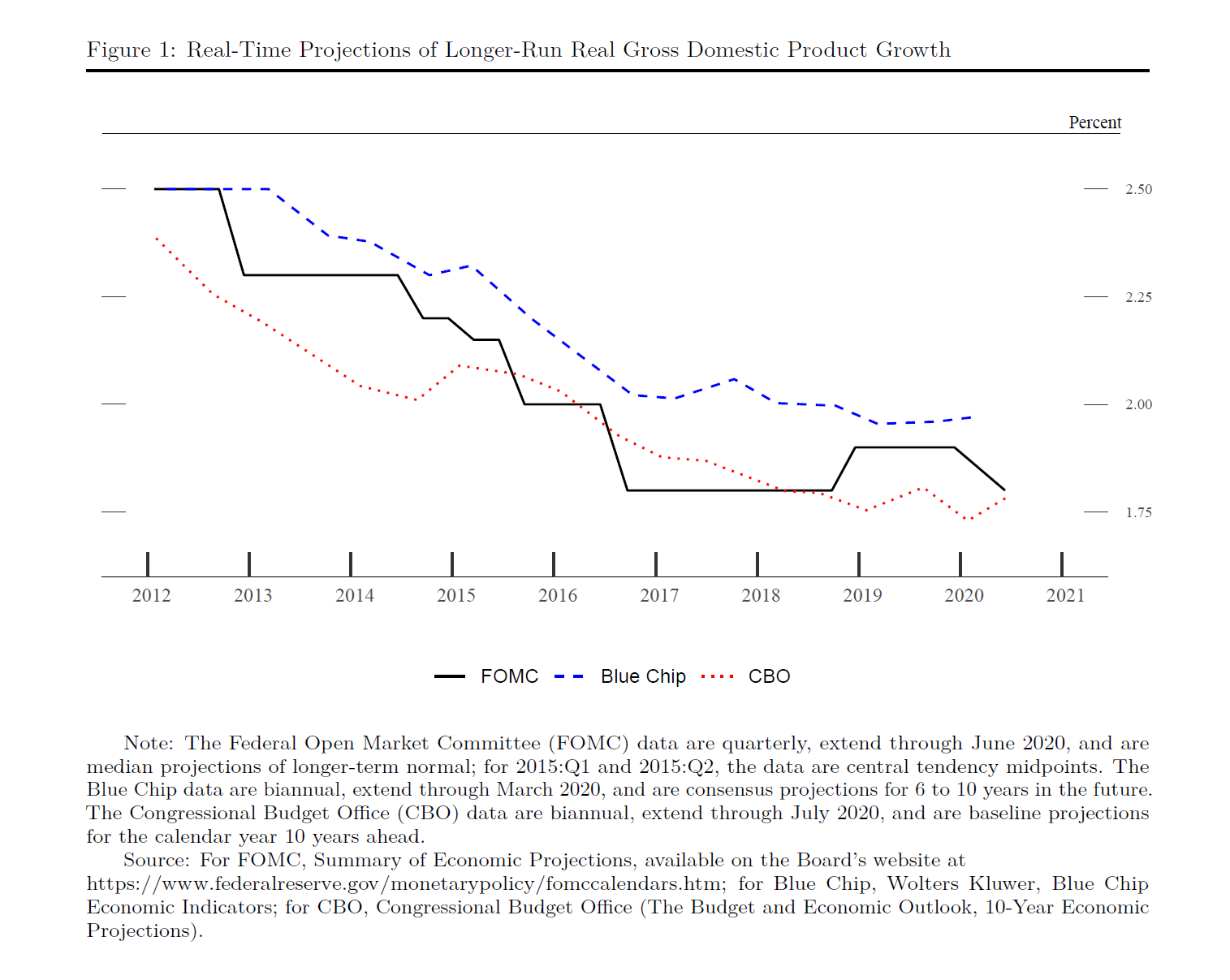
    Our evolving understanding of four key economic developments motivated our review. First, assessments of the potential, or longer-run, growth rate of the economy have declined. For example, since January 2012, the median estimate of potential growth from FOMC participants has fallen from 2.5 percent to 1.8 percent (see figure 1). Some slowing in growth relative to earlier decades was to be expected, reflecting slowing population growth and the aging of the population. More troubling has been the decline in productivity growth, which is the primary driver of improving living standards over time.10

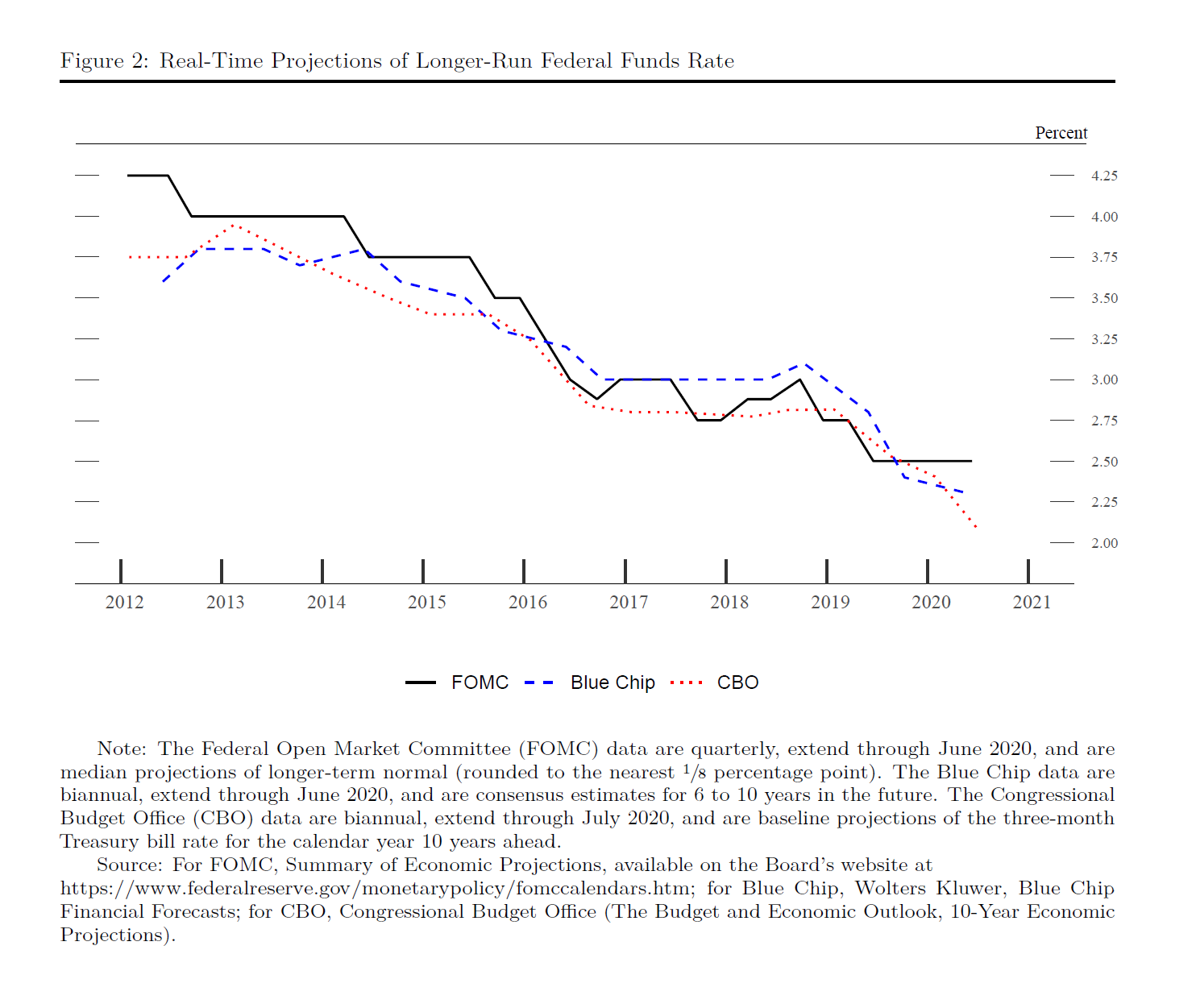
    Second, the general level of interest rates has fallen both here in the United States and around the world. Estimates of the neutral federal funds rate, which is the rate consistent with the economy operating at full strength and with stable inflation, have fallen substantially, in large part reflecting a fall in the equilibrium real interest rate, or “r-star.” This rate is not affected by monetary policy but instead is driven by fundamental factors in the economy, including demographics and productivity growth—the same factors that drive potential economic growth.11 The median estimate from FOMC participants of the neutral federal funds rate has fallen by nearly half since early 2012, from 4.25 percent to 2.5 percent (see figure 2).

    This decline in assessments of the neutral federal funds rate has profound implications for monetary policy. With interest rates generally running closer to their effective lower bound even in good times, the Fed has less scope to support the economy during an economic downturn by simply cutting the federal funds rate.12 The result can be worse economic outcomes in terms of both employment and price stability, with the costs of such outcomes likely falling hardest on those least able to bear them.

    August 27, 2020
  • What England Did to Help Their Economy: Half-Price Food For The Month of August

    The Eat Out to Help Out scheme should be extended to give small food and drink firms a continued boost throughout September, business leaders have said. The Federation of Small Businesses (FSB) is urging chancellor Rishi Sunak to extend the scheme into September as businesses “enter a period of economic make or break”. From The Independent

    Eat Out to Help Out


    Guidance

    Get a discount with the Eat Out to Help Out Scheme

    • English
    • Cymraeg

    From 3 to 31 August, get a 50% discount when you eat in at restaurants that are registered with the Eat Out to Help Out Scheme.

    Published 15 July 2020
    Last updated 29 July 2020 — see all updates
    From:
    HM Revenue & Customs 

    Use the Eat Out to Help Out Scheme at a participating establishment:

    • to get a 50% discount on food or non-alcoholic drinks to eat or drink in (up to a maximum of £10 discount per diner)

    • every Monday, Tuesday and Wednesday between 3 and 31 August

    • as many times as you like

    You do not need a voucher to use this scheme and you can use it at the same time as other offers and discounts. There is no minimum spend.

    You cannot claim discount on alcoholic drinks or service charges.

    The discount will be automatically available to you at participating establishments. Establishments will then claim a reimbursement from the government for the discount they’ve given you.

    Participating establishments may include:

    • restaurants, cafés, bars or pubs
    • work and school canteens
    • food halls

    All diners in a group of any size can use the discount.

    Find a restaurant

    Find now

    You will get up to 100 results within a 5 mile radius.

    Some restaurants may not have registered for the scheme yet.

    If you’re in an area under local lockdown

    You should follow guidelines if you’re in an area under local lockdown. Local restaurants may not be open and could still appear in the results when you use the restaurant finder tool.

    Help you can get

    You can report fraud to HMRC if you think an establishment is abusing the scheme.

    NHS have introduced the test and trace service to help track the spread of coronavirus.

    Published 15 July 2020
    Last updated 29 July 2020 + show all updates
    August 26, 2020
←Previous Page
1 … 64 65 66 67 68 … 386
Next Page→
Senior Women Web

Senior Women Web

An Uncommon Site for Uncommon Women

  • Blog
  • About
  • FAQs
  • Authors
  • Events
  • Shop
  • Patterns
  • Themes

Twenty Twenty-Five

Designed with WordPress