Author: SeniorWomenWeb

  • Researchers From Yale University, Stanford Medical School, University of California, Berkeley: Largest Study of Its Kind Finds Face Masks Reduce COVID-19

    platform opening ceremony and mask wearers

    Dignitaries wearing masks disembark from a northbound train on platform in California at the station’s opening ceremony, 2020

    Wearing face masks, particularly surgical masks, is truly effective in reducing the spread of COVID-19 in community settings, finds a new study led by researchers from Yale University, Stanford Medical School, the University of California, Berkeley, and the nonprofit Innovations for Poverty Action (IPA).

    The study, which was carried out among more than 340,000 adults living in 600 rural communities in Bangladesh, is the first randomized trial to examine the effectiveness of face masks at reducing COVID-19 in a real-world setting, where mask use may be imperfect and inconsistent.

    The results show that increased mask-wearing — the result of a community-level mask distribution and in-person promotion campaign — led to a significant reduction in the percentage of people with COVID-19, based on symptom reporting and SARS-CoV-2 antibody testing. The team tested both cloth and surgical masks and found especially strong evidence that surgical masks are effective in preventing COVID-19. In the study, surgical masks prevented one in three symptomatic infections among community members 60 years and older.

    The findings come at a crucial time in the U.S., when many in-person events have resumed and children The results show that increased mask-wearing — the result of a community-level mask distribution and in-person promotion campaign — led to a significant reduction in the percentage of people with COVID-19, based on symptom reporting and SARS-CoV-2 antibody testing. including those who are under 12 and do not yet qualify for vaccination The results show that increased mask-wearing — the result of a community-level mask distribution and in-person promotion campaign — led to a significant reduction in the percentage of people with COVID-19, based on symptom reporting and SARS-CoV-2 antibody testing. are returning to in-person school.Laura Kwong

    “These results suggest that we could prevent unnecessary death and disease if we get people to wear high-performance masks, such as surgical masks, in schools, workplaces, shopping centers, places of worship and other indoor spaces,” said study co-author Laura Kwong, an assistant professor of environmental health sciences at Berkeley’s School of Public Health. “I would strongly recommend that people who spend time in indoor public spaces, including students, wear surgical masks or other high-performance masks such as N95s, KN95s or KF94s. Fit and comfort are especially important for children, so child-sized KF94s may be most appropriate for them.” (Right, Laura Kwong)

    While prior research has compared the rates of COVID-19 among people who wear masks and those who do not wear masks, the results of these comparisons may be skewed by the fact that people who choose to wear masks may adopt other behaviors that also reduce their risk. This study was designed to overcome this limitation by randomly assigning half of the communities to receive the mask promotion campaign, while the other half did not receive the campaign.  

    “The randomized design provides confidence that the lower rates of COVID-19 in the intervention communities resulted from the mask promotion,” said Dr. Stephen Luby, co-author and a professor of medicine and infectious disease at Stanford. “These results illustrate the remarkable protection that low-cost masks provide.”

    The mask promotion campaign employed a set of four core strategies, named the NORM model, which succeeded at tripling mask-wearing from 13% in the comparison group to 42% in the treatment group. NORM stands for no-cost mask distribution, offering information, reinforcement to wear masks and modeling by local leaders.

    While some of these strategies may not be applicable to the U.S., Kwong says that mask-wearing by political leaders on both sides of the aisle could be the first step in tackling some of the politicization that has made mask-wearing so controversial in the U.S. Mask mandates could be another effective tool for encouraging more people in the U.S. to consistently wear masks.

    “While a few individuals have refused to follow mask mandates, or violently opposed individuals who remind them that they are required to wear a mask, mask mandates have been able to substantially increase mask-wearing in many locations,” Kwong said.

  • From the US Justice Department: A Florida Man Pleaded Guilty in the Southern District of Florida For His Role in a $73 Million Conspiracy to Defraud Medicare

    From the US Justice Department:                                                                                        Justice department name

    FOR IMMEDIATE RELEASE
    Wednesday, September 1, 2021

    Laboratory Owner Pleads Guilty to $73 Million Medicare Kickback Scheme

    A Florida man pleaded guilty yesterday in the Southern District of Florida for his role in a $73 million conspiracy to defraud Medicare by paying kickbacks to a telemedicine company to arrange for doctors to authorize medically unnecessary genetic testing. The scheme exploited temporary amendments to telehealth restrictions enacted during the COVID-19 pandemic that were intended to ensure access to care for Medicare beneficiaries.

    According to court documents, Leonel Palatnik, 42, of Aventura, admitted that, as a co-owner of Panda Conservation Group LLC, he conspired with other co-owners, and with Michael Stein, the owner of 1523 Holdings LLC, to pay kickbacks to Stein in exchange for his work arranging for telemedicine providers to authorize genetic testing orders for Panda’s laboratories. Panda’s owners and Stein entered into a sham contract for purported IT and consultation services to disguise the true purpose of these payments. 1523 Holdings then exploited temporary amendments to telehealth restrictions enacted during the pandemic by offering telehealth providers access to Medicare beneficiaries for whom they could bill consultations. In exchange, these providers agreed to refer beneficiaries to Panda’s laboratories for expensive and medically unnecessary cancer and cardiovascular genetic testing.

    Palatnik pleaded guilty to one count of conspiracy to offer kickbacks and one count of paying a kickback. He is scheduled to be sentenced on Nov. 9 and faces a maximum penalty of 15 years in prison. A federal district court judge will determine any sentence after considering the U.S. Sentencing Guidelines and other statutory factors.

    Assistant Attorney General Kenneth A. Polite Jr. of the Justice Department’s Criminal Division; Assistant Director Calvin Shivers of the FBI’s Criminal Investigative Division; and Special Agent in Charge Omar Pérez Aybar of the U.S. Department of Health and Human Services Office of the Inspector General (HHS-OIG) made the announcement.

    The FBI’s Miami and Dallas Field Offices and HHS-OIG are investigating the case, with assistance from the FBI’s Healthcare Rapid Response Team.

    Trial Attorney Ligia Markman of the National Rapid Response Strike Force is prosecuting the case.

    The case against Palatnik was brought as part of the COVID-19 Health Care Fraud coordinated law enforcement action on May 26 against 14 defendants in seven judicial districts. The law enforcement action was brought in coordination with the Health Care Fraud Unit’s COVID-19 Interagency Working Group, which is chaired by the National Rapid Response Strike Force and organizes efforts to address illegal activity involving health care programs during the pandemic.

    On May 17, the Attorney General established the COVID-19 Fraud Enforcement Task Force to marshal the resources of the Department of Justice in partnership with agencies across government to enhance efforts to combat and prevent pandemic-related fraud. The Task Force bolsters efforts to investigate and prosecute the most culpable domestic and international criminal actors and assists agencies tasked with administering relief programs to prevent fraud by, among other methods, augmenting and incorporating existing coordination mechanisms, identifying resources and techniques to uncover fraudulent actors and their schemes, and sharing and harnessing information and insights gained from prior enforcement efforts. For more information on the department’s response to the pandemic, please visit https://www.justice.gov/coronavirus.

    The Fraud Section leads the Health Care Fraud Strike Force. Since its inception in March 2007, the Health Care Fraud Strike Force, which maintains 15 strike forces operating in 24 federal districts, has charged more than 4,600 defendants who have collectively billed  for approximately $23 billion. In addition, the HHS Centers for Medicare and Medicaid Services, working in conjunction with the HHS-OIG, are taking steps to increase accountability and decrease the presence of fraudulent providers.

    Anyone with information about allegations of attempted fraud involving COVID-19 can report it by calling the Department of Justice’s National Center for Disaster Fraud (NCDF) Hotline at 866-720-5721 or via the NCDF Web Complaint Form at https://www.justice.gov/disaster-fraud/ncdf-disaster-complaint-form.

  • Women in Congress: Biographical Profiles of Former Female Members of Congress

    Since 1917, when Representative Jeannette Rankin of Montana became the first woman to serve in Congress, a total of 395 women have served as U.S. Representatives, Delegates, or Senators. This Web site, based on the publication Women in Congress, contains biographical profiles of former women Members of Congress, links to information about current women Members, essays on the institutional and national events that shaped successive generations of Congresswomen, and images of each woman Member, including rare photos.

    “Women Must Be Empowered”: The U.S. House of Representatives and the Nineteenth Amendment [PDF]

    House Joint Resolution 1 was one of more than 1,200 pieces of legislation introduced on Opening Day of the 66th Congress (1919–1921), May 19, 1919. Most were mundane; H.J. Res. 1 was anything but. Read the story of how the U.S. House of Representatives passed the 19th Amendment.

    Member Profiles

    Member Profiles

    Read biographical profiles of former women Representatives, Delegates, and Senators that focus on their congressional careers. These profiles also contain suggestions for further reading and references to Members’ manuscript collections.

    Women in Congress: An Introduction

    Women in Congress: An Introduction

    Early in the afternoon on May 21, 1919, Representative James Robert Mann of Illinois called up the first measure of the 66th Congress (1919–1921), House Joint Resolution 1. Widely known as the Susan B. Anthony amendment, H.J. Res. 1 was named for one of America’s foremost women’s rights champions.

    “I’m No Lady; I’m a Member of Congress,” 1917–1934

    The era of women in Congress began on April 2, 1917, when Montana’s Jeannette Rankin was sworn in as a Member of the House of Representatives. In August 1920, three months before the 1920 elections, the Nineteenth Amendment guaranteeing women the right to vote was added to the Constitution. Millions of women voted for the first time that fall.

    Onto the National Stage, 1935–1954

    Onto the National Stage, 1935–1954

    Thirty-six women entered Congress for the first time between 1935 and 1954, a tumultuous two decades that encompassed the Great Depression, World War II, and the start of the Cold War. Women participated in America’s survival, recovery, and ascent to world power in important and unprecedented ways; they became shapers of the welfare state, workers during wartime, and members of the military.

    A Changing of the Guard, 1955–1976

    A Changing of the Guard, 1955–1976

    The third generation of women in Congress—the 39 individuals who entered the House of Representatives and the Senate between 1955 and 1976—legislated during an era of upheaval in America. Overlapping social and political movements during this period encouraged more and more women to enter politics and provided valuable experience for a new group of feminist reformers.

    Assembling, Amplifying, and Ascending, 1977–2020

    Assembling, Amplifying, and Ascending, 1977–2020

    Early in the afternoon on January 4, 2007, Nancy Pelosi of California walked down the center aisle of the U.S. House of Representatives and climbed the few steps to the top of the rostrum amid a roar of applause. Moments earlier, she had been elected the first woman to serve as Speaker of the House.

  • Joan L. Cannon Wrote: A Curmudgeon’s Complaint

     chicken noodle soup

    by Joan L. Cannon

    Recently a writing friend told me of a plot premise that she’d thought of. It involved a woman going to the store to pick up a chicken, but she picks up the butcher instead. I thought of the sources for chickens these days and realized that a place where I would be most likely to buy one would offer no opportunity for meeting the butcher, let alone picking him up.

    When I was growing up, even in New York City, we had a local grocery store. The proprietor’s name was Mr. Lovelock. The worn floorboards were covered in sawdust. Every customer had to negotiate around the black and white cat who always occupied the center of the space between the door, the counters, and the shelves. When my mother had chosen what she wanted, we would go home to await a delivery by a lad who must have been about fourteen. There’s not much of that sort of customer relationship around these days. I’m eager to see how my writer friend’s story will develop, and where it will be set.

    Photo: Wikimedia Commons

    To be at the far end of your life tends to make you think backwards perhaps more than is good for the morale. So many changes that happened in the last century and this one have come about at the speed of a 100-yard Olympic sprint, and many are of marvelous consequence for those who have lived to see them. On the other hand, that pace has exacted a price, which is the leisure to contemplate details. Those details are of personalities, eccentricities, individualities, and the most obvious pleasures of the natural world which are rapidly becoming a backdrop. When using the word “leisure” I imply the time and freedom for appreciation.

    I’m distressed by the fact that I miss half the birdsong around us because it’s being drowned out by diesel eighteen-wheelers. I can barely see the mountains because of air pollution, and I have to watch my dog to be sure he isn’t getting into some area treated with chemicals to discourage weeds. As for buying the chicken, I have to pick one out from twenty others so encased in shrink-wrap I can’t tell them apart except for the weight indicated on the labels. Nowadays, if I’m willing to pay over $10 a pound instead of under $3, I can get a “free-range organic” bird, but even then I won’t have the feet available for broth that would be like what I imagine mothers hand out to cold sufferers.

    Real chicken soup is a thing of the past. I mind having to pay extra to get carrots with tops, lemons one-by-one, local tomatoes in August. A can of baked beans isn’t even just a can of baked beans; now I have to choose among several different versions for use with different accompaniments.  I admit it’s nice to be able to get “ethnic” and “gourmet” foods, but where’s the cheese wheel from which you could get a slice cut to order and so sharp it made your tongue sting when you tasted the sample offered on the blade of a knife half the size of a machete?

  • Friday, August 27, 2021 NIH Launches Study of Extra COVID-19 Vaccine Dose in People with Autoimmune Disease

     Kamala Harris receiving second doseTrial also will test pausing immunosuppressive medication to improve antibody response.

    VP Kamala Harris receiving 2nd dose of Covid-19 vaccine; credit Chia-Chi Charlie Chang

    The National Institutes of Health has begun a clinical trial to assess the antibody response to an extra dose of an authorized or approved COVID-19 vaccine in people with autoimmune disease who did not respond to an original COVID-19 vaccine regimen. The trial also will investigate whether pausing immunosuppressive therapy for autoimmune disease improves the antibody response to an extra dose of a COVID-19 vaccine in this population. The Phase 2 trial is sponsored and funded by the National Institute of Allergy and Infectious Diseases (NIAID), part of NIH, and is being conducted by the NIAID-funded Autoimmunity Centers of Excellence.

    “Many people who have an autoimmune disease that requires immunosuppressive therapy have had a poor immune response to the authorized and approved COVID-19 vaccines, placing these individuals at high risk for the disease,” said NIAID Director Anthony S. Fauci, M.D. “We are determined to find ways to elicit a protective immune response to the vaccines in this population. This new study is an important step in that direction.”

    An estimated 8% of Americans have an autoimmune disease, including a disproportionate number of people in the minority communities most severely impacted by COVID-19. Researchers have reported higher rates of severe COVID-19 and death in people with autoimmune disease than in the general population. It is unclear whether this is attributable to the autoimmune disease, the immunosuppressive medications taken to treat it, or both.

    The results of recent studies indicate that giving an extra dose of an authorized COVID-19 vaccine to solid organ transplant recipients, who must take immunosuppressive medications, can improve the immune response to the vaccine in many of these individuals. A NIAID study is underway to investigate this further. The recent findings in solid organ transplant recipients also suggest that an extra dose of a COVID-19 vaccine may help some people with autoimmune disease who take certain immunosuppressive medications. The Food and Drug Administration recently amended(link is external) the emergency use authorizations for the Pfizer-BioNTech and Moderna COVID-19 vaccines to allow the administration of an additional dose to solid organ transplant recipients and other people who have an equivalent level of immunocompromise.

    The new NIAID trial, called COVID‐19 Booster Vaccine in Autoimmune Disease Non‐Responders, initially will include people with one of five autoimmune diseases: multiple sclerosis, pemphigus, rheumatoid arthritis, systemic lupus erythematosus or systemic sclerosis. The immunosuppressive therapies commonly taken by people with these diseases have been associated with poor immune responses to vaccines.

    The study team will enroll approximately 600 participants ages 18 years and older at 15 to 20 sites nationwide. Participants must have had a negative or suboptimal antibody response to two doses of the Moderna COVID-19 vaccine, two doses of the Pfizer-BioNTech COVID-19 vaccine, or one dose of the Johnson & Johnson COVID-19 vaccine, all received prior to enrollment. Participants also must be taking one of three immunosuppressive therapies: mycophenolate mofetil (MMF) or mycophenolic acid (MPA); methotrexate (MTX); or B cell- depleting drugs.

    All participants will receive an extra dose of the same COVID-19 vaccine as they received originally. Then those participants who are taking MMF/MPA or MTX will be assigned at random either to continue taking their immunosuppressive medication without alteration or to pause taking their medication for a short period before and after receiving the extra vaccine dose. The main goal of the study is to determine the proportion of participants who have a significantly better antibody response four weeks after receiving the extra vaccine dose than they did after their original vaccinations.

    Study participants will be followed for a total of 13 months. Preliminary results are expected in November 2021.

    The COVID‐19 Booster Vaccine in Autoimmune Disease Non‐Responders trial is being led by Judith James, M.D., Ph.D., Meggan Mackay, M.D., M.S., Dinesh Khanna, M.B.B.S., M.Sc., and Amit Bar-Or, M.D., F.R.C.P.C. Dr. James is vice president of clinical affairs and program chair of the Arthritis & Clinical Immunology research program at the Oklahoma Medical Research Foundation in Oklahoma City. Dr. Mackay is a professor in the Institute of Molecular Medicine at the Feinstein Institutes for Medical Research in Manhasset, New York. Dr. Khanna is the Frederick G.L. Huetwell professor of rheumatology and the director of the scleroderma program in the department of internal medicine at University of Michigan in Ann Arbor. Dr. Bar-Or is the director of the Center for Neuroinflammation and Neurotherapeutics, chief of the multiple sclerosis division, and the Melissa and Paul Anderson President’s Distinguished Professor at the University of Pennsylvania in Philadelphia.

    Additional information about the COVID‐19 Booster Vaccine in Autoimmune Disease Non‐Responders trial, including the locations of study sites, is available in ClinicalTrials.gov under study identifier NCT05000216.

    NIAID conducts and supports research—at NIH, throughout the United States, and worldwide—to study the causes of infectious and immune-mediated diseases, and to develop better means of preventing, diagnosing, and treating these illnesses. News releases, fact sheets and other NIAID-related materials are available on the NIAID website.

    About the National Institutes of Health (NIH): NIH, the nation’s medical research agency, includes 27 Institutes and Centers and is a component of the U.S. Department of Health and Human Services. NIH is the primary federal agency conducting and supporting basic, clinical, and translational medical research, and is investigating the causes, treatments, and cures for both common and rare diseases. For more information about NIH and its programs, visit www.nih.gov.

    NIH…Turning Discovery Into Health®

  • Federal Reserve Chairman Jerome Powell: Monetary Policy in the Time of Covid

    At the “Macroeconomic Policy in an Uneven Economy,” economic policy symposium sponsored by the Federal Reserve Bank of Kansas City, Jackson Hole, Wyoming (via webcast)

    Seventeen months have passed since the U.S. economy faced the full force of the COVID-19 pandemic. This shock led to an immediate and unprecedented decline as large parts of the economy were shuttered to contain the spread of the disease.

    The path of recovery has been a difficult one, and a good place to begin is by thanking those on the front line fighting the pandemic: the essential workers who kept the economy going, those who have cared for others in need, and those in medical research, business, and government, who came together to discover, produce, and widely distribute effective vaccines in record time. We should also keep in our thoughts those who have lost their lives from Covid, as well as their loved ones.

    Strong policy support has fueled a vigorous but uneven recovery — one that is, in many respects, historically anomalous. In a reversal of typical patterns in a downturn, aggregate personal income rose rather than fell, and households massively shifted their spending from services to manufactured goods. Booming demand for goods and the strength and speed of the reopening have led to shortages and bottlenecks, leaving the COVID-constrained supply side unable to keep up. The result has been elevated inflation in durable goods — a sector that has experienced an annual inflation rate well below zero over the past quarter century.1 Labor market conditions are improving but turbulent, and the pandemic continues to threaten not only health and life, but also economic activity. Many other advanced economies are experiencing similarly unusual conditions.

    In my comments today, I will focus on the Fed’s efforts to promote our maximum employment and price stability goals amid this upheaval, and suggest how lessons from history and a careful focus on incoming data and the evolving risks offer useful guidance for today’s unique monetary policy challenges.

    The Recession and Recovery So Far
    The pandemic recession — the briefest yet deepest on record — displaced roughly 30 million workers in the space of two months.2 The decline in output in the second quarter of 2020 was twice the full decline during the Great Recession of 2007–09.3 But the pace of the recovery has exceeded expectations, with output surpassing its previous peak after only four quarters, less than half the time required following the Great Recession. As is typically the case, the recovery in employment has lagged that in output; nonetheless, employment gains have also come faster than expected.4

    The economic downturn has not fallen equally on all Americans, and those least able to shoulder the burden have been hardest hit. In particular, despite progress, joblessness continues to fall disproportionately on lower-wage workers in the service sector and on African Americans and Hispanics.

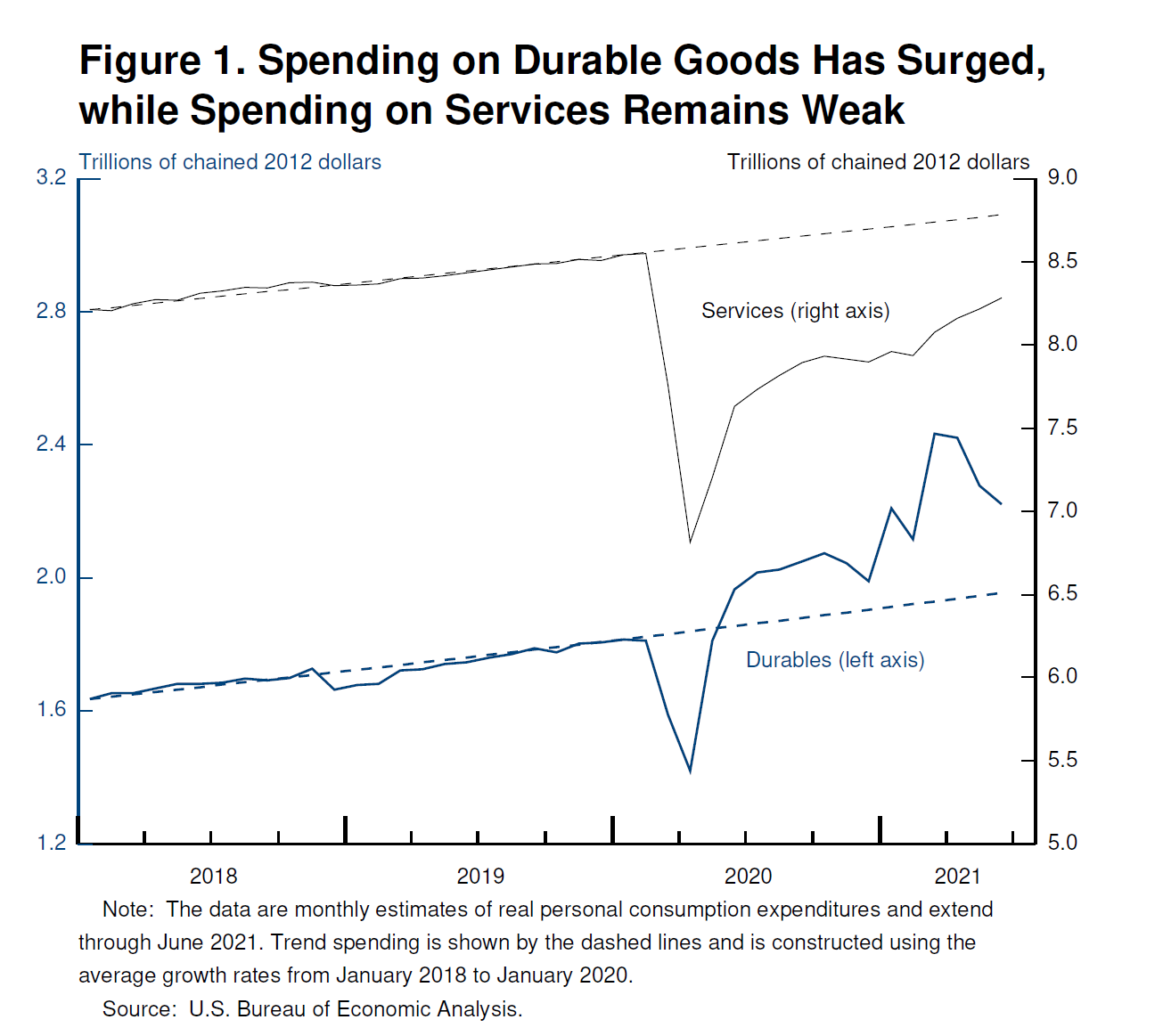
    The unevenness of the recovery can further be seen through the lens of the sectoral shift of spending into goods — particularly durable goods such as appliances, furniture, and cars — and away from services, particularly in-person services in areas such as travel and leisure (figure 1). As the pandemic struck, restaurant meals fell 45 percent, air travel 95 percent, and dentist visits 65 percent. Even today, with overall gross domestic product and consumption spending more than fully recovered, services spending remains about 7 percent below trend. Total employment is now 6 million below its February 2020 level, and 5 million of that shortfall is in the still-depressed service sector. In contrast, spending on durable goods has boomed since the start of the recovery and is now running about 20 percent above the pre-pandemic level. With demand outstripping pandemic-afflicted supply, rising durables prices are a principal factor lifting inflation well above our 2 percent objective.

    Given the ongoing upheaval in the economy, some strains and surprises are inevitable. The job of monetary policy is to promote maximum employment and price stability as the economy works through this challenging period. I will turn now to a discussion of progress toward those goals.

    The Path Ahead: Maximum Employment
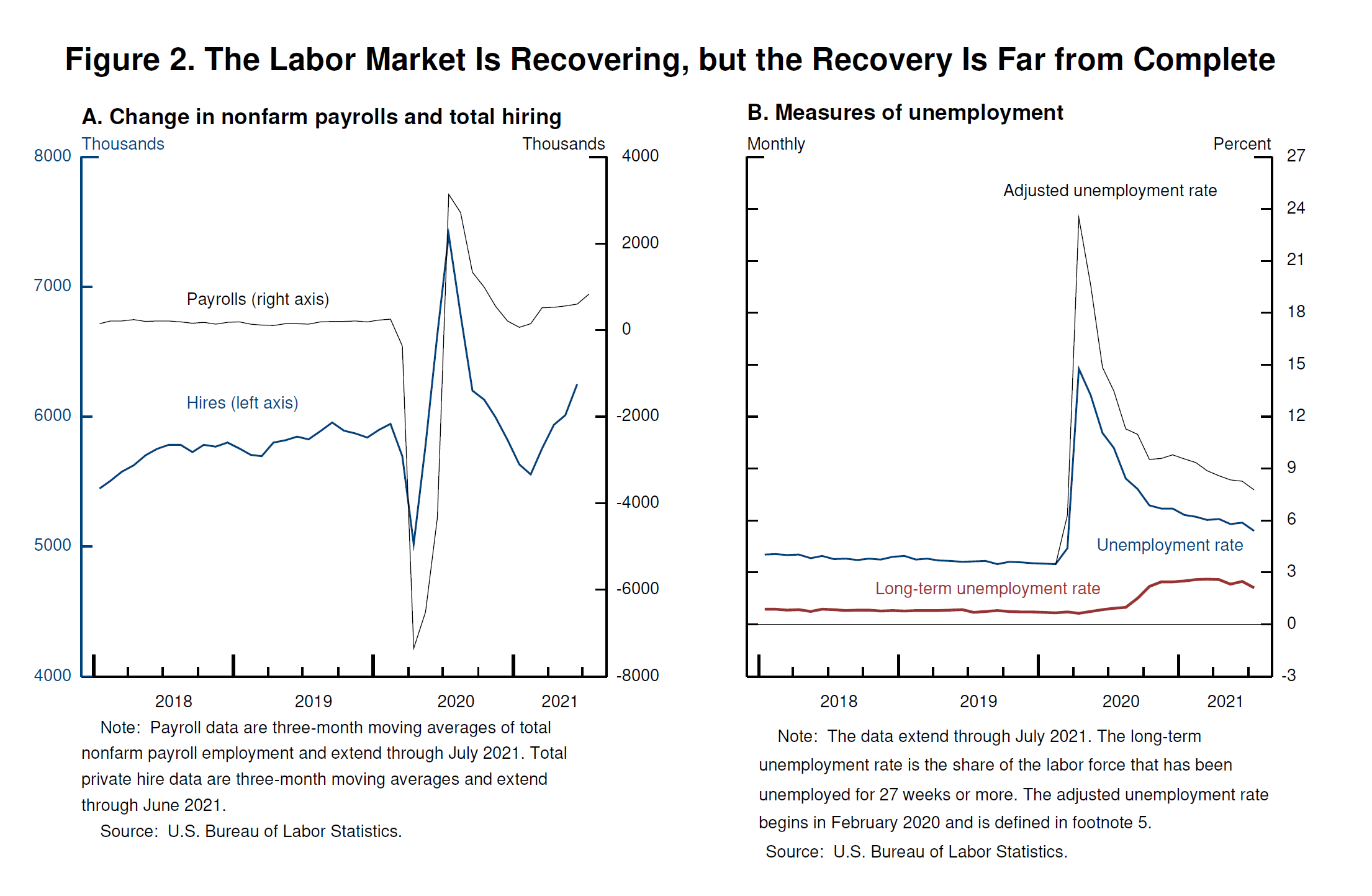
    The outlook for the labor market has brightened considerably in recent months. After faltering last winter, job gains have risen steadily over the course of this year and now average 832,000 over the past three months, of which almost 800,000 have been in services (figure 2). The pace of total hiring is faster than at any time in the recorded data before the pandemic. The levels of job openings and quits are at record highs, and employers report that they cannot fill jobs fast enough to meet returning demand.

    These favorable conditions for job seekers should help the economy cover the considerable remaining ground to reach maximum employment. The unemployment rate has declined to 5.4 percent, a post-pandemic low, but is still much too high, and the reported rate understates the amount of labor market slack.5 Long-term unemployment remains elevated, and the recovery in labor force participation has lagged well behind the rest of the labor market, as it has in past recoveries.

  • Population Changes Across the Country Since the 2010 Census: “our nation is growing slower than it used to”

    Today’s release reveals changes in the size and distribution of the population across the United States. The population of U.S. metro areas grew by 9% from 2010 to 2020, resulting in 86% of the population living in U.S. metro areas in 2020, compared to 85% in 2010.

    “Many counties within metro areas saw growth, especially those in the south and west. However, as we’ve been seeing in our annual population estimates, our nation is growing slower than it used to,” said Marc Perry, a senior demographer at the Census Bureau. “This decline is evident at the local level where around 52% of the counties in the United States saw their 2020 Census populations decrease from their 2010 Census populations.”census records in 1790

    Right: 1790 Census Enumerator Record

    County and metro area highlights:

    • The largest county in the United States in 2020 remains Los Angeles County with over 10 million people.
    • The largest city (incorporated place) in the United States in 2020 remains New York with 8.8 million people.
    • 312 of the 384 U.S. metro areas gained population between 2010 and 2020.
    • The fastest-growing U.S. metro area between the 2010 Census and 2020 Census was The Villages, FL, which grew 39% from about 93,000 people to about 130,000 people.
    • 72 U.S. metro areas lost population from the 2010 Census to the 2020 Census. The U.S. metro areas with the largest percentage declines were Pine Bluff, AR, and Danville, IL, at -12.5 percent and -9.1 percent, respectively.

    A data visualization released today shows the population change at the county level from the 2010 Census to the 2020 Census. Read more about population change in the America Counts story, More Than Half of U.S. Counties Were Smaller in 2020 Than in 2010.

    2020 Census Findings on Race and Ethnicity

    The 2020 Census used the required two separate questions (one for Hispanic or Latino origin and one for race) to collect the races and ethnicities of the U.S. population ­­— following the standards set by the U.S. Office of Management and Budget (OMB) in 1997. Building upon our research over the past decade, we improved the two separate questions design and updated our data processing and coding procedures for the 2020 Census. This work began in 2015 with research and testing centered on findings from the 2015 National Content Test, and the designs were implemented in the 2018 Census Test.

    The improvements and changes enabled a more thorough and accurate depiction of how people self-identify, yielding a more accurate portrait of how people report their Hispanic origin and race within the context of a two-question format. These changes reveal that the U.S. population is much more multiracial and more diverse than what we measured in the past.

    We are confident that differences in the overall racial distributions are largely due to improvements in the design of the two separate questions for race data collection and processing, as well as some demographic changes over the past 10 years.

    Today’s release of 2020 Census redistricting data provides a new snapshot of the racial and ethnic composition of the country as a result of improvements in the design of the race and ethnicity questions, processing and coding.

    “As the country has grown, we have continued to evolve in how we measure the race and ethnicity of the people who live here,” said Nicholas Jones, director and senior advisor for race and ethnicity research and outreach at the Census Bureau. “Today’s release of 2020 Census redistricting data provides a new snapshot of the racial and ethnic composition and diversity of the country. The improvements we made to the 2020 Census yield a more accurate portrait of how people self-identify in response to two separate questions on Hispanic origin and race, revealing that the U.S. population is much more multiracial and more diverse than what we measured in the past.”

    Race and ethnicity highlights:

    • The White population remained the largest race or ethnicity group in the United States, with 204.3 million people identifying as White alone. Overall, 235.4 million people reported White alone or in combination with another group. However, the White alone population decreased by 8.6% since 2010.
    • The Two or More Races population (also referred to as the Multiracial population) has changed considerably since 2010. The Multiracial population was measured at 9 million people in 2010 and is now 33.8 million people in 2020, a 276% increase.
    • The “in combination” multiracial populations for all race groups accounted for most of the overall changes in each racial category.
    • All of the race alone or in combination groups experienced increases. The Some Other Race alone or in combination group (49.9 million) increased 129%, surpassing the Black or African American population (46.9 million) as the second-largest race alone or in combination group.
    • The next largest racial populations were the Asian alone or in combination group (24 million), the American Indian and Alaska Native alone or in combination group (9.7 million), and the Native Hawaiian and Other Pacific Islander alone or in combination group (1.6 million).
    • The Hispanic or Latino population, which includes people of any race, was 62.1 million in 2020. The Hispanic or Latino population grew 23%, while the population that was not of Hispanic or Latino origin grew 4.3% since 2010.
  • ways to grasp a pencil

    Julia Sneden Wrote: Old Dogs, New Tricks

    ways to grasp a pencil

    I hope that whoever came up with that “You can’t teach an old dog new tricks” line has spent a long time in Purgatory, paying for making such a ridiculous generalization. (On the other hand, I hope that whoever came up with: “No generalization is true including this one” ascended straight to epigram heaven).

    https://rsuhenda1.workflow.arts.ac.uk/unit-7-user-research

    I feel indignant on behalf all the friends, acquaintances, and family members who, after the age of 50, have taken on new learning experiences ranging from Elder Hostel weekends, to career shifts, to taking up crafts like knitting or crochet, to learning new languages, to travel abroad, to rock climbing, to — well, you name it. Learning new tricks gives life some zing, and never more than when the rest of the world expects you to slow down.

    Oh, I know that the phrase should be regarded as metaphor, but even then I question its truth. I don’t for a moment believe that we’re doomed to keep repeating the mistakes of our youth. I know too many people who have taken their lives in hand and reinvented themselves. For instance:

        • A good friend who smoked 3 packs a day for 40 years made up her mind to become completely tobacco free at the age of 60, and did it.
        • A married couple I know sought counseling and rescued a relationship that had become bitter and destructive.
        • The nephew of a friend, who had always wanted to be a wood carver, tossed his banking career away, and moved to the mountains to become a successful artist.

    Mind you, there are a few tricks that we old dogs find especially hard to learn. Try, for instance, making changes that touch upon physical things, things that require muscles or nerves to learn new patterns.

    Shortly after I started lap swimming, it occurred to me that continually turning my head to the left to breathe might well wear out some of the internal mechanisms, or perhaps let similar mechanisms on the right side atrophy. I decided to breathe to the right as I did my smooth crawl up and down the pool. My first attempt was a horror. I rolled like a foundering ship. I swallowed a lot of water (that is what water I didn’t breathe in). It seemed as if the far end of the pool had moved itself back by at least 50 feet as I struggled along. Maybe, I thought, I’ll try alternate-side breathing first. That, too, was not easy, but at least I had the left-breath at every other stroke in which to grab some air. At the end of a couple of weeks, I was moving along smoothly again, and soon was able to do every third lap of the pool breathing entirely on my right side. I was disgustingly proud of myself.

    And then there was the matter of my pencil grip. At the age of 37, I started a new career as a kindergarten teacher. My first day on the job, the lead teacher, who was in her 70’s and scared me every bit as much as she scared the children, watched me writing a note.

    “You’ll have to change the way you hold your pencil,” she said.

    “Excuse me?” I replied, looking down at my hand.

    “You’re using your thumb and middle finger to control the pencil,” she said disapprovingly. “You’re supposed to hold it between thumb and pointer, with tall-man tucked firmly away. It would be very bad for the children to see a teacher holding her pencil like that.”

    The battle of the pencil grip was bad enough, but the first time she saw me cutting a piece of paper with the blunt-nosed, child sized scissors, she threw up her hands in horror.

  • AFL-CIO: Liz Shuler Has Been Elected to Serve as President of the Federation of 56 Unions and 12.5 Million Members

    Jerome Powell

    The AFL-CIO Executive Council today elected Liz Shuler, a visionary leader and longtime trade unionist, to serve as president of the federation of 56 unions and 12.5 million members. Shuler is the first woman to hold the office in the history of the labor federation. The Executive Council also elected United Steelworkers (USW) International Vice President Fred Redmond to succeed Shuler as secretary-treasurer, the first African American to hold the number two office. Tefere Gebre will continue as executive vice president, rounding out the most diverse team of officers ever to lead the AFL-CIO.  

    Right, Liz Shuler, new president of the AFL-CIO

    The election of Shuler and Redmond comes after the unexpected and untimely passing of Richard Trumka, who served as AFL-CIO president from 2009 until his death on Aug. 5, capping a more than 50-year career of dedication to America’s unions and working people. 

    Shuler grew up in a union household — her father, Lance, was a power lineman and longtime member of Electrical Workers (IBEW) Local 125 at Portland General Electric and her late mother, Joyce, worked as an estimator in the company’s service and design department. In 1993, Shuler was hired as an organizer at Local 125. 

    In 1998, Ed Hill, then-secretary-treasurer of the IBEW, assigned Shuler to California where she mobilized IBEW members to help defeat Prop. 226, the so-called paycheck protection initiative that threatened to silence union members in the political process. That victory prompted John J. Barry, then president of the IBEW at that time, to hire her as an international representative in the union’s Political/Legislative Affairs Department in Washington, D.C. In that role, Shuler ran grassroots political mobilization efforts and lobbied Congress on a range of issues important to working families. In 2004, she was promoted to assistant to the international president, where she served President Hill, who had succeeded to that position, in driving the agenda of the nearly 1-million member union. 

    In 2009, she joined forces with Trumka, becoming the first woman elected to the position of secretary-treasurer at an AFL-CIO convention and the youngest woman ever on the federation’s Executive Council. As secretary-treasurer, she also served as the chief financial officer, turning deficits into surpluses and steering the federation through multiple fiscal crises, including the COVID-19 pandemic.

    In addition to her stewardship of the federation’s finances, Shuler led the AFL-CIO’s initiatives on the future of work, retirement security, the clean energy economy, public safety reform, workforce development, and empowering women and young workers.

    The terms of the three executive officers run through June 2022, when delegates to the AFL-CIO Convention in Philadelphia will elect leaders for new four-year terms. 

  • The White House Says Boosters for All: Here’s What You Need to Know: “Stick to the advice from the CDC and the FDA, because they are doing their very best to ensure maximum protection and safety”

    football game during 1918 flu 

    [UPDATED at 3 p.m. ET to reflect news developments]

    The Biden administration announced plans Wednesday to offer boosters to all U.S. adults as soon as next month, saying that recent data, including some made available only in the past few days, played a role in that decision.

    “If you wait for something bad to happen before you respond to it, you find yourselves considerably behind,” Dr. Anthony Fauci said during a White House briefing. “You want to stay ahead of the virus.”

    White House officials emphasized that the rollout of boosters was pending review of evidence by officials at the Food and Drug Administration as well as the advisory committee to the Centers for Disease Control and Prevention.

    The rollout would begin the week of Sept. 20. U.S. residents 18 and older who received the Moderna or Pfizer-BioNTech vaccines would be eligible for a third shot eight months after their second dose. The timing would mean that health care workers, long-term care residents and older residents would be first in line for boosters.

    “If you are fully vaccinated, you still have a high degree of protection from the worst outcomes — we are not recommending you go out and get a booster today,” U.S. Surgeon General Vivek Murthy said. Johnson & Johnson vaccines were not distributed until March and a plan for those booster shots will come later, officials said.

    Political and corporate pressure to offer a booster to U.S. citizens has been mounting over the summer months, as the highly contagious delta variant has spread nationally and filled hospital beds. On Wednesday, Biden officials offered slides filled with charts of recent data, talked about antibody response, and noted that research showing waning vaccine strength in Israel played a key role in their decision as did a study from Mayo Clinic that is not yet peer-reviewed.

    “Stick to the advice from the CDC and the FDA, because they are doing their very best to ensure maximum protection and safety,” said Dr. Cody Meissner, a specialist in pediatric infectious diseases who sits on the FDA’s vaccine advisory panel. “People have to be very careful about statements that come from Big Pharma. They have a very different goal.”

    Dr. Sadiya Khan, an epidemiologist and cardiologist at Northwestern University’s Feinberg School of Medicine, said that taking any medication has risks and that adding an additional dose of vaccine might cause unnecessary side effects. “What we need is data,” she said.