Author: SeniorWomenWeb

  • Serena Nanda Reviews Brother Mambo: Finding Africa in the Amazon

    Brother Mambo: Finding Africa in the Amazon

    By J.D Lenoir with Phil Ceder, KutuKutuBrother Mambo

    Published by Black Rose Press, Castroville, Texas:  179 pp. 2022

    Reviewed by Serena Nanda

    Like early 20th century cultural anthropologists John Lenoir set out in the 1970s to spend some adventurous years doing fieldwork in an idyllic tropical paradise isolated from Western culture. But John never imagined how adventurous it would be. The readers of this fascinating and deeply moving memoir will experience the same surprises. John chose to work in the newly independent nation of Guyana in the Amazon basin of South America. His aim was to explore the effect of African culture on a slave plantation society only recently freed from European colonialism.

    But from the moment John exited the plane at Georgetown, Guyana’s capital, nothing turned out as he expected. Viewing him as another Western colonialist, the Guyanese government refused to allow him to carry out his research. Despite his deep disappointment, John was determined to pursue his research, temporarily remaining in Guyana to mull over his options. Here he experienced some very strange encounters including one with a hummingbird which eventually led him to an isolated jungle community of freed slaves in the neighboring nation of Suriname.  

    Traveling to Suriname by a ferry on the Maroni River, sharing a space meant for 50 passengers with over 400, after several days John disembarked at Paramaribo the Surinamese capital. He stayed there for a while in a local inn trying to figure out what was next in this totally foreign environment. Some friendly locals who spoke a little English taught him some “bush” language called Pamakan, and he explained to them what he was hoping to do. 

    These conversations ultimately led him to the village of Langatabiki, one of several isolated river communities of formerly enslaved Africans who had escaped European plantations. Surviving the bounty hunters who tried to recapture them, these former slaves had settled in hidden villages like Langatabiki, in the Amazon rain forests, reachable only by dugout canoe.  When John disembarked from the canoe, villagers gathered round to stare at this strange visitor trying to figure out why he was there. Speaking his few words of Pamakan, John was able to explain his purpose of staying in the village in order to learn about their society, which the village Paramount Chief allowed him to do.  

    Before anything else, John needed to know was where he could use a bathroom and get some water to drink.  The boys surrounding him laughed nervously and pointed to the river and John realized how profoundly different life would be here from that of New York. He was also really hungry and as he didn’t see any places to eat, couldn’t imagine how he would get food. Then he remembered a central anthropological theory which emphasized the importance of reciprocity, or gift giving, in small non-Western societies. John reached into his backpack, his only luggage, and took out some snack bars he had bought in Paramaibo. He unwrapped the bars and offered them to the boys surrounding him who eagerly devoured them. The boys then led him to the nearby hut where he would live, which contained only a hammock for sleeping. Leaving his backpack in the hut, John sat outside on a log and anxiously reflected on his chances of surviving in this village. But as evening advanced, a young boy came by with a covered package. It was dinner — rice topped with stewed fish and gravy, one of the best meals John had ever eaten. The anthropological theory about reciprocity had paid off. 

    After a few weeks in the village, John’s wife came down, as they had planned, bringing their pet cat. His happiness didn’t last long: only a few days later she left, deciding she could never live in a dark, oppressively hot hut, with no light, a dirt floor, sleeping in a hammock, no privacy, only a river for a bathroom and a bath and a one-burner propane stove for cooking. John was devastated by loneliness when she departed, but decided to stick it out. He was adapting to the culture and environment, had worked out trading arrangements with neighbors for food and got used to the howling jungle monkeys at night. 

    As he became friendly with the villagers John learned more of their language, partly in exchange for teaching them English. It became clear that he would be living here for a long time and some village women decided he needed a “bush” name. They chose the name Mambo, and since Pamakans, like many other non-Western cultures, added a kinship term when greeting people, John henceforth became Brother or BaMambo.   

    John’s understanding of Pamakan language and culture progressed largely with the help of KutuKutu, the young boy who had brought him his first meal (and the co-author of this memoir). KutuKutu’s help was especially useful in tense situations arising from John’s incomplete understanding of  trading arrangements. Early in his participant observation research, which is basic to ethnography, John began documenting village kinship relations on a map, naming the locations of people living in different huts. This frightened some of villagers who thought John would use their names to practice witchcraft on them.
  • National Institutes of Health: Researchers Uncover How the Human Brain Separates, Stores, and Retrieves Memories

     NIH images

    Monday, March 7, 2022

    NIH-funded study identifies brain cells that form boundaries between discrete events. 

    Researchers have identified two types of cells in our brains that are involved in organizing discrete memories based on when they occurred. This finding improves our understanding of how the human brain forms memories and could have implications in memory disorders such as Alzheimer’s disease. The study was supported by the National Institutes of Health’s Brain Research Through Advancing Innovative Neurotechnologies (BRAIN) Initiative and published in Nature Neuroscience.

    “This work is transformative in how the researchers studied the way the human brain thinks,” said Jim Gnadt, Ph.D., program director at the National Institute of Neurological Disorders and Stroke and the NIH BRAIN Initiative. “It brings to human neuroscience an approach used previously in non-human primates and rodents by recording directly from neurons that are generating thoughts.”

    This study, led by Ueli Rutishauser, Ph.D., professor of neurosurgery, neurology and biomedical sciences at Cedars-Sinai Medical Center in Los Angeles, started with a deceptively simple question: how does our brain form and organize memories? We live our awake lives as one continuous experience, but it is believed based on human behavior studies, that we store these life events as individual, distinct moments. What marks the beginning and end of a memory? This theory is referred to as “event segmentation,” and we know relatively little about how the process works in the human brain.

    To study this, Rutishauser and his colleagues worked with 20 patients who were undergoing intracranial recording of brain activity to guide surgery for treatment of their drug-resistant epilepsy. They looked at how the patients’ brain activity was affected when shown film clips containing different types of “cognitive boundaries” — transitions thought to trigger changes in how a memory is stored and that mark the beginning and end of memory “files” in the brain.

    The first type, referred to as a “soft boundary,” is a video containing a scene that then cuts to another scene that continues the same story. For example, a baseball game showing a pitch is thrown and, when the batter hits the ball, the camera cuts to a shot of the fielder making a play. In contrast, a “hard boundary” is a cut to a completely different story — imagine if the batted ball were immediately followed by a cut to a commercial.

  • The Horror; A “Vacuum Bomb”; Do You Remember the First Time You Heard the Term ‘Atomic Bomb’?

    Fact Sheet: Russia’s Use of Thermobaric Weapons in Ukraine 

    On February 28, 2022, the Ukrainian ambassador to the United States confirmed that Russia had used a “vacuum bomb,” killing 70 soldiers, as part of its illegal invasion of Ukraine. Two days prior, CNN reported  that Russian TOS-1 rocket launchers, which can launch up to 30 rockets armed with thermobaric warheads, were mobilized in eastern Ukraine. Thermobaric weapons have been described as the biggest non-nuclear bomb, but there is a massive leap in the destructive power to a weapon of mass destruction.

    What are thermobaric weapons?

    Thermobaric weapons are a subclass of volumetric weapons, a family that includes thermobaric weapons and fuel air explosives. They consist of a fuel container and two separate explosive charges. When a volumetric weapon is dropped or launched, the first charge detonates to disperse the fuel particles. The second charge ignites the dispersed fuel and oxygen in the air, creating a blast wave of extreme pressure and heat that has the potential to reverberate and to create a partial vacuum in an enclosed space. They are likely to cause civilian casualties due to their indiscriminate and uncontained nature.

    The effects of thermobaric bombs are compounded in enclosed spaces, making them highly effective in buildings. Russia’s unanticipated struggle with urban warfare thus far might explain its reported usage. The International Criminal Court (ICC) has decided to open an investigation into potential war crimes in Ukraine, which could include the use of thermobaric weapons.

    Comparison to nuclear weapons

    There is a massive difference between a thermobaric weapon and a nuclear weapon, but neither weapon is new. Fuel-air explosives were developed by the United States in the 1960s and used in Vietnam. They were also previously used by Russia in Chechnya in the 1990s, reportedly against China during a 1969 border conflict and most recently, in the conflict in Syria and possibly by the Syrian regime itself. It is believed that China and India also have these bombs. However, the United States and Russia have continued to improve them and billed them as a substitute to the vastly more destructive nuclear bombs in order to breach hardened military targets.

    Russia’s largest thermobaric weapons test in 2007 had a yield of 44 tons, while the U.S. B61 tactical nuclear weapons, which are deployed in Europe, at their lowest yield are ~300 tons. For greater comparison, U.S. strategic nuclear weapons have varying yields from around 50,000 tons to 1.2 megatons. Thermobaric bombs are not in the same class by any means.

    Misconceptions and misinformation

    Russian President Vladimir Putin appears to be pushing the limits of conventional warfare to break the will of the Ukrainian people. Thermobarics have extremely limited utility against military targets; their primary use has been against civilian areas. They still fall far short of nuclear weapons. A better comparison for thermobarics is to incendiary munitions, cluster munitions and barrel bombs. There is a legal argument that thermobaric weapons may be prohibited under the Convention on Certain Conventional Weapons if they count under Protocol III: Prohibitions or Restrictions on the Use of Incendiary Weapons, but they are not explicitly listed. Further, since the United States also keeps them in its military inventory, it is unlikely that they will be explicitly listed or that there will be a treaty banning their use.

    The claim about fuel-air explosives being comparable to low-yield nuclear weapons seems to have come in part from an article by a Russian scientist and a statement from a Russian official after the test in 2007. While articles like those listed distinguish between thermobaric weapons and fuel-air bombs as separate classes under the larger umbrella of volumetric weapons, some news stories like this one and even this book explicitly state that thermobaric weapons, fuel-air bombs, and vacuum bombs are all synonymous. This patent lays out the differences, which seem to come down to stages of anaerobic versus aerobic reactions.

  • Kaiser Health News: Biden’s Promise of Better Nursing Home Care Will Require Many More Workers

    [UPDATED at 10:25 a.m. ET]Lori Smetanka

    The Biden administration has identified core impediments to better nursing home care in its proposed overhaul of the industry, but turning aspirations into reality will require a complex task: mandating adequate staffing levels for all homes without bankrupting those that can’t afford far higher labor costs.

    Right: Lori Smetanka is the Executive Director of the National Consumer Voice for Quality Long-Term Care

    President Joe Biden’s proposals for the nation’s 15,000 skilled nursing facilities — released in advance of his State of the Union address this past Tuesday night — would lead to the most substantial increase in federal nursing home regulation since Congress reformed the industry in 1987. The centerpiece of the effort is establishing minimum staffing levels for facilities. To date, the Centers for Medicare & Medicaid Services requires “adequate” staffing but specifically mandates only a skeleton crew of round-the-clock nursing coverage and one registered nurse who works at least eight hours each day.

    CMS has rebuffed requests to mandate higher staffing levels in the past, saying each facility should “make thoughtful, informed staffing plans.” But multiple examinations — including a thorough CMS study in 2001 — have concluded staffing levels are frequently inadequate, particularly on nights and weekends. Studies have found that homes with higher staffing levels have fewer patient injuries. The 2001 study set a standard that many nursing homes currently don’t meet, saying optimal care required roughly one staffer for every seven short-stay patients — like those recovering from a hospital stay — and one staffer for every six long-stay residents.

    “We would not be surprised to see that number [of staffers] be higher in a new study because we know the care needs for residents and acuity levels have actually increased over the last 20 years,” said Lori Smetanka, executive director of the National Consumer Voice for Quality Long-Term Care, which advocates for older people who get services in nursing homes, assisted living facilities, and at home.

    Requiring adequate staffing levels won’t solve the problem many homes face in finding and retaining nurses and aides, a systemic issue made worse by the pandemic. And it’s likely that many facilities — particularly those with the largest share of Medicaid residents — would struggle to afford substantial increases in their workforces.

    “Regulations and enforcement, even with the best intentions, just can’t change that math,” Katie Smith Sloan, president and CEO of LeadingAge, an association of nonprofit aging service providers, said in a statement. Mark Parkinson, president and CEO of the American Health Care Association, the largest nursing-home lobbying group, said in a statement that “we cannot meet additional staffing requirements when we can’t find people to fill the open positions nor when we don’t have the resources to compete against other employers.”

  • National Archives Virtual Daytime Programs in March; Celebrating Women’s History Month

    Suffrage Parade

     Suffrage parade in New York City, ca. 1912. View in National Archives Catalog

    1950 Census Genealogy Series – Overview of What’s on the 1950 Census 
    March 2, at 1 p.m. ET
    Watch on our 
    National Archives YouTube Channel
    Our Genealogy/Census Subject Matter Expert Claire Kluskens will provide an overview of what’s available (and not available) in the 1950 Census. Learn more about the 1950 Census, which will be released to the public on April 1, with our Genealogy Series

    Book Talk – Saving Yellowstone: Exploration and Preservation in Reconstruction America
    Monday, March 7, at 1 p.m. ET
    Register in advance; watch on the National Archives YouTube Channel

    Each year nearly four million people visit Yellowstone National Park — one of the most popular of all national parks — but few know the fascinating and complex historical context behind its establishment 150 years ago this month. Megan Kate Nelson’s Saving Yellowstone is a story of adventure and exploration; Indigenous resistance; railroad, photographic, and publishing technologies; and the struggles of Black southerners to bring racial terrorists to justice. Joining Nelson in conversation will be Andrew R. Graybill, Director of the Clements Center for Southwest Studies at Southern Methodist University.

    Book Talk – Female Genius: Eliza Harriot and George Washington at the Dawn of the Constitution
    Tuesday, March 8, at 1 p.m. ET
    Register in advance; watch on the National Archives YouTube Channel

    Mary Sarah Bilder looks to the 1780s — the age of the Constitution — to investigate the rise of a radical new idea in the English-speaking world: female genius. English-born Eliza Harriot Barons O’Connor delivered a University of Pennsylvania lecture attended by George Washington as he and other Constitutional Convention delegates gathered in Philadelphia. As the first such public female lecturer, her courageous performance likely inspired the gender-neutral language of the Constitution. Female Genius reconstructs Eliza Harriot’s transatlantic life, paying particular attention to her lectures and to the academies she founded, inspiring countless young American women to consider a college education and a role in the political forum. By 1792 Harriot’s struggles reflected the larger backlash faced by women and people of color as new written constitutions provided the political and legal tools for exclusion based on sex, gender, and race. Joining the author in conversation will be Martha S. Jones, professor of history at Johns Hopkins University. Women’s History Month programming is made possible in part by the National Archives Foundation through the generous support of Denise Gwyn Ferguson.

    Book Talk – The Second World War and Echoes from the Past: A Conversation with Sir Antony Beevor
    Tuesday, March 8, at 2 p.m. ET

    Register in advance 
    The Second World War was a war like no other, and yet it has come to define our idea of war itself. Politicians and the mass media alike have felt compelled to dramatize the importance of a particular crisis by invoking parallels to the Second World War. And foreign dictators are constantly compared to Hitler. So, finding ourselves faced with the possibility of great power clashes once again, this is surely the time to reexamine both its characteristics and consequences. Antony Beevor’s books include StalingradBerlinD-DayThe Battle for Spain, and The Second World WarThis program is sponsored by Armed Forces Thanksgiving, Gerald R. Ford Presidential Foundation, Gerald R. Ford Presidential Library and Museum, and the World Affairs Council of Western Michigan.

    1950 Census Genealogy Series – Mapping the 1950 Census: Census Enumeration District Maps at the National Archives
    Wednesday, March 16, at 1 p.m.
    Watch on the 
    National Archives YouTube Channel
    A census enumeration district was an area that could be covered by a single enumerator, or census taker, in one census period. Enumeration districts varied in size from several city blocks in densely populated urban areas to an entire county in sparsely populated rural areas. In this presentation, Brandi Oswald, a supervisory archivist in the Cartographic Branch of the National Archives, will focus on locating and using census enumeration district maps, with an emphasis on maps from the 1950 census. Learn more about the 1950 Census, which will be released to the public on April 1, with our Genealogy Series.

    Book Talk – Only the Clothes on Her Back: Clothing and the Hidden History of Power in the 19th-Century United States
    Thursday, March 17, 1 p.m. ET
    Register in advance; watch on the 
    National Archives YouTube Channel
    Historian Laura F. Edwards explains how textiles tell a story of ordinary people and how they made use of their material goods’ economic and legal value in the period between the Revolution and the Civil War. Edwards uncovers long-forgotten practices that made textiles—clothing, cloth, bedding, and accessories—a unique form of property that people without rights could own and exchange. The value of textiles depended on law, and it was law that turned these goods into a secure form of property for marginalized people. Edwards grounds the laws relating to textiles in engaging stories from the lives of everyday Americans and shows that these stories are about far more than cloth and clothing; they reshape our understanding of law and the economy in America. Joining the author in conversation will be Adam Rothman, professor of history at Georgetown University. Women’s History Month programming is made possible in part by the National Archives Foundation through the generous support of Denise Gwyn Ferguson.

    2022 Environmental Film Festival Screenings – The River and The City
    Thursday, March 17 – Sunday, March 27: Films will be available for virtual viewing at the 
    Environmental Film Festival in the Nation’s Capital (dceff.org) 
    In partnership with the 2022 Environmental Film Festival in the Nation’s Capital (celebrating its 30th year), we will screen two classic documentaries from the motion picture holdings of the National Archives.

    The River (1937; 32 minutes) is Pare Lorentz’s monumental documentary about the exploitation and misuse of one of our greatest natural resources — the Mississippi River.
    Directed and written by Pare Lorentz. Music: Virgil Thomson. Narrator: Thomas Chalmers.
    Producer: Farm Security Administration

    The City (1939, 33 minutes)
    Produced for the 1939 New York World’s Fair, The City is a call to rebuild America’s cities in the form of planned communities.
    Directed by Ralph Steiner and Willard Van Dyke. Producer: American Institute of Planners. Music: Aaron Copland.   

    Discussion – Working for Suffrage: How Class and Race Shaped the US Suffrage Movement
    Friday, March 18, at 1 p.m. ET
    Register in advance; watch on the 
    National Archives YouTube Channel
    The fight for woman suffrage was a long-fought battle with support from well-organized national groups. Working-class women involved in grassroots efforts and other reform movements played a significant role in the fight for the right to vote. Historians Page HarringtonCathleen Cahill, and Alison Parker will discuss these women and the roles they played. Women’s History Month programming is made possible in part by the National Archives Foundation through the generous support of Denise Gwyn Ferguson.

  • GAO; Cybersecurity: Internet Architecture is Considered Resilient, but Federal Agencies Continue to Address Risks

    GAO-22-104560
    Published: Mar 03, 2022. Publicly Released: Mar 03, 2022.

     
    Fast Facts

    The internet is a vast system of interconnected networks used by billions of people. Its architecture — the backbone of the internet — is owned and governed by organizations around the world. No one organization is responsible for its policy, operation, or security.

    Generally, internet architecture is considered resilient, in part because of its decentralized nature. But reports we reviewed and subject matter experts have identified risks to key internet operations.

    Many federal agencies are involved in addressing these risks, taking actions such as disseminating threat information and participating in global internet governance groups.

    hands typing on a laptop keyboard with illustrative digital locks superimposed over them

    What GAO Found

    The communications sector operates the multiple, independent networks that form the basis for the internet. To support the exchange of network traffic, service providers manage and control core infrastructure elements with numerous components, including internet exchange points and submarine cable landing stations that connect to both domestic and international networks (see graphic). Multiple U.S. service providers operate distinct core networks that traverse the nation and interconnect with each other at several points.

    How U.S. Internet Core Networks Connect to Service Providers

    vdifs02FR_DataBeckerBDesktopFY21_ALL_STAFF-#920789-v12-GRAPHIC_PROOF-ITC-104560_CGB.bmp

    While experts consider the internet architecture to be resilient, it nevertheless faces a variety of cyber and physical risks that can impact its components; such risks can be intentional or unintentional (see table). In particular, cyber-related risks can impact two sets of protocols needed to ensure the uniqueness of names used in internet-based services and for facilitating the routing of data packets. Specifically, the domain name system translates names, such as www.gao.gov, to numerical addresses used by computers and other devices to route data. Additionally, the border gateway protocol is used to exchange network availability and routing information about individual networks (i.e., destinations). Both of these protocols are threatened by intentional abuse by malicious actors, as well as by unintentional failure. In addition, the internet architecture can be impacted by physical risks, such as cutting or removing fiber-optic cabling.

    Risks to Internet Architecture

    Cyber intentional

    • Denial-of-service attacks
    • Border gateway protocol (BGP) abuse
    • Domain name system (DNS) abuse
    • Supply chain exploitation
    • Malicious insider(s)

    Cyber unintentional

    • BGP failures
    • DNS failures
    • Hardware failures
    • Software failures
    • Operator error

    Physical intentional

    • Intentional damage to fiber-optic cabling
    • Attack on an internet architecture facility or related infrastructure

    Physical unintentional

    • Accidental damage to fiber-optic cabling
    • Severe natural event

    Source: GAO analysis of federal and nonfederal reports. | GAO-22-104560

    Risks, if realized, may result in incidents that disrupt the proper functioning of the internet, including outages, degradation of performance, and interception of traffic. Panelists serving on two panels convened by GAO also stated that the risk of intentional incidents affecting the internet architecture depends on the capabilities and motives of malicious actors. GAO and others have reported on the threats posed by criminal groups and nation states, among others, which could potentially use their capabilities to impact components of the internet architecture. For example, a 2017 Department of Homeland Security information technology-related risk assessment identified organized crime and nation states as threats to operations providing domain name routing services.

    As the U.S. government reduced its role regarding internet architecture components, including decommissioning early networks it had developed and relinquishing its oversight role of internet technical functions, those responsibilities passed to the global multistakeholder community. No one organization is responsible for the entirety of internet policy, operations, and security. However, the federal government fulfills a number of different roles that directly address risks to the internet architecture (see table). To fulfill these roles, agencies have taken actions. For example, DHS worked with members of the communications and information technology critical infrastructure sectors to, among other things, complete risk assessments on the sectors’ ability to provide internet functions. In addition, the Federal Communications Commission impacts the security of the internet architecture through licensing submarine cables and landing stations, and administering a program to remove and replace equipment determined to pose an unacceptable risk to national security.

    Federal Roles in Infrastructure Architecture Security

    Guiding Critical Infrastructure Protection and Performing Private Sector Engagement

    Engaging in International Cyber Diplomacy

    Supporting Cyber Research and Development

    Coordinating Cyber Incident Response

    Investigating and Prosecuting Cyber Criminal Activity

    Developing Security Standards

    Regulating Portions of the U.S. Communication Network

    Addressing Supply Chain Concerns Related to Data Routing Hardware and Services

    Operating Domain Name System Root Zone Servers

    Issuing Licenses to Land and Operate Submarine Cables

    Source: GAO analysis of federal law and policy, agency documentation, and prior GAO reports. | GAO-22-104560

    Why GAO Did This Study

    The internet is a global system of interconnected networks used by billions of people across the world to perform personal, educational, commercial, and governmental tasks. The U.S. government over time has relinquished its oversight role of the internet. A global, multistakeholder community made up of many organizations shapes internet policy, operations, and security. But the ongoing and increasing reliance on the internet underscores the need to understand the risks to its underlying architecture.

    The House Committee on Armed Services Report accompanying the William M. (Mac) Thornberry National Defense Authorization Act for Fiscal Year 2021 included a provision for GAO to examine internet architecture security. This report (1) identifies security risks related to the internet architecture and (2) determines the extent to which U.S. federal agencies have taken actions to address security risks to the internet architecture.

    GAO collected and analyzed publicly available reports from federal and nonfederal organizations to identify risks to internet architecture components (internet exchange points, submarine cabling, the domain name system, and border gateway protocol, among others). GAO also reviewed federal law and policy and its prior work to identify federal internet architecture security roles and responsible agencies. Based on the agencies’ roles, GAO collected and analyzed relevant documents and conducted interviews with officials from the responsible agencies.

    In addition, GAO convened two panels with subject matter experts. The panelists have experience in various aspects of the internet architecture, such as owning and operating elements of the infrastructure, participating in and contributing to standards setting organizations, and studying and participating in various multistakeholder governance entities.

    During the panel sessions, GAO presented previously identified cyber and physical risks and requested that the experts identify additional risks or concerns that were not identified. GAO and the experts also discussed federal government involvement in addressing the risks.

  • Drug Candidate Designed by NIH Scientists Reduced Brain Inflammation, Protected Against Cognitive Decline in Alzheimer’s Mouse Model

    Nigel Greig

    WHAT

    An anti-inflammatory drug candidate, known as 3,6’-dithiopomalidomide (DP), designed by researchers at the National Institute on Aging (NIA), protected lab mice against cognitive decline by reducing brain inflammation. An international research team led by the NIA scientists published their findings in Alzheimer’s and Dementia: The Journal of the Alzheimer’s Association. NIA is part of the National Institutes of Health.

    Study Lead Author, Nigel Greig, right

    The study results provide new evidence that brain inflammation — which occurs decades before Alzheimer’s symptoms are noticeable — is a key neuropathological pathway of interest in efforts to find potential treatments for Alzheimer’s.

    To investigate whether brain inflammation was directly involved in cognitive loss, researchers used a mouse model specially designed to produce up to five times the normal levels of beta-amyloid plaques. These plaques are a hallmark sign of Alzheimer’s and are thought to contribute to a destructive inflammatory response in the brain. After four months of treatment with DP, the mice showed reduced brain inflammation and neuron death, and they had more neural connections in the brain areas responsible for memory and attention. DP-treated mice also showed improvement in behavioral laboratory tasks that test spatial and working memory as well as anxiety behaviors and motor function, results the researchers see as protective against cognitive impairment.

    WHO

    Study Lead Author:

    • Nigel Greig, Ph.D., chief, Drug Design and Development Section, NIA Intramural Research Program

    Broader Perspectives:

    • Richard J. Hodes, M.D., director, NIA
    • Luigi Ferrucci, M.D., scientific director, NIA

    The research was funded in part by the NIH Intramural Research Program grant ZIAAG000994 and NIA grant R56AG057028.

    NIA leads NIH’s systematic planning, development, and implementation of research milestones to achieve the goal of effectively treating and preventing Alzheimer’s and related dementias. These activities relate to NIA’s AD+ADRD Research Implementation Milestone 6.D, “Initiate drug discovery efforts to develop novel therapeutic agents against at least six novel therapeutic targets….”

    About the National Institute on Aging (NIA): NIA leads the U.S. federal government effort to conduct and support research on aging and the health and well-being of older people. Learn more about age-related cognitive change and neurodegenerative diseases via NIA’s Alzheimer’s and related Dementias Education and Referral (ADEAR) Center website. Visit the main NIA website for information about a range of aging topics, in English and Spanish, and stay connected.

    NIH…Turning Discovery Into Health®

    Reference:

    Lecca D, et al. Role of chronic neuroinflammation in neuroplasticity and cognitive function: A hypothesis. Alzheimer’s & Dementia. 2022. doi:10.1002/alz.12610.

    ###

  • From The Desk of Secretary Antony J. Blinken, US Department of State

    State department photo of anthony blinken


    This email was adapted from the speech delivered at the UN Human Rights Council 49th Session on March 1, 2022.

    More than at any other point in recent history, the principles at the heart of the United Nations Human Rights Council’s work – and the entire United Nations – are being challenged.

    Russia is currently carrying out a premeditated, unprovoked, and unjustified attack on Ukraine, violating international law, flouting the core principles of international peace and security, and creating a human rights and humanitarian crisis.

    Reports of Russia’s human rights abuses and violations of international humanitarian law mount by the hour.

    Russian strikes are hitting schools, hospitals, and residential buildings. They are destroying critical infrastructure, which provides millions of people across Ukraine with drinking water, gas to keep them from freezing to death, and electricity. Civilian buses, cars, and even ambulances have been shelled. Russia is doing this every day – across Ukraine.

    The UN High Commissioner said yesterday that Russia’s attacks had killed at least a hundred civilians, including children, and wounded hundreds more – and said she expects the real figures are much higher. And the casualties keep mounting, including the many civilians killed and wounded in Russia’s monstrous rocket strikes that hit an apartment complex in Kharkiv yesterday. Russia’s violence has driven over half a million Ukrainians from the country in just a few days, including children, the elderly, and people with disabilities, who are making harrowing journeys through conflict zones.

    If President Putin succeeds in his stated goal of toppling Ukraine’s democratically elected government, the human rights and humanitarian crises will only get worse. Look at Crimea, where Russia’s occupation has come with extrajudicial killings, enforced disappearances, torture, arbitrary detention, the persecution of ethnic and religious minorities, and the brutal repression of dissent.

    The Kremlin is also ramping up its repression within Russia – where, even before the invasion, it was shuttering human rights organizations and harassing, poisoning, and imprisoning anti-corruption activists and political opponents.

    Authorities reportedly have detained thousands of Russians peacefully protesting the invasions, as well as journalists covering the demonstrations. Russian officials issued a warning to the country’s press that any reporting that refers to the assault as “an attack, an invasion, or a declaration of war” – in other words, that tells the truth – will result in media outlets being blocked and fined. And Russia’s Prosecutor’s Office said that any Russian who assists a foreign country, foreign organization, or international organization during its so-called “operation” may be imprisoned for up to 20 years.

    These are the human rights abuses the UN Human Rights Council was created to stop. If the Council cannot come together now, when will we come together?

    We must send a resolute and united message that President Putin should unconditionally stop this unprovoked attack, as the Secretary General and the High Commissioner have done, and immediately withdraw Russian forces from Ukraine.

    We, the UN Human Rights Council, must condemn, firmly and unequivocally, Russia’s attempt to topple a democratically elected government, and its gross human rights abuses and violations of international humanitarian law. And we must take steps to hold the perpetrators accountable. The UN Council’s decision to hold an urgent debate on the crisis in Ukraine is an important step toward ensuring documentation and accountability, and I thank the many members who supported it.

    We must underscore Russia’s obligation, even in its unlawful invasion, to respect international humanitarian law, including as it relates to the protection of civilians in the conflict.

    UN Council members should stop using language implying that all sides bear equal responsibility for the unprovoked attack of one side. This isn’t even-handed – it’s wrong – and fails to place accountability where it belongs. The same goes for UN members who argue, falsely, that denouncing human rights abuses is “politicizing” the situation. It is failing to speak up about human rights abuses that politicizes the situation.

    We must reject Russia’s attempts to falsely justify this attack as a defense of human rights – misappropriating terms that we reserve for the worst atrocities and disrespecting every victim of those crimes.

    Finally, we must press the Kremlin to respect the human rights of all Russians – including the right of citizens to peacefully express dissent and journalists to report the news – and provide information to the families of Russian soldiers, who deserve to know the fate of loved ones killed in President Putin’s war of choice.

    One can reasonably ask whether a UN member state that tries to take over another UN member state – while committing horrific human rights abuses and causing massive humanitarian suffering – should be allowed to remain on the UN Human Rights Council.

    Even as the UN Council focuses on the crisis in Ukraine, it is far from the only part of the world where the Council’s attention is needed.

  • Ferida’s Wolff’s Backyard: Geese Coming Home

    By Ferida Wolff

    Geese Coming HomeGeese Coming Home article photo

    The weather is strange here lately. The temperature has been going up and down, rising to Spring temps and then falling back to Winter cold. I wonder what the migratory birds are thinking of this.

    The other day I was on my way to the store when I passed a line of geese. It seemed like they had just flown south for the winter and yet here was a flock back already. They looked as if they were walking home, wherever that might be, after a winter retreat in a warmer climate.

    Today the temperature was in the high 60s but tomorrow it should be in the 30s. Will the geese be as surprised as I am about the variation in the season? Will they be confused about their decision to come back?

    As the climate warms up, I wonder if the geese migration will change.  Perhaps it is inborn and they will continue in their usual pattern or they may adapt and shift when or if they migrate. Nature is always interesting to observe. Meanwhile, Welcome back geese!

    https://www.canadiangeographic.ca/article/animal-facts-canada-goosetiming  

    http://naturemappingfoundation.org/natmap/ca/facts/birds/canada_goose.html

    ©2022 Ferida Wolff for SeniorWomen.com; photo by Ferida Wolff

    An essay on keeping geese from PETA* (People for the Ethical Treatment of Animals)

    The Hidden Lives of Ducks and Geese

    Mighty Ducks

    Ducks are outgoing, social animals who feel most at ease when they’re in large groups, which are called “paddlings” when on water. They spend their days looking for food in the grass or in shallow water, and they sleep with their paddling-mates at night. They’re meticulously clean animals who keep their nests free of waste and debris, and they enjoy preening their feathers and flaunting their beautiful plumage for potential mates. In nature, they live for up to 10 years.

    Skilled swimmers and fliers, they can travel hundreds of miles each year during their migrations. Like geese, they fly in formation for protection and to reduce air resistance, and they can travel at speeds of up to 60 miles per hour!

  • Women Consistently Earn Less Than Men; Women Are Over-represented in Lower Paying Jobs and, As They Age, the Pay Gap Widens Even More

    By Earlene K.P. Dowell

    JANUARY 27, 2022

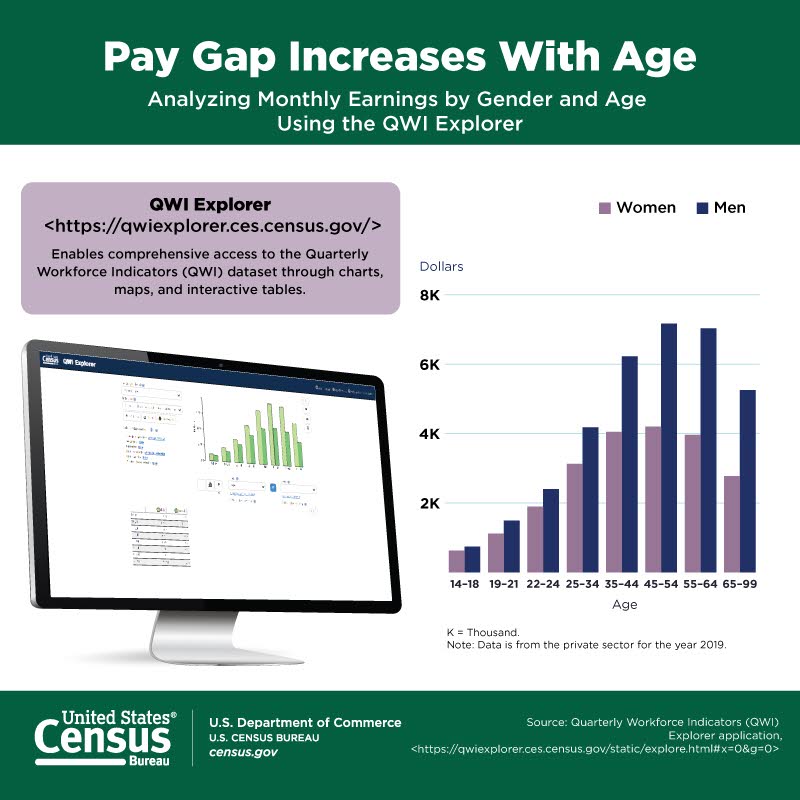
    Women are over-represented in lower paying jobs and, as they age, the pay gap widens even more.

    The U.S. Census Bureau’s Quarterly Workforce Indicators (QWI) shows the pay and age dynamic of women and men. Here, we looked at workers ages 35-44.

    According to the QWI data based on unemployment insurance wage records for the third quarter of 2020 (the most recent national data), women in the United States earned 30% less than men and that pay gap increased with age.

    The gender gap has narrowed for younger women as they increase their education level and break into occupations traditionally dominated by men.

    Although the gender pay gap has narrowed since the signing of the Equal Pay Act of 1963women earned 82 cents for every dollar a man earns according to 2020 data from the Bureau of Labor Statistics.

    The gender gap has narrowed for younger women as they increase their education level and break into occupations traditionally dominated by men.

    While women have a growing presence in higher paying industries like Information or Professional, Scientific, and Technical Services, they are still over-represented in lower paying industries.

     Full quarter employment (stable): average monthly earnings in 2020 for quarter 3.

    QWI Explorer provides easy access to national data on the earnings of women and men. Figure 1 shows a gap in monthly wages of almost $4,000 for women compared to men with a bachelor’s or advanced degree.

    Women are more likely than men to be employed in professional and related occupations, according to a 2019 BLS report. Within the professional category, however, the proportion of women in higher-paying jobs is much smaller than that of men.

    Figure 2 shows there are nearly 15 million women in Health Care and Social Services, over 7 million in Retail and Trade and 5.5 million in Accommodations and Food Services.

    Beginning of employment in 2020 quarter 3.

    QWI Explorer

    The QWI Explorer allows users to examine different aspects of the labor market through interactive tables that compare and rank labor force statistics on:

    • Employment.
    • Job creation and destruction.
    • Wages.
    • Hires and separations.

     Through interactive visualizations and detailed reports, users can analyze earnings by worker sex, race, education, industry, and age across national, state, metro/micropolitan, and workforce investment areas.

    An infographic published last year using 2019 data from the Longitudinal Employer-Household Dynamics (LEHD)’s Quarterly Workforce Indicators (QWI) Explorer illustrates the trend.


    Pay gap increases with age: Analyzing montly earnings by gender and age using the QWI explorer

     Earlene K.P. Dowell is a program analyst in the Census Bureau’s Economic Management Division/Data User and Trade Outreach Branch.