Not for the first time I saw a call for a contest for manuscripts on marriage. As a theme/subject for nonfiction it’s an appealing and challenging topic, but a part of the guidelines stopped me, so to speak, in my tracks.
“Document and make sure of your sources.” I immediately envisioned an exclamation mark after that clause, or perhaps an emoticon indicating wondering amusement. I wondered if the editors were seeking social scientists or psychologists who work from statistics and anecdote.
Why wouldn’t they look to the real experts on marriage: those who have experienced it and been not just happy, but fulfilled by it? That instruction about what could end up as footnotes, at first reverberated like a joke. Only at first. Most young people of my generation had some practice for future relationships that began in their teens. Nothing old or new in that. Most had a lot less practice, and often none, for the physical side of matrimony before entering it than they would today. By and large, none of us had anything like the typical breadth of field experienced by today’s younger generation.
Since our youth was involved with a war (WWII) that altered almost every aspect of life, perhaps Society’s accustomed sway was somewhat reassuring, at least to some of us. There was a kind of desperation like that of the previous generation’s experience with the previous great war, but still, some holds were barred to young people that now would be viewed with amused pity by the current analogous age group.
No couples with whom I was acquainted ever lived with a partner before tying the proverbial knot, though several certainly spent weekends together. Maybe that was a factor in how some of us learned (albeit unwittingly) to decide how to make a choice of a permanent partner. Now I’m tempted to discuss my own decisions, but if I were to do that, I wouldn’t be writing about Marriage as such. Hence, an example.
In one case, a girl’s meeting with a rather handsome young man, two or three years her senior, took place at a confirmation class at the church near their homes. Imagine a thirteen-year-old being asked to a movie by a sixteen-year-old. Imagine a virginal if not totally naïve girl and a young man with a good deal of ‘street smarts,’ a student at one of the prestigious special public high schools in Manhattan. Imagine what it might have been like for her when he had enlisted in the Navy, then came home to date as he had before, along with his shipmates. The drinking age was lowered to eighteen, and no bar would turn away uniformed service men.
As it turned out, this was one of those practice-for-marriage times. When, after the war, they met again, each thought they might pick up where they had left off, and both discovered too much had changed. To be honest, they discovered that their separate experiences were too divergent. They were really no longer a couple.
In another case, college seniors who had known each other casually for four years are thrown together by circumstance after graduation. He had been pining for two years after a classmate who was fond of him but in no way serious. The young woman in question had wished for months that she might be the object of his affections, but with no hope, though he was cordial and friendly. Both were working in the same city, so she and her parents became logical places for weekend visits and occasional dinners. In the course of several months, he became more attentive. In less than a year, to her delight, he declared he wanted to make her his wife.
They went to his home, and his parents arranged an engagement party, published the engagement announcement in the local paper, and his father ordered him to the local jeweler to buy a ring.
McKnights Long-Term Care News*: Primary Care Clinicians On Front Lines of Early Alzheimer’s Care in Rural U.S., Study Reveals
Primary care doctors and nurse practitioners, rather than specialists, are more likely to provide care for early-onset dementia in rural areas, putting these patients and clinicians at a disadvantage, say the authors of a new study. The researchers recommend innovative approaches to ensuring specialty care for patients, and training or guidance for clinicians.
Investigators analyzed the health records of 71,000 adults with early-onset Alzheimer’s disease and related dementias (ADRDs). Among patients with new early-onset ADRDs, those in rural areas had fewer neuropsychological tests, fewer visits to clinical psychologists, and greater odds of a diagnosis and subsequent care by primary care physicians and nurse practitioners than patients living in urban areas, investigators found.
The dearth of dementia care is not ideal, the researchers wrote. Rural primary care doctors may be overburdened and are not necessarily trained in dementia diagnosis and care. Patients, meanwhile, may fare better with specialized care and infrastructure, they explained.
“Specialty care, including neuropsychological assessments, are pretty critical for people with dementia to get an accurate diagnosis and set a symptom management plan,” said Wendy Yi Xu of Ohio State’s College of Public Health, in a statement accompanying the study’s publication in JAMA Network Open. “These are advanced, complex tests that most primary care physicians are not trained to perform.”
Telehealth, Specialty Consults
Given the increasing rate of early-onset ADRDs, community healthcare leaders and policymakers must look for ways to deliver necessary care to these patients, Xu and colleagues wrote. The researchers recommended an increase in specialist telehealth visits, added dementia training for primary care providers, and boosted availability of specialist consultations for these physicians.
“Clinician training or consultative guidance to PCPs may be viable options to help overcome neuroscience workforce deficiencies in rural areas,” they concluded.
Nearly 1 in 5 Americans live in a rural area, according to the Department of Health and Human Services. On Monday, HHS announced federal investments of nearly $60 million to increase the healthcare workforce in an effort to improve access to quality health care in rural communities.
Nearly $10 million will go toward establishing new medical residency programs in rural communities to boost the number of physicians trained in these settings, HHS reported.
The study was published in JAMA Network Open.
Related articles:
Nearly half of Alzheimer’s cases are mild, supporting a focus on early intervention
Early Alzheimer’s diagnosis may unintentionally hamper social engagement
ADHD linked to Alzheimer’s disease across generations, scientists say
*McKnights Long-Term Care News is located in Northbrook, Il
Senator Ron Wyden’s Office: On Health Care, Inflation Reduction Act Includes the Culmination of Wyden’s Work On the Finance Committee to Address the High Cost of Prescription Drugs
Washington, D.C. – Legislation authored by Senate Finance Committee Chair Ron Wyden, D-Ore., passed the Senate as part of the historic Inflation Reduction Act.
The linchpin of the Inflation Reduction Act’s clean energy package is Wyden’s Clean Energy for America Act, first introduced in 2015, which reforms the energy tax code to incentivize emissions reductions rather than specific technologies.
The Clean Energy for America Act would reduce carbon emissions in the power sector by about 70 percent over the next decade, and is the main driver of the overall 40 percent reduction in emissions achieved by the Inflation Reduction Act.
“This historic clean energy package has been a decade in the making. When clean energy legislation failed in 2010, we regrouped to ensure success the next time Democrats had an opportunity,” said Wyden. “We turned to emissions-based, technology-neutral tax incentives, and spent nearly a decade preparing this bill. My lodestar has been achieving the greatest emissions and cost-savings possible with 50 votes. That’s why the Inflation Reduction Act’s clean energy tax package is about 90 percent of the Clean Energy for America Act that the Senate Finance Committee approved in May 2021. We built the support needed over time.
Wyden continued, “This bill will reduce energy costs, secure our energy independence, and drastically cut carbon emissions. For the first time, the tax code is going to reward emissions reductions, and encourage the development of new clean energy technologies as soon as they come online. No longer will Congress need to legislate technology by technology, making it easier to innovate and bring new technologies to market. Importantly, this is permanent energy policy. Congress will no longer need to extend these incentives every few years, giving companies and states certainty to plan clean energy projects and create jobs. This is among the most consequential bills of my service in the Senate.”
On health care, the Inflation Reduction Act includes the culmination of Wyden’s work on the Finance Committee to address the high cost of prescription drugs.
The bill would finally allow Medicare to negotiate lower drug prices, particularly for the most expensive drugs that have no competition after being on the market for years. The bill also includes an inflation rebate that limits Big Pharma’s ability to price gouge year after year, and it creates strong protections for seniors including a $2,000 per year out-of-pocket cap.
Jo Freeman Reviews Fierce and Fearless: Patsy Takemoto Mink, First Woman of Color in Congress
GAO Report On Air Travel and Communicable Diseases: Federal Leadership Needed to Advance Research
Fast Facts
Concerns about air travel’s role in disease transmission have intensified during the COVID-19 pandemic. Researchers have examined how factors like aircraft boarding methods affect the exposure risk of passengers and crew members.
However, stakeholders said more research involving real-world situations and human behavior is needed and could guide actions to protect public health. Stakeholders noted a lack of federal leadership to advance such research.
Congress should consider directing FAA to develop and implement a strategy for research on communicable diseases in air travel, in coordination with other federal agencies and external partners.
What GAO Found
GAO identified research conducted on communicable diseases in air travel in several areas. For example, research has examined how air moves in aircraft and studied the effect of different airline operations—such as boarding aircraft from back to front—on the risk of disease exposure. However, stakeholders GAO interviewed described the need for more research involving real-world situations and human behavior. Additional research could inform the development of evidence-based mitigation measures, policy, and regulations to protect public health. Stakeholders cited several challenges, particularly the lack of federal leadership to facilitate interdisciplinary research and address gaps, to conducting research on communicable diseases in air travel. Stakeholders said researchers’ inability to access aircraft, airports, or data also poses challenges to performing needed research.
Examples of Conditions or Behaviors That May Affect Disease Transmission on an Airplane
Several agencies have focused on those research areas most relevant to their priorities and mission. Such agencies include the Department of Health and Human Services (HHS), the Department of Transportation’s Federal Aviation Administration (FAA), and the Department of Homeland Security (DHS). None of these agencies have undertaken efforts to advance needed research on communicable diseases in air travel more broadly. Officials with each of these agencies said a more coordinated federal approach to identify and advance relevant research could generate valuable information and inform policy development and guidance. In addition, bringing various federal agencies’ assets to bear could link researchers with aviation stakeholders across areas of expertise, provide clearer access to federal funding for research, and help identify needed research across different disciplines.
While FAA acknowledges that it has broad authority to conduct and sponsor research on communicable diseases in air travel, the agency has historically maintained that this work lies outside its core responsibility for aviation safety. Yet, FAA has prior experience conducting and supporting such research, as well as strong aviation industry ties critical to advancing needed research. In particular, FAA has undertaken related research in the past—usually in response to statutory mandates — including work on disease transmission in aircraft cabins. Moreover, leading the development of a coordinated strategy would be consistent with FAA’s efforts to develop a national aviation-preparedness plan, in coordination with DHS and HHS, as GAO recommended. Such a strategy would help focus research efforts to better inform the development of policies and requirements to protect the health of passengers and crew.
Why GAO Did This Study
The COVID-19 pandemic has intensified ongoing concerns about air travel’s role in spreading disease and raised questions about the safety of passengers and crew. Research that could provide quality information on communicable diseases in air travel can help to protect public health.
The CARES Act includes a provision for GAO to monitor and report on federal efforts related to the COVID-19 pandemic. GAO was also asked to review research on disease transmission in air travel. This report examines: (1) the status of research on communicable diseases in air travel, including stakeholders’ views on additional needed research and challenges to conducting it, and (2) the extent to which FAA and other federal agencies are advancing such research.
To conduct this work, GAO interviewed stakeholders, including federal officials, researchers, and aviation industry and union representatives. GAO also reviewed academic literature and agency documents, including research plans, as well as key considerations for interagency collaboration.
Recommendations
Congress should consider directing FAA to develop and implement a strategy to identify and advance needed research on communicable diseases in air travel, in coordination with appropriate federal agencies—such as DHS and HHS—and external partners.
Matter for Congressional Consideration
| Matter | Status | Comments |
|---|---|---|
| Congress should consider directing FAA to develop and implement a strategy to identify and advance needed research on communicable diseases in air travel, in coordination with appropriate federal agencies, such as DHS and HHS, and external partners. In alignment with leading practices for interagency collaboration, this strategy should, at a minimum, clearly identify the roles and responsibilities for participating agencies, determine the resources needed, and document any relevant agreements. (Matter for Consideration 1) |
|
When we confirm what actions the agency has taken in response to this recommendation, we will provide updated information. |
Kaiser Health News Research Roundup: Pan-Coronavirus Vaccine; Long Covid; Supplemental Vitamin D; Cell Movement
“Each week, Kaiser Health News compiles a selection of recently released health policy studies and briefs.”
ScienceDaily: Promising Developments In Pursuit To Design Pan-Coronavirus Vaccine Researchers have shown that a specific area of the SARS-CoV-2 spike protein is a promising target for a pan-coronavirus vaccine that could offer some protection against new virus variants, common colds, and help prepare for future pandemics. (The Francis Crick Institute, 7/27)
CIDRAP: Persistent Brain Fog, Hair Loss Highlighted In Long-COVID Studies Two new studies describe long-COVID symptoms, with one finding that 53% of hospitalized COVID-19 patients still had cognitive impairment (“brain fog”) 13 months after infection, and another adding conditions such as hair loss and sexual dysfunction to the list of persistent symptoms among outpatients. (Van Beusekom, 7/27)
In an ancillary study of the Vitamin D and Omega-3 Trial (VITAL), we tested whether supplemental vitamin D3 would result in a lower risk of fractures than placebo. (LeBoff, M.D., et al, 7/28)”
ScienceDaily: Researchers Identify How Cells Move Faster Through Mucus Than Blood Researchers have discovered that certain cells move surprisingly faster in thicker fluid because their ruffled edges sense the viscosity of their environment and adapt to increase their speed. Their combined results in cancer and fibroblast cells suggest that the viscosity of a cell’s surrounding environment is an important contributor to disease, and may help explain tumor progression, scarring in mucus-filled lungs affected by cystic fibrosis, and the wound-healing process. (University of Toronto, 7/25)
This is part of the KHN Morning Briefing, a summary of health policy coverage from major news organizations. Sign up for an email subscription.
GAO Report: Sexual Harassment: Opportunities Remain for VA to Improve Program Structure, Policies, and Data Collection
GAO-22-106103 …Published: Jul 28, 2022. Publicly Released: Jul 28, 2022
We testified that VA has implemented 2 of the 7 recommendations from our June 2020 sexual harassment report, but significant issues still prevent the agency from effectively protecting its employees. Without additional action, VA will likely continue to be among agencies with a high percentage of employees reporting being harassed.
For example, VA continues to have the person who oversees personnel functions (e.g., hiring, promotions) also oversee the employment discrimination and harassment complaint processes. This can create a conflict of interest and erode employees’ trust that sexual harassment complaints will be handled appropriately.
What GAO Found
The Department of Veterans Affairs (VA) has taken steps to improve its efforts to prevent and address sexual harassment, but could realign its organizational structure, further strengthen policies, and better assess data. Most notably, VA has not taken sufficient action in response to our two priority recommendations on its structure for equal employment opportunity (EEO). GAO’s 2020 report made seven recommendations for VA to address aspects of agency policies and complaint processes that may have hindered agency efforts to combat sexual harassment. VA has implemented two of these recommendations and five require additional action to be fully implemented. For example, VA has:
- Formalized its Harassment Prevention Program (HPP) and updated training materials. VA implemented two recommendations from GAO’s 2020 report. First, VA formalized its HPP, which seeks to prevent harassment and address it before it becomes unlawful. In March 2022, VA finalized its HPP Handbook that outlines key processes the agency should follow in addressing sexual harassment allegations. Second, VA has developed new mandatory training that includes more information on sexual harassment and the reporting processes available to employees.
- Not yet realigned its EEO organizational structure to avoid potential conflicts of interest. GAO made two recommendations to help address potential conflicts of interest; neither has been fully implemented. For example, VA’s EEO Director continues to oversee both EEO complaint processes and general personnel functions. According to the Equal Employment Opportunity Commission — the agency tasked to ensure agency compliance with EEO requirements — this practice does not adhere to one of its key directives to ensure fair complaint processing.
- Not yet fully reviewed policies and information documents to ensure consistency. GAO found some policies and information documents were not consistent with the overarching sexual harassment policy and some have outdated or missing information. VA said it is developing procedures to help ensure all policies are complete and accurate across VA, but has not yet completed its efforts.
- Not yet completed efforts to collect and assess complete information on sexual harassment. GAO found that VA lacked a full picture of sexual harassment at VA because it did not require managers to report all complaints nor had it assessed other available data. VA now requires managers to report all complaints, and it developed a tracking system to capture this information. However, VA has not assessed data on these complaints or finalized plans for assessing other available data.
- Not yet developed clear requirements for evidence needed to ensure corrective actions were taken. GAO found that VA did not require documentation of corrective actions taken in all sexual harassment cases. VA has since begun tracking some of these corrective actions. However, VA has not yet clearly specified to managers the procedures for documenting corrective actions.
Why GAO Did This Study
Sexual harassment in the workplace can cause harmful psychological, physical, occupational, and economic effects for workers. Several federal laws, executive orders, and agency directives are aimed at preventing and addressing sexual harassment at federal agencies.
GAO issued a June 2020 report (GAO-20-387) that reviewed VA’s efforts to prevent and address sexual harassment at the agency. In this report, GAO made seven recommendations. This testimony discusses VA’s efforts to implement GAO’s recommendations to 1) ensure VA’s EEO structure is properly aligned; 2) improve the agency’s policies to prevent and address sexual harassment of VA employees; 3) collect and analyze data to inform VA about sexual harassment of its employees; and 4) improve relevant training.
To update the status of the recommendations, GAO analyzed newly-available federal survey data on the prevalence of sexual harassment and reviewed agency guidance and documentation.
Recommendations
In its June 2020 report, GAO made seven recommendations, including that VA ensure that its EEO Director position is not responsible for personnel functions; require managers to report sexual harassment centrally; and require additional employee training. VA is in various stages of implementing the recommendations. VA concurred with all but the EEO Director position recommendation, which GAO maintains is warranted.
Full Report
“Few rights are more central to individual freedom than the right to control one’s own body. The Justice Department will use every tool at our disposal to protect reproductive freedom.”
REPRODUCTIVE RIGHTS; – Attorney General Merrick B. Garland
Read the full statement
“Few rights are more central to individual freedom than the right to control one’s own body. The Justice Department will use every tool at our disposal to protect reproductive freedom.”
– Attorney General Merrick B. Garland
Read the full statement
REPRODUCTIVE RIGHTS TASK FORCE
Associate Attorney General Gupta Announces Reproductive Rights Task Force
On July 12, the Department of Justice announced the establishment of the Reproductive Rights Task Force, formalizing the Department’s ongoing work to protect reproductive freedom under federal law.
Among other responsibilities, the Task Force will monitor and evaluate all state and local legislation, regulations, and enforcement actions that threaten to:
- Infringe on federal legal protections relating to the provision or pursuit of reproductive care;
- Impair women’s ability to seek reproductive care in states where it is legal;
- Impair individuals’ ability to inform and counsel each other about the reproductive care that is available in other states;
- Ban Mifepristone based on disagreement with the FDA’s expert judgment about its safety and efficacy; or
- Impose criminal or civil liability on federal employees who provide reproductive health services in a manner authorized by federal law.
PROTECTING ACCESS TO REPRODUCTIVE SERVICES
The Civil Rights Division enforces the Freedom of Access to Clinic Entrances Act, which prohibits anyone from obstructing access to reproductive health services through violence, threats of violence, or property damage.
The Assistant Attorney General for the Civil Rights Division leads the National Task Force On Violence Against Reproductive Health Care Providers. The Task Force coordinates national investigation and prosecution of violence against reproductive health care providers, patients, and facilities, collects and coordinates information regarding such incidents, makes security recommendations to enhance the safety of providers, assists U.S. Attorneys’ Offices investigating and prosecuting clinic violence, and helps train prosecutors and investigators to handle such cases.
If you have experienced violence, threats of violence, or property damage related to reproductive health services, please submit a report to the FBI Reporting System or call 1-800-CALL-FBI (225-5324).
If you think that you are being discriminated against unlawfully in connection with reproductive health services or if your health information privacy rights have been violated, please submit a report to HHS.
Learn more about your reproductive rights at HHS.gov.
If you are in danger, call 911.
NEWS
Readout of Justice Department Leadership Meeting with Reproductive and Civil Rights Organizations
Press Release (7/26/22)
Readout of Reproductive Rights Task Force Meeting with Offices of State Attorneys General
Press Release (7/22/22)
Justice Department Announces Reproductive Rights Task Force
Press Release (7/12/22)
Attorney General Merrick B. Garland Statement on Supreme Court Ruling in Dobbs v. Jackson Women’s Health Organization
Press Release (6/24/22)
IMPLEMENTING THE EXECUTIVE ORDER ON PROTECTING ACCESS TO REPRODUCTIVE HEALTHCARE SERVICES
The Department is taking steps to implement the President’s Executive Order on Protecting Access to Reproductive Healthcare Services. The Executive Order provides that:
- The Attorney General shall provide technical assistance concerning Federal constitutional protections to States seeking to afford legal protection to out-of-State patients and providers who offer legal reproductive healthcare.
- The Attorney General and the Counsel to the President shall convene a meeting of private pro bono attorneys, bar associations, and public interest organizations in order to encourage lawyers to represent and assist patients, providers, and third parties lawfully seeking these services throughout the country.
- The Attorney General and the Secretary of Homeland Security shall consider actions to ensure the safety of patients, providers, and third parties, and to protect the security of clinics, pharmacies, and other entities providing, dispensing, or delivering reproductive and related healthcare services.
Justice Department Commemorates Anniversary of Americans with Disabilities Act: Eliminate Discriminatory Barriers, Support Full Participation, Community Integration, Independent Living and Economic Self-sufficiency
Today, the Department of Justice commemorates the 32nd anniversary of the Americans with Disabilities Act (ADA), the preeminent civil rights law requiring equal opportunity for people with disabilities. Recently, the ongoing COVID-19 pandemic and the opioid epidemic have exacted a steep toll on many people with disabilities and shed light on the continued urgency of ADA enforcement.
“The Americans with Disabilities Act embodies a national promise to eliminate discriminatory barriers and support full participation, community integration, independent living and economic self-sufficiency for people with disabilities,” said Assistant Attorney General Kristen Clarke of the Justice Department’s Civil Rights Division. “We will continue using this bedrock civil rights law to eliminate barriers and safeguard the rights of people with disabilities across the country.”
Promoting Web Accessibility
The COVID-19 pandemic has shown, for example, the vital importance of equal access to the web. This year, the department published guidance on the ADA requirements for website accessibility and announced it is also undertaking a rulemaking concerning standards for web accessibility for state and local government entities. The department’s enforcement efforts have removed barriers that prevented people with disabilities from booking vaccine appointments on the web and finding critical vaccine information. Since November 2021, the department has reached settlement agreements with CVS Pharmacy Inc., Hy-Vee Inc., The Kroger Co., Meijer Inc. and Rite Aid Corporation to ensure that people with disabilities can book COVID-19 vaccine appointments and obtain vaccine information online.
Warning About the Risks of Artificial Intelligence in Hiring
The department has also prioritized ensuring that state and local government employers do not use new technologies to discriminate against job applicants or employees with disabilities. In May, the department, partnering closely with the Equal Employment Opportunity Commission, issued guidance about disability discrimination when employers use artificial intelligence and other software tools, including algorithmic decision-making tools, to make employment decisions.
Ensuring Fair Treatment of People with Opioid Use Disorder
The department has also enforced the ADA to safeguard the rights of people with opioid use disorder (OUD) who are in treatment or recovery. In April, the department published guidance explaining how the ADA protects individuals with OUD from discrimination. The department is working to ensure that people in treatment and recovery have an equal opportunity to receive services and to participate in their communities and the workforce. For example:
- In February, the department filed a lawsuit against the Unified Judicial System of Pennsylvania, alleging that it prohibits or otherwise limits participants in its court supervision programs from using medication for OUD. And in March, the department entered into a settlement agreement to resolve similar allegations concerning Massachusetts’ drug courts.
- The department also issued a letter finding that the Indiana State Board of Nursing violated the ADA by denying a nurse the opportunity to participate in a rehabilitation program, required to reinstate her nursing license, because she takes medication for OUD.
- The department secured a settlement agreement with a Colorado-based employment, residential and social services program resolving allegations that the program denied admission to an individual because she takes medication for OUD.
Promoting Access to Transportation including Ridesharing Services
After filing a lawsuit in November, the department entered into a multi million-dollar settlement agreement with Uber Technologies Inc. Under the agreement, Uber committed to policy changes and will offer several million dollars in compensation to more than 65,000 Uber users who were charged discriminatory fees due to disability.
Why Some Cities Lost Population in 2021: One Specific Group — Younger Adults in Their Early 20s to Mid-30s
By Catherine Doren
June 30, 2022
The significant declines in population in some central counties of large metropolitan areas last year were due largely to a loss of population in one specific group — younger adults in their early 20s to mid-30s.
Previously released population estimates for counties showed core counties of many large metro areas experienced large declines in their population from July 1, 2020-2021. Estimates by population characteristics released today show us why.
The Census release tells us that changes in age structure were a major contributor to population declines in central counties of some of the nation’s most populous metro areas, including New York-Newark-Jersey City, San Francisco-Oakland-Berkeley and Boston-Cambridge-Newton.
Yet, relative to the U.S. population, the counties with especially large declines continued to have a large proportion of younger working-age adults in 2021 even after these population losses.
A population pyramid of New York County, NY (Manhattan), shows the size of the population by age (five-year age groups from 0 to 84, and the age group 85 and older) and sex (male, female).
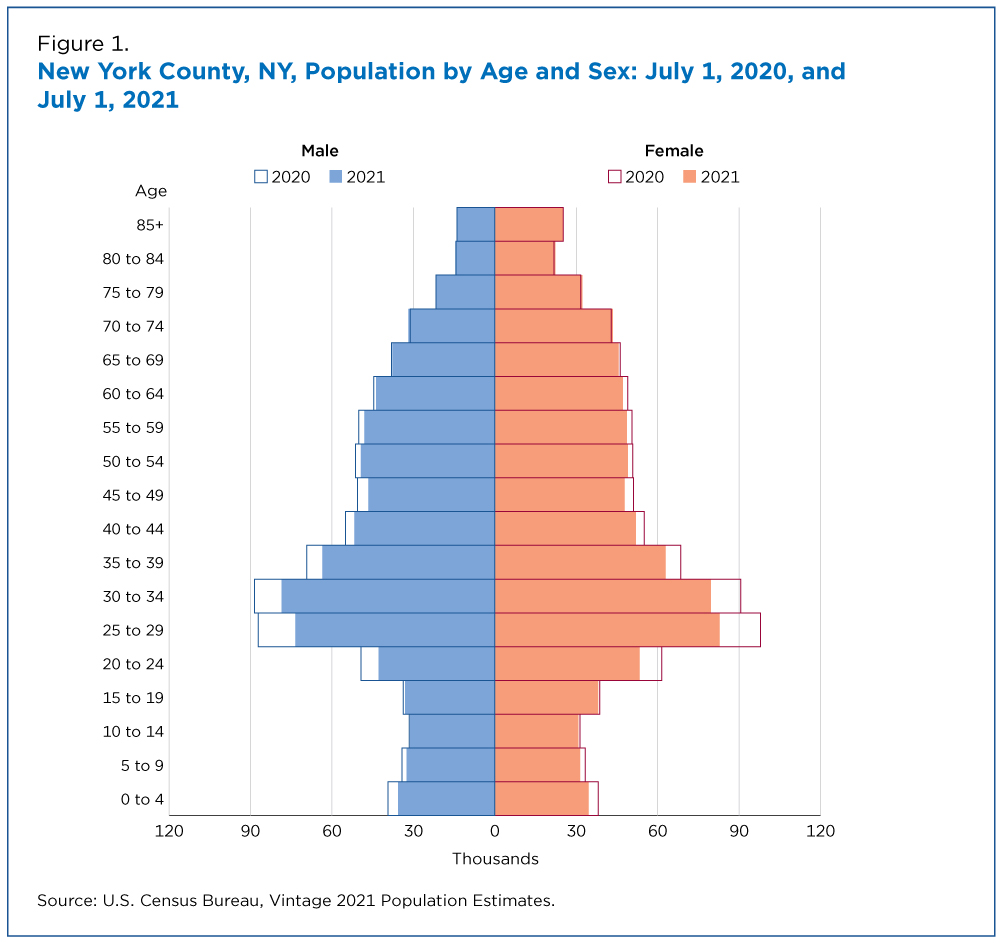
In July 2020, the population of both males and females in their 20s and 30s was considerably larger than other age groups (Figure 1).
By July 2021, although this age group was still large in the grand scheme of the population, its male and female peaks in New York County show the most marked loss of all age groups.
For example, New York County’s population declined by 6.6% from July 1, 2020-2021, but the population ages 20-34 declined by 13.6% — twice the county’s rate.

San Francisco County in California (Figure 2) and Suffolk County in Massachusetts (Figure 3) experienced similar patterns of population change.
In San Francisco County, the percent loss in that same population group ages 20-34 was even larger, at 15.5%, compared to less than one-half that rate, 6.3%, for the county’s total population.
Suffolk County, which contains Boston, had a smaller total population loss of about 3%, but the 20-34 age group had a similarly pronounced decline of 5.7%.