Author: SeniorWomenWeb

  • Looking Ahead to 2014 Elections: Voting Laws Roundup 2013

    In 2013, some state legislators continue to push laws that would make it harder for eligible American citizens to vote. But there’s good news, too. More and more states are pressing measures to improve elections. (*See Editor’s Note about GAO report on Challenges to Voters with Disabilities)

    Below you will find a regularly-updated, comprehensive roundup of introduced, pending, active, and passed voting laws, prepared by the Brennan Center for Justice at the NYU School of Law. (See a detailed summary of restrictive legislation, as of April 5th.)Election Day 1922

    Numbers Overview

    Since the beginning of 2013, restrictive voting bills have been introduced in more than half the [US] states:

    • At least 80 restrictive bills were introduced in 31 states.
    • Of those, 62 restrictive bills are still pending in 25 states.
    • Of those, 25 restrictive bills are currently active in 12 states[1], in that there has been legislative activity beyond introduction and referral to committee (such as hearings, committee activity, or votes).
    • Two states have already passed three restrictive bills this session. Virginia and Arkansas both passed restrictive legislation requiring a photo ID to vote, and Virginia passed legislation making it harder for community groups to conduct voter registration drives.

    “Country Gentleman” magazine cover, November 1922. The 19th Amendment giving all women the right to vote wasn’t ratified until August 1920. Painted by J. F. Kernan, Wikimedia Commons

    At the same time, across the country, politicians from both sides of the aisle have introduced and supported bills that expand access to registration and voting.  

    • At least 195 bills that would expand access to voting were introduced in 45 states.
    • Of those, 155 bills are still pending in 37 states.
    • Of those, 41 bills are currently active in 21 states[2], in that there has been legislative activity beyond introduction and referral to committee (such as hearings, committee activity, or votes).
    • Three states have passed three bills that expand opportunities for eligible citizens to register to vote. Virginia passed online voter registration and New Mexico passed a bill that automates the registration process at the state’s DMVs. Oklahoma passed a bill that allows more types of photo IDs to satisfy its existing, strict, voter ID law.
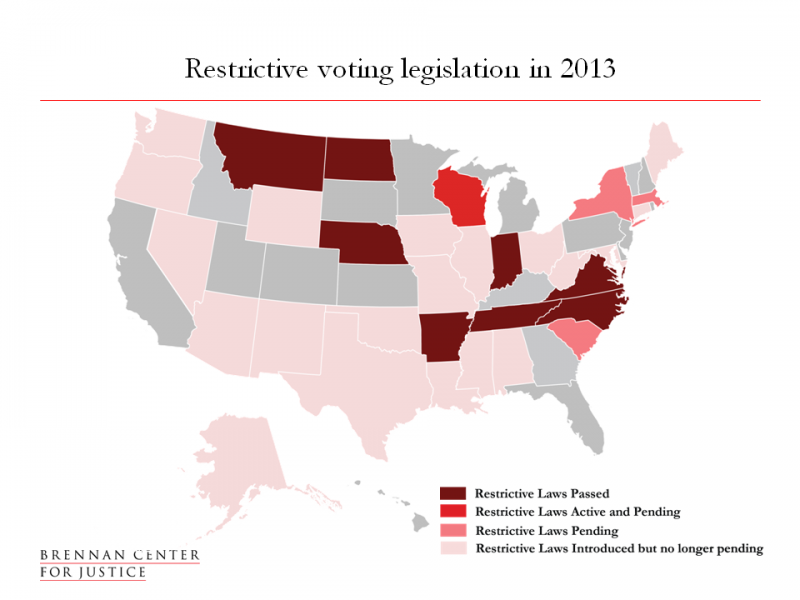
    Voting Restrictions

    Note: In the cases where more than one piece of restrictive legislation has been introduced in a state, we designate the state’s passed, active, or pending status based on its most active piece of legislation.

    Restrictions Passed in 2013 

    Arkansas:

    • Photo ID required to vote (legislature overrode gubernatorial veto)
  • A Timely Show, Precision and Splendor: Clocks and Watches at The Frick Collection

    By Val Castronovo

    No better time to check out this small gem of an exhibit at The Frick Collection than now.  The magnolia trees are in bloom, and there’s arguably no better spot in town to watch nature’s glory unfold than from inside the new Portico Gallery of the Gilded Age mansion, which has floor-to-ceiling windows fronting the Fifth Avenue Garden. 

     Former home of Pittsburgh steel magnate and art patron Henry Clay Frick (1849-1919), the museum has a world-renowned collection of Old Master paintings and European sculpture and decorative arts.  In 1999, Winthrop Kellogg Edey, a lifelong collector of antique clocks, gave the museum 38 timepieces — 25 of which (11 clocks and 14 watches) are now on view at The Frick, which boasts one of the most significant public collections of European clocks and watches in the US.  These items, together with five clocks on loan from collector Horace Wood Block, comprise the current exhibition.

     A tribute to art and a tribute to science, the elaborate gilded works on display date from the early 16th to the 19th century. Their provenance: England, France, Italy, Germany and Switzerland.  They were valued as much for their artistry and craft as for their functionality.  They were status items in many cases, especially the early clocks and watches, which were imprecise and not reliable.  They signified a person’s wealth and taste.  Napoleon, Louis XVI, Marie-Antoinette, and the daughters of Louis XV were just some of the many rich and famous people who coveted them.

     The show at The Frick, the curators tell us, traces the “evolution over the centuries of more accurate and complex timepieces,” all the while chronicling the “aesthetic developments that reflected Europe’s latest styles,” such as its embrace of neoclassicism in the late 18th century, a reaction to the rococo style that was so popular with the court of Louis XV and throughout Europe. 

     The clocks are noteworthy for their cases, the architecture that houses and embellishes delicate mechanisms tracking time — traditional time, calendrical time, even astronomical time, as is the case with 17th century clockmaker David Weber’s two-foot-tall ‘tower clock’, which has seven dials, including a central astrolabe dial.  Crafted from gold, silver, gilt bronze and brass, malachite, marble and porcelain, the cases are adorned with columns, pediments, classical statues, crowns of laurel, and mythological figures, an obvious bow to the ancient Greeks and Romans.

     One standout piece among many:  Garniture of One Clock and Two Vases (c. 1764), a trio of Chinese Qing dynasty vases made from a rare porcelain, celadon bleu fleuri.  To suit the current fashion — “French collectors’ perpetual quest for increasingly more elaborate and novel luxury items” — a clock mechanism with a gilded snake to indicate the time was added to one of the vases soon after the items arrived in France; gilt bronze mounts with neoclassical architectural motifs embellish all three.

    The watches are equally refined and, like the early clocks, the first watches were more status markers than timekeepers.  Watches became more accurate after the introduction of the balance spring in 1675. (For clocks, the introduction of the pendulum clock in 1653 marked a turning point, making for more precise time measurements.) 

    Images:

    Chavannes le Jeune (active c. 1650–1660), enameling attributed to Pierre Huaud (1612–1680), Gold and Enamel Pendant Watch, c. 1660, The Frick Collection, New York, Bequest of Winthrop Kellogg Edey; photo: Richard di Liberto

  • Homeland Security Grants to States Gutted

    scene after explosions, Boston Marathon, 2013
    In the aftermath of the Boston Marathon bombing, the state of Massachusetts, the city of Boston and federal authorities quickly joined together to respond to the emergency. But in recent years, federal funding for state homeland security efforts to respond to emergencies has been gutted.

    Federal grant spending on state and local homeland security is at an all-time low. The largest Department of Homeland Security formula grant program for states went from a high of $2 billion in 2003 to just $294 million in 2012. And with the sequester, grants from the state homeland security grant program will drop at least another 5 percent.

    The grants are intended to help states purchase equipment and create plans for responding and recovering from terrorist attacks or other catastrophes.

    In Massachusetts, funding from the state homeland security grant program is down 76 percent in the last five years, to $4 million in fiscal 2012, according to Federal Funds Information for States. The state ranked 34th in per capita spending in homeland security grant funding, at $1.20 per person.

    Not only is the overall funding down, but domestic attention has not been placed on responding to bomb threats, said Ben Bawden, a government affairs consultant representing state and local public safety organizations, including the National Fusion Center Association and the Association of State Criminal Investigative Agencies. Bombing has traditionally been an overseas concern, said Bawden, and state and local agencies aren’t getting training on how to respond to bomb emergencies.

    Wikimedia Commons photograph originally posted to Flickr of the Boston Marathon explosions, April 15, 2013

  • Quality First, Price Second: “It doesn’t cost any more to feed a good horse than a bad one.”

     by Joan L. Cannon

    When we met a lady in an expected place but unexpected circumstances, we began automatically to be on the alert. That was the way it was for us then we met Thene (short for Parthenia). From the first moment, we saw she was unique. She supplied us with more than one aphorism over the years we knew her.

    We met her because we’d heard she was a wonderful riding instructor. Our children had a pony, and I hadn’t had any instruction for more than 20 years, so we decided to check her out.saddlebreds in Kentucky

    A stocky, upright, white-haired lady in a typical ‘house dress’ greeted us by the back door of her Victorian house on a pleasant side street. Clearly a lot had changed in the neighborhood since the house had been built. Across a small yard stood what was obviously a small stable that had probably begun life as a garage. The sliding doors were open, and inside we could see six stalls with five equine heads observing over the half doors.

    Thene’s personal history enticed the whole family. I still have a picture of my mother, me, and our three children mounted on Thene’s horses. Three generations, and Thene. My husband had to be at work during these times, but he would often accompany me on a Saturday to discuss our management of the pony’s replacement. That way he could offer help with some chores and have the opportunity to talk with her. She gave us a small library of quotable quotes over the year we knew her: “time come, baby come” for when awaiting a foaling or any other anticipated event; “if everybody hung their troubles on the line, you’d take your own off first;” “comparisons are odious;” and other turn-of-the-century aphorisms. She showed us how to put the best finishing polish on a groomed animal with her bare hand. She could explain what to do on horseback in ten words that someone else would take ten minutes to teach.

    The daughter of the first veterinarian in the town, she had remained where she grew up, taking care of her mother after her father’s death and her sister’s marriage. She let slip enough about her own youth for us to know she’d given up her first love to do her duty — back during World War I.

  • Are Genes Ownable? Challenging Patents on Breast and Ovarian Cancer Genes in the Supreme Court

    Editor’s Note: Since my mother died from ovarian cancer we have a particular interest in this case and the implications for those who want or need to be tested for BRCA1 and BRCA2 gene mutations. However, this case, as noted in the ACLU release below, has significant implications for scientific research, second opinions and medical care beyond the genes cited in the case.

    The US Supreme Court heard arguments on April 15th  in a case seeking to invalidate patents on two genes associated with hereditary breast and ovarian cancer.BRCA1, Breast Cancer 1, early onset (Illustration is of Breast Cancer 1, Early Onset from Wikipedia)

    The lawsuit was filed by the American Civil Liberties Union and the Public Patent Foundation (PUBPAT) on behalf of researchers, genetic counselors, patients, breast cancer and women’s health groups, and medical professional associations representing 150,000 geneticists, pathologists and laboratory professionals. The patents allow a Utah company, Myriad Genetics, to control access to the genes, thereby enabling them to limit others from doing research or diagnostic testing of the genes, which can be crucial for individuals making important medical decisions.

    “Myriad did not invent the human genes at issue in this case, and they should not be allowed to patent them. The patent system was designed to encourage innovation, not stifle scientific research and the free exchange of ideas, which is what these patents do,” said attorney Chris Hansen of the ACLU, who argued the case.

    A federal district court invalidated all of the challenged patents in 2010. In 2012, a federal appeals court ruled for the second time that the patents on the genes were valid. Its 2-1 decision followed a Supreme Court order directing the appeals court to reconsider its initial decision in light of a related patent case decided by the Supreme Court last spring.

    “The Patent Office’s policy of granting companies complete control over portions of our bodies is both morally offensive and a clear violation of the law,” said Daniel B. Ravicher, executive director of PUBPAT and co-counsel in the lawsuit. “Genes are the foundation of life, they are created by nature, not by man, and that is why we were here today at the Supreme Court to make sure they are not controlled by corporations through the patent system.”

  • Red and Fuschia Vegetable Towers, a Hori Hori Trowel and Other Gardening Tools; What Plants Talk About

    When we make trips to some of our local favorite nurseries for plants, it’s usually, “Oh, I just need another tarragon … lobelia … thunbergia … scabiosa … snap peas ” and, in no time, the car back-back is laden with new purchases.

    That’s not so for garden tools; we’re old enough to have accumulated many pruners, including an ancient one from my late father, but the hunt for additions never quite abates completely. Invariably nowadays, I reach for my favorite Japanese Saboten 1208 or 1218 (pink or yellow, small and comfortable to the arthritic hand. Gardener's Hollow Leg

    And so it was that, after our annual pruning lecture at Berkeley Horticulture, we spied a marvelous bag for cutting flowers that circles the waist and leaves your hands free to reach for the next rose, salvia discolor branch (see below), gazania or whatever catches your fancy for the collection of vases in the house. It’s called The Gardener’s Hollow Leg ® and is a improvement over the baskets, trugs and enameled containers I’d have to balance and carry by hand to hold the bounty I’d collect. There’s a new Gardener’s Hollow Leg Junior size for those younger companions to wear or walkers and participants in Earth Day endeavors using them to store items. These bags would also be extremely handy for those adventurous enough to climb a ladder for trimming or obtaining higher-branch bounty.

    Owner and inventor Bob Blomberg explains his path to The Gardener’s Hollow Leg thusly:”What about all these piles of clippings on the walk?!  If only I had some way to eliminate the last minute clean up.  If I only had a bag that was always at my side so I could put my clippings in it throughout the day and dump it into the compost container each time it was full!  That way, when I was done pruning, I would be done!”

    So armed and armoured against thorns and ready to stash my cuttings for the house in the bag attached to my hip, I’d set out wearing my West County Rose Gauntlets and, occasionally, some chaps to protect my legs.  Finally,  I make sure to put a container of Technu in the bath to scrub off any poison plant oils after gardening; regardless of whether you’ve observed any poison ivy, oak, sumac on your patch, it’s wise to take precautions. 

    We noted the brightly colored plant supports (peas, tomatoes, sweet peas, lemon cucumber) that we found at Annie’s Annuals recently and happily scooped up four. Two of GlamosWire.com’s deep red enamelled towers and two fuschia pink now grace our vegetable growing area; it’s possible to find 10-packs of the towers for a variety of plants to climb. The towers are tall enough for ample climbing and the color choices appeal to our fashion sense. And not only that, Glamos Wire, located in Minnesota, has been family owned since 1899 and their products are made in the US.

    Finally, my gifted husband recommends the Hida Tool Stainless Steel Serrated Edge trowel-knifeHori Hori Stainless Steel Trowel Knife It’s used for digging, transplanting, weeding and cutting. The stainless steel blade is completely tempered to increase durability and is rust resistant. One side is serrated to make cutting weeds and small branches easier. The Hori Hori knife comes in a synthetic leather sheath. What’s very helpful is that one side is marked for both inches and centimeters for alignment with proscribed depths. It’s perfect for cutting out recalcitrant plants and roots quickly and efficiently.

    Iron and Wood Garden Tools forged by the Fisher Blacksmithing firm in Montana, have the look of Old World implements, that is, strong and hand-forged.

    PBS’  Nature dedicated an episode to What Plants Talk About, A world where plants communicate, co-operate and, sometimes, wage all-out war.

    Watch What Plants Talk About on PBS. See more from Nature.

  • A Sandy Hook Mother’s Appeal for Commonsense Gun Responsibility Reforms

    Remarks of Francine Wheeler
    The President’s Weekly Address

    Hi. As you’ve probably noticed, I’m not the President. I’m just a citizen. And as a citizen, I’m here at the White House today because I want to make a difference and I hope you will join me.

    My name is Francine Wheeler. My husband David is with me. We live in Sandy Hook, Connecticut.

    David and I have two sons. Our older son Nate, soon to be 10 years old, is a fourth grader at Sandy Hook Elementary School. Our younger son, Ben, age six, was murdered in his first-grade classroom on December 14th, exactly 4 months ago this weekend.

    David and I lost our beloved son, but Nate lost his best friend. On what turned out to be the last morning of his life, Ben told me, quite out of the blue, “ I still want to be an architect, Mama, but I also want to be a paleontologist, because that’s what Nate is going to be and I want to do everything Nate does.”

    Ben’s love of fun and his excitement at the wonders of life were unmatched His boundless energy kept him running across the soccer field long after the game was over. He couldn’t wait to get to school every morning. He sang with perfect pitch and had just played at his third piano recital. Irrepressibly bright and spirited, Ben experienced life at full tilt.

    Until that morning. 20 of our children, and 6 of our educators – gone. Out of the blue.

    I’ve heard people say that the tidal wave of anguish our country felt on 12/14 has receded. But not for us. To us, it feels as if it happened just yesterday. And in the four months since we lost our loved ones, thousands of other Americans have died at the end of a gun. Thousands of other families across the United States are also drowning in our grief.

    Please help us do something before our tragedy becomes your tragedy.

    Sometimes, I close my eyes and all I can remember is that awful day waiting at the Sandy Hook Volunteer Firehouse for the boy who would never come home — the same firehouse that was home to Ben’s Tiger Scout Den 6. But other times, I feel Ben’s presence filling me with courage for what I have to do — for him and all the others taken from us so violently and too soon. 

    We have to convince the Senate to come together and pass commonsense gun responsibility reforms that will make our communities safer and prevent more tragedies like the one we never thought would happen to us.

    When I packed for Washington on Monday, it looked like the Senate might not act at all. Then, after the President spoke in Hartford, and a dozen of us met with Senators to share our stories, more than two-thirds of the Senate voted to move forward. 

    But that’s only the start. They haven’t yet passed any bills that will help keep guns out of the hands of dangerous people. And a lot of people are fighting to make sure they never do.

    Now is the time to act. Please join us. You can talk to your Senator, too. Or visit WhiteHouse.gov to find out how you can join the President and get involved.

    Help this be the moment when real change begins. From the bottom of my heart, thank you.

     Close Transcript

  • CultureWatch: A Review of Louise Erdrich’s The Round House

    THE ROUND HOUSE

    by Louise Erdrich
    Published by Harper Collins Books, ©2012; 321 pages

    Fans of Louise Erdrich, and (full disclosure) I count myself among them, will be pleased to discover that she has given us a worthy addition to her impressive body of work. Ms. Erdrich has produced poetry, short stories, and children’s books, as well as thirteen (13!) earlier novels.Author photo

    The list of awards and honors she has received in the past thirty years is so long that in the interest of saving space, I’ll simply note that The Round House received the National Book Award in 2012, an award well-earned.

    Erdrich is a member of the Turtle Mountain Band of the Chippewa (also called Ojibway), a tribe of Native Americans that inhabits areas and/or reservations scattered along the border between the United States and Canada, stretching west from Ohio through Michigan, Wisconsin, Minnesota, to North Dakota and north into Ontario, Canada. Her books reflect her heritage, but beyond that, they introduce the reader to some of the complex relationships between Native Americans and the populations of towns that surround them.

    Make no mistake: the books are not polemics in defense of “the noble savage.” While Erdrich  affords us a clear-eyed look into the prejudices and arrogance of many of her characters, she has a firm grip on universal values that pertain to people of every culture. Her stories involve human beings, not stereotypes, and open our hearts to many possibilities heretofore unthought-of.

    At the same time, they offer to a reader a true glimpse into some of the things with which Native Americans must cope, whether on the reservation or living outside its borders. Along with recognition of problems like alcoholism and poverty, we are introduced to the dichotomy of modern life and ancient traditions and ceremonies.

  • Washington State’s Death With Dignity Act: A Gratefully Received But Rarely Used Prescription

    By the end of 2011, most of the 255 Washington residents who received a prescription for lethal medication to end their lives under the state’s Death with Dignity Act had been diagnosed with terminal cancer. Of those, 40 were patients at Seattle Cancer Care Alliance, part of the Pacific Northwest’s only National Cancer Institute-designated Comprehensive Cancer Center.Seattle Cancer Care Alliance Clinic

    Photograph: Seattle Cancer Care Alliance Clinic Building, Seattle, Washington

    Because several states are considering similar Death with Dignity laws, and because such legislation disproportionately affects cancer patients and their families, SCCA conducted a study to describe the institution’s implementation of the Washington state law and its experience with patients who chose to participate. The study’s findings are published in the April 11, 2013 issue of The New England Journal of Medicine.

    The study found that overall, SCCA’s Death with Dignity program was rarely used, but in those cases where it was, the program was well-accepted by patients and physicians. “Qualitatively, patients and families were grateful to receive the lethal prescription whether or not it was used,” the authors wrote.

    The study found the most common reasons for participating included loss of autonomy, an inability to engage in enjoyable activities and loss of dignity.

    “People who pursue Death with Dignity tend to be individuals who want to be independent and want to have control over the conditions and timing of their final moments of life,” said Elizabeth Trice Loggers, M.D., Ph.D., corresponding author and medical director of SCCA’s Supportive and Palliative Care Service.

    Washington was the second state, after Oregon, to enact a Death with Dignity law. It was passed in November 2008 after a voter-approved referendum and enacted in March 2009. Under Washington law, competent adults residing in the state with a life expectancy of six months or less due to a diagnosed medical condition may request and self-administer lethal medications prescribed by a physician. Prescribing physicians do not assist patients to ingest the medicine.

    SCCA patient participants
    A total of 114 patients inquired about the institution’s Death with Dignity program between March 5, 2009 and Dec. 31, 2011. Of these, 44 did not pursue the program; 30 others initiated the process but either elected not to continue or died before completing the steps necessary to obtain a prescription for lethal medicine. Forty patients received a prescription and 24 died after ingesting the medication, which was secobarbital, a barbiturate. The average time from ingestion to death was 35 minutes. The remaining 16 patients did not use the drug and eventually died of their disease.

    For this study, SCCA patients were characterized as participants if they completed the steps required for a physician to prescribe lethal medication.

    The participants were mostly Caucasian men with more than a high school education, married and ranged in age from 42 to 91.

    Policy debate and decision
    Loggers said that while SCCA’s goals are to cure cancer and save lives, providers also must be prepared to help patients with terminal disease by offering palliative care and other end-of-life services.

  • Drawing Surrealism at the Morgan Library: The Exquisite Corpse Will Drink the New Wine

    Few artistic movements of the twentieth century are as celebrated and studied as surrealism. Many of the works of its best known practitioners — including Salvador Dalí, Max Ernst, René Magritte, Joan Miró, and Leonora Carrington — have become touchstones of modern art and some of the most familiar images of the era.

    Critical to the development of surrealism was the art of drawing. For those involved in the movement, it was a vital means of expression and innovation, resulting in a rich array of graphic techniques that radically pushed conventional art historical boundaries. Yet the medium has been largely overlooked in visual arts studies and exhibitions as scholars and institutions have focused more on surrealist painting and sculpture.

    Olga by Francis PicabiaFrancis Picabia (1879–1953) Olga, 1930. Graphite pencil and crayon on paper; Bequest of Mme Lucienne Rosenberg. © 2012 Artists Rights Society (ARS), New York / ADAGP, Paris

    The central role drawing played in surrealist art is explored in a large-scale exhibition at The Morgan Library & Museum entitled Drawing Surrealism. The show will include more than 165 works on paper by 70 artists from 15 countries, offering important new understanding of surrealism’s emergence, evolution, and worldwide influence. The exhibition is co-organized with the Los Angeles County Museum of Art (LACMA) and will be on view at the Morgan through April 21, 2013.

    Drawing Surrealism is presented chronologically with interwoven thematic sections devoted to the surrealists’ principal drawing techniques and to international developments. Important drawings will be shown from countries beyond the movement’s Western European geographic roots, including sheets from Eastern Europe, Japan, the United States, and Latin America. The exhibit  includes works from the Morgan, as well as from the collections of LACMA, Tate Modern, the Musée national d’art moderne at the Pompidou Center, the Museum of Modern Art, and the Menil Collection. It also includes drawings from a number of major private collections in the United States and abroad, which are rarely accessible to the public.