Author: SeniorWomenWeb

  • US Department of Justice: “From Nuremberg to Ukraine: Accountability for War Crimes and Crimes Against Humanity”

     Wednesday, September 28, 2022

    Opening Statement as Prepared for DeliveryEli Rosenbaum

    Thank you, Chairman and Ranking Member, for inviting the Department of Justice to address gaps in federal law that significantly limit our ability to bring war criminals and perpetrators of human rights crimes to justice.

    Given the shocking crimes being perpetrated by Russia during its unprovoked war against Ukraine, this hearing could not possibly be held at a more appropriate, urgent, or, frankly, terrifying time.

    The Justice Department is committed to holding the perpetrators of such grave crimes fully accountable. During a trip to Ukraine in June, Attorney General Garland announced the creation of the Department’s War Crimes Accountability Team, to centralize and strengthen our Ukraine accountability efforts, and he asked me to lead it. 

    Counselor for War Crimes Accountability Eli M. Rosenbaum (right)

    Unfortunately, however, the Title 18 war crimes statute does not cover the vast majority of war criminals who have come to the United States, who are here, or who will eventually come here – because it confers jurisdiction only when a victim or perpetrator is a U.S. person, not on the basis that the perpetrator has immigrated to our country or is otherwise on U.S. soil. The statute also contains other provisions that limit our ability to enforce it.

    Having prosecuted World War II Nazi cases for nearly four decades, I can attest to the deep frustration we experienced because statutory limitations like those made it impossible to criminally prosecute any of the many Nazi criminals we found here. Instead, we could bring only civil actions against them. Russian and other war criminals who come here should not be able similarly to escape criminal justice or even find safe haven here.

    There’s a second major gap: the federal torture statute doesn’t confer jurisdiction based on the victim’s U.S. nationality. Thus, even if a civilian U.S. citizen or a U.S. military servicemember becomes a victim of torture abroad under color of law, the U.S. ordinarily has no jurisdiction to prosecute unless the perpetrator is a U.S. citizen or is subsequently present here.

    And there’s a third major gap: we don’t have a statute criminalizing “crimes against humanity.” Such laws – the first of which the United States famously co-prosecuted at the post-World War II Nuremberg trials – allow for the prosecution of certain criminal acts, such as enslavement or mass murder, when committed as part of a systematic or widespread attack against a civilian population, even if those acts occur outside the context of an armed conflict or a genocide. War crimes and genocide statutes alone simply are not sufficient to address the full and tragic array of large-scale atrocity crimes that continue to beset the world. I would be pleased to provide examples of infamous and horrific crimes that are beyond federal prosecutors’ reach in the absence of a crimes against humanity statute.  

    The Departments of Defense, Homeland Security, State, and Justice, among other agencies, have agreed on technical solutions that would fill all three gaps that I’ve just mentioned. If those gaps are filled, the Justice Department can play, and is eager to play, a much fuller role in the crucial effort to make the post-Holocaust imperative “Never Again” a reality, not just an endlessly unrealized aspiration. 

    Thank you, Chairman and Ranking Member, for affording me the opportunity to testify here today. I would be pleased to respond to questions.
  • Jo Freeman Reviews Formidable: American Women and the Fight for Equality

     
    Review of
    Formidable: American Women and the Fight for Equality, 1920-2020                 Formidable: American Women
    by Elisabeth Griffith
    New York: Pegasus Books, 2022, xx + 507 pages with photographic insert
    $35.00 cloth
     
    by Jo Freeman
     
    This book is a good introductory overview of US women’s accomplishments and activism over the last hundred years, in only 500 pages.  Despite the subtitle, the book is not about feminists.  It is about formidable women, many of whom would not think of calling themselves feminists.  Eleanor Roosevelt disdained feminism, but, as her chapter documents, she worked hard to improve women’s lives.  Nancy Drew and Wonder Woman get a couple paragraphs.  Betty Crocker gets several honorable mentions. Sophonisba Preston Breckinridge doesn’t get any. There’s a lot about politicians and the laws they passed, as well as sports figures and entertainers.
     
    The author makes a special effort to be racially correct, to the point of not using parallel construction.  Women are Black or white, if they aren’t Asian or Indigenous.  She included Black women everywhere she could squeeze them in, as well as racist statements made by suffragists, feminists and others without concern for context.
     
    She regularly refers to “privileged women,” without telling us what she means by that term.  It’s used negatively for white women, though surely Eleanor Roosevelt would fit that description. The author appears unaware that the feminists she calls “libbers” consider that term to be a slur and is very critical of Betty Friedan.  As one of those early “libbers,” I remember debating with others whether Jackie Kennedy was a sister or just another privileged woman.  Over a period of weeks, we concluded that one woman’s privilege is another woman’s prison.  The bird in the gilded cage, fed every day, is still behind bars, not flying free while foraging for food.
     
    The ten chapters in chronological order cover periods.  For example, “From Rosie to Rosa Parks” goes from 1945 to 1959 and “Pillboxes & Protests” goes from 1960 to 1972.  These are not the years of the civil rights movement (where women were very active but seldom acknowledged) or what’s often called Second-Wave Feminism.  They were the years where “protest became … a privileged pastime.”
     
    In an Epilogue she sums up how far women have come in the last century, as well as some of the walls they have run into.  She touts many firsts but omits the fact that women are now president of both the AFL-CIO and the U.S. Chamber of Commerce.
     
    The book could have used a better copy editor.  For example,  the section on The Southern Christian Leadership Council should have said Conference.  Highlander sometimes appears as Highland.  There is an Index, which too many books don’t have these days.  Endnotes and a select Bibliography open the door to further reading.  
     
    If you know little or nothing about women’s history in the United States this book is a good place to start.   When you are finished, pick up a good book on feminist history.  There is so much more to the story of the fight for equality — which is not yet over.  
     
    Copyright © 2022 Jo Freeman
     
    Jo has finished her book Tell It Like It Is: Living History in the Southern Civil Rights Movement, 1965-66 and is looking for a publisher.
  • Center for Strategic and International Studies: “The Future Outlook with Dr. Anthony Fauci”

    Dr. Fauci and Stephen Morrison

    DATE Monday, September 19, 2022, at 1:00 p.m. ET                   

    FEATURING Anthony Fauci Chief Medical Advisor to the President; Director, National Institute of Allergy and Infectious Diseases

    CSIS EXPERTS J. Stephen Morrison Senior Vice President and Director, Global Health Policy Center, CSIS Transcript By Superior Transcriptions LLC www.superiortranscriptions.com

    J. Stephen Morrison: Hello. I’m J. Stephen Morrison, senior vice president here at the Center for Strategic and International Studies, CSIS, in Washington, D.C., where I direct the CSIS Global Health Policy Center. Today I’m joined in conversation with Dr. Anthony Fauci, chief medical advisor to the President of the United States, and director since 1984 of the National Institute of Allergy and Infectious Diseases at the National Institutes of Health. Many thanks for taking time today, Dr. Fauci, to be with us. And many thanks to you for your decades of service in protecting our nation.

    Anthony Fauci: Thank you very much, Steve. As always, it’s a great pleasure to be with you.

    Dr. Morrison: I want to talk this time today to reflect on where we are. What is the storyline as we approach the three-year mark in this coronavirus pandemic, as the new winter opens, as we enter a new phase of a bivalent vaccine that’s just been introduced? I’d like to take a broad view that looks at the achievements as well as the challenges. We’ll break it into those two parts. I’d like to begin with the historic achievements for which we should be proud and derive lots of hope and optimism, and which provide the foundation for the future. I’ll turn to the tough challenges after that.

    We live in a wildly paradoxical moment, very mixed. Just last night, President Biden announced on “60 Minutes” that the pandemic is over for Americans while commenting also that the pandemic has imposed profound psychological impacts upon Americans, and at the same time that we know that 230,000 or more Americans will die of Covid this year and that we live with the uncertainty around what may happen next in terms of new subvariants.

    We often fail to fully appreciate the magnitude of the historical achievements and the degree to which they they’ve changed our relationship with this dangerous virus over the past three years. Our attention often just turns to other pressing matters.

    So these achievements are several. There’s science, and the science itself; the technical innovations therein; the people themselves, those who’ve shown remarkable courage, commitment, bravery; the citizens who’ve shown remarkable generosity and creativity; and they’re the machinery of government.

    We brought $4.6 trillion of relief to various dimensions of the response through bipartisan action by Congress and through the mobilization of Operation Warp Speed under President Trump, and a massive effort at vaccinating the country and bringing therapies and other expanded testing capacities by the Biden administration in this era.

    My question to Dr. Fauci, just to open this up, what’s the best way, in your view, to tell the story to Americans of the historic successes and to keep those achievements front and center as we think about the future?

  • Merrick B. Garland Administers the Oath of Allegiance and Delivers Congratulatory Remarks at Ellis Island Ceremony in Celebration of Constitution Week and Citizenship Day

    Merrick Garland remarks
     
    Attorney General Merrick B. Garland at Ellis Island Ceremony in Celebration of Constitution Week and Citizenship Day, New YorkNY; Saturday, September 17, 2022. Credit: CBS News

    Remarks as Delivered

    It is my great honor to welcome you as the newest citizens of the United States of America. Congratulations!  Please be seated.

    Just now, each of you took an oath of allegiance to the United States. In so doing, you took your place alongside generations who came before you, many through this very building, seeking protection, freedom, and opportunity.

    This country – your country – wholeheartedly welcomes you.

    I know that you have made sacrifices in order to be here today. You should be proud of all you have accomplished. I am proud of you.

    You have made the decision to become Americans not only at an important time in our country’s history, but on an important day.

    It was 235 years ago on this day, September 17, 1787, that 39 delegates to the Constitutional Convention representing 12 states signed their names to the Constitution of the United States.

    Like you, those who signed the Constitution were relatively new Americans. In fact, America had only existed for 11 years at that point.  

    Like you, those Americans had great hopes for their own future – and for the future of their new country.

    In the preamble of the Constitution, those Americans enumerated those hopes: to form a more perfect union; establish justice; ensure domestic tranquility; provide for the common defense; promote the general welfare …

    And importantly – in their words – “to secure the Blessings of Liberty to ourselves and our Posterity.”

    Like them, each of you has now made a commitment not only to this nation and your fellow Americans, but to the generations of Americans who will come after you. 

    In that commitment, you have given your posterity – and the posterity of all of us – a precious gift.

    I know how valuable that gift is because it is the same one my grandparents gave my family and me.

    I come from a family of immigrants who fled religious persecution early in the 20th Century and sought refuge here in the United States. Some of my family entered right here, at Ellis Island.

    My grandmother was one of five children born in what is now Belarus. Three made it to the United States, including my grandmother who came through the Port of Baltimore.

    Two did not make it. Those two were killed in the Holocaust.

    If not for America, there is little doubt that the same would have happened to my grandmother.

  • Ferida Wolff’s Backyard: Butterfly on a Sunflower; A Popular Choice of the English Subjects Placing Tributes to Queen Elizabeth


    sunflower Butterfly on a Sunflower

    Taking a walk in a local nature center on a hot day. It was pleasant walking along the dirt paths in the cool shade of the trees on another 90-degree day. Each step brought something else to observe. The birds were out in numbers, chirping and flitting from tree to tree. The leaves were starting to cover the walkway, adding crunch to our footsteps. The water from the creek was the lowest it has ever been; the hot summer and lack of rain was condensing its flow.  There were still some flowers blooming which added color to the scene.

    Then we saw them – Monarch Butterflies flitting from flower to flower. They loved the sunflowers and we loved watching them. They like to winter in warmer places like Mexico and California but I wonder if that will change as our temperature rises. Maybe they’ll end up staying in my backyard. Meanwhile, they are appreciated whenever they appear and I wish them a safe trip to warmer climes.

    https://monarchconservation.org/wp-content/uploads/2020/02/MBF-Fun-Facts-Feb-21.FINAL_.pdf

    ©2022 Ferida Wolff for SeniorWomen.com

    Editor’s Note

    Mourners leave sunflowers outside Windsor Castle in tribute to the queen.

    WINDSOR, England — Thousands of people paid their respects to Queen Elizabeth II outside Windsor Castle on Saturday, placing bouquets of flowers, many of them sunflowers, at the gates to the castle where the queen had spent much of her time.

    Natalie Prince, a Windsor florist, said she had sold 8,000 sunflowers by Saturday afternoon.

    “She was a ray of sunshine to so many people,” said Ms. Prince, 35. “She was our sort of ray of hope.”

    “The common sunflower is valuable from an economic as well as from an ornamental point of view. The leaves are used as fodder, the flowers yield a yellow dye, and the seeds contain oil and are used for food. The sweet yellow oil obtained by compression of the seeds is considered equal to olive or almond oil for table use. Sunflower oil cake is used for stock and poultry feeding. The oil is also used in soap and paints and as a lubricant. The seeds may be eaten dried, roasted, or ground into nut butter and are common in birdseed mixes. The Editors of Encyclopaedia Britannica

  • Women’s Congressional Policy Institute Weekly Legislative Update: A Bill to Require the Director of the National Institutes of Health to Conduct an Evaluation of Menopause-related Research

    Bills Introduced: September 5-9, 2022                                                                                  

    David McKinley

    Abortion H.R. 8776 — Rep. Ralph Norman (R-SC)/Energy and Commerce (9/6/22) — A bill to prohibit the use of federal funds for abortion through financial or logistical support to individuals traveling to another state or country to receive an abortion.

    Reproductive Health H.R. 8774 — Rep. David McKinley (R-WV)/Energy and Commerce (9/6/22) — A bill to require the director of the National Institutes of Health to conduct an evaluation of menopause-related research (including gaps in research and knowledge regarding the causes, symptoms, and treatments for menopause), to develop a strategic plan to resolve gaps in knowledge and research, and identify topics in need of further research relating to potential treatments for menopause-related symptoms, and for other purposes.

    Veterans S. 4797 — Sen. Todd Young (R-IN)/Veterans’ Affairs (9/7/22) — A bill to designate the clinic of the Department of Veterans Affairs in Mishawaka, Indiana, as the “Jackie Walorski VA Clinic.”

    Violence Against Women H. Res.1332 — Del. Eleanor Holmes Norton (D-DC)/Oversight and Reform (9/6/22) — A resolution expressing support for the designation of September 2022 as National Campus Sexual Assault Awareness Month.

    This Week:

    September 12-16, 2022 Floor Action: The House and Senate are in session this week.

    Child Protection – On Tuesday, the House is scheduled to consider S. 3103, the Eliminating Limits to Justice for Child Sex Abuse Victims Act of 2022.

    Human Trafficking – Also on Tuesday, the House is scheduled to consider S. 4785, a bill to extend by 19 days the authorization for the special assessment for the Domestic Trafficking Victims’ Fund.

    Mark-Ups: International – On Wednesday, the House Foreign Affairs Committee will mark up several bills, including H.R. 8446, the Global Food Security Reauthorization Act of 2022. This bill contains provisions relating to improving the livelihood of women and adolescent girls.

    Hearings: Veterans – Also on Wednesday, the House Veterans’ Affairs Committee will hold a hearing, “Examining Women Veterans Access to the Full Spectrum of Medical Care Including Reproductive Healthcare Through the Department of Veterans Affairs (VA) Veterans Health Administration (VHA).”  

  • Play Ball! National Archives Celebrates Sports History with Exhibit All American: The Power of Sports

    Jackie Robiinson


    The National Archives celebrates the role of sports in creating, spreading, and promoting American identity with a new exhibit, All American: The Power of Sports, opening on September 16, 2022. The power of sports has many applications. Sports unite people, teach values, and inspire hope and pride. In the United States, sports have powered efforts to bring citizens together, shape them, and project a vision of what it means to be American. But sports convey power to athletes too — power to break social barriers and protest injustice. All American explores the power of sports both to embody our national ideals and challenge us to live up to them.

    All American is free and open to the public and will be on display in the Lawrence F. O’Brien Gallery of the National Archives Museum in Washington, DC, through January 7, 2024. This 3,000-square-foot exhibit showcases more than 75 items including original records, artifacts, and photographs. Highlights include original sports equipment and jerseys gifted by star athletes to Presidents, early 20th-century tobacco baseball cards, trophies, rare pictures and film footage, patents, and more!

    All American examines the Power of Sports through four sections:

    • Section 1:  The Power to Unite – explore how sports unite citizens and inspire patriotism.
    • Section 2:  The Power to Teach – discover the use of sports to teach American values. 
    • Section 3:  The Power to Break Barriers – learn how sports bridge social divides. 
    • Section 4:  The Power to Promote – see athletes aid diplomacy around the world and protest inequality at home. 

    Visitors will be able to:

    • See the original Title IX that prohibits sex discrimination in education (on limited display — check back for dates) 
    • Learn why Presidents pitch Opening Day baseballs and host champions at the White House, and see the New York Fire Department jacket worn by President Bush to pitch at Yankee Stadium after the attacks of 9/11 
    • Glimpse rare footage of WWI soldiers trying out sports in training, on ships, and “over there.”
    • “Meet” the trailblazers — historic athletes who cleared roadblocks, shattered stereotypes, and paved the way for today’s titans.
    • See how the pandemic affected pro-baseball and diminished World Series players and crowds — in 1918! 
    • Learn how President Roosevelt “green lighted” professional baseball to lift morale during World War II.  
    • Discover how Indigenous students at Native American boarding schools and Japanese Americans incarcerated during World War II used sports to elevate morale and proclaim their identities.
    • Learn the mystery of the recently discovered photos of a championship-winning Black football team at West Point in 1926 — four decades before the school’s team was integrated until 1966! Related National Archives News story: National Archives Unveils Photos of Buffalo Soldiers at West Point
    • View pages from boxer Jack Johnson’s handwritten autobiography.
    • Find out why Jim Thorpe’s 1912 Olympic gold medals were revoked, and see the replica medals that were finally restored to his family in 1982.
    • See historic sports trophies including Althea Gibson’s 1958 Wimbledon trophy (on loan from the Smithsonian National Museum of American History) and the 1929 West Point Cavalry (Buffalo Soldiers) Football Championship Trophy (on loan courtesy of Ron Pomfrey) displayed for the first time. 
    • Read letters written by Jackie Robinson to promote civil rights.
  • Women at War 1939 – 1945, The Imperial War Museums: Queen Elizabeth

    During WWII, Queen Elizabeth, pat of the Women at War Series Imperial Museum


     Women at War 1939 – 1945
    Auxiliary Territorial Service: Princess Elizabeth, a 2nd Subaltern in the ATS, wearing overalls and standing in front of an L-plated truck. In the background is an Austin K2/Y military ambulance. This is photograph TR 2835 from the collections of the Imperial War Museums, England. 
    Photographs taken, or artworks created, by a member of the forces during their active service duties are covered by Crown Copyright provisions. Faithful reproductions may be reused under that licence, which is considered expired 50 years after their creation. Ministry of Information Second World War Colour Transparency Collection
     Crown copyright is defined under section 163 of the Copyright, Designs and Patents Act 1988 as works made by officers or servants of the Crown in the course of their duties.  
     

    The Queen’s relationship with the Armed Forces began when, as Princess Elizabeth, she joined the Auxiliary Territorial Service (ATS) in 1945, becoming the first female member of the Royal Family to join the Armed Services as a full-time active member. During her time in the ATS, the Princess learnt to drive and to maintain vehicles.  

    Princess Elizabeth began her training as a mechanic in March 1945. She undertook a driving and vehicle maintenance course at Aldershot, qualifying on April 14.  Newspapers at the time dubbed her “Princess Auto Mechanic.” There were a wide range of jobs available to female soldiers in the ATS as cooks, telephonists, drivers, postal workers, searchlight operators, and ammunition inspectors. Some women served as part of anti-aircraft units, although they were not allowed to fire the guns. The jobs were dangerous, and during the course of the war, 335 ATS women were killed and many more injured. By June 1945, there were around 200,000 members of the ATS from across the British Empire serving on the home front and in many overseas theaters of war.

    While Princess Elizabeth spent the majority of her days at the training facility, it was close enough to Windsor Castle that the princess would return there each evening rather than sleep at the camp with her fellow ATS members. The King and Queen and Princess Margaret visited Princess Elizabeth at the Mechanical Transport Training Section in Camberley, Surrey, and watched her learn about engine maintenance. When describing the visit to LIFE Magazine, the Princess commented  “I never knew there was quite so much advance preparation [for a royal visit] … I’ll know another time.” 

  • Bringing Inflation Down: Federal Reserve Vice Chair Lael Brainard At the Clearing House and Bank Policy Institute 2022 Annual Conference

    September 07, 2022

    Bringing Inflation Down

    Vice Chair Lael Brainard

    At the Clearing House and Bank Policy Institute 2022 Annual Conference, New York, New York

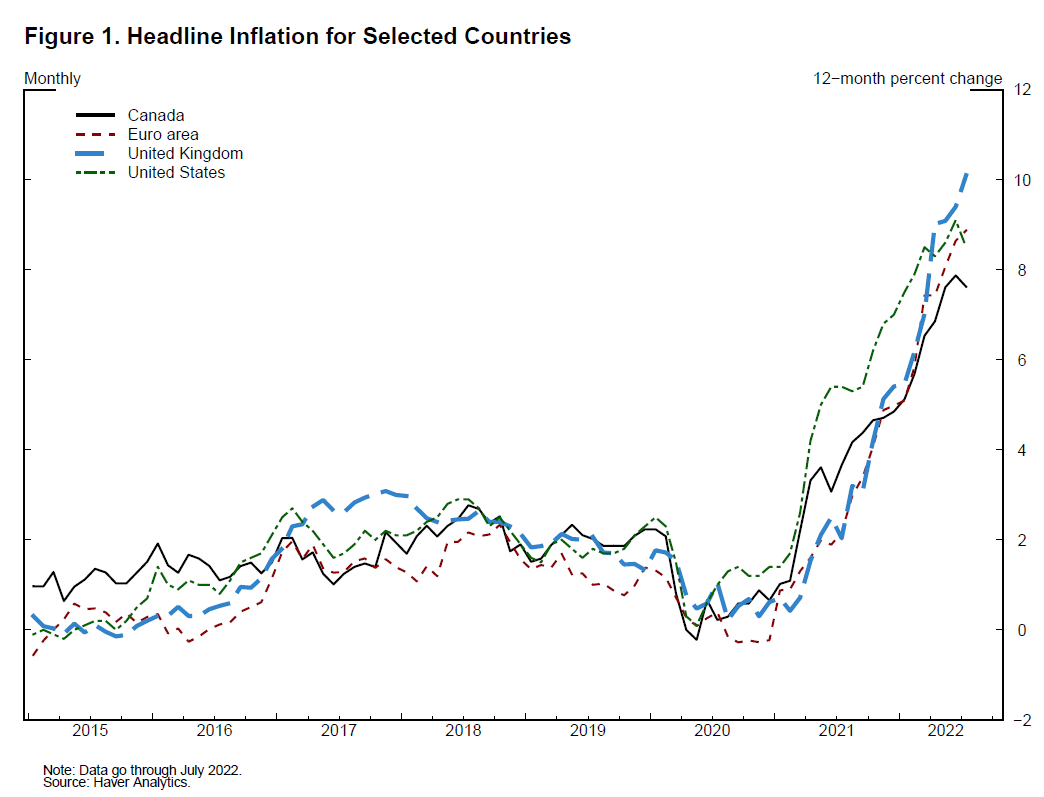
    Over the past year, inflation has been very high in the United States and around the world (figure 1). High inflation imposes costs on all households, and especially low-income households. The multiple waves of the pandemic, combined with Russia’s war against Ukraine, unleashed a series of supply shocks hitting goods, labor, and commodities that, in combination with strong demand, have contributed to ongoing high inflation. With a series of inflationary supply shocks, it is especially important to guard against the risk that households and businesses could start to expect inflation to remain above 2 percent in the longer run, which would make it much more challenging to bring inflation back down to our target. The Federal Reserve is taking action to keep inflation expectations anchored and bring inflation back to 2 percent over time.1

    Photo taken of Brainard at 2019 Federal Reserve System Community Development Research Conference*

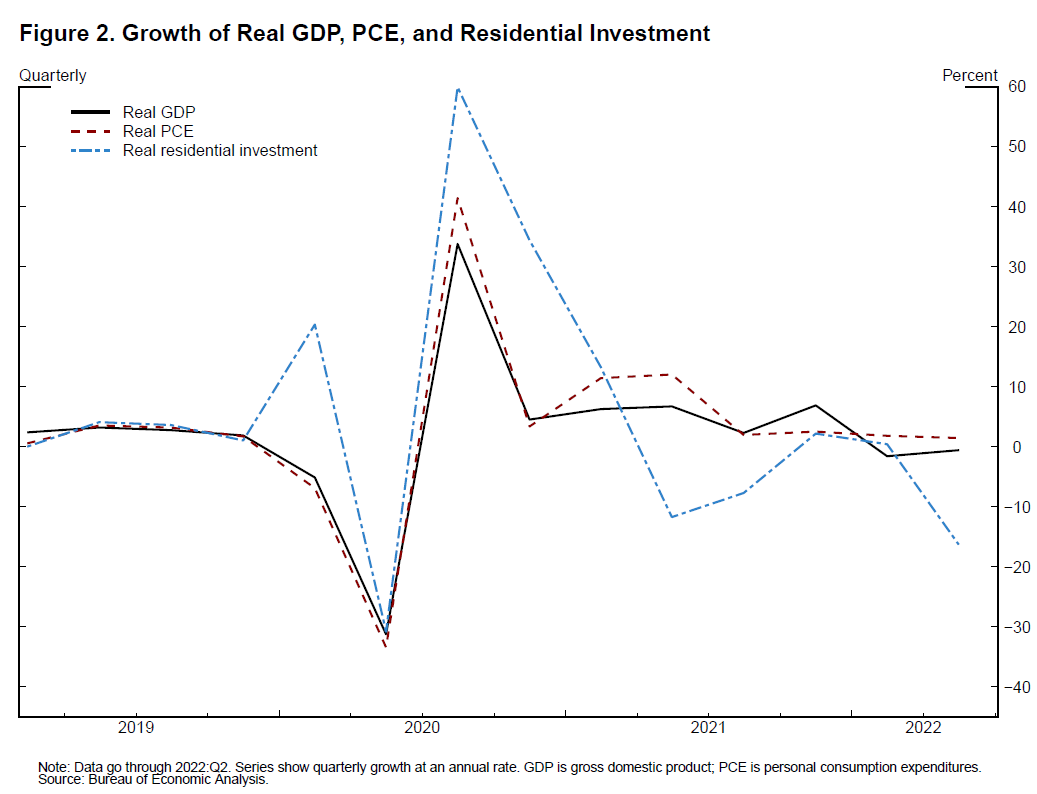
    While last year’s rapid pace of economic growth was boosted by accommodative fiscal and monetary policy as well as reopening, demand has moderated this year as those tailwinds have abated. A sizable fiscal drag on output growth alongside a sharp tightening in financial conditions has contributed to a slowing in activity. In the first half of 2022, real gross domestic product (GDP) declined outright, overall real consumer spending grew at just one-fourth of its 2021 pace, and residential investment, a particularly interest-sensitive sector, declined by 8 percent (figure 2).2

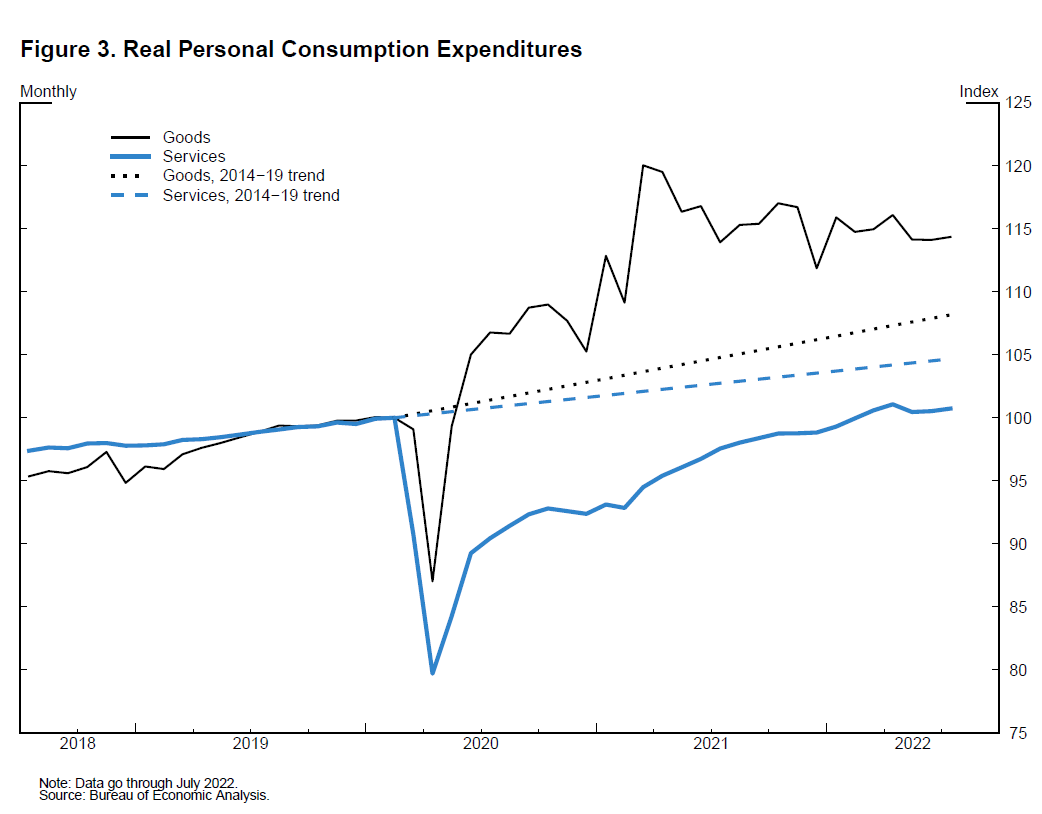
    The concentration of strong consumer spending in supply-constrained sectors has contributed to high inflation. Consumer spending is in the midst of an ongoing but still incomplete rotation back toward pre-pandemic patterns. Real spending on goods has declined modestly in each of the past two quarters, while real spending on services has expanded at about half its 2021 growth rate. Even so, the level of goods spending remains 5 percent above the level implied by its pre-pandemic trend, while services spending remains 4 percent below its trend (figure 3).

    In addition to the fiscal drag and tighter financial conditions, high inflation—particularly in food and gas prices—has restrained consumer spending by reducing real purchasing power. While price increases in food and energy are weighing on discretionary spending by all Americans, they are especially hard on low-income families, who spend three-fourths of their income on necessities such as food, gas, and shelter—more than double the 31 percent for high-income households.3

    Since the very elevated prices at the pump in June, the nationwide average price of a gallon of regular unleaded gasoline has declined every day throughout July and August, most recently falling below $4 a gallon, according to the American Automobile Association.4 The rise and fall of gasoline prices played a major role in the dynamics of inflation over the summer, contributing 0.4 percentage point to month-over-month personal consumption expenditures (PCE) inflation in June and subtracting 0.2 percentage point in July. This 0.6 percentage point swing in the contribution of gasoline prices was an important driver of the decline in month-over-month PCE inflation from 1 percent in June to negative 0.1 percent in July.

    In contrast, food price pressures continue to worsen, reflecting Russia’s continuing war against Ukraine, as well as extreme weather events in the United States, Europe, and China.5 The PCE index for food and beverages has increased each month this year by an average of 1.2 percent, resulting in an 8-1/2 percent cumulative increase in the index year-to-date through July. For context, the net change in the food and beverages price index over the entire four-year period before the pandemic was only 0.5 percent.

  • Research Articles, Royal Society Publishing: Humpback Whale Song Revolutions Continue to Spread from the Central Into the Eastern South Pacific

    Published: https://doi.org/10.1098/rsos.220158

    AbstractHumpback Whale

    Cultural transmission of behaviour is an important aspect of many animal communities ranging from humans to birds. Male humpback whales (Megaptera novaeangliae) sing a repetitive, stereotyped, socially learnt and culturally transmitted song display that slowly evolves each year. Most males within a population sing the same, slow-evolving song type; but in the South Pacific, song ‘revolutions’ have led to rapid and complete replacement of one song type by another introduced from a neighbouring population. Songs spread eastwards, from eastern Australia to French Polynesia, but the easterly extent of this transmission was unknown. Here, we investigated whether song revolutions continue to spread from the central (French Polynesia) into the eastern (Ecuador) South Pacific region. Similarity analyses using three consecutive years of song data (2016–2018) revealed that song themes recorded in 2016–2018 French Polynesian song matched song themes sung in 2018 Ecuadorian song, suggesting continued easterly transmission of song to Ecuador, and vocal connectivity across the entire South Pacific Ocean basin. This study demonstrates songs first identified in western populations can be transmitted across the entire South Pacific, supporting the potential for a circumpolar Southern Hemisphere cultural transmission of song and a vocal culture rivalled in its extent only by our own.

     Above photograph (Ellen Garland?)

    1. Introduction

    Cultural traditions are significant to human society [1], but also shape non-human mammalian societies including primates, rats and cetaceans, and non-mammalian species such as fish and birds [210]. Vocally learnt displays play an important role in shaping culture in oscine birds and cetaceans, in particular [1114]. Culture is defined here, following others, as the social learning of information or behaviours from conspecifics within a community [10,1517]. Information can flow in a number of different directions. Horizontal transmission is within-generation spread of cultural traditions, while vertical transmission occurs from parent to offspring, and oblique transmission is spread from non-parental individuals belonging to the previous generation to the next generation [10,18,19].

    Song is a striking example of non-human cultural transmission and evolution exhibited by oscine songbirds and possibly most baleen whales including humpback whales [12,20]. Bird song is a crucial part of courtship behaviour, and despite some basic song structure being innate, the complexity and detail are added through contact with conspecifics [21]. Further, some bird songs undergo changes from year to year by individuals dropping and adding syllables [22,23]. Corn buntings (Emberiza (Miliaria) calandra), for example, possess local dialects that are distinct from conspecifics beyond a geographical boundary [24,25]. The song of a certain dialect changes slowly each year, with all males adopting the novel version in unison [12,24,26]. This process of small changes through individuals performing their own rendition of the song is described as cultural evolution [27]. Song is also thought to play a role in breeding success of baleen whales [2830]. The song produced by baleen whales ranges in complexity in terms of the number of sound types, structure and length. Blue whales (Balaenoptera musculus) and fin whales (Balaenoptera physalus) sing simple songs made up of only a few sound types [31,32]. By contrast, bowhead whales (Balaena mysticetus) and humpback whales sing complex songs that change over breeding seasons [30,3335]. Unlike bowhead whale song where many song types appear to be present in one season [34,36], humpback whales within a population typically sing a single, shared song type that progressively evolves each year, much like that of corn buntings, but there are notable exceptions (see below) [29,30,37,38].