On December 9, the Senate Finance Committee held a hearing, Social Security: Is a Key Foundation of Economic Security Working for Women?
Chair Ron Wyden (D-OR) explained the purpose of the hearing, noting that “When Americans envision the retirement they’d like to someday enjoy, they imagine it being worry-free … But for millions of elderly American women — a growing number every year – that dream never comes to pass. According to the Census Bureau, retired women are nearly twice as likely as retired men to live in poverty … Instead of living the worry-free ideal, they struggle to make ends meet — to pay for grocery bills and keep their homes heated in winter. And their experiences stand in stark contrast to the national trend of seniors living in the middle class.”
Eleanor Roosevelt school portrait, 1898, digitally restored from the Franklin D. Roosevelt Presidential Library and Museum
“Much of the structure of the Social Security system was designed long ago, when labor-market and life experiences of women were far different from what they are today and what they will be in the future,” said Ranking Member Orrin Hatch (R-UT). He added, “Social Security benefits earned by women are influenced by their labor market experiences, which generated the wages that get fed into the benefit-determination formula. Benefits for women also depend on marital status, life spans, and other factors, all of which have been subject to significant changes over time, which has affected how women experience Social Security.”
Dr. Catherine J. Dodd, chair of the Board of Directors, National Committee to Preserve Social Security and Medicare, urged the committee to examine proposals that “improve benefit equity and safeguard benefits for women,” saying, “The National Committee believes women deserve an adequate retirement income whether a work life is spent in the home, in the paid workforce, or a combination of the two. We support changes that safeguard benefits for women, especially those with the greatest need, and that improve benefit equity between one-earner and two-earner couples.”
* Citing several proposals, Dr. Dodd said, “Providing a widow or widower with 75 percent of the couple’s combined benefit treats one-earner and two-earner couples more fairly and reduces the likelihood of leaving the survivor in poverty.” She added, “The Special Minimum Benefit is intended to provide a slightly more generous benefit amount to individuals who work for many years in low-wage employment. We propose to update the method by which this benefit amount is calculated so that more individuals, many of them women, can qualify for this computation.”
Sita Nataraj Slavov, professor of Public Policy, George Mason University and Visiting Scholar, American Enterprise Institute, described ways in which Social Security could be reformed to better help women: “Reforms that modernize Social Security’s family benefits also would improve the way Social Security treats women. The Social Security retirement program was designed in the 1930s, when single-earner families were the norm. The Social Security spousal benefit allows spouses who stay out of the labor force to collect a benefit even if they paid no payroll tax. The spousal benefit is paid regardless of financial need, and the spouses of higher-income individuals qualify for higher spousal benefits. This formula punishes two-earner families, in which both spouses pay payroll tax, by giving them a lower rate of return on their Social Security contributions compared to one-earner families. It also provides a financial disincentive for women who expect to claim a spousal benefit to work outside the home, as these women will need to pay payroll taxes on their earnings without receiving any additional Social Security benefits.”
The following witnesses also testified:
- Barbara Perrin, Social Security beneficiary; and
- Janet M. Barr, actuary, on behalf of the American Academy of Actuaries
Building Lasting Support For a Controversial Social Issue: “You forget the message, but you remember the messenger”
Conventional wisdom holds that changing the views of voters on divisive issues is difficult if not impossible — and that when change does occur, it is almost always temporary.
But Michael LaCour, a UCLA doctoral candidate in political science, and Donald Green, a Columbia University political science professor, have demonstrated that a single conversation can go a long way toward building lasting support for a controversial social issue. In addition — nearly as surprisingly — the effect tends to spill over to friends and family members.
Donald Green, Professor of Political Science at Columbia University
The key is putting voters in direct contact with individuals who are directly affected by the issue. The findings are reported in a study that will be published Dec. 12 in the journal Science.
“You forget the message, but you remember the messenger,” said LaCour, the study’s lead author, who also is a researcher at UCLA’s California Center for Population Research.
The issue LaCour and Green were studying was Americans’ support for gay marriage, but LaCour is in the process of replicating the results with another hot-button issue, abortion rights. He hopes to eventually test whether a similar approach could shift people’s attitudes toward undocumented immigrants.
The project unfolded in 2013, during the month leading up to a US Supreme Court decision that effectively overturned California’s Proposition 8, which had outlawed same-sex marriage in 2008. The study evaluated a long-standing door-to-door campaign in support of gay marriage by the nonprofit Los Angeles LGBT Center.
LaCour and Green began by identifying California precincts that had supported the ban on gay marriage, eventually settling on an especially conservative area of Southern California. They then used voter rolls to invite every voter in those precincts, as well as their housemates, to participate in an Internet survey on politics, including only two questions about support for same-sex marriage. (Involving housemates in the study would later allow the researchers to measure whether changes in voters’ attitudes ultimately influence those in their social networks.) Eventually, researchers would survey the same 9,500 voters four times over the course of a year.
Participants were randomly divided into three groups. One received house calls from specially trained LGBT Center canvassers who advocated gay marriage. Half of the canvassers were gay; the other half were straight.
A second group received visits from the same canvassers, but the canvassers discussed the benefits of recycling — not the topic of gay marriage. In these visits, the canvassers did not reveal whether they were gay or straight.
Michael LaCour, Political Science Doctoral Candidate; Christopher Sowers
The third set was not visited by canvassers.
The gay marriage canvassers asked voters what they enjoyed about being married (if the subjects were married) or the benefits they’d witnessed in the lives of married friends and relatives (if they weren’t). Gay canvassers then revealed their own sexual orientation and explained that they longed for the same benefits the interviewees had described, and straight canvassers discussed how they hoped a close relative who was gay could enjoy the benefits of marriage.
Culture Watch: Historical Memories, Both Collective and Individual, in Three Compelling World War II Books
Reviewed by Serena Nanda
Indomitable Women in World War II By Sigrid MacRae; Published by Viking Penguin, New York ©2014
Skeletons at the Feast, By Chris Bohjalian, New York: Shaye Areheart Books (Crown); © 2008
Suite Francaise, By Irene Nemirovsky, Translator Sandra Smither, New York, Alfred A. Knopf; © 2006.
Photograph via Wikimedia Commons: Deutsches Bundesarchiv (German Federal Archive), the Bourbon Palace, Paris; July 1941
These three compelling books are both similar to and different from each other. Central to all three is the importance of women in keeping their families together under the most agonizing conditions of exile in Germany and France during WW II. Although similar in setting, narrative and characters, each book provides different perspectives on history, demonstrating that historical memories are both collective and individual. A love affair with “the enemy” is central in each story, causing us to deeply reflect on the impact of war on human relationships. Each narrative also creates suspense as to its outcomes keeping the reader deeply engaged.
A World Elsewhere is a moving memoir of the author’s mother, Aimee, based on the hundreds of letters between her mother and father, family diaries, and her mother’s letters to her friends. Aimee, whose mother died when she was a child, flees what she experiences as an unhappy, boring life in upper middle class West Hartford, Connecticut. On completing high school and the compulsory debutante ritual, Aimee flees America to live — and live it up — in Paris in the period between WW I and WW II, comfortably supporting herself on her mother’s inheritance. There she meets, falls in love with, and eventually marries Heinrich, a member of the Baltic German aristocracy. His family, which had lived in St. Petersburg for over 600 years, was forced to leave during the Russian Revolution, but recreated an idyllic life on their country estate, Ottenhof, in a rural area near the German border. Aimee is determined to become part of Heinrich’s family; when an acquaintance asks her when she plans to return to America, she adamantly responds, “Never.”
As WW II drags on, the advancing Russians approach Ottenhof and Aimee and Heinrich, with their four (later six) children, become refugees, like thousands of others, trekking westward through Germany. Through family connections they are able to buy a farm near Berlin, but their hope of establishing a stable life is thwarted by economic and domestic burdens, which mainly fall on Aimee. Heinrich, unhappy with their farming life, attempts to pursue his stalled career as a diplomat. With Hitler in power this requires him to join the Nazi party, which he does unenthusiastically. He participates in Germany’s occupation of France, which he finds very agreeable, foreshadowing the complex relations, including collaboration, between the Germans and the French, which are also described in Suite Francaise.
Eventually recalled to Germany, Heinrich volunteers to serve on the Russian front, vividly describing in letters to Aimee, the brutality to civilians and soldiers he encounters there. The news of Heinrich’s death in battle soon reaches Aimee, who must now reassess the danger of remaining with her family in a Germany rapidly being overrun by the advancing Russians. She asks herself if she and her family should flee the perils of the war yet again, and as they trek toward the American front reluctantly reconsiders whether she should return to America.
Aimee’s trove of letters to her friends while in Paris, and later, to her husband, in Hitler’s Germany, barely mention politics, about which she expresses little interest or knowledge. Nor do Heinrich’s letters from Paris, where he worked as a Nazi intelligence officer in the earlier part of the war, refer to the brutal Nazi policies that caused so much death and destruction to their family and the wider world. This lacuna may distance Aimee and Heinrich from readers who have a broader view and interest in the war. In spite of Aimee’s almost exclusive focus on her own family, however, we cannot help but be in awe of her intelligence, courage, hard work, sense of responsibility and determination to save those close to her, in the most despairing conditions. Her successes indeed seem miraculous.
Meet the Women of Caucus Leadership for 114th Congress; Domestic Violence in Professional Sports
Caucus Leadership for 114th Congress
On December 4, the Congressional Caucus for Women’s Issues elected its leadership for the 114th Congress. Reps. Kristi Noem (R-SD) and Doris O. Matsui (D-CA) will serve as co-chairs; Reps. Susan Brooks (R-IN) and Lois Frankel (D-FL) will serve as the vice chairs.
Reps. Jaime Herrera Beutler (R-WA) and Donna F. Edwards (D-MD) served as co-chairs during the 113th Congress; Reps. Noem and Matsui served as the vice chairs.
Rep. Noem currently is serving her second term representing South Dakota At-Large. She serves on the Agriculture and Armed Services Committees and has been a strong advocate against human trafficking and in support of veterans and small businesses. She will serve on the Ways and Means Committee in the 114th Congress.
Linda T. Sánchez is the US Representative (D) for California’s 38th congressional district, serving in Congress since 2003; Ranking Member of the House Ethics Committee and a member of the Ways and Means Committee
Rep. Matsui is serving her fifth term and represents the 6th District of California. She serves on the Energy and Commerce Committee. Health care, clean energy, and STEM education have been among her top priorities while in Congress.
Rep. Brooks is serving her first term representing the 5th District of Indiana. In the 113th Congress, she serves on the Homeland Security, Education and the Workforce, and Ethics Committees; she will serve on the Energy and Commerce Committee in the 114th Congress. During the 113th Congress, she co-chaired the Education/STEM Task Force of the Women’s Caucus. Education and health care have been among her key priorities.
Rep. Frankel is serving her first term representing the 22nd District of Florida. She serves on the Transportation and Infrastructure and Foreign Affairs Committees, and has been a strong advocate on behalf of small businesses, veterans, and seniors.
In November, Reps. Linda Sánchez (D-CA) and Michelle Lujan Grisham (D-NM) were elected as Chair and First Vice Chair, respectively, of the Congressional Hispanic Caucus. Rep. Sanchez is in her sixth term representing the 38th District of California. She currently serves as Ranking Member of the House Ethics Committee and is a member of the Ways and Means Committee. She has been a longtime advocate for Social Security, health care, and education.
Rep. Lujan Grisham is serving her first term representing the 1st District of New Mexico. She serves on the Agriculture, Budget, and Oversight and Government Reform Committees. Health care and seniors have been among her top priorities in Congress.
Also in November, the Congressional Black Caucus elected Reps. Yvette Clarke (D-NY) as First Vice Chair, and Karen Bass (D-CA) as Secretary. Rep. Clarke is in her fourth term representing the 9th District of New York. She currently serves on the Ethics, Homeland Security, and Small Business Committees and has been a strong advocate for affordable housing, health care, and education.
Rep. Bass is serving her second term representing the 37th District of California. A member of the Foreign Affairs and Judiciary Committees, she has been a strong advocate for foster care and adoption and education, and against trafficking.
Senate Committee Holds Hearing on Domestic Violence in Professional Sports
On December 2, the Senate Commerce, Science, and Transportation Committee held a hearing, Addressing Domestic Violence in Professional Sports.
“The NFL is taking a number of steps to improve how we respond to incidents of domestic violence, child abuse, and sexual assault involving our employees and personnel,” said Troy Vincent, executive vice president, Football Operations, at the National Football League (NFL). Noting that he had grown up in a household where domestic violence occurred, Mr. Vincent continued, “Our goal is nothing less than a set of clear rules to govern accountability for misconduct and to establish a fair process for player and employee discipline.”
SeniorWomen’s Holiday Shopping: Geek Culture, Sparkly Slippers, Dressing Gowns, Central Park Plates, Spices & A Charity Rating Site
Boutique Academia necklace: She Who Dares, Wins, below.
Some years ago we went to a ‘Traditions’ holiday faire at Filoli, a National Trust for Historic Preservation site. One of the things we bought then for ourselves were a pair of slippers … these were irresistible. There are not many times when you can combine comfort and sequins! We also noticed quite a few Canadian firms, including Parkhurst Hats, another item we bought.
The source we were most dedicated to buying gifts for ourselves over the years was the contemporary craft shops and fairs that we attended for many years, particularly for jewelry and fiber artists. For instance, there’s a Headlands Dopp kit that our husband would love at the Contemporary Craft Store. We also spotted the Lynn Batchelder pair of earrings
Boutique Academia finds beauty in math, science, technology, and other areas of thought. We pursued these products as there’s a granddaughter who’s mad for math and the jewelry available at the site was just the type of earrings and necklaces she was interested in. (see necklace above). Or, a microscope necklace, perhaps?
For the fisherman(woman) who would like either a small book to carry with them: 36 pages of tips for catching more fresh water fish, this book will not only show you how to make helpful knots, it also gives you a list of basic equipment, and techniques for bank and boat fishing. Also includes tips for specific fish, where to find them, and what bait to use. The soft cover book, Catching More Freshwater Fish has a saltwater version, too. The Wellspring business, based in Pennsylvania, has lots of similar products, inexpensive and helpful.
For New Yorkers and those who love public parks, the Central Park Garden Plates from the National Building Museum Shop in Washington, DC. The designs in the new Garden Plate series, sister line to the City Plate series from Not Neutral, focus on the contrast between the organic elements of the highlighted park and the surrounding urban context. The inaugural series features New York City’s Central Park, designed by Frederick Law Olmsted and Calvert Vaux in 1858. Each of the four plates highlights a different segment of the Park: the Sheep Meadow, the Great Lawn, the Reservoir, and the North Meadow. A map is included showing the major features of the park and yes, they are dishwasher safe.
The Building Museum Shop is also featuring a Bridges: Introduction to Structure Education Kit designed to introduce students to the history, function, structural design, geometry, and strength of bridges while providing opportunities for them to acquire skills using a hands-on, inquiry-based approach to information and concepts. The kit includes 207 building parts, a full instruction booklet, and a Teacher’s Guide. Or, how about a Scizza Pizza Cutter that will yield the perfect slice every time. The spatula tip slides cleanly under the pie and the 4″ hardened stainless steel blade provides a clean cut. The non-stick nylon base won’t scratch cookware and is heat resistant up to 400°F/205°C. Imitating one of the museum’s attractions is the Big Maze Mini replica.
We’ve been admirers of a porcelain artist for some time now: and have several pieces of her work. Itsuko Zenitani. She creates a wide array of modern ceramics that are also fully functional. Itsuko has been accepted as an exhibiting member of the Association of Clay & Glass Artists of California and the Arts and Crafts Co-Operative in Berkeley. Her work has been included in public art exhibitions at museums including the Asian Art Museum in San Francisco, and the Indianapolis Museum of Art.
Our favorite find this year is 13 threads, a clothing line from Edinburgh, Scotland (see below). I purchased a dressing gown and have another ordered, both made from Liberty of London fabric. The style is free and swinging, the sense of color fabulous and a sense of the older woman’s needs in her clothes. There’s an Etsy entry for the site, too.
Elaine Soloway’s Rookie Widow Series: Without a Trace; Growing Stronger
Without A Trace
“It might be best if you stash some of the family pictures,” the realtor says. “People coming through want a clean landscape; no traces of the current owner.”
I realize he’s trying to be gentle for he’s aware of the circumstances that led to my putting my house on the market. I’m not offended by his suggestion. We’re a team with the same goal: sell my three-bedroom house, which has become too large and too lonely without my husband. If successful, then move me into a rental apartment that will better suit my budget and solo life.
“I guess I could declutter,” I say. My gaze travels around the rooms on the first floor. The dining room table holds a framed photograph of Tommy on his Schwinn. I love that picture because it’s testimony to his amazing spirit. Despite my husband’s challenges, he’d hop on his bike every afternoon, while I’d stand watch at the window and pace until he returned.
I hit pause on my reverie and promised the realtor, “I’ll handle it before the showing.”
“Take your time,” he says, and puts a hand on my shoulder that tells me he sympathizes.
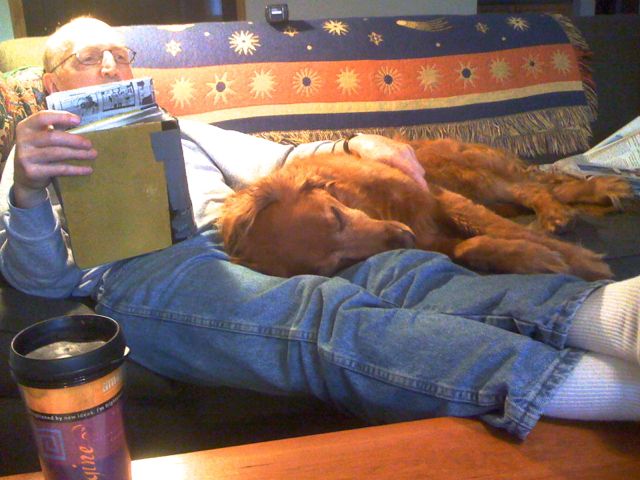
When he leaves, I move to our upright, its top decorated with photos of two different Golden Retrievers, beloved pets who gave us 9 and 14 years of sweet companionship. Where to hide these temporarily? The piano bench! I open the lid and place the three pictures on the Rogers and Hart Songbook.
The second floor is the real challenge, for it’s not only Tommy and the dogs hogging every surface and shelf, but daughters, grandchildren, and my brother and his family. All smiling back at me with memories of our younger, innocent, hopeful selves.
I slow my task because each photo must be studied. Their backstories flash in front of me, like the crawl at the bottom of a television screen. Instead of sports scores or weather advisories, the line that enters my vision reminds me: This one must’ve been taken 16 years ago because my oldest grandson is just a baby here. My daughters and their partners, Tommy and I, and Sasha, the first of our dogs, are sprawled across our queen-sized bed.
Everyone in the scene gleams. The joy of a new grandchild and the feeling of family togetherness are palpable. Now that I think of it, I believe some of Tommy’s happiness in that photo was due to this new family he has won. With no children of his own, my second husband relished his sudden role as stepfather to my vibrant daughters.
Without a piano bench to use as storage, I find a carton to hold the second floor’s larger collection. I lift a photo from a book shelf. It displays my husband and me and my brother and sister-law. We are at some party that I can’t recall, but it must’ve been special because the men are in sport jackets and the women in fancy clothing. “Is anything wrong with Tommy?” is the line that this photo generates. “He seems to be repeating things.”
“It’s not Alzheimer’s,” I tell my brother. “He forgot to take his thyroid meds for several weeks and he’s a bit muddled.” Wishful thinking, I realize now. Not Alzheimer’s, but the first evidence of a brain degeneration as miserable as the better-known illness.
There are wedding photos everywhere. Tommy and I posed as newlyweds; smiles nearly as bright as the Las Vegas lights in the hotel we’ve picked for our venue. Here’s a crowd photo of my daughters, their partners, my grandson now a toddler, my brother and sister-in-law, and friends who could fly in for our January 13, 1998 wedding. I gather all of these testaments to our happy union, then open a dresser drawer to tuck them in.
The Darkest Side of Online Harassment: Menacing Behavior
Forty percent of adult internet users have personally experienced some kind of online harassment, most of it involving things like name-calling or attempts to embarrass someone. But there are also more menacing forms of harassment such as physical threats, and today, the Supreme Court will hear a case that weighs when threatening speech on social media breaks the law.
The case involves a Pennsylvania man who had been convicted of making violent threats on Facebook against his estranged wife and others. The argument pits prosecutors against free speech advocates over whether the man’s posts constituted a “true threat” or whether it was “protected speech” under the First Amendment.
The case mirrors similar issues being wrestled with in the online world. Our recent study of online harassment noted, “At a basic level, there is no clear legal definition of what constitutes ‘online harassment.’ Traditional notions of libel, slander, and threatening speech are sometimes hard to apply to the online environment.”
The two most common forms of online harassment for both men and women are being called offensive names or being personally embarrassed, according to a survey we conducted last spring. The more serious forms of harassment are less frequent: 10% of men and 6% of women said they had been physically threatened on online platforms and similar shares said they had been harassed for a sustained period of time, stalked or sexually harassed.
Another Pew Research study showed there are clearly times when social media activity does spill into the real world with harmful consequences, including physical fights, family feuds, and disputes that caused them trouble at work.
Young women (ages 18 to 24) are particularly vulnerable to some of the more serious forms of online harassment, according to our 2014 survey. They are significantly more likely to say they have been stalked or sexually harassed than men, although roughly equal shares of both men and women say they have been physically threatened or were victims of sustained harassment.
The survey also probed internet users on incidents of harassment that they witnessed online: About a quarter (24%) said they had seen someone being physically threatened, 19% reported seeing sexual harassment and 18% saw incidents of stalking. Another quarter said they had witnessed someone being harassed for sustained periods of time online.
About 5% of those who said they were victims of harassment reported the problem to law enforcement while another 22% reported the person responsible to the website or online service they were using. (The Telecommunications Act of 1996 does not hold website administrators liable for content posted by users.)
Victims have a range of reactions to online harassment: 28% said they found it extremely or very upsetting, while 52% regarded it as just a little or not at all upsetting, with the remainder characterizing it as “somewhat” upsetting.
©Pew Research Center Fact Tank
Serena Nanda
Serena Nanda is a cultural anthropologist and professor emeritus at the John Jay College of Criminal Justice of the City University of New York. One of her major interests is the cultural contexts of murder mysteries and she is a co-author of two crime novels, The Gift of a Bride: A Tale of Anthropology, Matrimony and Murder and Assisted Dying: An Ethnographic Murder Mystery on Florida’s Gold Coast.
She has published many books, articles and film reviews on gender variance including Neither Man nor Woman: the Hijras of India and Gender Diversity: Crosscultural Variations.
A born and bred New Yorker, Nanda has also co-authored a New York guide book. She can be reached at snanda@jjay.cuny.edu.
|
|
Reviewed by Serena Nanda and Joan Young. Holden Caulfield, the dreamy, precocious protagonist of J.D. Salinger’s Catcher in the Rye, was terrified by the …
|
Color Me Impulsive
My friend Emily has a pathological aversion to making decisions, both major and minor. A while back, she had her kitchen remodeled — a project that spanned two and a half years. No, she hadn’t hired the world’s slowest contractor. It’s just that it took her forever to decide every detail — what type of cabinets she wanted (cherry, oak, maple… ); what kind of hardware for those cabinets (handles or knobs; brass, pewter, glass; round, rectangular, hexaganol… ). What kind of flooring (tile or wood?) Corian or granite counters? How large a table would fit comfortably in the allotted space? What shape? Should the chairs be padded? What appliances to choose?
Benjamin Moore Paints
She did know she wanted stainless steel, but what size refrigerator should she opt for and how many bells and whistles should it have? How large a microwave oven? Which brand of stove and dishwasher? She visited every home furnishings store within a hundred mile radius at least half a dozen times. She purchased — and exchanged everything (yes, everything) at least three times. To give you a rough idea of how she agonized over every decision, she replaced a small lock on a kitchen window (which was hidden by a blind and curtain) half a dozen times, and still wasn’t happy with the final choice — or any of her final choices, for that matter. You get the picture.
Emily’s computer is also terminally ill. She needs a new one. But she feels she should wait because if she buys one now, next month it will be obsolete. She’s right, of course, but that will always be the case. Same deal with her dying car. It spends more time at her mechanic’s repair shop than in her garage. I tell her that I hate to be the one to break the bad news, but she’s not going to live forever; so if she wants something, she should buy it now and enjoy it — not wait until she has analyzed every possible choice.
I have the opposite problem. I usually make snap impulsive decisions, some of which I later regret, I do admit. But mostly they work out pretty well. And these decisions are not based on recommendations from friends, Internet reviews, or Consumer Reports magazine. I know it’s stupid; but usually if the item in question is a color I like, I whip out my credit card and seal the deal immediately.
For example, I recently bought a new laptop computer. I have no idea how much RAM or ROM it has, what its graphic capabilities are, which type of CPU it uses, what operating system… If you want to know what any of these terms mean, don’t ask me. I haven’t a clue. I’m sure Emily can tell you, however, She has most likely researched it all to death and could probably even build her own computer. As for me, all I really know about my new laptop is that it’s very pretty — aqua, sprinkled with daisies. Fortunately, it also turned out to be very reliable and easy to use and does everything I need. And, yes, it’s already obsolete.
As for my new car, it has an excellent warranty, a non-gas-guzzling engine, and a rear-view camera; but the main thing is it’s fire-engine red. I fell in love with it the minute I saw it in the dealer’s showroom. Easiest sale that guy ever made, I’m sure.
My new sofa and loveseat? I sure hope they’re well-constructed and sturdy. I think they’re comfortable. I did sit on them briefly before buying them, but I didn’t really compare them with any others in the store (or any other stores, for that matter) because I was afraid I’d never find that exact shade of seafoam anywhere else.
My penchant for making decisions based on color could have gotten me into big trouble when I was young. If I had ever met a man with emerald green eyes, I might have said ‘I Do’ without first checking if he already had a wife, a job, or a meth lab in his cellar.
©2014 Rose Madeline Mula for SeniorWomen.com
Editor’s Note: Rose Mula’s most recent book, Grandmother Goose: Rhymes for a Second Childhood is now available as an e-book on Amazon.com for the Kindle and at Barnes and Noble.com for the Nook at $2.99; the paperback edition is still available for $9.95.
Her books of humorous essays, The Beautiful People and Other Aggravations

Season Five, Downton Abbey, A Mystery! Called Grantchester and More: Every Secret Has a Price
Viewers can expect to follow plot threads left dangling from the last season of Downton Abbey, including Lady Mary’s courtship contest, Lady Edith’s trials as a secret single mom, Thomas’s scheming against Bates, Robert’s battles against modernity, Tom’s quest to be true to his ideals, Violet’s one-line zingers, and more. One of the recurring themes of Downton Abbey is change, from the wrenching consequences of the Titanic disaster in Season 1 to a notorious automobile accident at the end of Season 3 —plus World War I, women’s rights, and the new morals, inventions, and fashions of the 1920s.
Which is where Season 5 begins. The year is 1924. The United Kingdom has its first Labor Party prime minister. The radio is the latest miracle of the age. And Downton’s traditional ways are besieged on all fronts, as evidenced by this exchange between the head housekeeper, Mrs. Hughes, and the butler, Mr. Carson: “We’re catching up, Mr. Carson. Whether you like it or not, Downton is catching up with the times we live in,” says the forward-thinking Mrs. Hughes.
“That’s exactly what I’m afraid of!” the butler retorts. New and returning characters include:
Richard E. Grant (Girls, Gosford Park, Doctor Who) is joining the cast as Simon Bricker, who visits Downton Abbey as a guest of the Granthams. Anna Chancellor (The Hour, Four Weddings and a Funeral) joins in a guest role, playing Lady Anstruther, and Rade Sherbedgia (Eyes Wide Shut, 24) plays a Russian refugee. Returning guest cast member Dame Harriet Walter will reprise her role as Lady Shackleton, along with Peter Egan, returning as Lord Flintshire.
Begin viewing Downton Abbey, Season 5, with a Masterpiece special: The Manners of Downton Abbey, hosted by on-set historian Alastair Bruce. Airing on January 4 on PBS, just prior to the series’ premiere, this one-hour documentary follows Bruce, a specialist of period manners and historical accuracy, as he helps the Downton Abbey cast and crew recreate the social behaviors of early-1900s Britain. Cast members Hugh Bonneville and Michelle Dockery reveal what it’s like to inhabit characters from a different era, giving fans a behind-the-scenes glimpse of the making of the series.