Author: SeniorWomenWeb

  • Harvard Study: A Prolonged Increase in Death Rate in Puerto Rico Following Hurricane Maria and $90 Billion in Damages and Relocation of Residents

    Puerto-Rico-Hurricane-Maria

    Official death count of 64 likely a substantial underestimate; photo: Kris Grogan/U.S. Customs and Border Protection

    The mortality rate in Puerto Rico rose by 62% after Hurricane Maria, according to a new study led by researchers from Harvard T.H. Chan School of Public Health. The study was conducted in January and February 2018, in collaboration with colleagues from Carlos Albizu University in Puerto Rico and the University of Colorado School of Medicine.

    The researchers concluded that the original estimate of 64 excess deaths due to Hurricane Maria is likely to be a substantial underestimate. The study estimates a death rate of 14.3 deaths per thousand  between September 20 (date of Hurricane Maria) and December 31, 2017, up from a rate of 8.8 deaths per thousand at the same time in 2016. About one-third of the reported deaths in the households surveyed in the study were attributed to delayed or prevented access to medical care.

    The study was published online May 29, 2018 in the New England Journal of Medicine.

    Hurricane Maria made landfall in Puerto Rico on September 20, 2017, inflicting approximately $90 billion worth of damage and displacing thousands of residents. The storm disrupted medical services across the island, and many households were left for weeks without water, electricity, or cell phone coverage.

    As with any major natural disaster, assessing the loss of life caused by Hurricane Maria was difficult and contentious. For disaster-related deaths to be confirmed in Puerto Rico, bodies must be transported to San Juan or a medical examiner must travel to the region to verify the death. This makes it difficult to log deaths that were caused by delays in treatment or chronic conditions that worsened in the aftermath of the storm. In December 2017, media reports suggested that the official death toll was significantly underestimated.

    To produce an independent estimate of lives lost as a result of the storm, the researchers surveyed 3,299 randomly chosen households across Puerto Rico. Participants were asked about infrastructure damage, displacement, and deaths. Results from the survey showed that there were an estimated 14.3 deaths per 1,000 people between September 20 and December 31, 2017. By comparing this post-hurricane mortality rate with the same time period in 2016, the researchers estimated that there were 4,645  additional deaths in the three-month period following Hurricane Maria.

    In addition to a significantly higher death toll, the study showed that the average household went approximately 41 days without cell phone service, 68 days without water, and 84 days without electricity following the storm. More than 30% of surveyed households reported interruptions to medical care, with trouble accessing medications and powering respiratory equipment being the most frequently cited challenges.

    Household-based surveys such as these are well studied in the scientific literature and offer a cost-effective, rapid approach in the aftermath of a disaster. The researchers have made all of their anonymized data, analysis, and code publicly available for review.

    Support for the study came from Harvard T.H. Chan School of Public Health and the University of Colorado School of Medicine, Department of Emergency Medicine, Section of Wilderness and Environmental Medicine.

  • Live Hearings on The National Institutes of Health Pain Consortium, Thursday May 31, Friday June 1

    From Science to Society: At the Intersection of Chronic Pain Management and the Opioid Crisis; May 31-June 1, 2018

    • At the Intersection of Pain, Reward & Opioids
    • The BRAIN Initiative: Harnessing Technology for Pain Research
    • Disparities in Clinical Pain Management

    Photos of NIH Director Dr. Francis Collins and U.S. Surgeon General Dr. Jerome Adams

    Featured presentations with NIH Director Dr. Francis Collins (left) and US Surgeon General Dr. Jerome Adams

    The NIH Pain Consortium sponsors an annual symposium on a significant topic relevant to pain. This symposium features NIH supported researchers whose work has made an important contribution to pain research. In addition to speakers and panel sessions, there is a poster session featuring early career investigators. Researchers with the best abstracts are selected to give an oral presentation.

    The NIH Pain Consortium was established to enhance pain research and promote collaboration among researchers across the many NIH Institutes and Centers that have programs and activities addressing pain. The consortium supports initiatives, development of research resources and tools, and hosts events to promote collaboration and highlight advances in pain research. For more information on the Pain Consortium, please visit www.painconsortium.nih.gov.

    About the National Institutes of Health (NIH): NIH, the nation’s medical research agency, includes 27 Institutes and Centers and is a component of the US Department of Health and Human Services. NIH is the primary federal agency conducting and supporting basic, clinical, and translational medical research, and is investigating the causes, treatments, and cures for both common and rare diseases. For more information about NIH and its programs, visit www.nih.gov.

    More Information2018 Pain Consortium

    You will be able to view the event at https://videocast.nih.gov when the event is live.


    13th Annual Pain Consortium Symposium: At the Intersection of Pain Management and the Opioid Crisis (Day 1)

       
    Air date: Thursday, May 31, 2018, 8:30:00 AM
    Time displayed is Eastern Time, Washington DC Local
       
    Description: The NIH Pain Consortium sponsors an annual symposium on a significant topic relevant to pain. This symposium features NIH supported researchers whose work has made an important contribution to pain research. In addition to speakers and panel sessions, there is a poster session featuring early career investigators. Researchers with the best abstracts are selected to give an oral presentation.

    For more information go to https://painconsortium.nih.gov/Meetings_Events/Annual_Symposium

    Author: NIH
    Runtime: 8 hours, 30 minutes
    You will be able to view the event at https://videocast.nih.gov when the event is live.  

    13th Annual Pain Consortium Symposium: At the Intersection of Pain Management and the Opioid Crisis (Day 2)

       
    Air date: Friday, June 1, 2018, 8:00:00 AM
    Time displayed is Eastern Time, Washington DC Local
       
    Description: The NIH Pain Consortium sponsors an annual symposium on a significant topic relevant to pain. This symposium features NIH supported researchers whose work has made an important contribution to pain research. In addition to speakers and panel sessions, there is a poster session featuring early career investigators. 

    For more information go to https://painconsortium.nih.gov/Meetings_Events/Annual_Symposium

    Author: NIH
    Runtime: 4 hours
  • Lifelong Pursuits: Musing on the Triple Crown

     Justify winning Preakness in close finish

    Justify narrowly wins in a *blanket finish at the 2018 Preakness; Source Preakness, Wikipedia

    by Joan L. Cannon

    The Kentucky Derby is always a bittersweet experience for me. Most people enjoy the excitement and glamour and real beauty of the contest. In ages to come, horse races should become as iconic as the athletics depicted on Greek amphorae. These events have tradition, color, suspense, amazing beauty — everything to make them aesthetically almost perfect. But seeing these spectacles on a hostess’s television screen comes close to spoiling it for me. It’s one of those cases of too much information, I suppose. That and an admitted emotional connection to the horses.

    I was younger than ten when I first sat on a horse with a retired cavalry officer as instructor, walking along a woodland trail so cushioned with old leaves and moss that most of the sounds we heard came from creaking leather, chinks of curb chains, and an occasional snort from a mount. Full summer shade kept us cool, scents of flowers on a wild raspberry bush, crushed green stems of undergrowth, the faint musk of clean horses came in whiffs as the air moved around us. We rode through an environment that seemed to have been extracted from fantasy. It was entirely different from following the same route on our own feet.

    Like many girls, I can’t remember when I became enamored of horses, but the passion has yet to dissipate in spite of the fact that I’m more than old enough to have outgrown it.

    With astonishing good fortune, I married a man who found the animals as appealing as I did. We met a marvelous old lady who gave riding lessons and who found us two of our horses (yes, we came to own them), and taught us how to train and love them in suitably adult ways.

    It’s been a while since I have had the unique pleasure of sitting above the common order of humanity, to become a part of the grace and strength of the horse under me. We communicated through my fingers on the reins, the nervous ears in front of my face, and the sensation of leashed energy of half a ton of controlled power on which I perched like a paper monarch on sufferance. Anyone on horseback becomes a new person somehow more important, who exists until her feet touch the ground again.

    Read the rest of Joan Cannon’s essay: http://seniorwomen.com/articles/articlesCannonTripleCrown.html

    *finish so close that a blanket would cover all the contestants involved ©Harper Collins Publishers

    ©Joan L. Cannon for SeniorWomen.com

  • The Growing Outdoor Recreation Economy: Conservation of Public Lands Helps Small Businesses Thrive

     
    Public Lands

    Outdoor recreation in Oregon’s Steamboat Creek Watershed and on other public lands and waters accounts for significant consumer spending and helps support the gateway communities around these national treasures.

    Paul Colangelo/International League of Conservation Photographers

    A key element of the growing outdoor recreation economy — which accounts for $887 billion in annual consumer spending and supports 7.6 million jobs, according to the Outdoor Industry Association — are small businesses, especially those that operate in the gateway communities around public lands. Sure, online shopping is convenient, but it’s to a local business that most visitors turn when they need a replacement tent or last-minute supplies before heading out to camp, fish, hunt, or find solace in the outdoors.

     The Pew Charitable Trusts is highlighting the intersection of these businesses and public lands. Who better to do that than some of the motel and restaurant owners, outfitters, gallery proprietors, and mom-and-pop merchants whose survival depends on national parks, national forest, wilderness, Bureau of Land Management landscapes, and national monuments.

    Public Lands

    “Since the protection of the Grand Staircase-Escalante National Monument, our local tourism industry in Escalante has grown and is thriving. Thanks to our national monuments, people want to live here, and new home construction is at an all-time high.” — Suzanne Catlett, board president of the Escalante & Boulder Chamber of Commerce, Utah. The Pew Charitable Trusts


    Public Lands

    “People flock to Northern California for our pristine rivers, spectacular views, and endless recreational opportunities. Over a million visits a year for quiet recreation on Northern California’s BLM lands shows just how important these places are for camping, hunting, fishing, biking, and boating. In order to foster this key part of our local economy, we need to care for these places and see the connection that stewardship of these places has on our local businesses.” — Aaron Ostrom, co-owner, Pacific Outfitters, Eureka

    Bob Wick/Bureau of Land Management


    Public Lands

    “We can attribute our success to Idahoans’ love of the outdoors and Idaho’s vast wilderness that has endured unchanged for thousands of years. The Boulder-White Cloud Mountains are Idaho at its best. They not only provide the clear, free-flowing water for many of our wild rivers, they also help drive the outdoor recreation industry, which provides Idaho with billions of dollars every year.” —  Jo Cassin and Stan Kolby, owners, Idaho River Sports, Boise

    The Pew Charitable Trusts

    Public Lands

    “The economic impact of recreation in our state is arguably one of the most important economic drivers. Colorado represents the best in diversity in recreation. And each opportunity to protect those areas, maintain them, and present a good outdoor product to residents and visitors will allow communities to continue to thrive. Rural communities are most at risk when the economic benefit of recreation in our state is ignored.” — David Leinweber, owner, Angler’s Covey Inc., and board member, Pikes Peak Outdoor Recreation Alliance, Colorado Springs

    Bob Wick/Bureau of Land Management


    Public Lands

    “We started seeing evidence of the monument’s influence in May 2016. People, most of whom were already visiting Acadia National Park, Maine came and stayed with us, citing talk of a new national monument in the Katahdin region as the catalyst for their visit. The monument breathed new life into our fall [business] and drove a 33 percent year-over-year increase in revenue at the River Drivers Restaurant as day and overnight visitation to the region grew.” — Matthew Polstein, owner, New England Outdoor Center and Twin Pines camps, Millinocket, Maine

    Cathy Johnson

    Small businesses and protected public lands fit hand in glove, drawing visitors who spend money at local retailers. That’s good for the ongoing sustainability of local communities. And protected public lands create a more enjoyable outdoor experience for hunters, anglers, hikers, birders, and other visitors, and if properly managed will continue to do so for generations to come. 

    John Gilroy directs The Pew Charitable Trusts’ U.S. public lands program.

  • Retraction Watch: A Cancer Researcher Said She Collected Blood From 98 People; It Was All Her Own

    A researcher collected her own blood and forged the labels so it would appear to be samples from nearly 100 people, according to a new finding of research misconduct released today by the US Office of Research Integrity (ORI).

    The former researcher at the University of Texas MD Anderson Cancer Center swapped her own blood samples for those taken from 98 human subjects. The misconduct affects two grant progress reports and two papers; one paper has already been retracted, and the former “research interviewer” — Maria Cristina Miron Elqutub — has agreed to correct or retract the other.

    Adel El-Naggar, a co-author on both of the papers also based at the University of Texas MD Anderson Cancer Center, told Retraction Watch:

                This is an unfortunate situation.

    El-Naggar said he didn’t know many details of the investigation, but as the principal investigator on the affected grant (worth approximately $1.3 million), he has been informed.

    He said the institution had decided that “all publications related to this incident” should be withdrawn, but could not specify which ones. El-Naggar said researchers at the institution realized something was wrong when they used the same blood samples for another study, and found they did not produce the same result as the one Elqutub reported.

    We found a discrepancy.

    According to today’s notice:

    ORI found that Respondent engaged in research misconduct by recording dates and providing her own blood samples to cause these samples to be falsely labeled as samples from ninety-eight (98) study subjects in a cancer genetics study involving human blood samples.

    We were unable to find contact details for Elqutub. A spokesperson for the University of Texas MD Anderson Cancer Center told us:

    The University of Texas MD Anderson Cancer Center supports the findings of the Office of Research Integrity and has worked closely with the U.S. Department of Health and Human Services to reach a settlement. MD Anderson is committed to the highest standards of scientific integrity and works to uphold those standards through structured training programs and reporting mechanisms for institutional research conduct.

    According to El-Naggar, Elqutub worked in the lab of Erich Sturgis. When we contacted Sturgis’s office seeking comment, he referred us to a university spokesperson.

    Earlier this year, we reported on the retraction of one of the two papers affected by Elqutub’s work, a 2015 paper in Cancer that has been cited eight times, according to Clarivate Analytics’ Web of Science. At the time, a spokesperson for the American Cancer Society — which publishes the journal — told us that Sturgis had initially asked for a correction to the paper. The journal ultimately retracted it, noting:

    …the authors discovered that, unbeknownst to them, the sampling had been compromised, resulting in duplicate samples involving 93 controls and 4 cases.

    Apparently, “duplicate samples” in the notice refers to Elqutub’s blood (which seems quite oblique). When we asked Sturgis for more details about the Cancer retraction after it first appeared, he also referred us to a university spokesperson.

    The other paper flagged in the ORI notice is a 2015 paper from PLOS ONE, which has been cited twice. A spokesperson for PLOS told us:

    We were only just made aware of this issue and are evaluating it. We will follow up per our editorial processes to establish appropriate steps to correct the record. We hope to identify a way forward soon.

    For three years, Elqutub has agreed to have her research supervised, and — if she is employed by an institution that seeks federal funds — submit a certification that the data she provides are legitimate.

    El-Naggar told us:

    For my standpoint, this issue has been resolved locally and with the funding agency.

    Editor’s Note: Retraction Watch tracks retractions as a window into the scientific process. The staff:

    Adam Marcus is the managing editor of Gastroenterology & Endoscopy News and Anesthesiology News. His freelance articles have appeared in ScienceThe EconomistThe Christian Science MonitorThe ScientistBirder’s World, Sciam.com, and many other publications and web sites. Adam has an BA in history from the University of Michigan and an MA in science writing from Johns Hopkins. He can be reached at adam@retractionwatch.com

    Ivan Oransky, Distinguished Writer In Residence at New York University’s Carter Journalism Institute, where I teach medical journalism in the Science, Health, and Environmental Reporting Program. I’m also the president of the Association of Health Care Journalists. The views here do not necessarily represent those of any of those organizations.  In the past, I’ve been vice president and global editorial director of MedPage Today, executive editor of Reuters Health, managing editor, online, of Scientific American, deputy editor of The Scientist, and editor-in-chief of the now-defunct Praxis Post.  For three years, I taught in the health and medicine track at the City University of New York’s Graduate School of Journalism.

    Retraction Watch is part of The Center for Open Science (COS) and The Center For Scientific Integrity (CSI)

  • What Are Common Misunderstandings About Net Neutrality?

    Net neutrality

    Partial map of the Internet based on the January 15, 2005 data found on opte.org.  Each line is drawn between two nodes, representing two IP addresses. The length of the lines is indicative of the delay between those two nodes. 

    By Melissa De Witte, Stanford

    Following the US Senate vote to roll back net neutrality regulations, Stanford scholar Gregory Rosston offers his perspective about the future of the internet.

    In December 2017, the FCC repealed “Title II” regulations that classified the internet as a public utility. Under these rules, internet service providers (ISPs) were required to treat all data equally and fairly. For example, ISPs could not favor one website over another, nor could they speed up, slow down or block access to websites in exchange for fees or other reasons.

    But as Rosston has pointed out, the definition of net neutrality means different things to different people. According to Rosston, repealing or reinforcing net neutrality regulations is not as big a deal as people think due to the large changes that will arise because of technological advances and innovations in services and business plans.

    Some have said net neutrality regulations were too strict. The rules undermined competition and made investing in new technologies more challenging. It was, they believed, bad for innovation. Others argued its repeal could hinder free speech and stymie diverse opinions. And if the web was under a “pay to play” business model, larger companies could have an unfair advantage over less resourced websites.

    But repealing or reinforcing net neutrality regulations is not as big a deal as people think it is, said Rosston in a recent policy brief he authored, Net Neutrality: Changing Regulations Won’t Kill the InternetRosston said he wouldn’t put a lot of weight on the arguments from either side, especially when compared to the large changes that will arise because of technological advances and innovations in services and business plans. Broadband services have existed for over two decades where there were no net neutrality rules, and for some of the time, there were different sets of rules. During these periods the internet and companies relying on internet services have thrived and consumer demand exploded, he said.

    Rosston is the director of Stanford’s Public Policy Program and is the Gordon Cain Senior Fellow at the Stanford Institute for Economic Policy Research. Stanford News Service interviewed Rosston about this issue.

    What are common misunderstandings about net neutrality?

    Probably the biggest complaint is that without net neutrality rules there will be no regulation at all. Instead, the change is from regulating internet providers as “public utilities” to regulating them as most other businesses in the economy. We have had a long experience with public utility regulations where companies and municipalities have provided telephone, electricity and water services across the country. Tight regulation is great for such services that do not experience a lot of change — when was the last innovation in municipal water delivery, for example? With a rapidly changing product such as internet access, it is much tougher to have regulations that benefit consumers both in terms of price and innovation.

    At the same time, there are companies that would be subject to net neutrality rules that stipulate there is no need for such intrusive regulation because they would never block, throttle or even prioritize traffic. It is hard to understand why, if the rules are not affecting their services, the rules are problematic.

    Net neutrality is sometimes equated with a free, fair and open internet. Is this a fair assessment?

    Net neutrality is one of the great bumper stickers of the century. But it, and even Title II regulation, does not guarantee a free, fair and open internet. It could bar some practices that could harm consumers. For example, some companies may not innovate new services that require access to consumers directly. It also could bar some practices such as blocking unwanted content or prioritizing high-value services such as remote medical technology that could help consumers.

    How might net neutrality affect investment?

    The only difference between me and other people opining on this is that I am willing to admit that the answer is unclear. Internet service providers claim that it will reduce their investment by reducing the return to investment in the network. But, at the same time, edge service providers (websites or apps that delivers content online) claim that net neutrality rules will increase their investment. Assuming they are both correct, it is not clear what the ultimate effect would be on investment, and more importantly, the delivery of products and services.

    What would you say to people who are worried that ending net neutrality means they will have to buy packages or services from their ISP, instead of picking and choosing the pieces they want?

    Some people want packages whereas others want to assemble them. It is great when consumer choice can pick either the package or the piece parts when consumers have different preferences. The key is whether there can be competition for internet services. For example, if 5G wireless service develops enough to provide competition for wired in-home broadband, much of the worry motivating net neutrality rules should be ameliorated because competition in delivery would prevent providers from exploiting market power.

    There are other channels trying to block the repeal of net neutrality — including one lawsuit filed in California with three dozen entities from the tech and public sector. Some states are taking net neutrality to the local level and are implementing their legislation. How do see this playing out?

    I am not a lawyer but will offer a point of view. States and localities have two paths: they can try to mandate local net neutrality rules, and they can try to use their purchasing power to push providers toward net neutrality principles. The legal one would get them closer to their desired outcome but will be tough as the internet seems to fit under “interstate commerce” law, so federal jurisdiction could prevail. Limiting purchases to those providers who offer net neutral service could work if there is enough money at stake and there are competitive choices.

    Now that the repeal has passed the Senate, it still has to go through the House of Representatives, will the repeal be likely to pass the next hurdle?

    Republicans may try to pursue a lighter approach to net neutrality by introducing their own bill. That way they can claim to be in support of net neutrality and not be subject to relentless attack on a position where the majority of the public favors net neutrality rules (possibly without really knowing what they are or do).
  • California State Insurance Commissioner Dave Jones Statement on Trump Rule to Restrict Funds for Women’s Health Services

    Editor’s Note: We realize that this message was intended for the state of California, but this issue extends to women’s health issues throughout the United States. We don’t know if your state will be affected but we felt the message important.

    SACRAMENTO, Calif. – In response to reports that the Trump administration is preparing the release of a rule restricting Title X funding for organizations providing vital women’s health services, such as Planned Parenthood, California Insurance Commissioner Dave Jones issued the following statement:
     
    “President Trump’s actions demonstrate a fundamental disrespect for women and their rights. Millions of women access basic health care services each year at clinics that receive Title X funding. The Trump Administration’s proposed regulations are a direct attack on the right of all women to make their own reproductive health care decisions. It is the height of irresponsibility to interfere with a doctor or other medical professional’s ability to provide appropriate medical information or referrals to their patients. Trump’s actions are an outrageous attempt to deny women access to a wide range of critical health care services and we will fight this every step of the way. State and federal law requires that preventative health care services such as contraceptives, cancer screening and testing for STDs be available at no cost to patients with insurance, but President Trump’s actions interfere with the right to access these services as well as the right to access abortion services.”
    • The Title X Family Planning program was enacted in 1970. Title X is the only federal grant program dedicated solely to providing individuals with comprehensive family planning and related preventive health services. The almost 4000 Title X funded service sites provide contraceptive education and counseling; breast and cervical cancer screening; sexually transmitted disease (STD) and human immunodeficiency virus (HIV) testing, referral, and prevention education; and pregnancy diagnosis and counseling.For many patients, Title X providers are their only ongoing source of health care and health education. In 2016, Title X funded providers served more than 4 million family planning clients.

    Trump Proposes Cutting Planned Parenthood Funds. What Does That … https://californiahealthline.org/…/trump-proposes-cutting-planned-parenthood-funds-… 3 days ago – The Trump administration is pulling out an old regulation that it believes will be … Let us know. … All those changes would particularly affect Planned Parenthood. … a broad array of reproductive health services to women and men, also … What Is Planned Parenthood’s Relationship To Title X And Medicaid?

  • A UK Law Requires Companies Employing More Than 250 to Report Their Gender Pay Gap: What Does the US Have?

    Mandatory gender pay gap reportingParliament of the United Kingdom

    From 2017, any organisation that has 250 or more employees must publish and report specific figures about their gender pay gap.

    The gender pay gap is the difference between the average earnings of men and women, expressed relative to men’s earnings. For example, ‘women earn 15% less than men per hour’.

    Employers must both:

    If your organisation has fewer than 250 employees, it can publish and report voluntarily but is not obliged to do so.

    When you must publish and report

    The figures must be calculated using a specific reference date – this is called the ‘snapshot date’. The snapshot date each year is:

    • 31 March for public sector organisations
    • 5 April for businesses and charities

    Organisations must publish within a year of the snapshot date. For example, businesses and charities must publish by 4 April each year. Public sector organisations must publish by 30 March each year.

    ‘Relevant employer’

    Your organisation will be a ‘relevant employer’ and must publish and report if it has 250 or more employees who are based in England, Scotland or Wales.

    The legal entity that is the ‘relevant employer’ (for example, the private limited company or public sector organisation) must register with and report to the Gender pay gap reporting service.

    If your organisation is a ‘relevant employer’ and runs multiple payrolls (for example payrolls for different departments or business functions), you must merge relevant data from all your payrolls and report one set of figures for your organisation.

    Private sector group structures

    Private sector organisations that are part of a group must report individually if they are ‘relevant employers’.

    Additionally, corporate groups can voluntarily report combined figures for the entire group.

    Public sector organisations – who must report and publish

    Public sector organisations include government departments, the armed forces, local authorities, NHS bodies and most schools.

    If your organisation is listed in Schedule 2 to the Equality Act 2010 (Specific Duties and Public Authorities) Regulations 2017, you must publish and report your gender pay gap data following the public sector rules (using a snapshot date of 31 March). Your HR department should be able to tell you if this applies to you.

    If you’re a public sector employer and not listed in Schedule 19 to the Equality Act 2010, you must publish and report – but follow the private and voluntary sector regulations. You must use a snapshot date of 5 April.

    Government departments must publish and report gender pay gap data covering all of their employees – including their executive agencies (as these are the same legal entity). Executive agencies can also voluntarily report for their own organisations.

    Arms-length bodies (such as statutory non-departmental bodies) must publish and report as they are separate legal entities from their sponsor department.

    If you’re a school of any kind and your legal entity employs 250 or more people, you must report and publish. You won’t be included in your local education authority’s gender pay gap reporting.

    For maintained schools in and out of federations, the governing body is responsible for publishing their own gender pay gap reports. Maintained schools may be foundation, community, voluntary, nursery or special schools.

    For academies in and out of chains, and for free schools, the proprietor is responsible for reporting their gender pay gap data. Independent and private schools should follow the private sector gender pay reporting regulations (using 5 April as the snapshot date). The legal employer must report and publish their gender pay gap data.

    If your organisation is a Scottish or Welsh public authority and you already follow gender pay gap reporting requirements in your country, you don’t need to publish or report under these rules.

    Who counts as an ‘employee’

    The definition of ‘employee’ for gender pay gap reporting includes:

    • people who have a contract of employment with your organisation
    • workers and agency workers (those with a contract to do work or provide services)
    • some self-employed people (where they must personally perform the work)

    When to count agency workers and self-employed people in your organisation

    If your organisation uses agency workers or service companies, they count as part of the headcount of the agency or service company that provides them – not your organisation.

    You must include self-employed people in your organisation’s calculations if they must personally perform work for you and you have the data available, for example where a project initiation document exists or a schedule of fees is in place.

    Part-time workers and job-sharing

    You must count each part-time worker as one employee for gender pay gap reporting purposes.

    If you use job-share arrangements, every employee within a job-share counts as one employee. So, if 2 people job-share, they count as 2 employees for gender pay gap reporting purposes.

    When employees have more than one job with your organisation, you can either choose to count them according to how many employment contracts they have or as one employee. Your organisation can choose the most appropriate approach – but it will help the accuracy of your figures if you consistently apply what you decide.

    Overseas workers and international jobs

    As a general rule, you must count an employee based overseas if they have an employment contract subject to English, Scottish or Welsh law.

    Partners in partnerships

    You don’t have to include partners in traditional partnerships and limited liability partnerships in your calculations. This is because partners take a share of the organisation’s profits, which is not directly comparable with employees’ pay.

    Data you must publish and report

    You must publish on your organisation’s public-facing website and report to government your organisation’s:

    • mean gender pay gap in hourly pay
    • median gender pay gap in hourly pay
    • mean bonus gender pay gap
    • median bonus gender pay gap
    • proportion of males and females receiving a bonus payment
    • proportion of males and females in each pay quartile

    You’ll need to:

    You must publish and report your organisation’s figures if you’re a ‘relevant employer’. The Equality and Human Rights Commission can enforce any failure to comply with the regulations.

    Support to manage and improve your organisation’s gender pay gap

    You can read about the actions employers can take to close the gender pay gap.

    You can also get advice on managing your organisation’s gender pay gap from the Advisory, Conciliation and Arbitration Service (Acas) website.

    Acas offers:

    • practical guidance on identifying gender pay issues and improving them
    • training courses and events on calculating your organisation’s gender pay gap
    • tools and support to communicate with your employees about gender pay issues
    Published 22 February 2017 
    Last updated 1 December 2017 + show all updates
     
    Crown Copyright
  • 100 Pairs of Shoes: Walk This Way Exhibition Includes Stories of Conformity, Independence, Culture, Class, Politics and Performance

    Stuart Weitzman collection

    On view through October 8, 2018

     This spring, a new exhibition at the New-York Historical Society explores how shoes have transcended their utilitarian purpose to become representations of culture — coveted as objects of desire, designed with artistic consideration, and expressing complicated meanings of femininity, power, and aspiration for women and men alike. On view April 20 through October 8, 2018, in the Joyce B. Cowin Women’s History Gallery at the Center for Women’s History, Walk This Way: Footwear from the Stuart Weitzman Collection of Historic Shoes highlights 100 pairs of shoes from the iconic designer’s extensive private collection, assembled over three decades with his wife Jane Gershon Weitzman.

    Editor’s Note: Don’t overlook the Society’s unique store, full of thoughtfully selected items.  Below, a Ruth Bader Ginsburg dollRuth Bader Ginsburg

    Walk This Way will surprise and delight visitors with its unexpected lens on women’s history through Stuart Weitzman’s unparalleled historic footwear collection,” says Dr. Louise Mirrer, president and CEO of the New-York Historical Society. “Shoes on view range from designs to be worn in the privacy of a woman’s home, shoes that American suffragists wore as they marched through city streets, ‘sexy’ heels that reflected changing norms of female aesthetics, and professional shoes suitable for the increasing numbers of women in the workforce.  We are thrilled to be able to offer the public this unique opportunity to explore the private collection of a collector extraordinaire who is also America’s top shoe designer.”

    The exhibition considers the story of the shoe from the perspectives of collection, consumption, presentation, and production. It explores larger trends in American economic history, from industrialization to the rise of consumer culture, with a focus on women’s contributions as producers, consumers, designers, and entrepreneurs. Walk This Way is coordinated by Valerie Paley — New-York Historical’s vice president, chief historian, and director of the Center for Women’s History — with Edward Maeder, consulting curator, and Jeanne Gardner Gutierrez, curatorial scholar in women’s history.

    As Stuart Weitzman himself expresses in the exhibition catalogue, shoes “tell an almost infinite number of stories. Stories of conformity and independence, culture and class, politics and performance.”

  • National Institutes of Health: Mediterranean Diet May Slow Development of Alzheimer’s Disease, Recipes by Lisa Mosconi

    Dr. Lisa Mosconi

    At a Glance, National Institutes of Health Research Matters

    • Researchers found that eating a Mediterranean diet slows some changes in the brain that may indicate early Alzheimer’s disease.
    • The results point to a lifestyle change that could help reduce the risk of this type of age-related dementia.
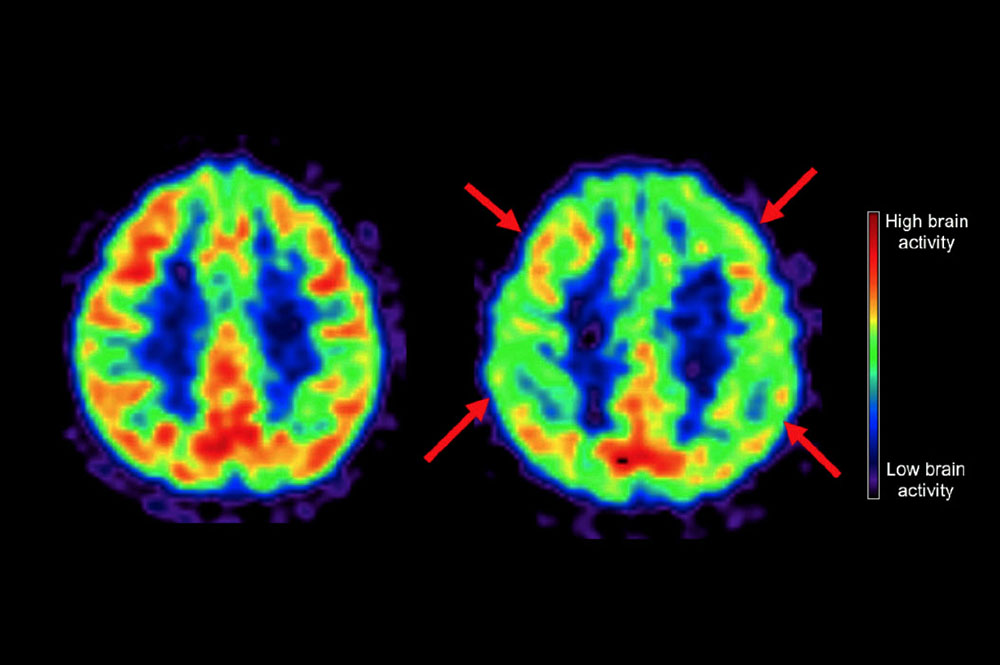
    PET scans show the higher brain activity of a 50-year-old woman on a Mediterranean-style diet (left, image shows more red, which indicates higher activity) and a 50-year-old on a Western diet most of her life (right, image shows much less red). Arrows point to areas that are typically affected by Alzheimer’s disease, with lower activity for Western diet.

    PET scans show the higher brain activity of a 50-year-old woman on a Mediterranean-style diet (left, image shows more red, which indicates higher activity) and a 50-year-old on a Western diet most of her life (right, image shows much less red).  Arrows point to areas that are typically affected by Alzheimer’s disease, with lower activity for Western diet. Weill Cornell Medicine

    Alzheimer’s disease is the most common type of dementia that occurs with aging. Experts estimate that more than 5 million Americans are currently living with the disease. But scientists know little about what lifestyle factors might protect people against developing Alzheimer’s disease. They do know that brain changes associated with the disease can occur decades before symptoms are seen.

    In previous work, a research team led by Dr. Lisa Mosconi from Weill Cornell Medicine found differences in brain imaging scans between people who reported eating a Mediterranean diet and those who ate a standard Western diet. A Mediterranean diet is high in foods such as fruits, vegetables, and lean protein. In contrast, a standard Western diet contains an excess of red meat, saturated fats, and refined sugar. The differences that the research team found may signal early Alzheimer’s disease.

    In a new study, Mosconi and her colleagues measured changes in brains over time. They performed baseline brain imaging in 34 people who ate a Mediterranean diet and 36 people who ate a Western diet. The volunteers ranged in age from 30 to 60 and showed no symptoms of dementia when the study began. The researchers then repeated the scans at least two years later. The study was supported by NIH’s National Institute on Aging (NIA). Results were published online in Neurology on April 13, 2018.

    The brain scans taken at the beginning showed that the people who ate a Western diet already had more beta-amyloid deposits than those who ate a Mediterranean diet. Beta-amyloid is a protein known to collect in the brains of people with Alzheimer’s disease. The brains of those who ate a Western diet also showed lower energy use — a sign of brain activity — at the beginning of the study than those who ate a Mediterranean diet. Both these differences suggest the early development of dementia.

    In the follow-up scans, people in the Western diet group showed even greater beta-amyloid deposits and reductions in energy use than the Mediterranean diet group. Factors such as age, sex, and a gene linked to Alzheimer’s risk didn’t account for the differences.

    “We’re seeing these changes only in parts of the brain specifically affected by Alzheimer’s, and in relatively young adults,” Mosconi says. “It all points to the way we eat putting us at risk for Alzheimer’s down the line. If your diet isn’t balanced, you really need to make an effort to fix it, if not for your body, then for your brain.”

    The researchers estimate that there may be as much as a three-and-a-half-year delay in progression of Alzheimer’s disease in people who have eaten a Mediterranean diet for many years, rather than a standard Western diet. Research that involves larger and more diverse groups of people over longer periods of time is needed to confirm these findings. More work is also needed to understand exactly how a Mediterranean diet may protect people from harmful brain changes.

    —by Sharon Reynolds

    Recipes by Dr. Lisa Mosconi from Weill Cornell Medicine

    BeveragesDrinking spring or mineral water is the best way to provide your thirsty brain with all the fluids and electrolytes it needs to stay well hydrated.

    BreakfastsWhat our brains need first thing in the morning is light, sustained energy. 

    EntreesLike a car, your brain needs quality fuel to run efficiently.

    DessertWho said dessert can’t be healthy?  With these nutrient-dense, brain healthy options, guilt-free never tasted so good.