Undaunted: How Women Changed American Journalism
Ferida Wolff’s Backyard: Mushrooms, Mushrooms, Mushrooms and An Observational Trek
I looked down at the grass on the street side lawn as I started my daily walk. It looked like two golf balls had been lost and ended up on the grass. Then I looked closer and saw that they were really round, white mushrooms, a kind I hadn’t seen before. Quite impressive.
I’ve been noticing that there are more mushrooms popping up on lawns recently. Brown ones, white ones, flat, round, and, well, traditionally mushroom-shaped. I looked up mushrooms and I think the ones I saw were like Giant Puffballs (Calvatia gigantea).
Each day’s walk has become an observational trek. It’s hard to believe how many mushrooms there are. There are over 14,000 species out there! Some are edible-and delicious-but many are poisonous so it isn’t wise to pick any off the lawns.
But whatever kind is local, they are so interesting to see. It makes my daily walk new each time.
11 edible mushrooms
https://www.plantsnap.com/blog/edible-mushrooms-united-states/
(Copyright) 2023 By Ferida Wolff
Oppenheimer: July 28 UC Berkeley Panel Discussion Focuses On The Man Behind The Movie
Robert Sanders, UC Berkeley Media relations| July 19, 2023

J. Robert Oppenheimer (left) and the actor Cillian Murphy, who plays Oppenheimer in the new film. (Photo credits: Atomic Archive and Universal Pictures, respectively)
The story behind the summer blockbuster movie Oppenheimer, which opens across the nation on Friday, July 21, began at the University of California, Berkeley.
A 25-year-old J. Robert Oppenheimer arrived at UC Berkeley in fall 1929 as an assistant professor, and over the next dozen years established one of the greatest schools of theoretical physics in the U.S. — one that continues to this day. He made UC Berkeley’s physics department the center of American thought about the new field of quantum mechanics and how to apply it to atoms, nuclei and even neutron stars.
He and Ernest O. Lawrence, who made the campus the go-to place for experimental particle physics with his work on the atom-smashing cyclotron, were instrumental in raising the alarm that the Germans could be trying to develop an atomic bomb, and that the U.S. should do the same.
The three-hour movie, directed by Christopher Nolan and partly filmed at UC Berkeley, follows Oppenheimer through his leadership of the Manhattan Project to develop the first nuclear weapons and his subsequent humiliation when the Atomic Energy Commission stripped him of his security clearance in 1954 because of claims that he was a Communist sympathizer and an unreliable adviser.
To provide a different perspective on that history, four UC Berkeley faculty members and a nuclear physicist from Los Alamos National Laboratory will assemble for a panel discussion at 11:30 a.m. on Friday, July 28, to discuss Oppenheimer’s pre-war UC Berkeley years and his scientific and human legacy.
The public can register here for the in-person-only event in Chevron Auditorium at International House in Berkeley.

Christopher Nolan brought his film crew to UC Berkeley in May 2022 to film scenes for the movie Oppenheimer, opening July 21, 2023, across the U.S. Along Campanile Way, cast members seen in 1930s attire include Josh Hartnett (gray suit) playing Berkeley professor E. O. Lawrence, and Cillian Murphy (brown suit, seen from rear), playing J. Robert Oppenheimer, the Berkeley theoretical physicist who led the Manhattan Project to develop an atomic bomb. (Photo credit: Brittany Hosea-Small)
The discussion is moderated by Cathryn Carson, UC Berkeley professor of history and a specialist in the history of 20th century physics, including its cultural, social and political contexts. She co-edited a volume of papers about Oppenheimer, Reappraising Oppenheimer: Centennial Studies and Reflections, that was presented during a 2004 conference celebrating the 100th anniversary of his birth.
Carson is joined by Jon Else, UC Berkeley professor emeritus of journalism and longtime director of the documentary program at UC Berkeley’s Graduate School of Journalism. Else directed the 1981 documentary, The Day After Trinity: J. Robert Oppenheimer and the Atomic Bomb, which was the first documentary about Oppenheimer’s role in the Manhattan Project. Trinity was Oppenheimer’s name for the first-ever test of an atom bomb, which lit up the night sky in the New Mexico desert on July 16, 1945.

The participants in the July 28 panel are Cathryn Carson, Mark Chadwick, Jon Else, Yasunori Nomura and Karl van Bibber.
Also participating in the July 28 discussion are two physicists: Yasunori Nomura, professor of physics and director of the Berkeley Center for Theoretical Physics; and Karl van Bibber, a professor of nuclear engineering who spent 25 years conducting nuclear energy research at Lawrence Livermore National Laboratory.
Mark Chadwick, chief scientist and chief operating officer for weapons physics at Los Alamos National Laboratory, will round out the panel. In 2021, he edited and published a suite of papers on the technical history of the Trinity test, written on the occasion of its 75th anniversary.
They’ll delve into Oppenheimer’s impact on quantum mechanics and quantum field theory, the school of theoretical physics he created at UC Berkeley — where he supervised 25 Ph.D. students and many more postdoctoral fellows — and the left-leaning milieu at UC Berkeley that made it an unusual place from which to select the director of a top secret government project.
Some Facts About Drowning Prevention | CDC Centers for Disease Control and Prevention; https://www.cdc.gov, Drowning is Preventable
From the Editor: We’ve tried to replicate parts of the CDC Center for Disease Control and Prevention’s presentation of their Drowning Prevention information but urge you to go to their pages in effort to gain a organized way to compile as much information as you can. Tam Martinides Gray, Editor
Drowning is a serious public health problem. Drowning can happen in seconds and is often silent. It can happen to anyone, any time there is access to water. Drowning is preventable. View the At-a-Glance document below to see how CDC uses data and research to prevent drowning and save lives. The Lifesaving Society designates the third week in July (July 16-22, 2023) as National Drowning Prevention Week (NDPW) to focus community and media attention on the drowning problem and drowning prevention.
Drowning kills about 4,000 people each year in the United States. #1
Drowning is the leading cause of death for children 1 to 4 years old.
8,000
There are about 8,000 emergency department visits for nonfatal drowning each year.
Women’s Labor Force Exits During COVID-19: Differences by Motherhood, Race, and Ethnicity

Board of Governors of the Federal Reserve System
The Federal Reserve, the central bank of the United States, provides the nation with a safe, flexible, and stable monetary and financial system.
Finance and Economics Discussion Series (FEDS)
October 2021 (Revised July 2023)
Women’s Labor Force Exits during COVID-19: Differences by Motherhood, Race, and Ethnicity
Katherine Lim and Mike Zabek
Abstract:
While the descriptive impacts of the pandemic on women have been well documented in the aggregate, we know much less about the impacts of the pandemic on different groups of women. After controlling for detailed job and demographic characteristics, including occupation and industry, we find that the pandemic led to significant excess labor force exits among women living with children under age six relative to women without children. We also find evidence of larger increases in exits among lower-earning women. The presence of children predicted larger increases in exits during the pandemic among Latina and Black women relative to White women. Overall, we find evidence that pandemic induced disruptions to childcare, including informal care from family and friends. Our results suggest that the unique effect of childcare disruptions during the pandemic exacerbated pre-existing racial and income inequalities among women.
Keywords: Women, Labor Force Participation, Race, Ethnicity, Labor Supply, COVID-19
DOI: https://doi.org/10.17016/FEDS.2021.067r1
PDF: Full Paper; https://www.federalreserve.gov/econres/feds/files/2021067r1pap.pdf
Original Paper: PDF | Accessible materials (.zip)
Disclaimer: The economic research that is linked from this page represents the views of the authors and does not indicate concurrence either by other members of the Board’s staff or by the Board of Governors. The economic research and their conclusions are often preliminary and are circulated to stimulate discussion and critical comment. The Board values having a staff that conducts research on a wide range of economic topics and that explores a diverse array of perspectives on those topics. The resulting conversations in academia, the economic policy community, and the broader public are important to sharpening our collective thinking.
BOARD OF GOVERNORS of the FEDERAL RESERVE SYSTEM
TOOLS AND INFORMATION
National Institutes for Health Study Offers Insights Into How Cells Reverse Their Decision to Divide
Finding could point toward more effective treatments that could potentially prevent cancer relapse.
A new study suggests that cells preparing to divide can reverse this process and return to a resting state, challenging long-held beliefs about cell division. If interrupted early in their preparation to divide, cells were able to halt the division process, known as mitosis. The finding, led by researchers at the National Cancer Institute (NCI), part of the National Institutes of Health, and reported July 5, 2023, in Nature, could point toward more effective treatments to interrupt the process by which cancer cells divide quickly and spread.
Right: Breast cancer cells going through the cell cycle. Credit: Cappell Lab
When cells receive growth-promoting signals, called mitogens, they enter the cell cycle — synthesize new copies of their DNA in a series of steps that culminate in cell division. Scientists have long thought that the preparatory stage of this cycle includes a point after which cells cannot halt the process. Researchers believed that after this “point of no return,” growth signals are no longer needed to drive cells to divide.
In the new study, scientists at NCI’s Center for Cancer Research captured videos of thousands of cells undergoing mitosis and watched what happened to those cells when mitogens were withdrawn. About 15% of the cells exited the cell cycle and returned to a resting state. What those cells had in common was that they hadn’t been as far along as others in the cycle when they stopped receiving growth-promoting signals. In experiments with many different kinds of cells, researchers found that all types of cells were capable of exiting the cell cycle if it was early enough.
Drugs that inhibit the cell cycle regulators CDK4 and CDK6, such as the breast cancer drug palbociclib (Ibrance), likely interrupt cells’ progression through the cell cycle differently than previously thought, the researchers said. They are now looking at whether they can take advantage of this new molecular mechanism to design a more durable therapy by combining CDK4 and CDK6 inhibitors with traditional chemotherapy drugs that induce DNA damage.
Who
Steven D. Cappell, Ph.D., Center for Cancer Research, National Cancer Institute
The Study
“Loss of CDK4/6 activity in S/G2 phase leads to cell cycle reversal” appears July 5, 2023, in Nature.
About the National Cancer Institute (NCI): NCI leads the National Cancer Program and NIH’s efforts to dramatically reduce the prevalence of cancer and improve the lives of people with cancer. NCI supports a wide range of cancer research and training extramurally through grants and contracts. NCI’s intramural research program conducts innovative, transdisciplinary basic, translational, clinical, and epidemiological research on the causes of cancer, avenues for prevention, risk prediction, early detection, and treatment, including research at the NIH Clinical Center—the world’s largest research hospital. Learn more about the intramural research done in NCI’s Center for Cancer Research. For more information about cancer, please visit the NCI website at cancer.gov or call NCI’s contact center at 1-800-4-CANCER (1-800-422-6237).
About the National Institutes of Health (NIH): NIH, the nation’s medical research agency, includes 27 Institutes and Centers and is a component of the U.S. Department of Health and Human Services. NIH is the primary federal agency conducting and supporting basic, clinical, and translational medical research, and is investigating the causes, treatments, and cures for both common and rare diseases. For more information about NIH and its programs, visit www.nih.gov.
NIH…Turning Discovery Into Health®
When cells receive growth-promoting signals, called mitogens, they enter the cell cycle—synthesize new copies of their DNA in a series of steps that culminate in cell division. Scientists have long thought that the preparatory stage of this cycle includes a point after which cells cannot halt the process. Researchers believed that after this “point of no return,” growth signals are no longer needed to drive cells to divide.
In the new study, scientists at NCI’s Center for Cancer Research captured videos of thousands of cells undergoing mitosis and watched what happened to those cells when mitogens were withdrawn. About 15% of the cells exited the cell cycle and returned to a resting state. What those cells had in common was that they hadn’t been as far along as others in the cycle when they stopped receiving growth-promoting signals. In experiments with many different kinds of cells, researchers found that all types of cells were capable of exiting the cell cycle if it was early enough.
Drugs that inhibit the cell cycle regulators CDK4 and CDK6, such as the breast cancer drug palbociclib (Ibrance), likely interrupt cells’ progression through the cell cycle differently than previously thought, the researchers said. They are now looking at whether they can take advantage of this new molecular mechanism to design a more durable therapy by combining CDK4 and CDK6 inhibitors with traditional chemotherapy drugs that induce DNA damage.
IRS Newswire: Bookmark and Share, News Releases IRS: IRS, Security Summit Partners Warn Taxpayers of New Scam
|
8:09 AM (1 hour ago)
|
Reply |
||
|
||||
|
|||
|
|||
News EssentialsThe Newsroom TopicsIRS Resources |
Issue Number: IR-2023-123Inside This IssueIRS, Security Summit partners warn taxpayers of new scam; unusual delivery service mailing tries to trick people into sending photos, bank account information IR-2023-123, July 3, 2023 WASHINGTON ― The Internal Revenue Service warned taxpayers today to be on the lookout for a new scam mailing that tries to mislead people into believing they are owed a refund. The new scheme involves a mailing coming in a cardboard envelope from a delivery service. The enclosed letter includes the IRS masthead and wording that the notice is“in relation to your unclaimed refund.” Like many scams, the letter includes contact information and a phone number that do not belong to the IRS. But it also seeks a variety of sensitive personal information from taxpayers – including detailed pictures of driver’s licenses – that can be used to by identity thieves to try obtaining a tax refund and other sensitive financial information. “This is just the latest in the long string of attempts by identity thieves posing as the IRS in hopes of tricking people into providing valuable personal information to steal identities and money, including tax refunds,” said IRS Commissioner Danny Werfel. “These scams can come in through email, text or even in special mailings. People should be careful to watch out for red flags that clearly mark these as IRS scams.” The Security Summit – a coalition between the IRS, state tax administrators and the nation’s tax industry – continue to warn people to protect their personal information to protect against tax-related identity theft as well as scams like this. In this new scam, there are many warning signs that can be seen in many similar schemes via email or by text. An unusual feature of this scam is that it tries tricking people to email or phone very detailed personal information in hopes of stealing valuable information. The letter tells the recipients they need to provide “Filing Information” for their refund. This includes some awkwardly worded requests like this: “A Clear Phone of Your Driver’s License That Clearly Displays All Four (4) Angles, Taken in a Place with Good Lighting.” The letter proceeds for more sensitive information including cellphone number, bank routing information, Social Security number and bank account type, followed by a poorly worded warning: “(You’ll Need to Get This to Get Your Refunds After Filing. These Must Be Given to a Filing Agent Who Will Help You Submit Your Unclaimed Property Claim. Once You Send All The Information Please Try to Be Checking Your Email for Response From The Agents Thanks” This letter contains a variety of warning signs, including odd punctuation and a mixture of fonts as well as inaccuracies. For example, the letter says the deadline for filing tax refunds is Oct. 17; the deadline for people on extension for their 2022 tax returns is actually Oct. 16, and those owed refunds from last year have time beyond that. And the IRS handles tax refunds, not “unclaimed property.” Important reminders about scams Taxpayers and tax professionals should be alert to fake communications posing as legitimate organizations in the tax and financial community, including the IRS and states. These messages can arrive in the form of an unsolicited text or email to lure unsuspecting victims to provide valuable personal and financial information that can lead to identity theft, including phishing and smishing. The IRS never initiates contact with taxpayers by email, text or social media regarding a bill or tax refund. As a reminder: Never click on any unsolicited communication claiming to be the IRS as it may surreptitiously load malware. It may also be a way for malicious hackers to load ransomware that keeps the legitimate user from accessing their system and files. Individuals should never respond to tax-related phishing or smishing or click on the URL link. Instead, the scams should be reported by sending the email or a copy of the text/SMS as an attachment to phishing@irs.gov. The report should include the caller ID (email or phone number), date, time and time zone, and the number that received the message. Taxpayers can also report scams to the Treasury Inspector General for Tax Administration or the Internet Crime Complaint Center. The Report Phishing and Online Scams page at IRS.gov provides complete details. The Federal Communications Commission’s Smartphone Security Checker is a useful tool against mobile security threats. The IRS also warns taxpayers to be wary of messages that appear to be from friends or family but that are possibly stolen or compromised email or text accounts from someone they know. This remains a popular way to target individuals and tax preparers for a variety of scams. Individuals should verify the identity of the sender by using another communication method; for instance, calling a number they independently know to be accurate, not the number provided in the email or text.
Thank you for subscribing to the IRS Newswire, an IRS e-mail service. If you know someone who might want to subscribe to this mailing list, please forward this message to them so they can subscribe. |
||
We’ve Pumped So Much Groundwater That We’ve Nudged The Earth’s Spin
THE SHIFTING OF MASS AND CONSEQUENT SEA LEVEL RISE DUE TO GROUNDWATER WITHDRAWAL HAS CAUSED THE EARTH’S ROTATIONAL POLE TO WANDER NEARLY A METER IN TWO DECADES
15 June 2023
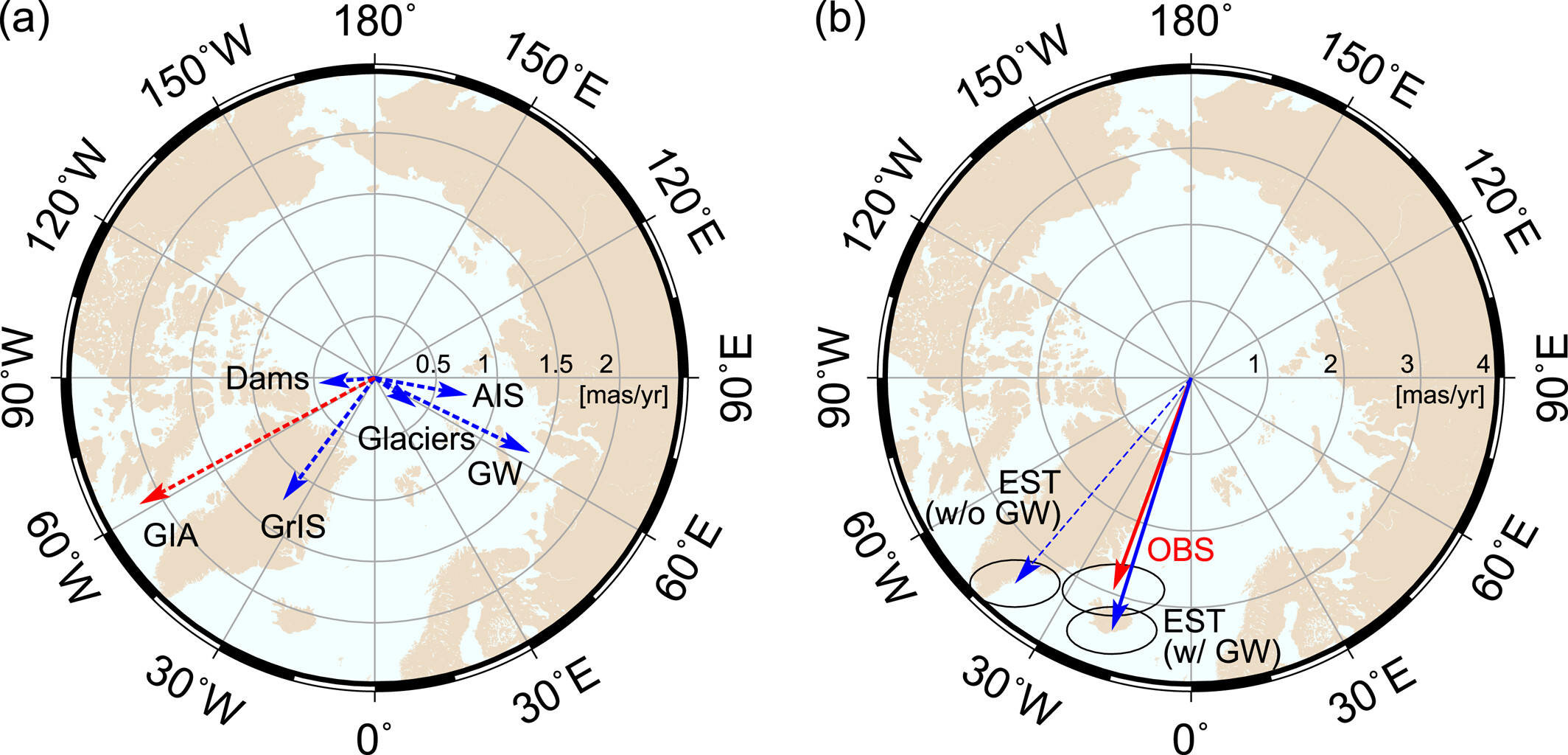
Here, the researchers compare the observed polar motion (red arrow, “OBS”) to the modeling results without (dashed blue arrow) and with (solid blue arrow) groundwater mass redistribution. The model with groundwater mass redistribution is a much better match for the observed polar motion, telling the researchers the magnitude and direction of groundwater’s influence on the Earth’s spin. Credit: Seo et al. (2023), Geophysical Research Letters
WASHINGTON — By pumping water out of the ground and moving it elsewhere, humans have shifted such a large mass of water that the Earth tilted nearly 80 centimeters (31.5 inches) east between 1993 and 2010 alone, according to a new study published in Geophysical Research Letters, AGU’s journal for short-format, high-impact research with implications spanning the Earth and space sciences.
Based on climate models, scientists previously estimated humans pumped 2,150 gigatons of groundwater, equivalent to more than 6 millimeters (0.24 inches) of sea level rise, from 1993 to 2010. But validating that estimate is difficult.
One approach lies with the Earth’s rotational pole, which is the point around which the planet rotates. It moves during a process called polar motion, which is when the position of the Earth’s rotational pole varies relative to the crust. The distribution of water on the planet affects how mass is distributed. Like adding a tiny bit of weight to a spinning top, the Earth spins a little differently as water is moved around.
“Earth’s rotational pole actually changes a lot,” said Ki-Weon Seo, a geophysicist at Seoul National University who led the study. “Our study shows that among climate-related causes, the redistribution of groundwater actually has the largest impact on the drift of the rotational pole.”
Water’s ability to change the Earth’s rotation was discovered in 2016, and until now, the specific contribution of groundwater to these rotational changes was unexplored. In the new study, researchers modeled the observed changes in the drift of Earth’s rotational pole and the movement of water — first, with only ice sheets and glaciers considered, and then adding in different scenarios of groundwater redistribution.
The model only matched the observed polar drift once the researchers included 2150 gigatons of groundwater redistribution. Without it, the model was off by 78.5 centimeters (31 inches), or 4.3 centimeters (1.7 inches) of drift per year.
“I’m very glad to find the unexplained cause of the rotation pole drift,” Seo said. “On the other hand, as a resident of Earth and a father, I’m concerned and surprised to see that pumping groundwater is another source of sea-level rise.”
“This is a nice contribution and an important documentation for sure,” said Surendra Adhikari, a research scientist at the Jet Propulsion Laboratory who was not involved in this study. Adhikari published the 2016 paper on water redistribution impacting rotational drift. “They’ve quantified the role of groundwater pumping on polar motion, and it’s pretty significant.”
The location of the groundwater matters for how much it could change polar drift; redistributing water from the midlatitudes has a larger impact on the rotational pole. During the study period, the most water was redistributed in western North America and northwestern India, both at midlatitudes.
Countries’ attempts to slow groundwater depletion rates, especially in those sensitive regions, could theoretically alter the change in drift, but only if such conservation approaches are sustained for decades, Seo said.
The rotational pole normally changes by several meters within about a year, so changes due to groundwater pumping don’t run the risk of shifting seasons. But on geologic time scales, polar drift can have an impact on climate, Adhikari said.
The next step for this research could be looking to the past.
“Observing changes in Earth’s rotational pole is useful for understanding continent-scale water storage variations,” Seo said. “Polar motion data are available from as early as the late 19th century. So, we can potentially use those data to understand continental water storage variations during the last 100 years. Were there any hydrological regime changes resulting from the warming climate? Polar motion could hold the answer.”
A Square Peg In A Round Hole By Rose Madeline Mula
I don’t fit in.
For example, I feel I’m the only person on the planet who does not like “Hamilton.” I hate rap, and having it spouted by historical characters in silk knee breeches and powdered wigs does not make it more palatable. The show’s creator, Lin-Manuel Miranda, certainly deserves kudos for his ingenuity; but doesn’t he also deserve some condemnation for trivializing a significant era in American history by making Alexander and his cohorts sound like Snoop Dogg?
Another point: Though I do own a cell phone, I also still have a landline. I simply cannot discard it. But at least it’s serviced by modern, cordless phones and not obsolete, rotary-dial antiques.
Also, I must keep hard copies of every document in my life. My printer is essential, as are my overstuffed file cabinets, even though my filing skills have deteriorated so badly that once a piece of paper disappears into said cabinets, it’s lost forever.
I don’t like tiramisu. Or sushi.
While most of my peers seem to have a compulsion to “get out of the house” every day, even if only to drive aimlessly to nowhere for an hour or two, I hate to leave my home. I’m happy when my calendar shows no outside activity required for the day.
I haven’t been inside a store for two years. I don’t miss any of them. Not a bit. I am delighted to have Instacart deliver my groceries — and Amazon everything else I could possibly want — to my door on demand, without having to navigate aisle after aisle searching for a mango, or that foot callus file I always wanted but could never find. It’s like having my own Aladdin’s lamp!
Most of my neighbors in my condo building have mats at their doors that are truly welcoming. They say “So glad you’re here!” or “Welcome! Come in and cozy up!” Mine says “Oh, no! Not you again!” (I don’t mean it, of course; but I can never resist humor.)
Unlike my girl friends (yes, I still call them “girls”) who visit nail salons regularly, I have had only one professional manicure in my entire way-too-long life.
I still have an AOL email address. I can’t understand all the ads touting the softness of bed sheets. I hate soft sheets. I like
mine crisp. The stiffer the better.
I am writing this on a gorgeous sunny day, sitting on my balcony, surrounded by a multitude of empty balconies. None of my neighbors are on them. Maybe they’re all “out of the house” driving to nowhere. Or at the pool. Not me. I can’t swim. Or ride a bike (one with only two wheels).
I have absolutely no desire to keep up with the Kardashians. Or even the Johnsons down the hall.
If my jeans develop rips, I throw them out. And I certainly don’t spend a boodle of Benjamins to buy brand new, pre-ripped ones.
Ferida Wolff’s Backyard: Awesome Goldfinches, Part of the Incredible Possibilities That Nature Might Offer
As our communities become more urbanized, the natural features around us tend to get pushed into the background and often go unnoticed. In “Ferida’s Backyard,” I look at the details of nature locally, from a neighborhood perspective, frequently from a backyard vantage point. It excites me to share what I see. An awareness of the natural connection can beautifully enhance our lives.
SUNDAY, JUNE 25, 2023
Awesome Goldfinches
Outside our front door was a wonderful sight – a male goldfinch was sitting on one of our Astilbe plants. His beautiful gold color was startling. As we watched, a female goldfinch flew to one of the other Astilbe plants and seemed to be watching the male. He didn’t chase her away so perhaps they were a couple.
They sat there together/apart for several minutes until we had to go out. Then our movement disturbed them and they zipped off and we haven’t seen them since.
A sight like that is breathtaking.
I remember hearing once that we should look for awe in each day. That is how I felt about seeing those beautiful birds. It was awesome and started my day with enthusiasm to be on the lookout for the incredible possibilities that nature might offer – if we are open to seeing them.
Directions for growing Astilbe plants:
https://www.thespruce.com/growing-astible-plants-1402833
Copyright 2023 Ferida Wolff …
‘The Goldfinch,’ a Dickensian Novel by Donna Tartt